


This NASA view combines two images from NASA's Solar Dynamics Observatory captured on Jan. 7, 2014. …
Update for 9:30 a.m. ET:
Tuesday's massive solar flare has forced the commercial spaceflight
company Orbital Sciences to postponed the planned launch of a private
cargo mission to the International Space Station today. Read the full
story here: Huge Solar Flare Delays Private Rocket Launch to Space Station
NASA's Solar Dynamics Observatory captured a video of the huge solar flare as
it developed, showing it as an intense burst of radiation from a
colossal sunspot region known as AR1944. The sunspot group — which is
currently in the middle of the sun as viewed from Earth — is "one of the
largest sunspots seen in the last 10 years," NASA officials wrote in a
statement. It is as wide as seven Earths, they added.
Tuesday's big flare was an X1.2-class solar event on the scale used to
classify sun storms. It occurred at 1:32 p.m. EST (1832 GMT) and came
just hours after an M7.2-class flare. Space weather officials at the the
Space Weather Prediction Center overseen by NOAA are expecting the
flare to spark geomagnetic storms in Earth's magnetic field when a wave
of super-hot solar plasma associated with the flare - known as a coronal
mass ejection - reaches Earth in the next few days. [Photos: The Biggest Solar Flares of 2014]
"This is the first significant flare of 2014, and follows on the heels
of mid-level flare earlier in the day," NASA spokeswoman Karen Fox of
the agency's Goddard Space Flight Center in Greenbelt, Md., wrote in a
statement. "Each flare was centered over a different area of a large
sunspot group currently situated at the center of the sun, about half
way through its 14-day journey across the front of the disk along with
the rotation of the sun."
X-class solar flares are the most
powerful solar storms on the sun. Mid-level storms are dubbed M-class
events and can supercharge Earth's northern lights displays, with weaker
C-class flares rounding out the top three.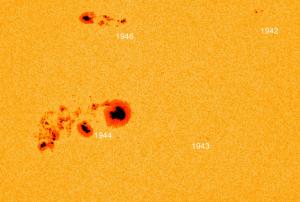
When aimed directly at Earth, the strongest X-class solar flares can pose a risk to astronauts in orbit and interrupt communications and navigation satellite operations.
Tuesday's solar flare did force the commercial spaceflight company
Orbital Sciences to delay the launch of its first Cygnus cargo mission
to the International Space Station from NASA's Wallops Flight Facility
on Wallops Island, Va.
NASA
officials told SPACE.com today that the crew of the International Space
Station will not have to take measures to shelter themselves from the
solar flare's radiation effects. There are currently six astronauts
living on the station as part of the outpost's Expedition 38 crew. The
team includes three Russian cosmonauts, two NASA astronauts and one
Japanese astronaut.
The sun is currently in an active phase of its 11-year solar cycle. The current cycle, called Solar Cycle 24, began in 2008.
Editor's Note: This
story was updated at 9:26 a.m. EST to include new details about the
effects of the solar flare for astronauts on the International Space
Station and its delay of an Orbital Sciences Cygnus cargo mission to the
station from Wallops Island, Va.
Email Tariq Malik at tmalik@space.com or follow him @tariqjmalik and Google+. Follow us @Spacedotcom, Facebook and Google+. Original article on SPACE.com.
- X-Flare Exploded From Massive Earth-Facing Sunspot | Video
- The Sun's Wrath: Worst Solar Storms in History
- Anatomy of Sun Storms & Solar Flares (Infographic)
- Solar Quiz: How Well Do You Know Our Sun?


0 comments:
Post a Comment