


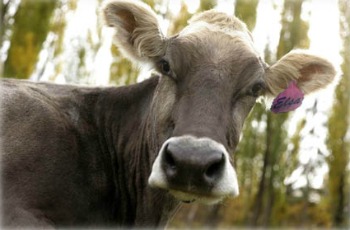
Holy (and Hardy) Cows!
How Brown Cows Help Micro Dairy Reach Success
http://www.great-group-activities.com/micro-dairy.html
by Barbara Berst Adams
Copyright National Lilac Publishing, LLC
On a rocky hillside in the rugged Cache Valley of northern Utah, five Swiss Brown cows graze about 5.5 acres (4 owned, 1 ½ leased). The really interesting part of this lovely vision is that their milk provides the full time living for the owners of Rockhill Creamery, Jennifer Hines and Pete Schropp, a husband and wife team who turn the milk into artisan cheese.
How they do it
How? Well, there’s an old but dying truth in Northern Europe among traditional dairy farmers. They say you can tell which meadow the milk and cheese came from, because the flavor is different depending on the herbs grown in the different fields. But this ability to taste and desire the differences in different locations hasn’t died completely, and it may be returning to the USA (and hopefully the world) in many forms.
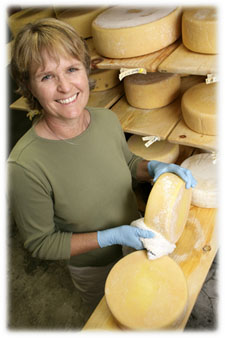
In this author’s opinion, Rockhill Creamery is tapping into this revival that’s even beyond the more obvious sustainability trends.
Beyond sustainability
Of course their cows are raised sustainably. They are antibiotic-free, rBGH-free, and eat grass and clover when it isn’t snowing. “Our pastures are a combination of blue grass and clover,” Pete says. “We have tried to keep them in more productive grasses, but we are surrounded by houses with blue grass yards and blue grass is very competitive. We are able to control weeds through mechanical means, and by rotating between cows, heifers, smaller steer calves, and horses, we get a pretty good, even graze.
Sometimes, in the early spring, I do mow some of the high spots. We do harrow frequently. Since our farm is so small, our pastures are not the sole source of feed for our cows.

“We provide our cows with free choice minerals and salt. I offer them one commercial block of trace minerals, one chunk of southern Utah mineral salt (from the Redmond Salt Company -- the RealSalt™ people), and a regular white salt block also.”
But the story, the flavor, and the request from customers – including chefs, gets deeper than this. Cheese from Rockhill Creamery is not just cheese from generic sustainably raised cows. “We have a very nice mineral package in our custom grain ration that they are fed twice daily while in the milk parlor,” explains Pete. “We have a friend that helped us develop our own ration ... no urea, or other animal sources of protein. We use whole, flaked soybeans for our protein, whole, flaked corn and barley for the energy. It costs us quite a bit more than the standard dairy ration available at our co-op, but we have had several chefs actually request copies of the ingredients lists for what our cows eat, so our customers are quite involved with how we choose to feed our cows.”
Further, the creamery’s milk for cheese currently comes from Elsa, Ingrid, Greta, a new gal named Chloe, plus the beloved Ruby, who came down with pneumonia last winter, but then made an inspiring recovery after the careful care given by her owners combined with her own strength and will to live. While all the cows are pampered and respected by their owners, they also must become rugged and healthy themselves against the harsh white northern Utah winters. Cheese from Rockhill Creamery is different than that from other regions and other meadows. It’s from, as the owners describe them, very hardy cows, and also of a unique breed of cow.
“Brown Swiss produce milk with almost the perfect protein to butter fat ratio for cheese making," says Pete. “We knew that we wanted to make whole-milk cheeses, so that was important to us. The yield we get is quite high because of that ratio. Brown Swiss are also the most beautiful of all breeds (I am not biased in any way!). And they are the most docile -- very easy to be around, and very safe for the milker.”
Fans of their cheese can enjoy the farm owners’ blog, entitled “Holy Cows,” a high-tech form of the old farm journal non-farmers often love to read and live vicariously through. We can read about how the cows love playing in the snow, how Ruby, when ill, was covered with a blanket and treated by the vet, and of her remarkable recovery. We can see how the progress of the new aging room is coming along, and smile at Pete’s amusing description of what happened when the bull was brought in.
And their cheese-making is definitely artisan. It begins, of course, with receiving very good milk from their Brown Swiss cows. They use cow-to-can milking with a machine, but no pipeline. (Pete says they can't be grade A with an open pail.) They use this high quality raw milk with a variety of cultures to produce artisan cheeses that are aged in their aging “cave.” The aging time is broken down into three stages, offering a milder creamier cheese after the shortest duration, and a harder cheese with deeper, complex flavors for the cheese with the longer term aging. Cheese flavors include Farmhouse Gouda with its hand-rubbed olive oil rind, Zwitser (which means “Swiss” in Dutch) for which is added an extra enzyme to the Farmhouse Gouda to create a flavorful variation, Peppercorn made with whole black peppercorns, Dark Canyon Edam aged between two to four months named after a favorite canyon in Utah – a cheese which changes to Snow Canyon Edam after it ages longer, more than four months, also named after another Utah canyon, a rich flavored Wasatch Gruyere, and their own cows-milk Desert Red Feta rubbed with red salt minerals mined from Southern Utah.
How it all started
“We had been raising baby dairy heifers as replacements for some area dairies,” says Pete. “We had invested quite a bit of money and time into the business, and it seemed as though each time we just started to make some money and settle into a good working relationship, the dairy would close or go out of business. So we decided that we needed to come up with a business plan that gave us more control over our own destiny. Our farm is too small to be profitable, unless we added value to what we produced, so after considering many options, we decided the cheese business was the perfect fit for us. I really enjoy working with livestock, and Jennifer is a true "foodie."
Their market outlets
Pete and Jennifer sell their cheeses to various restaurants with names including Deer Valley Resort and Garden Café, to retail foods markets such as one named Sweet Peas Natural Market, and online in the form of gift boxes, samplers, or wheels of cheese, from a quarter wheel to full wheels. They have also established a cheese club membership where customers can choose from a variety of subscription packages to have cheese delivered on a regular basis.
In addition, they operate a farmstand in their granary which they open on Saturdays from 11 a.m. to 4 p.m. May through October. For other times, they allow potential farm visitors to call ahead if they want to visit the farm when the farmstand isn’t open. Their farmstand offers cheese samples and they also sell other locally produced food items, such as artisan bread from a producer named Crumb Brothers Artisan Bread.
The road to ultimate success
Pete explains here how many other individuals and entities, from local specialty food shop owners to the Slow Food Movement, helped make their dairy a success. “When we first decided to get into the cheese business, we introduced ourselves to the owner of one of Salt Lake City's best specialty food shops - Liberty Heights Fresh. Steven Rosenberg is a well-known supporter of local producers of all types. He showed quite an interest. It took us two years to complete all the building, etc. When we were finally licensed in January 2005 we got in touch with Steven again, and he came to visit us that March. Ever since he has been a great ally. He helped us get a spot at the Salt Lake Downtown Farmers Market - a very large market that exposed us to thousands of folks. He steered media folks our way, including a reporter for Via Magazine, the West's AAA travel magazine with several million readers.
“That same year we sold at the Cache Valley Gardeners Market here in our valley. So, with the exposure that we received from the two farmers markets, as well as the media, we were well on our way to developing a recognized brand.
“In 2006 we added the Park City Farmers market to our outlets and began approaching stores and restaurants - mostly in person, but some through letters and samples shipped. That summer, the Utah chapter of Slow Food, USA held a "farmer/chef mingle" in Salt Lake City and invited chefs from the area's fine restaurants, hotels and ski resorts. We met several chefs for the first time, and got to see others in a much more casual setting than their kitchens. Then, that fall, we hosted a Slow Food Utah event here at our farm. We had a couple of local chefs cater it, they used almost all local produce, meat, bread, and of course, lots of cheese. We had stations set up explaining all aspects of our operation. We invited both the local lamb/beef producer and the vegetable provider to educate our guests about their respective operations. The folks that came to that dinner were all foodies, and included several culinary arts instructors, a local TV station's food personality, and just a lot of nice folks to get to know. Our local paper did a feature story on the event.
“During all this time, we also developed our web page, did underwriting on our local public radio station, donated cheese to several charitable events and kept going out and meeting chefs and cheese mongers in the Salt Lake area.
“This last June, our business was good enough that Jennifer was able to quit her 3/4 time job and devote more time to the cheese business. In the first few weeks of her new effort, we expanded into Portland and Seattle area markets. We got a great customer in Denver. And continue to sell more and more cheese in the Salt Lake area.
Pete further illustrates how some marketing methods, such as their farmstand, have proven valuable in less than obvious ways. “Our farmstand is responsible for a very small portion of our sales - less than 3%. But it has proven to be worth all the effort for giving us a place to entertain visiting chefs, store staffs, etc. We have a great customer in Pocatello, Idaho. He has a wine bar and bistro. Just before he opened, he was out on a drive looking for local foods (Pocatello is just 70 miles north of here) and stopped by our farmstand one Saturday. He spent an hour seeing the operation, meeting the cows, sampling cheese. When he left, he told us he would call in an order soon. We thought, ‘Oh yeah, sure you will.’ The next week he placed his first order and has been one of our great customers ever since.”
Plans for the future
At the time of this writing, a new cow named Chloe had just been purchased. Their other current milk cows are, as mentioned above, still “Elsa, Ingrid, Greta and Ruby,” says Pete. “We have five daughters that we are bringing along also. Iggy is Ingrid's daughter and she is due to calve in April. We also have Heide, Greta's daughter, that will join the herd late this summer. Opal, Ruby's daughter will also be joining the herd this summer. And Elsie, Elsa's daughter, is just old enough to breed right now, so she'll be in milk sometime next winter. Bell, is the daughter of a cow we no longer have, she is a cross breed so we will sell her when she gets a little closer to calving. She'll go to another dairy or to a family who wants a milk cow.” Pete and Jennifer plan to work towards becoming more profitable and less labor intensive, while continuing to provide their great customers with fine, hand-crafted cheese.
Advice (and a warning) for future sustainable dairy owners
“Don't decide to milk cows, goats, sheep or anything else if you ever hope to take a vacation again!” says Pete. “Cows must calve to come into milk. We always dry off our cows at least two months before they are due to calve. And, in the past, we have tried to do that all in synch (seasonally). So far, that is not working. Our cows just don't get pregnant the first time (that's not how my mom said those things happened!) or anywhere close to the same time. (Plus,) seasonal milking makes managing the rest of the business very difficult. We sell a lot of our cheese to restaurants at very specific ages. If we were to stop production (for all cows at the same time) all together we would have to stop selling those cheeses for two months. We do have a few folks who help us with milking, cleaning cheese, wrapping/packaging. Each only works a few hours a week. So it's hard enough to find folks that can afford to do that. If we then told them, "sorry, come back in two months and we'll start again," it would be impossible to find help. And last but not least, our winters are really long and can be quite miserable, we might as well be working. I'd like to figure out how to take summers off!”
But the rewards are definitely there. “The first good snow of each season gets the cows in such a playful mood,” says Pete. “They are very fun to watch romp and play in the deep snow. The farmers’ market season is just pure joy. To see the hundreds of folks that are our regular customers come back year after year and carry on about how much they love our cheese, that makes the long, lonely winter worth it every time. And to be in a business that allows us to get to know the best chefs of the area, the craziest foodies and the most down-to-earth farmers all at the same time, now that's a business to love.” And finally, Pete reminds current or aspiring small sustainable dairies of the following: “Stay small and stay simple. And whatever you do, keep it fun.”
RESOURCES:
Brown Swiss Cattle Breeders’ Association’s website:
www.brownswissusa.com


