It's a racket... Look at the education systems in other countries. We have been robbed!
Updated Jan. 7, 2014 12:20 p.m. ET
In the field of higher education, reality is outrunning
parody. A recent feature on the satire website the Onion proclaimed,
"30-Year-Old Has Earned $11 More Than He Would Have Without College
Education." Allowing for tuition, interest on student loans, and four
years of foregone income while in school, the fictional student "Patrick
Moorhouse" wasn't much better off. His years of stress and study, the
article japed, "have been more or less a financial wash."
"Patrick"
shouldn't feel too bad. Many college graduates would be happy to be $11
ahead instead of thousands, or hundreds of thousands, behind. The
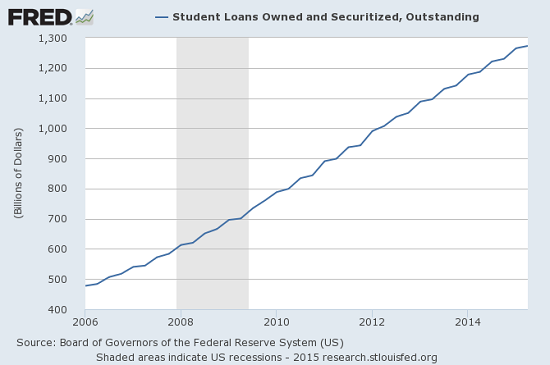
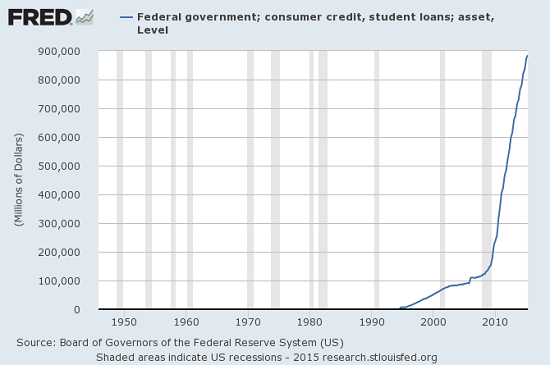
credit-driven higher education bubble of the past several decades has
left legions of students deep in debt without improving their job
prospects. To make college a good value again, today's parents and
students need to be skeptical, frugal and demanding. There is no single
solution to what ails higher education in the U.S., but changes are
beginning to emerge, from outsourcing to online education, and they
could transform the system.
Though the GI Bill converted college
from a privilege of the rich to a middle-class expectation, the higher
education bubble really began in the 1970s, as colleges that had
expanded to serve the baby boom saw the tide of students threatening to
ebb. Congress came to the rescue with federally funded student aid, like
Pell Grants and, in vastly greater dollar amounts, student loans.
Predictably
enough, this financial assistance led colleges and universities to
raise tuition and fees to absorb the resources now available to their
students. As University of Michigan economics and finance professor
Mark Perry
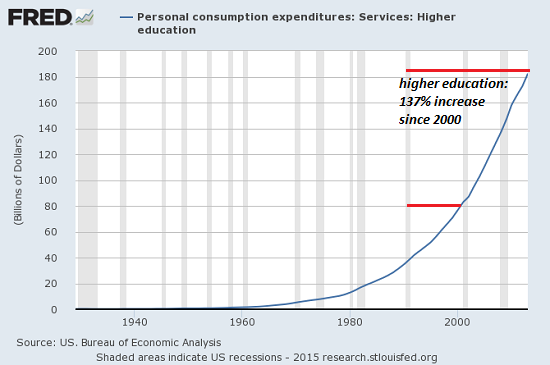
has calculated, tuition for all universities, public and private,
increased from 1978 to 2011 at an annual rate of 7.45%. By comparison,
health-care costs increased by only 5.8%, and housing, notwithstanding
the bubble, increased at 4.3%. Family incomes, on the other hand, barely
kept up with the consumer-price index, which grew at an annual rate of
3.8%.
The Saturday Essay
For many families, the gap between soaring tuition costs and stagnant
incomes was filled by debt. Today's average student debt of $29,400 may
not sound overwhelming, but many students, especially at private and
out-of-state colleges, end up owing much more, often more than $100,000.
At the same time, four in 10 college graduates, according to a recent
Gallup study, wind up in jobs that don't require a college degree.
Students
and parents have started to reject this unsustainable arrangement, and
colleges and universities have felt the impact. According to a recent
analysis by this newspaper, private schools are facing a long-term
decline in enrollment. More than a quarter of private institutions have
suffered a drop of 10% or more—in some cases, much more. Midway College
in Kentucky is laying off around a dozen of its 54 faculty members;
Wittenberg University in Ohio is eliminating nearly 30 of about 140
full-time faculty slots; and Pine Manor College in Massachusetts, with
dorm space for 600 students but only 300 enrolled, has gone coed in
hopes of bringing in more warm bodies.
Even elite institutions
haven't been spared, as schools such as Haverford, Morehouse and
Wellesley have seen their credit ratings downgraded by Moody's over
doubts about the viability of their high tuition/high overhead business
models. Law schools, including Albany Law School, Brooklyn Law School
and Thomas Jefferson Law School, have also seen credit downgrades over
similar doubts. And now Democrats on Capitol Hill are pushing
legislation to give colleges "skin in the game" by clawing back federal
aid money from schools with high student-loan default rates. Expect such
proposals to get traction in 2014.
America's higher education
problem calls for both wiser choices by families and better value from
schools. For some students, this will mean choosing a major carefully
(opting for a more practical area of study, like engineering over the
humanities), going to a less expensive community college or skipping
college altogether to learn a trade.
For their part, schools
must adjust to the new economic reality, as some already have. In 2011,
the University of the South in Sewanee, Tenn., cut tuition by 10%. The
discount not only increased enrollment but, ultimately, brought in more
money. For academic year 2014-15, Ashland University in Ohio has cut its
tuition by 37%—more than $10,000. Faced with plummeting applications,
the law schools at George Mason, Penn State, Seton Hall and the
University of Iowa have rolled back or frozen their tuition fees.
Many colleges, according to a survey released last spring by the
National Association of College and University Business Officers, are
also offering hidden discounts in the form of increased financial aid.
The survey found that for the fall of 2013, the average "tuition
discount rate" for incoming freshmen (that is, the reduction of the list
price through grants and scholarships) hit an all-time high of 45%.
Such variable pricing is likely to become more widely publicized in the
future as competition for students increases and as parents paying full
tuition object to being taken advantage of.
But discounts don't
address the real problem: high costs. What's really needed in U.S.
higher education is major structural change. To remain viable, colleges
and universities need to cut expenditures dramatically. For decades,
they have ridden the student-loan gravy train, using the proceeds to
build palatial buildings, reduce faculty teaching loads and, most
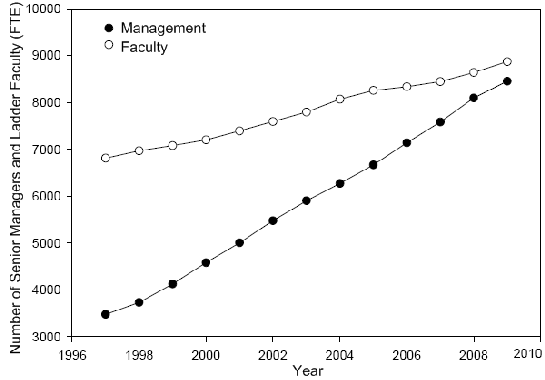
notably, hire armies of administrators.
Most of the growth in
higher education costs, according to a 2010 study by the Goldwater
Institute, a libertarian think tank, comes from administrative bloat,
with administrative staff growing at more than twice the rate of
instructional staff. At the University of Michigan, for example, there
are 53% more administrators than faculty, and similar ratios can be
found at other institutions.
Under financial pressure, many
schools have already farmed out the teaching of classes to low-paid
adjuncts who have no job security and often no benefits.
This
approach could be extended to administration, replacing salaried
employees with low-paid "adjunct administrators" to handle routine
functions. Many in the corporate world have reaped considerable savings
by outsourcing back-office functions, and there is no reason this
approach can't work in higher education. (If U.S. News & World
Report wants to improve its widely cited college rankings, it might
start by giving schools credit for leaner administration.)
Another
reform that would be useful at both public and private institutions is
budget transparency. University finances are notoriously Byzantine, and
administrators generally like it that way. But change is afoot here too.
Several years ago, the state of Oregon launched a website,
updated daily, that shows where every state dollar is spent. The result:
Anyone can see how much Oregon's higher-education system is spending on
things like travel, instruction and athletics. This is the sort of
transparency that taxpayers should demand from public universities—and
perhaps even from private universities that receive significant amounts
of public money, as nearly all do.
New instructional methods can
also contribute to cost savings. Online courses are already making
inroads, and the model makes intuitive sense for many subjects: Take the
top teachers in a field and give online access to their lectures to
students at many different colleges. There isn't a lot of one-on-one
interaction in such courses, but how much genuine interaction is there
in a live 200-student lecture class?
Once students have acquired
basic instruction in larger, less personal classes, they can apply it
in smaller advanced classes, where they would deal with faculty face to
face. This approach is already used to great effect by the popular Khan
Academy, a sophisticated not-for-profit website where primary and
secondary students view lectures at their convenience and perfect their
skills through video-game-like software. Students can then use classroom
time to work through problems with teachers and apply what they have
learned. The idea is to take advantage of mass delivery where it works
best and to allow individualized attention where it helps most.
Traditional
universities are experimenting too. The Georgia Institute of Technology
is offering an entirely online master's degree in computer science for
$7,000. This isn't a ghettoized offering from the extension school but
rather, in the words of Georgia Tech Provost Rafael Bras, "a
full-service degree." The Massachusetts Institute of Technology has
already put many of its courses online; you can learn from them and even
get certification, but there is no degree attached. If
US were to add standard exams and a diploma, its online degree might
be worth a lot—perhaps not as much as an old-fashioned MIT degree but
more than a degree from many existing bricks-and-mortar schools.
Neil Shah explains how young people have become more
wary of taking on more debt in general as student loan debt has reached
record levels. Photo: AP Images. (3/5/2013)
Another alternative, already beginning to get some traction,
lies in the rise of various certification systems. A college degree is
often used by employers as an indication that its holder has a
reasonable ability to read, write, show up on time and deal with others.
But many employers are unhappy with the skills that today's graduates
possess.
This has led to the rise of certification schemes from
within the higher education world, including the Educational Testing
Service's Revised Collegiate Learning Assessment (CLA+) and ACT's
WorkKeys, which is explicitly aimed at employment skills. Manufacturing
companies are working with online schools and community colleges to
create "stackable certificates" that vouch for specific competencies.
Such programs may someday bypass higher education entirely, testing and
certifying people's skills regardless of how they obtained them.
But
what about the "college experience"—late-night dorm bull sessions,
partying and pizza? Won't it be ruined by these new approaches to
instruction? Not necessarily.
We may eventually see the rise of
"hoteling" for college students whose courses are done primarily online.
Build a nice campus—or buy one, from a defunct traditional school—put
in a lot of amenities, but don't bother hiring faculty: Just bring in
your courses online, with engineering from Georgia Tech, arts and
literature from Yale, business from Stanford and so on. Hire some
unemployed Ph.D.s as tutors (there will be plenty around, available at
bargain-basement rates) and offer an unbundled experience. It's a
business model that just might work, especially in geographic locations
students favor. Grand Cayman is awfully nice this time of year.
On
the other hand, for some students, avoiding the traditional
campus-based college scene might be a boon in the long run. Recent
research by the sociologists
Elizabeth Armstrong
of the University of Michigan and
Laura Hamilton
of the University of California, Merced, points to the problem of
what they call the "party pathway." In a study they conducted among 48
female students in one residence hall at Indiana University from 2004 to
2009, they found that young women who were similar in terms of
"predictors" (grades and test scores) nonetheless emerged from college
on very different career trajectories. Those from more modest
circumstances were often done in by their partying-related stumbles and
actually experienced downward mobility after graduating.
None of
these alternatives to a traditional university degree is "the answer" to
the higher education bubble. And we certainly shouldn't discard
entirely the old-fashioned approach to college, whatever its
shortcomings. A rigorous liberal arts education, with an emphasis on
reading carefully and writing clearly, remains a tremendous asset, for
employment as for citizenship. (The key word here, however, is
"rigorous.")
But there is no point in trying to preserve the old
regime. Today's emphasis on measuring college education in terms of
future earnings and employability may strike some as philistine, but
most students have little choice. When you could pay your way through
college by waiting tables, the idea that you should "study what
interests you" was more viable than it is today, when the cost of a
four-year degree often runs to six figures. For an 18-year-old,
investing such a sum in an education without a payoff makes no more
sense than buying a Ferrari on credit.
The economist
Herbert Stein
once said that if something can't go on forever, it will stop.
The pattern of the last few decades, in which higher education costs
grew much faster than incomes, with the difference made up by borrowing,
can't go on forever. As students and parents begin to apply the brakes,
colleges need to find ways to make that stop a smooth one rather than a
crash.
Mr. Reynolds is a law professor at the University of
Tennessee in Knoxville. This essay is adapted from his new book, "The
New School: How the Information Age Will Save American Education From
Itself," published by Encounter Books.
http://online.wsj.com/news/articles/SB10001424052702303870704579298302637802002