Showing posts with label Shiia Islam. Show all posts

Tuesday, February 2, 2016

You Won’t Believe What This US Ambassador Said About al-Qaeda’s Syrian Allies

By Daniel McAdams, Ron Paul Institute for Peace and Prosperity.
undefinedRobert Ford was US Ambassador to Syria when the revolt against Syrian president Assad was launched. He not only was a chief architect of regime change in Syria, but actively worked with rebels to aid their overthrow of the Syrian government.Ford assured us that those taking up arms to overthrow the Syrian government were simply moderates and democrats seeking to change Syria’s autocratic system. Anyone pointing out the obviously Islamist extremist nature of the rebellion and the foreign funding and backing for the jihadists was written off as an Assad apologist or worse. Ambassador Ford talked himself blue in the face reassuring us that he was only supporting moderates in Syria. As evidence mounted that the recipients of the largesse doled out by Washington was going to jihadist groups, Ford finally admitted early last year that most of the moderates he backed were fighting alongside ISIS and al-Qaeda. Witness this incredible Twitter exchange with then-ex Ambassador Ford:
undefined
Then late last year the McClatchy News Service ran an article in which Ambassador Ford admitted that his “moderates” regularly collaborated with ISIS and al-Qaeda to the point where he no longer thought the US government should be arming them.

So those who pointed out that the rebellion in Syria was foreign-driven and jihadist from the start were no longer crazy conspiracy theorists, but were rather conspiracy factists.
Did that stop Ford from pushing radicals, though? Hardly!
As the Syria peace talks are scheduled to begin within days in Geneva, with a main sticking point being whether to admit groups that have allied with al-Qaeda to the negotiating table as potential leaders of “new Syria,” it is extremely instructive to recall what Ambassador Ford said about one such group, Ahrar al-Sham, to a BBC interviewer last October.
Ahrar al-Sham, according to experts including those at Stanford University, “was founded by members of Al Qaeda and maintains links to AQ’s core leadership.” The group vigorously rejects the notion of an elected government in Syria after the overthrow of Assad, instead calling for:
…a Divine system prescribed for his Caliph and slaves… It is the system where the rule is for the pure Islamic law. Allah’s law is complete, and you need only consider the texts and derive rules.
Ahrar al-Sham has been reported by Christian rights groups in Syria to have executed Christians in Idlib, Syria, after they captured the town last year. The Christians committed the “crime” of not following Sharia law.
Sounds like a pretty bad group, but nevertheless it still has its Western cheerleaders…including Ambassador Robert Ford!
Here’s Ford in an interview with the BBC last October about Ahrar al-Sham (emphasis added):
Stephen Sackur BBC: “Ok, let me ask bluntly, Ahrar al Sham (The Free Men of Syria) group, one of the most powerful groups you would call “moderate”, is it really moderate when a group like that proclaims its desire to see Sharia as the driving force of a “future Syria”.. which clearly makes comments which suggest that Alawites and Christians would find it very difficult to find a place in their Syria…. Are these moderate?? You regard this as moderation?”
Robert Ford: “This is how I define as a moderate in the Syrian context, Stephen; a moderate is a group that accepts there has to be a political negotiation and there has to be a political process after a transition government is set up.. a political process to determine the future permanent government of Syria.. That there must be pluralism in that process… and it’s one that works with other groups/ factions in a pluralistic setting… I don’t agree at all with Ahrar al Sham’s desires to set up an Islamic State (in Syria).. but I have to admit that they accept the needs to be a political negotiation.. I have to admit they’re willing to work with other groups and they do on the ground with great effect…This is one of the reasons, they’re strong as they are, as you mentioned… It’s not a group I ever want my daughter to marry into… I don’t agree with their vision of society…but I would not call them Jihadis, they’re not looking to impose an Islamic State at sword point… Different, they’re therefore, from alQaida… Different therefore from the Islamic State..And they’re willing to accept even such things as Parliament…and some kind of government institutions… So, yes they want Sharia … but the kind of Sharia they want may in fact, in the end, not look like the kind of Sharia the “Islamic State” already imposing over most of central and Eastern of Syria…”
Is it any surprise that Syria is in the current disastrous state, where hundreds of thousands have died in a war instigated by those who knew from the beginning would only benefit radical Islamist extremists? Is there no justice for those who push such murder and mayhem on such a grand scale? Today, as civilized people recognize International Holocaust Remembrance Day, is Nuremberg dead?

Saturday, January 9, 2016

One Map That Explains The Dangerous Saudi-Iranian Conflict

Tyler Durden's picture


http://www.zerohedge.com/news/2016-01-09/one-map-explains-dangerous-saudi-iranian-conflict
The Kingdom of Saudi Arabia executed Shiite Muslim cleric Nimr al-Nimr on Saturday. Hours later, Iranian protestors set fire to the Saudi embassy in Tehran. On Sunday, the Saudi government, which considers itself the guardian of Sunni Islam, cut diplomatic ties with Iran, which is a Shiite Muslim theocracy.
To explain what’s going on, the New York Times provided a primer on the difference between Sunni and Shiite Islam, informing us that “a schism emerged after the death of the Prophet Muhammad in 632” — i.e., 1,383 years ago.
But to the degree that the current crisis has anything to do with religion, it’s much less about whether Abu Bakr or Ali was Muhammad’s rightful successor and much more about who’s going to control something more concrete right now: oil.
In fact, much of the conflict can be explained by a fascinating map created by M.R. Izady, a cartographer and adjunct master professor at the U.S. Air Force Special Operations School/Joint Special Operations University in Florida.
What the map shows is that, due to a peculiar correlation of religious history and anaerobic decomposition of plankton, almost all the Persian Gulf’s fossil fuels are located underneath Shiites. This is true even in Sunni Saudi Arabia, where the major oil fields are in the Eastern Province, which has a majority Shiite population.
As a result, one of the Saudi royal family’s deepest fears is that one day Saudi Shiites will secede, with their oil, and ally with Shiite Iran.
This fear has only grown since the 2003 U.S. invasion of Iraq overturned Saddam Hussein’s minority Sunni regime, and empowered the pro-Iranian Shiite majority. Nimr himself said in 2009 that Saudi Shiites would call for secession if the Saudi government didn’t improve its treatment of them.
shia-oil-cropped-2
The map shows religious populations in the Middle East and proven developed oil and gas reserves. Click to view the full map of the wider region. The dark green areas are predominantly Shiite; light green predominantly Sunni; and purple predominantly Wahhabi/Salafi, a branch of Sunnis. The black and red areas represent oil and gas deposits, respectively.
Source: Dr. Michael Izady at Columbia University, Gulf2000, New York
As Izady’s map so strikingly demonstrates, essentially all of the Saudi oil wealth is located in a small sliver of its territory whose occupants are predominantly Shiite. (Nimr, for instance, lived in Awamiyya, in the heart of the Saudi oil region just northwest of Bahrain.) If this section of eastern Saudi Arabia were to break away, the Saudi royals would just be some broke 80-year-olds with nothing left but a lot of beard dye and Viagra prescriptions.
Nimr’s execution can be partly explained by the Saudis’ desperation to stamp out any sign of independent thinking among the country’s Shiites.
The same tension explains why Saudi Arabia helped Bahrain, an oil-rich, majority-Shiite country ruled by a Sunni monarchy, crush its version of the Arab Spring in 2011.
Similar calculations were behind George H.W. Bush’s decision to stand by while Saddam Hussein used chemical weapons in 1991 to put down an insurrection by Iraqi Shiites at the end of the Gulf War. As New York Times columnist Thomas Friedman explained at the time, Saddam had “held Iraq together, much to the satisfaction of the American allies Turkey and Saudi Arabia.”
Of course, it’s too simple to say that everything happening between Saudis and Iranians can be traced back to oil. Disdain and even hate for Shiites seem to be part of the DNA of Saudi Arabia’s peculiarly sectarian and belligerent version of Islam. In 1802, 136 years before oil was discovered in Saudi Arabia, the ideological predecessors to the modern Saudi state sacked Karbala, a city now in present-day Iraq and holy to Shiites. The attackers massacred thousands and plundered the tomb of Husayn ibn Ali, one of the most important figures in Shiite Islam.
Without fossil fuels, however, this sectarianism toward Shiites would likely be less intense today. And it would definitely be less well-financed. Winston Churchill once described Iran’s oil – which the U.K. was busy stealing at the time — as “a prize from fairyland far beyond our brightest hopes.”
Churchill was right, but didn’t realize that this was the kind of fairytale whose treasures carry a terrible curse.

Monday, January 4, 2016

This Just Became The Most Important Map In Geopolitics

Tyler Durden's picture

http://www.zerohedge.com/news/2016-01-04/just-became-most-important-map-geopolitics
Earlier today, in “Mid-East Melee: Sectarian Showdown Looms As Bahrain Cuts Ties With Iran, UAE Recalls Ambassador,” we brought you the latest from the war-torn Mid-East where a worsening spat between Saudi Arabia and Iran threatens to plunge the region into chaos.
Make no mistake, things were already out of control. The conflict in Syria has mushroomed into a global proxy war, Iraq is struggling to drive Islamic State from key cities, and Yemen remains mired in war nine months after the Saudis entered the fray to drive back the Houthis and restore the Hadi government.
Against that backdrop, the region could have done without the events that unfolded over the weekend. By executing prominent Shiite cleric Nimr al-Nimr, Riyadh has infuriated the Shiite community which took to the streets in protest, even going so far as to firebomb the Saudi embassy in Tehran.
In order to understand the upcoming sectarian strife and in order to fully grasp who belongs to Iran’s sphere of influence and who is loyal to the Saudis, one needs to have a working knowledge of what the Sunni-Shiite split looks like across the region. Because this is set to become the key geopolitical issue in the weeks and months ahead, we thought it an opportune time to present the following map from Goldman which does a nice job of delineating the sectarian split. Note the asterisks which indicate the affiliation of a country’s leadership.

From Goldman
Where are the main sectarian and ethnic divides in the Middle East today? Saudi Arabia and Iran, with their large respective Sunni and Shiite majorities, are generally viewed as two major opposing forces in the Middle East. They lie on opposite sides of an abstract and somewhat contentious demarcation known as the Shiite crescent, an area of Shiite influence stretching from Iran through southern Iraq and into parts of Syria and Lebanon.
The region’s geopolitical, religious, and sectarian relationships are in reality more dynamic and complex. The conflict in Syria continues to pit anti-government insurgents, including Sunni Islamists, against the Alawite (Shiite) government’s forces and Shiite militias supported by Iran. In Iraq, some Sunnis have felt increasingly disenfranchised under the Shiite-majority government in Baghdad (a relatively new development given Iraq’s long history of Sunni rule). The Islamic State (IS) militant group has exploited this sentiment, particularly in the Sunni-majority areas of northern Iraq.
How are the different branches of Islam represented in politics? In some countries, such as Saudi Arabia, the rulers adhere to the same branch of Islam as the majority of their citizens. However, this is not always the case. Despite being predominantly Shiite, Iraqis lived under Sunni rulers for much of history, including under the Ottoman Empire and the Ba’thist regime of Saddam Hussein. (Ba’thists are members of the Arab Socialist Ba’th Party, a political party founded in Syria in the 1940s on platforms of Arab nationalism and anti- colonialism. In Iraq, the Ba’thists governed from 1958 until the fall of Saddam Hussein in 2003.) The Iraqi Ba’thist regime was secular in name but reserved political influence for the Sunni elite. In a break from its long history of Sunni political dominance, Iraq is currently ruled by a Shiite-majority government centered in Baghdad. Conversely, in Sunni-majority Syria, members of the Shiite Alawite sect have controlled the government since 1970.
What is the composition of Sunnis and Shiites in the Muslim world today? Sunnis make up the majority of Muslims worldwide – an estimated 85-90%. Sunnis comprise 85% or more of the Muslim populations in Saudi Arabia, Qatar, Jordan, Syria, and the United Arab Emirates, and 70-85% in Kuwait, Pakistan, and Afghanistan. Shiites comprise the majority in Bahrain, Iraq, and Azerbaijan (all 60-65% Shiite), as well as in Iran (90-95%), home of the largest Shiite population. Although the Middle East and North Africa region is overwhelmingly Muslim (93%), it is home to only around 20% of Muslims worldwide. The majority – over 60% – lives in the Asia-Pacific region.

Sunday, January 3, 2016

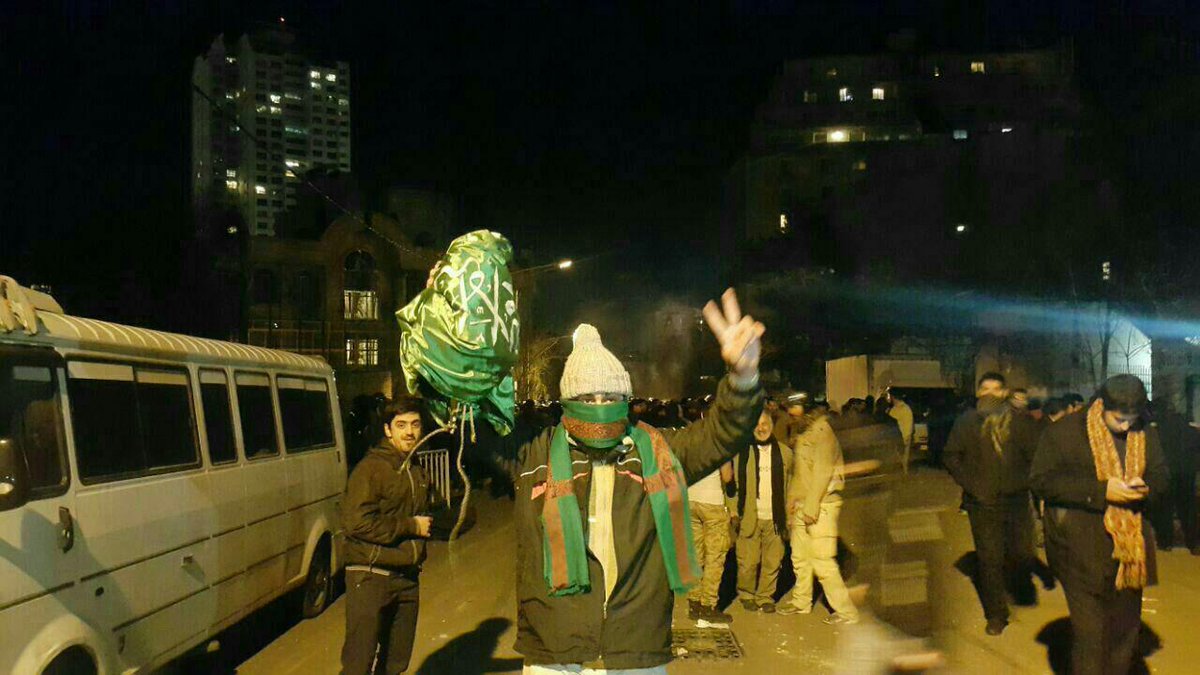
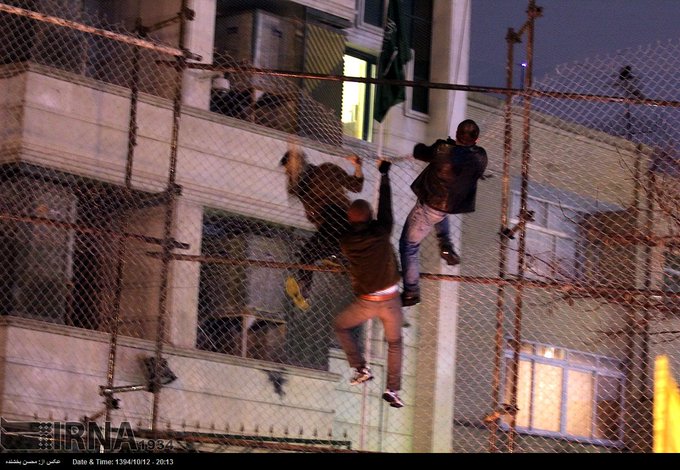
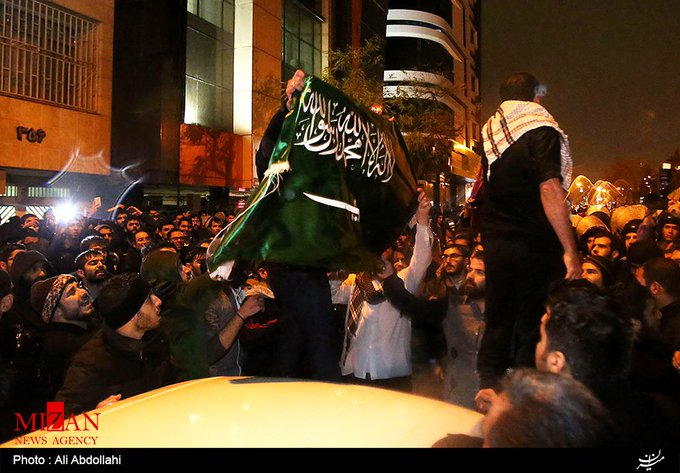
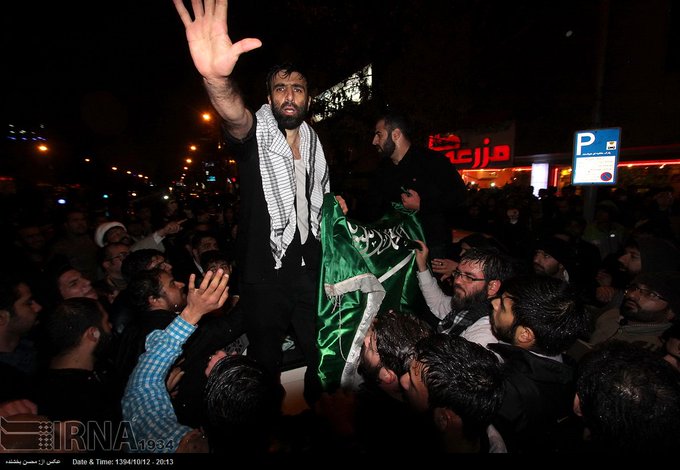
Protesters Storm, Set Fire To Saudi Embassy In Iran

Tyler Durden's picture


http://www.zerohedge.com/news/2016-01-02/protesters-storm-set-fire-saudi-embassy-iran
Earlier today, Saudi Arabia announced it had staged its largest mass execution in 25 years. 
43 al-Qaeda conspirators were killed along with 4 Shiites accused of shooting policemen in the anti-government protests which broke out during the Arab Spring. Among the Shiites killed: prominent cleric Nimr al-Nimr.
His death drew sharp criticism from Iran and Hezbollah with the latter calling the execution a “grave mistake.” Here's WSJ:
Lebanese militant group Hezbollah called Mr. al-Nemer’s execution a “stain that would haunt this regime,” while former Iraqi Prime Minister Nouri al-Malki, another ally of Iran, said the execution “will topple the Saudi regime.”

Arab Gulf allies of the kingdom such as Bahrain and the United Arab Emirates said they supported steps taken by Saudi Arabia to “confront terrorism.”

Mr. al-Nemer was sentenced to death in October 2014 and charged with crimes including disobeying the ruler, inciting sectarian strife and bearing arms against security forces.

Mr. al-Nemer wasn’t widely known outside Qatif before 2011, when he emerged as a leading voice behind Shiite protests that rocked the oil-rich eastern part of Saudi Arabia for two years.

He was arrested after a car chase near his family’s farm in their hometown of Awwamiya in July 2012. Authorities said he opened fire at security forces. His family has denied this and said he was unarmed.
“We condemn a deplore this unjust killing and consider it an example of killing wisdom and moderation,” Mr. al-Nemer’s family said in a statement.
"The Saudi government supports terrorists and takfiri [heretic] extremists, while executing and suppressing critics inside the country," Iran's Foreign Ministry declared. These are "hostile statements," Riyadh responded, adding that Iran's comments constitute "a blatant intervention in the kingdom’s affairs.”
Protests erupted in the Qatif district of Saudi Arabia's Eastern Province as well as in Bahrain, where hundreds took to the streets, burning tires and braving tear gas fired by police. As we reported earlier today, protesters had also converged on the Saudi embassy in Iran. 
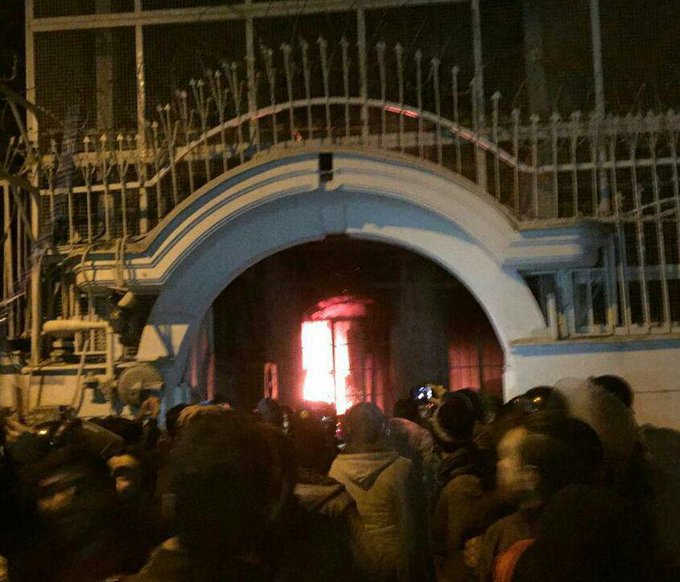
Now, in what looks like a repeat of the Iran Hostage Crisis, the protesters in Tehran have reportedly broken into the Saudi embassy and set it ablaze with Molotov cocktails. 
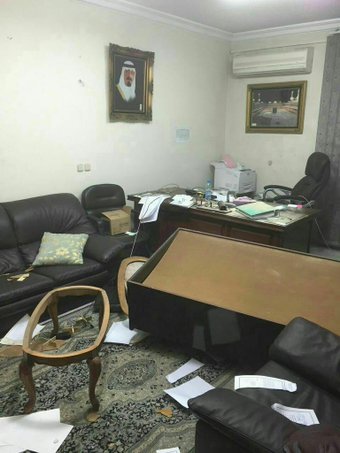
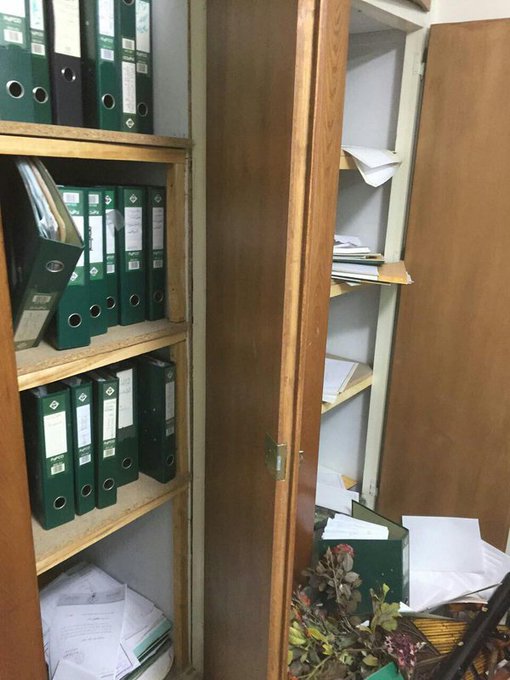
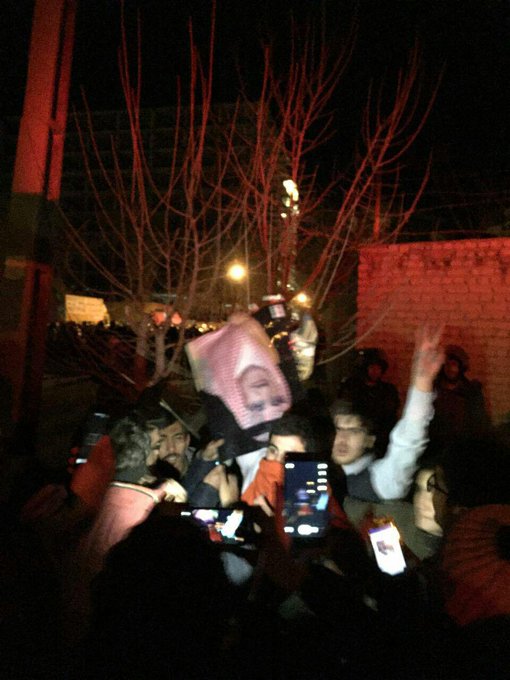
"Images shared on social media early on Sunday morning appeared to show Iranian protesters breaking into Saudi Arabia's embassy in Tehran and starting fires, after gathering there to denounce the kingdom's execution of a Shi'ite cleric," Reuters reports. "One photograph, posted on Twitter, showed protesters outside the embassy building with small fires burning inside, while another showed a room with smashed furniture purportedly inside the building."

Sobhan Hassanvand 
It's 23:50 here in Tehran, seems protest agnst Nimr execution continues outside Saudi embassy in Tehran right now pic.twitter.com/5LLj89FhYn
View image on Twitter

: Angry protesters storm Saudi embassy in Tehran
Police disperse protesters at Saudi embassy in Tehran
Saudi Arabia flag brought down at embassy in Tehran pic.twitter.com/7ptL0gV0ZF
View image on Twitter

PHOTOS: Saudi consulate in Mashhad protected w/ fence, angry protesters at consulate over al-Nimr execution pic.twitter.com/3MxFFxMbXX
Protesters in Mashhad bring down Saudi flag at consulate following al-Nimr execution pic.twitter.com/2abn4V2KgW
View image on TwitterView image on TwitterView image on Twitter
As a reminder, the Sheikh was a prominent voice in the anti-government movement in Saudi Arabia. Riyadh effectively killed (literally) two birds with one stone with his execution: 1) a dissident voice was forever silenced, 2) a message was sent to Tehran, whose regional influence is expanding in Iraq and Yemen and whose forces have served to shore up the Assad government in its fight against Sunni extremists in Syria.
Now, the Iranians look set to send a message back to Riyadh as the sectarian divide once again rears its ugly head.
Meanwhile, Iran's foreign ministry is calling for "calm." Here's Reuters:
Iran's Foreign Ministry called for calm in the early hours of Sunday after police dispersed angry protesters who had stormed Saudi Arabia's embassy in Tehran.

Demonstrators broke into the embassy and started fires before being cleared away by the police, Iran's ISNA news agency reported, after gathering there to denounce the kingdom for executing a prominent Shi'ite cleric on Saturday.

The ministry issued a statement calling on protesters to respect the diplomatic premises, according to the Entekhab news website.
If this situation escalates, clearly crude oil will be well bid on Sunday afternoon.

Thursday, December 17, 2015

Saudi Royal Family Announces Its New Global Sunni Military Empire

(NOTE: Some news-media have made clear to me flat-out that they won’t publish anything that criticizes the Saudi royal family, especially not as being what they really are, but I have included those media on my distribution-list anyway, as I always do. I send everything I do to all of them, regardless of whether or not they will consider publishing my reports.)
An official announcement from the world’s leading, and most fundamentalistic, Sunni Islamic nation, Saudi Arabia, on Tuesday December 15th, has introduced a Sunni-Islamic counterpart to NATO, and it includes one NATO member, Turkey, which is already at war against NATO’s enemy Russia, and against Russia’s ally the non-sectarian, secular Shiite, Bashar al-Assad, who runs Syria. The Sauds’ “Joint Statement on Formation of Islamic Military Alliance” has been signed by 34 Sunni-led nations, with “more than ten other Islamic countries” that “have expressed their support for this … alliance and will take the necessary measures” to join, “including Indonesia” (the highest-population Islamic-majority nation). All of those “Islamic countries” are specifically Sunni-led, not  Shiite-led.
The two top importers of U.S. weapons are #1 Saudi Arabia, and #2 Turkey. Both are Sunni, and no Shiite nation is even on the list. The new, 34-nation-plus military alliance could cause U.S. military producers to soar. And the figures shown there for Saudi Arabia grossly understate the reality. For example, on 13 September 2010, Britain’s Telegraph  bannered “US secures record $60 billion arms sale to Saudi Arabia,” and other lesser arms bonanzas to the U.S. from the Sauds came in the years after, so that a figure of only “$1,199,000,000” for the year 2014 (given in the first of those two links) is no fair indication of the reality, which is that the Saud family dwarfs any other buyer of U.S. armaments. And, U.S. ‘news’ media refuse to allow their reporters to cover the ugly reality of how those weapons are being used — and they fire any who publicly object.

Saudi Arabia is owned by King Salman al-Saud, the world’s wealthiest person, who might now be on his way to becoming the Sunni faith’s globe-spanning “Caliph,” or Islamic Emperor — an aspiration of his family ever since his ancestor Muhammad Ibn Saud in 1744 swore an anti-Shiite oath, along with the fundamentalistic anti-Shiite cleric Muhammad Ibn Wahhab, who agreed that his followers would endorse Saud’s descendants to rule Arabia if the Saud clan would impose Wahhab’s extremist interpretation of the Quran. In fact, an official of the U.S.-backed Syrian ‘moderates’ called recently for exterminating Shiites, and the Saud family supports those ‘moderates.’ Furthermore, a recent poll showed that 92% of the Saudi public support ISIS, which is only natural since ISIS is only enforcing the laws that the Saud family have already long been imposing upon their own public.
However, ISIS claims that the Saud family are impostors, who must be replaced by the leaders of ISIS, who won’t ‘cooperate’ with ‘the infidels.’ And, so, the Sauds now are arming not only against Shiite-led nations, and against those nations’ major ally Russia, but also against groups that, even inside the Sauds’ own country, are more popular than the Sauds themselves are (which probably isn’t very popular, since the Sauds refuse to allow so important a matter to be polled — any honest poll of it would expose to Western publics the total fraudulence of the aristocracies’ rationalizations for their wars to replace the Syrian government and for the rest of the West’s geopolitics).
The alleged purpose of this newly formed military alliance is “to fight terrorism” (something that all nations claim to be doing), an ambiguous phrase (something that aristocrats specialize in). It might include even the Oklahoma City bombing by Timothy McVeigh and the anti-Israeli attacks by the Shiite Hezbollah group in Lebanon, but this “terrorism” might (far more feasibly) instead refer only to the “terrorism” practiced by Sunni groups, such as ISIS and Al Qaeda — the groups that, like Saudi Arabia itself, are famous specifically for beheading  people they don’t approve. (Shiite nations, even the most fundamentalistic one, Iran, prefer other methods of execution, if they use any at all — typically, such as in Iran, hanging.)
Saudi Arabia was founded in 1744 by an oath between Saud and Wahhab to exterminate Shiites and then take over the world. The Saudi royal family were the main funders of Al Qaeda: that group’s bookkeeper and bagman who personally collected in cash each one of the many million-dollar-plus donations to Al Qaeda, said that, “Without the money of the — of the Saudi you will have nothing.” He listed almost all of the top Sauds as people from whom he had been collecting. There also is evidence suggesting that the Saud family’s Prince Bandar bin Sultan al-Saud (who was on that list), a longtime buddy of both President Bushes, might have communicated to George W. Bush in private, well prior to 11 September 2001, that Al Qaeda was planning and soon would perpetrate a massive attack in the United States, and that Bush shouldn’t let the CIA chief or his anti-terrorism specialists into his presence to provide him the details privately and, because “We don’t want the clock to start ticking.” The now-standard cover-story, that the U.S. couldn’t have been protected from that attack, was already planned, even as the attack itself was being organized. Furthermore, it’s widely suspected that the missing 28 pages from the Senate’s investigation into the pre-9/11 intelligence, addresses this “highly sensitive” (meaning: the public isn’t supposed to know it) matter. All that’s been publicly released is that, “It’s about the Bush Administration and its relationship with the Saudis.” The Obama Administration is hiding those 28 pages from the public.
The Sauds privately agreed to an alliance in 1945 with the United States to continue sharing with U.S. oil companies, if the U.S. would protect them from the Saudi public. Thus, the Sauds receive favorable press coverage in the U.S. press, which are owned by members of the same U.S.-and-allied aristocracy that control the U.S. Government (via the press, lobbyists, etc., all of which they hire if not own). Consequently, too, the Sauds’ foreign invasions to impose Sunni rulers even in majority-Shiite lands are hidden by the U.S. press. This is a bipartisan hiding: not only mainstream ‘news’ media such as CNN and The New York Times and Salon are part of it, but the clearly partisan (i.e., Republican) conservative ’news’ media, such as those of Rupert Murdoch (Fox, WSJ, N.Y. Post, etc.) also are. (In fact, when the Saudi Prince who was the second-largest stockholder in Murdoch’s News Corp. sold most of his holding of that stock in 2014, Forbes  noted that he “also has a substantial shareholding in Time Warner,” which includes CNN.)
The Sauds’ imperial announcement, which provided no details on what is to be meant by the phrase “to fight terrorism,” stated:
The countries participating in the alliance along with the Kingdom of Saudi Arabia are: Jordan, United Arab Emirates, Pakistan, Bahrain, Bangladesh, Benin, Turkey, Chad, Togo, Tunisia, Djibouti, Senegal, Sudan, Sierra Leone, Somalia, Gabon, Guinea, Palestine, Comoros, Qatar, Cote d’Ivoire, Kuwait, Lebanon, Libya, Maldives, Mali, Malaysia, Egypt, Morocco, Mauritania, Niger, Nigeria, .Yemen
(The dot before “Yemen” is a typographical error in the Saudi announcement, one that the Saudi Press Agency commonly makes — it means nothing at all, except that the Saud family place low priority on editing “typos” out of English translations of their official pronouncements.)
Turkey is the only NATO member in this group. Turkey (after shooting down a Russian plane over Syria) is at war against Russia, because Turkey is trying to defeat the military campaign by Russia to destroy the many fundamentalist Sunni groups, jihadist groups including Al Qaeda and ISIS, that are trying to take over Syria. Turkey’s virtual dictator, the fundamentalist Sunni Recep Tayyip Erdoğan, wants to sell Syria’s oil on global markets — he’s already doing it illegally, and wants to be doing it legally, such as by installing (with U.S. and Saudi help) a fellow-fundamentalist Sunni as Syria’s leader.
Tha Saudi announcement says nothing about what relationship (other than already including one NATO member) the new, Saudi-led, military alliance will have with NATO, which is America’s alliance against Russia. (It used to be America’s anti-communist alliance; but, once communism ended, the U.S. aristocracy kept NATO going, in order to take over Russia itself, such as by surrounding it with NATO nations and ultimately forcing out and replacing the current independent Russian government.)
Outside NATO, the United States has additional major military bases in Saudi Arabia and Bahrain, and longstanding alliances also with Pakistan and Egypt, as well as extensive military cooperation with Jordan, UAE, and Kuwait.
The U.S. has been trying to conquer Russia ever since the negotiations in 1990 for the end (which occurred in 1991) of the Soviet Union and of its Warsaw Pact (the Soviets’ counterpart to NATO). And, like the Saudis, the U.S. is also hostile toward the world’s leading, and coincidentally its most fundamentalistically led, Shiite nation: Iran. Moreover, both of these military alliances are also very much against Russia. So: NATO and the newly formed, Saudi-led, Sunni military alliance might ultimately join into one.
A conference had been expected to meet on December 15th in Riyadh to select which jihadist groups would receive the backing of the Sauds to take over Syria; however, that was cancelled when the Sauds announced that only a single jihadist group that’s actually fighting in Syria would be allowed to attend. Most of the jihadist groups still want to overthrow the Sauds for working with ‘infidels.’ Consequently that meeting is not being held, after all.
No Shiite nation was mentioned in the Saudi announcement of the new military alliance, and the possibility therefore exists that the reason why the Saud family created this alliance was as part of that family’s intense hostility, ever since at least 1744, against Shiites.
The response of the U.S. regime to the Sauds’ war against Shiia has been twofold: to condemn it verbally, while participating in (and even leading it) in the real world, the anti-Shiia operations against Syria and Iran (both of them because they’re allied with Russia).
—————