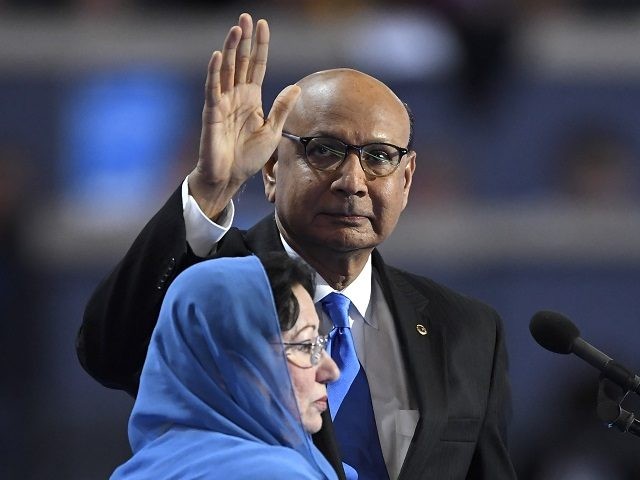
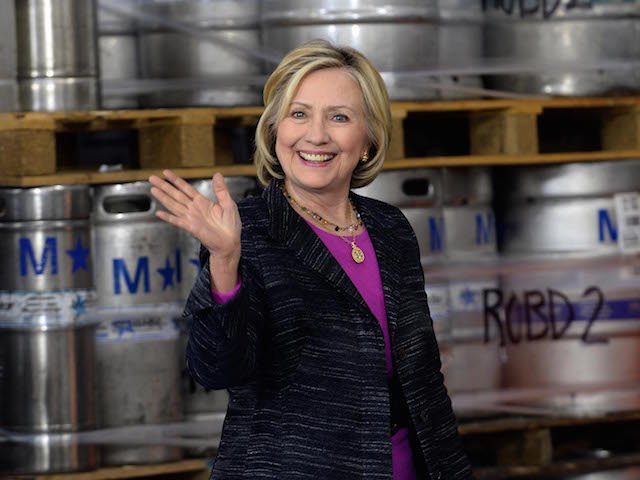
Khizr
Khan, the Muslim Gold Star father that the mainstream media and former
Secretary of State Hillary Clinton have been using to criticize Donald
J. Trump, has deep ties to the government of Saudi Arabia—and to
international Islamist investors through his own law firm. In addition
to those ties to the wealthy Islamist nation, Khan also has ties to
controversial immigration programs that wealthy foreigners can use to
essentially buy their way into the United States—and has deep ties to
the “Clinton Cash” narrative through the Clinton Foundation.
Khan and his wife Ghazala Khan both
appeared on stage at the Democratic National Convention to attack, on
Democratic presidential nominee Hillary Clinton’s behalf, Donald
Trump—the Republican nominee for president. Their son, U.S. Army Captain
Humayun Khan, was killed in Iraq in 2004. Khizr Khan, in his speech to
the DNC, lambasted Donald Trump for wanting to temporarily halt Islamic
migration to America from countries with a proven history of exporting
terrorists.
Since then, Clinton operative George
Stephanopoulos—who served as a senior adviser to the president in Bill
Clinton’s White House and is a Clinton Foundation donor
as well as a host on the ABC network—pushed Trump on the matter in an
interview. Trump’s comments in that interview have sparked the same
mini-rebellion inside his party, in the media and across the aisle that
has happened many times before. The usual suspects inside the GOP, from
former Florida Gov. Jeb Bush to Sen. Lindsey Graham (R-SC) to House
Speaker Paul Ryan to Senate Majority Leader Mitch McConnell to Ohio Gov.
John Kasich, have condemned Trump in one way or another. The media
condemnation has been swift and Democrats, as well their friends
throughout media, are driving the train as fast as they can.
Video: FBI interviews Clinton in email probe: campaign
But until now, it looked like the Khans
were just Gold Star parents who the big bad Donald Trump attacked. It
turns out, however, in addition to being Gold Star parents, the Khans
are financially and legally tied deeply to the industry of Muslim
migration–and to the government of Saudi Arabia and to the Clintons
themselves.
Khan, according to Intelius as also reported by Walid Shoebat,
used to work at the law firm Hogan Lovells, LLP, a major D.C. law firm
that has been on retainer as the law firm representing the government of
Saudi Arabia in the United States for years. Citing federal government
disclosure forms, the Washington Free Beacon reported the connection
between Saudi Arabia and Hogan Lovells a couple weeks ago.
“Hogan Lovells LLP, another U.S. firm
hired by the Saudis, is registered to work for the Royal Embassy of
Saudi Arabia through 2016, disclosures show,” Joe Schoffstall of the
Free Beacon reported.
The federal form filed with the Department of Justice
is a requirement under the Foreign Agents Registration Act of 1938,
which makes lobbyists and lawyers working on behalf of foreign
governments and other agents from abroad with interests in the United
States register with the federal government.
The government of Saudi Arabia, of course, has donated heavily to the Clinton Foundation.
“The Kingdom of Saudi Arabia has given
between $10 and $25 million to the foundation while Friends of Saudi
Arabia has contributed between $1 and $5 million,” Schoffstall wrote.
Trump, of course, has called on Hillary Clinton to have the Clinton Foundation return the money.
“Saudi Arabia and many of the countries
that gave vast amounts of money to the Clinton Foundation want women as
slaves and to kill gays,” Trump wrote in a Facebook post back in June, according to Politico. “Hillary must return all money from such countries!”
“Crooked Hillary says we must call on
Saudi Arabia and other countries to stop funding hate,” Trump posted in a
separate Facebook posting at the time. “I am calling on her to
immediately return the $25 million plus she got from them for the
Clinton Foundation!”
Of course, to this day, Hillary Clinton and her Clinton Foundation has kept the money from the Saudi Arabian government.
Schoffstall’s piece in the Washington Free Beacon also notes how Hogan Lovells lobbyist Robert Kyle, per Federal Election Commission (FEC) records, has bundled more than $50,000 in donations for Clinton’s campaign this year.
“Many lawyers at Hogan Lovells remember
the week in 2004 when U.S. Army Capt. Humayun Khan lost his life to a
suicide bomber,” Polantz wrote. “Then-Hogan & Hartson attorneys
mourned the death because the soldier’s father, Khizr Khan, a Muslim
American immigrant, was among their beloved colleagues.”
Polantz wrote that Khan worked at the mega-D.C. law firm for years.
“Khan spent seven years, from 2000 to
2007, in the Washington, D.C., office of then-Hogan & Hartson,”
Polantz wrote. “He served as the firm’s manager of litigation
technology. Although he did not practice law while at Hogan, Khan was
well versed in understanding the American courts system. On Thursday
night, he described his late son dreaming of becoming a military
lawyer.”
But representing the Clinton Foundation
backing Saudi Arabian government and having one of its lobbyists bundle
$50,000-plus for Clinton’s campaign are hardly the only places where the
Khan-connected Hogan Lovells D.C. mega-firm brush elbows with Clinton
Cash.
The firm also handles Hillary Clinton’s
taxes and is deeply connected with the email scandal whereby when she
was Secretary of State, Hillary Clinton set up a home-brew email server
system that jeopardized classified information handling and was
“extremely careless” according to FBI director James Comey.
“A lawyer at Hogan & Hartson [Howard
Topaz] has been Bill and Hillary Clinton’s go-to guy for tax advice
since 2004, according to documents released Friday by Hillary Clinton’s
campaign,” The American Lawyer’s Nate Raymond wrote in 2008,
as Hillary Clinton ran for president that year. “The Clintons’ tax
returns for 2000-07 show combined earnings of $109 million, on which
they paid $33 million in taxes. New York-based tax partner Howard Topaz
has a broad tax practice, and also regularly advises corporations on
M&A and executive compensation.”
“Topaz was a partner at Hogan &
Hartson, which later merged to become known as Hogan Lovells, where
Topaz continues to practice. The firm’s lawyers were major donors to
Hillary Clinton’s first presidential campaign,” Howley wrote.
For her private email system, Clinton used a spam filtering program MX Logic.
“Hogan & Hartson handled the patent
for MX Logic’s email-filtering program, which McAfee bought the small
company for $140 million in 2009 in order to acquire,” Howley wrote.
“The MX Logic company’s application for a trademark for its SPAMTRAQ
program was filed in 2004 on Hogan & Hartson stationery and signed
by a Hogan & Hartson attorney. Hogan & Hartson has been
responsible for MX Logic annual reports. The email company’s Clinton
links present more evidence that Clinton’s political and legal
establishment was monitoring her private email use.”
If that all isn’t enough, that same Hogan
& Hartson law firm—now Hogan Lovells—employed Loretta Lynch, the
current Attorney General of the United States. Lynch infamously just a
few weeks ago met with Bill Clinton, Hillary’s husband and the former
president, on her private jet in Phoenix just before clearing Hillary
Clinton of any wrongdoing when it came to her illicit private email
server system.
Sen. Chuck Grassley, the chairman of the
U.S. Senate’s Judiciary Committee, has detailed how the EB5 immigration
program is “riddled with flaws and corruption.”
“Maybe it is only here on Capitol Hill—on
this island surrounded by reality—that we can choose to plug our ears
and refuse to listen to commonly accepted facts,” Grassley said in a statement earlier this year.
“The Government Accountability Office, the media, industry experts,
members of congress, and federal agency officials, have concurred that
the program is a serious problem with serious vulnerabilities. Allow me
to mention a few of the flaws.”
From there, Sen. Grassley listed out several of the “flaws” with the EB5 immigration program that Khan works in:
– Investments can be spent before business plans are approved.
– Regional Center operators can charge exorbitant fees of foreign nationals in addition to their required investments.
– Jobs created are not “direct” or verifiable jobs but rather are “indirect” and based on estimates and economic modeling.
– Jobs created by U.S. investors are
counted by the foreign national when obtaining a green card, even if
EB-5 money is only a fraction of the total invested.
– Investment funds are not adequately vetted.
– Gifts and loans are acceptable sources of funds from foreign nationals.
– The investment level has been stagnant for nearly 25 years.
– There’s no prohibition against foreign governments owning or operating regional centers or projects.
– Regional centers can be rented or sold without government oversight or approval.
– Regional centers don’t have to certify that they comply with securities laws.
– There’s no oversight of promoters who work overseas for the regional centers.
– There’s no set of sanctions for violations, no recourse for bad actors.
– There are no required background checks on anyone associated with a regional center.
– Regional centers draw Targeted
Employment Area boundaries around poor areas in order to come in at a
lower investment level, yet the jobs created are not actually created in
those areas.
– Every Targeted Employment Area designation is rubberstamped by the agency.
– Adjudicators are pressured to get to a yes, especially for those politically connected.
– Visas are not properly scrutinized.
– Visas are pushed through despite security warnings.
– Files and applications lack basic and necessary information to monitor compliance.
– The agency does not do site visits for each and every project.
– There’s no transparency on how funds are spent, who is paid, and what investors are told about the projects they invest in.
That’s not to mention the fact that,
according to Sen. Grassley, there have been serious national security
violations in connection with the EB5 program that Khan works in and
around already. In fact, the program—according to Grassley—was used by
Middle Eastern operatives from Iran to attempt to illicitly enter the
United States.
“There are also classified reports that
detail the national security, fraud and abuse. Our committee has
received numerous briefings and classified documents to show this side
of the story,” Grassley said in the early February 2016 statement. “The
enforcement arm of the Department of Homeland Security wrote an internal
memo that raises significant concerns about the program. One section of
the memo outlines concerns that it could be used by Iranian operatives
to infiltrate the United States. The memo identifies seven main areas of
program vulnerability, including the export of sensitive technology,
economic espionage, use by foreign government agents and terrorists,
investment fraud, illicit finance and money laundering.”
Maybe all of this is why–as Breitbart
News has previously noted–the Democratic National Convention made
absolutely no mention of the Clinton Foundation or Clinton Global
Initiative. Hillary Clinton’s coronation ceremony spent exactly zero
minutes of the four nights of official DNC programming talking about
anything to do with perhaps one of the biggest parts of her biography.
https://seeker401.wordpress.com/2016/05/16/hillarys-email-bombshell-saudis-financed-the-benghazi-attack/
Bernie Sanders may have been chivalrous when he told a beleaguered
Hillary Clinton, “The American people are sick and tired of hearing
about your damn emails.” But when it comes to actually reading some of
Clinton’s confidential exchanges, that’s another matter.
In December 2014, Hillary Rodham Clinton began providing the State
Department with personal emails sent or received during her tenure as
Secretary of State. The final batch was released on February 29, 2016.
The entire collection is now posted on the State Department’s Public Reading Room and is searchable via this link.
But the collection is not complete. Clinton admits to having deleted 32,000 emails“deemed
private.” Among the missing are a number of politically charged emails
sent to Secretary Clinton by a trusted colleague named Sidney
Blumenthal. Blumenthal’s emails were allegedly captured and copied by
Marcel Lazar Lehel, an unemployed Romanian taxi driver better known as
“Guccifer” and “Small Fume.” In April of this year, Lehel became an
instant celebrity after he was identified as the cyber-savvy interloper
who had hacked into Clinton’s official email account during her time as
Secretary of State. (Lehel was recently awarded an all-expenses-paid
trip from a Romanian prison to the US where he will spend his days in an
American jail cell under 18-month extradition order.)
Guccifer’s sudden celebrity may seem a bit odd, given the fact that
he initially released Clinton’s compromised communiqués some time
ago—back in 2013, to be precise.
Before Guccifer became tabloid-fodder in the West, he had already
popped a number of eyes by sharing his disclosures with the Russian
media organization RT (“Hillary Clinton’s ‘hacked’ Benghazi emails: FULL RELEASE“) on March 20, 2013. (A second bundle of Guccifer’s Blumenthal-Clinton emails was released on March 22, 2013.)
Given the current frenzy over Guccifer and his revelations, it is
remarkable that his headline-grabbing “leaks” went virtually unreported
when he first twisted the spigot back in 2013. At the time, the
mainstream media took little notice. The only “news outlets” to pick up
on Guccifer’s cyber-pranks were a few conspiracy sites like The Smoking Gun and Cryptome. [Note: You may experience trouble trying to access the Cryptome website.]
The tranche of Clinton’s “damn emails” subsequently posted by RT
included some pretty damning revelations. Perhaps none was more shocking
than the disclosure that the deadly attack on the American consulate in
Benghazi on September 11, 2012—which took the life of US ambassador
John Christopher “Chris” Stevens—was secretly financed by powerful
figures in Saudi Arabia.
This information was contained within the text of four messages
Secretary Clinton received from Blumenthal. It should be noted that
Blumenthal was not an employee of the US State Department. He was an
employee of the Clinton Foundation, earning salary of $10,000 a month as
a consultant providing memo-worthy Intel to Secretary Clinton. On the
side, Blumenthal also was serving an entrepreneurial role inside a
Libyan company called Osprey that was hoping to reap lucrative medical
and military contracts under the new post-Qadaffi government. (Since
such business deals could require State Department approval, Hillary
Clinton might be asked someday whether this relationship with Blumenthal
posed a “conflict of interest.”)
One confidential memo dispatched to Clinton on February 16, 2013 bore
the warning: “The following information comes from extremely sensitive
sources and it should be handled with care.” In this memo, Blumenthal
included a lengthy report from an “individual with sensitive access”
who, “speaking on condition of absolute secrecy” described the role of
the Mokhtar Belmokhtar (a former Al-Qaeda fighter from Algeria who
became the leader of the Al-Murabitoun militia) in a January 16, 2013
hostage-taking incident at an Algerian gas facility. (A four-day battle
eventually freed 685 Algerian workers and 107 foreigners and left 39
foreign hostages dead).
Blumenthal’s source then turned to the attack on the US Consulate in
Benghazi which was mounted by Ansar al Sharia, another radical militia.
“This individual adds that this information provided by the French
[intelligence] service indicates that the funding for both attacks
originated with wealthy Sunni Islamists in Saudi Arabia. During July and
August 2012, these financiers provided funds to Al Qaeda in the Islamic
Mahgreb (AQIM) contacts in southern Europe, who in turn passed the
money onto AQIM operatives in Mauritania. The money was used to recruit
operatives and purchase ammunition and supplies.”
“In a separate conversation,” Blumenthal’s memo continues, “Algerian
DGSE [the state intelligence agency] officers note in private that
Libyan intelligence officers tell them that the Benghazi attacks were
funded by these financiers in Saudi Arabia.”
Alleged Saudi funding of the attack in Benghazi is particularly
troubling in light of the mounting suspicions that the 28 censored pages
of Washington’s official 911 report spell out the role that powerful
officials in Saudi Arabia played in supporting the hijackers who brought
down the World Trade Center towers in 2011. It is disturbing to
discover that Hillary Clinton was informed of Saudi involvement in the
death of Ambassador Stevens in 2013 and has opted to remain silent.
The Blumenthal memos make many references to the complex role of
foreign intelligence—most prominently the CIA and Britain’s Secret
Intelligence Service (SIS)—both during Qaddafi’s reign and after the
unraveling of Libya’s government.
One of Blumenthal’s sources refers to the “heightened public interest
in the liaison relationships conducted by the CIA and the SIS with
Qaddafi’s intelligence and security services” and mentions the
international organization Human Rights Watch (HRW) and its “efforts to
tie Western governments to human rights violations committed under
Qaddafi.” According to one of Blumenthal’s sources, Mohammed Yousef
el-Magariaf, a Libyan politician who served as the president of the
General National Congress and “interim head-of-state,” was concerned
that his “enemies are working to take advantage of his suspected links
to the CIA” and predicted “this situation will only grow more complex as
Qaddafi’s son, Saif al Islam Qaddafi and al Senousi are brought before
Libyan courts” since It was believed “both men will be linked to Western
intelligence during their trials.”
Compounding the problem, Blumenthal warned Clinton, were “messages to
Libya from the CIA and SIS [that] were found among the Tripoli
Documents published by HRW indicating that the United States and Britain
were eager to help Libya capture several senior LIFG [Libyan Islamic
Fighting Group] figures.”
———-
emails keep circling HRC..will they eventually bring her down?
blumenthal..clan of berg?
Prior to the release of the New York Times bestselling investigative exposé Clinton Cash by Government Accountability Institute
President and Breitbart Senior Editor-at-Large Peter Schweizer, Hillary
Clinton and her supporters claimed she was among the most vetted
political figures in America—a candidate about whom everything was
known.
Yet as media outlets across the ideological spectrum have confirmed
and verified the book’s explosive revelations about Clinton’s tenure as
Sec. of State and the influx of hundreds of millions of dollars from
foreign sources into the Clinton Foundation, the nation has learned much
it did not know. Subsequent reporting by national news outlets has
expanded on the book’s findings using its investigative methodology.
Indeed, the dizzying flurry of resulting Hillary Clinton Foundation scandals has been difficult to keep up with. As CNN’s John King
put it on Sunday, “You can’t go 20 minutes in this town, it seems,
without some sort of a story about Clinton Foundation that gives you a
little bit of the creeps.”
Early on, as Clinton Cash bombshells began appearing in the New York Times, Washington Post, New Yorker, Bloomberg,
and elsewhere, Hillary Clinton’s campaign sought to calm nervous
campaign donors by announcing the creation of a special “rapid response”
War Room aimed at combating a book, an unprecedented move in the annals
of modern presidential campaigning. The Clinton campaign team built a
website called “The Briefing,”
issued memos, and tasked an eight-person team to create videos
featuring embattled Clinton spokesperson Brian Fallon as he awkwardly
and unsuccessfully attempted to smear Peter Schweizer. Team Clinton’s message: all of Clinton Cash’s revelations are incorrect or merely “coincidences.”
Yet as the nation’s largest news organizations began to confirm
finding after finding, the Clinton campaign did the only thing it could:
it gave up in its attempts to refute the swelling avalanche of now
well-established facts. Indeed, the Clinton campaign’s last video
response on its “The Briefing” YouTube page is dated May 5th—Clinton Cash’s official launch date.
To date, Hillary Clinton has yet to substantively answer a single question from the mountain of Clinton Cash questions that continue to pile up with each passing day.
The result: according to Tuesday’s CNN poll, the “Clinton Cash Effect” has rendered Hillary Clinton historic new lows in her favorability with American voters.
Below we chronicle just 21 of the myriad Clinton Cash-related
revelations that have emerged since the book’s publication—all of which
have been confirmed and verified as accurate by national media
organizations.
Huffington Post: Clintons Bagged at Least $3.4 Million for 18 Speeches Funded by Keystone Pipeline Banks
Canadian Imperial Bank of Commerce and TD Bank—two of the Keystone XL
pipeline’s largest investors—fully or partially bankrolled eight
Hillary Clinton speeches that “put more than $1.6 million in the
Democratic candidate’s pocket,” reports the Huffington Post.
Moreover, according to Clinton Cash, during Hillary
Clinton’s tenure as Sec. of State, Bill Clinton delivered 10 speeches
from Nov. 2008 to mid-2011 totaling $1.8 million paid for by TD Bank,
which held a $1.6 billion investment in the Keystone XL pipeline.
The Clintons’ speaking fees windfall, which has infuriated environmental groups, have yet to be addressed by Hillary Clinton.
New York Times: Clinton Foundation Shook Down a Tiny Tsunami Relief Nonprofit for a $500,000 Speaking Fee
Bill Clinton refused to give a speech for a tiny nonprofit seeking to
raise money for tsunami victims until the group agreed to pay a
$500,000 speaking fee to the Clinton Foundation. The Times reported
that the Clinton Foundation “sent the charity an invoice,” which
“amounted to almost a quarter of the evening’s net proceeds—enough to
build 10 preschools in Indonesia.”
New York Magazine: Clinton Foundation “Strong-Armed” Charity Watchdog Group
When “the Clinton Foundation wound up on a ‘watch list’ maintained by
the Charity Navigator, dubbed the ‘most prominent’ nonprofit watchdog,”
reported New York Magazine writer Gabriel Sherman, “the Foundation attempted to strong-arm them by calling a Navigator board member.”
International Business Times: Hillary Clinton’s State Dept. Gave Clinton Foundation Donors Weapons Deals
“Under Clinton’s leadership, the State Department
approved $165 billion worth of commercial arms sales to 20 nations whose
governments have given money to the Clinton Foundation, according to an
IBTimes analysis of State Department and foundation data,” reports IBT.
“That figure—derived from the three full fiscal years of Clinton’s term
as Secretary of State (from October 2010 to September 2012)—represented
nearly double the value of American arms sales made to the those
countries and approved by the State Department during the same period of
President George W. Bush’s second term.” Salon, MotherJones, HuffingtonPost, Slate, and several other liberal publications reported on IBT’s findings.
Washington Post: Clintons Hid 1,100 Foreign Donor Names in Violation of Ethics Agreement with Obama Admin.
Clinton Cash revealed five hidden foreign donations. On the heels of the book’s publication, the Washington Post
uncovered another 1,100 foreign donor names hidden in the Canada-based
Clinton Giustra Enterprise Partnership—a Clinton Foundation initiative
Bill Clinton erected with controversial billionaire mining executive
Frank Giustra.
“A charity affiliated with the Clinton Foundation failed to reveal
the identities of its 1,100 donors, creating a broad exception to the
foundation’s promise to disclose funding sources as part of an ethics
agreement with the Obama administration,” reports the Washington Post.
“The number of undisclosed contributors to the charity, the
Canada-based Clinton Giustra Enterprise Partnership, signals a larger
zone of secrecy around foundation donors than was previously known.”
In a follow-up story, the Post
reports that only 21 of Frank Giustra and Bill Clinton’s secret 1,100
foreign donors have subsequently been revealed. If and when the other
1,079 hidden donors names will be revealed is presently unclear—and will
be the subject of forthcoming investigative reports by Breitbart News.
Vox: At Least 181 Clinton Foundation Donors Lobbied Hillary’s State Dept.
“Public records alone reveal a nearly limitless supply of cozy
relationships between the Clintons and companies with interests before
the government,” reports Vox.
“There’s a household name at the nexus of the foundation and the State
Department for every letter of the alphabet but “X” (often more than
one): Anheuser-Busch, Boeing, Chevron, (John) Deere, Eli Lilly, FedEx,
Goldman Sachs, HBO, Intel, JP Morgan, Lockheed Martin, Monsanto, NBC
Universal, Oracle, Procter & Gamble, Qualcomm, Rotary International,
Siemens, Target, Unilever, Verizon, Walmart, Yahoo, and Ze-gen.”
BuzzFeed: Two of Hillary Clinton’s Top Donors Were Major Felons
When Hillary Clinton ran for president in 2008, two of her biggest
fundraisers were conducting massive Ponzi schemes. One was Hsu, who
posed as a garment tycoon, and is now serving a 24-year sentence in
federal prison in Milan, Michigan. The other, Hassan Nemazee, is serving
a 12-year sentence in Otisville, New York, for bank fraud. He used fake
documents and nonexistent loans to trick bankers into extending him
more credit,” reports Ben Smith of BuzFeed. “Those two convictions cast light on a central perplexity of the 2016 presidential cycle, and its ‘Clinton Cash‘ phase:
Why are shady people with murky interests always hanging around
political superstars, and particularly Bill and Hillary Clinton?”
Daily Beast: Clintons’ Charity Scored Millions from Qatar and Donations from Corrupt FIFA Soccer Organization
“The Clinton global charity has received between $50,000 and $100,000
from soccer’s governing body and has partnered with the Fédération
Internationale de Football Association on several occasions, according
to donor listings on the foundation’s website,” reports The Daily Beast.
“Qatar 2022 committee gave the foundation between $250,000 and $500,000
in 2014 and the State of Qatar gave between $1 million and $5 million
in previous, unspecified years.”
Associated Press: The Clintons’ Have a Secret “Pass-Through” Company—WJC, LLC
“The newly released financial files on Bill and Hillary Rodham
Clinton’s growing fortune omit a company with no apparent employees or
assets that the former president has legally used to provide consulting
and other services, but which demonstrates the complexity of the
family’s finances,” reported the AP.
“The officials, who spoke on condition of anonymity because they were
not authorized to provide private details of the former president’s
finances on the record, said the entity was a ‘pass-through’ company
designed to channel payments to the former president.”
Hillary Clinton has yet to release the names and amounts of the payments that flowed through the hidden WJC, LLC, company.
New York Times: Hillary Funneled $10K Monthly Payments to Sidney Blumenthal Through Clinton Foundation
“An examination by The Times suggests that
Mr. Blumenthal’s involvement was more wide-ranging and more complicated
than previously known, embodying the blurry lines between business,
politics and philanthropy that have enriched and vexed the Clintons and
their inner circle for years,” reports the Times.
“While advising Mrs. Clinton on Libya, Mr. Blumenthal, who had been
barred from a State Department job by aides to President Obama, was also
employed by her family’s philanthropy, the Clinton Foundation…and
worked on and off as a paid consultant to Media Matters and American
Bridge, organizations that helped lay the groundwork for Mrs. Clinton’s
2016 campaign.”
New Yorker: Bill Clinton Scored a $500,000 Speech in Moscow Paid for by a Kremlin-backed Bank
The New Yorker confirmsClinton Cash’s reporting
that Bill Clinton bagged $500,000 for a Moscow speech paid for by “a
Russian investment bank that had ties to the Kremlin.”
“Why was Bill Clinton taking any money from a bank linked to the Kremlin while his wife was Secretary of State?” asks the New Yorker. To date, Hillary Clinton nor her campaign have answered that question.
Washington Post: Hillary Clinton’s Brother Sits on
the Board of a Mining Co. that Received a Coveted Haitian “Gold
Exploitation Permit” that Has Only Twice Been Awarded in 50 Years.
Rodham Met the Mining Executive in Charge of the Company at a Clinton
Foundation Event.
“In interviews with The Washington Post,
both Rodham and the chief executive of Delaware-based VCS Mining said
they were introduced at a meeting of the Clinton Global Initiative—an
offshoot of the Clinton Foundation that critics have long alleged
invites a blurring of its charitable mission with the business interests
of Bill and Hillary Clinton and their corporate donors.”
“Asked whether he attends CGI meetings to explore personal business
opportunities, Rodham responded, ‘No, I go to see old friends. But you
never know what can happen.’”
New York Times: Court Proceedings Reveal Hillary’s Brother Claimed Admits Clinton Foundation and the Clintons Are Key to His Haiti Connections
“I deal through the Clinton Foundation,” Tony Rodham said according to a transcript of his testimony obtained by The Times.
“That gets me in touch with the Haitian officials. I hound my
brother-in-law [Bill Clinton], because it’s his fund that we’re going to
get our money from. And he can’t do it until the Haitian government
does it.”
Wall Street Journal: Clinton Foundation Violated
Memorandum of Understanding with the Obama Admin. By Keeping Secret a
Foreign Donation of Two Million Shares of Stock from a Foreign Executive
with Business Before Hillary’s State Dept.
Clinton Cash revealed that Canadian mining tycoon Stephen
Dattels scored an “open pit mining” concession at the Phulbari Mines in
Bangladesh where his Polo Resources had investments. The coveted perk
came just two months after Polo Resources gave the Clinton Foundation 2,000,000 shares of stock—a donation the Clinton Foundation kept hidden.
New York Times: Hillary Clinton’s Campaign Claims
She Had No Idea Her State Dept. Was Considering Approving the Transfer
of 20% of U.S. Uranium to the Russian Govt.—Even as the Clinton
Foundation Bagged $145 Million in Donations from Investors in the Deal
In a 4,000-word front-page New York Times investigation, the Times confirmed in granular detail Clinton Cash’s
reporting that Hillary’s State Dept. was one of nine agencies approving
the sale of Uranium One to the Russian government. “The sale gave the
Russians control of one-fifth of all uranium production capacity in the
United States,” reports the Times. The Times then published a detailed table and infographic
cataloging the $145 million in donations to the Clinton Foundation made
by uranium executives involved in the Russian transfer of 20% of all
U.S. uranium.
Bloomberg: A For-Profit University Put Bill Clinton on Its
Payroll and Scored a Jump in Funding from Hillary Clinton’s State Dept.
When Clinton Cash Revealed the Scheme, Bill Clinton Quickly Resigned.
Even as Hillary Clinton and Democrats continue to blast for-profit
colleges and universities, Hillary Clinton’s campaign continues to
stonewall questions about how much Bill Clinton was paid by Laureate
International Universities, one of the largest for-profit education
companies in the world—and an organization that has underwritten Clinton Foundation events. As soon as Clinton Cash revealed Bill Clinton spent years on Laureate’s payroll, the former president quickly resigned.
According to an analysis by Bloomberg:
“in 2009, the year before Bill Clinton joined Laureate, the nonprofit
received 11 grants worth $9 million from the State Department or the
affiliated USAID. In 2010, the group received 14 grants worth $15.1
million. In 2011, 13 grants added up to $14.6 million. The following
year, those numbers jumped: IYF received 21 grants worth $25.5 million,
including a direct grant from the State Department.”
Hillary Clinton has refused to answer questions about the Clintons’ income from the for-profit education company.
New York Times: The Head of the Russian Govt’s
Uranium Company Ian Telfer Made Secret Donations Totaling $2.35 Million
to the Clinton Foundation—as Hillary Clinton’s State Dept. Approved the
Transfer of 20% of All U.S. Uranium to the Russians
Ian Telfer, the former head of the Russian-owned uranium company,
Uranium One, funneled $2.35 million to the Clinton Foundation—donations
that were never revealed until Clinton Cash reported them and the New York Times confirmed them.
Hillary Clinton has yet to answer a single question about Uranium One.
Washington Post: Bill and Hillary Clinton Have Made at Least $26 Million in Speaking Fees from Entities Who Are Top Clinton Foundation Donors
According to the Post’s independent analysis,
“Bill Clinton was paid more than $100 million for speeches between 2001
and 2013, according to federal financial disclosure forms filed by
Hillary Clinton during her years as a senator and as secretary of
state.”
The Post added: “Bill Clinton was paid at least $26 million
in speaking fees by companies and organizations that are also major
donors to the foundation he created after leaving the White House,
according to a Washington Post analysis of public records and foundation date.”
Washington Free Beacon: Former Clinton Campaign
Operative-Turned-ABC News Host George Stephanopoulos Failed to Disclose
His $75,000 Donation and Deep Involvement in the Clinton Foundation
Before Launching an Attack Interview Against Clinton Cash Author
Clinton political operative-turned-ABC News anchor George
Stephanopoulos infamously hid his $75,000 Clinton Foundation donation
from ABC News viewers before launching a partisan attack “interview”
with Clinton Cash author Peter Schweizer.
Roundly condemned by numerous journalists,
Stephanopoulos apologized and received zero punishment from ABC News.
Hillary Clinton’s campaign then used footage from the Stephanopoulos’
attack “interview” with Schweizer in its political campaign videos.
“It was outrageous,” said former ABC News anchor Carole Simpson.
Hillary Clinton has yet to answer whether her campaign coordinated with Clinton Foundation donor George Stephanopoulos.
CNBC: Clinton Foundation Mega Donor Frank Holmes Claimed He
Sold Uranium One Before Hillary Clinton’s State Dept. Approved the
Russian Transfer—Despite His Company’s Own SEC Filings Proving Otherwise
In a highly embarrassing CNBC grilling,
Clinton mega donor and uranium executive Frank Holmes claimed he sold
his Uranium One stock well before Hillary Clinton’s State Dept. greenlit
the transfer of 20% of all U.S. uranium to the Russian government in
2010.
However, according to his company’s, U.S. Global Investors, own 2011 SEC filing, Holmes’ company did, in fact, still hold Uranium One stock, a point he later conceded.
Politico: Hillary’s Foundation Accepted $1 Million from Human Rights Violator Morocco for a Lavish Event
“The event is being funded largely by a contribution of at least $1
million from OCP, a phosphate exporter owned by Morocco’s constitutional
monarchy, according to multiple sources with direct knowledge of the
event,” reports Politico.
“But in 2011, Clinton’s State Department had accused the Moroccan
government of ‘arbitrary arrests and corruption in all branches of
government.’” ABC News similarly confirmed the Clinton Foundation’s acceptance of the unseemly funds.
————
Hillary Clinton has refused to substantively answer a single question
related to the above 21 revelations, or the scores of others not
reflected above.
In answer to a question about Clinton Cash, Bill Clinton said the book “won’t fly.” The book has remained on the New York Times bestseller list three weeks in a row after debuting at number two.
Now, with Hillary Clinton’s poll ratings at all-time lows, Americans
and the nation’s journalists eagerly await the chance to hear Hillary
Clinton’s answers to the growing mountain of Clinton Cash-related revelations, investigative findings that have consumed and imperiled her candidacy.
The headline on the website Pravda trumpeted President Vladimir V. Putin’s latest coup, its nationalistic fervor recalling an era when its precursor served as the official mouthpiece of the Kremlin: “Russian Nuclear Energy Conquers the World.”
The article, in January 2013, detailed how the Russian atomic energy agency, Rosatom, had taken over a Canadian company with uranium-mining stakes stretching from Central Asia to the American West. The deal made Rosatom one of the world’s largest uranium producers and brought Mr. Putin closer to his goal of controlling much of the global uranium supply chain.
But the untold story behind that story is one that involves not just the Russian president, but also a former American president and a woman who would like to be the next one.
At the heart of the tale are several men, leaders of the Canadian mining industry, who have been major donors to the charitable endeavors of former President Bill Clinton and his family. Members of that group built, financed and eventually sold off to the Russians a company that would become known as Uranium One.
Photo
Frank Giustra, right, a mining financier, has donated $31.3 million to the foundation run by former President Bill Clinton, left.CreditJoaquin Sarmiento/Agence France-Presse — Getty Images
Beyond mines in Kazakhstan that are among the most lucrative in the world, the sale gave the Russians control of one-fifth of all uranium production capacity in the United States. Since uranium is considered a strategic asset, with implications for national security, the deal had to be approved by a committee composed of representatives from a number of United States government agencies. Among the agencies that eventually signed off was the State Department, then headed by Mr. Clinton’s wife, Hillary Rodham Clinton.
As the Russians gradually assumed control of Uranium One in three separate transactions from 2009 to 2013, Canadian records show, a flow of cash made its way to the Clinton Foundation. Uranium One’s chairman used his family foundation to make four donations totaling $2.35 million. Those contributions were not publicly disclosed by the Clintons, despite an agreement Mrs. Clinton had struck with the Obama White House to publicly identify all donors. Other people with ties to the company made donations as well.
And shortly after the Russians announced their intention to acquire a majority stake in Uranium One, Mr. Clinton received $500,000 for a Moscow speech from a Russian investment bank with links to the Kremlin that was promoting Uranium One stock.
At the time, both Rosatom and the United States government made promises intended to ease concerns about ceding control of the company’s assets to the Russians. Those promises have been repeatedly broken, records show.
The New York Times’s examination of the Uranium One deal is based on dozens of interviews, as well as a review of public records and securities filings in Canada, Russia and the United States. Some of the connections between Uranium One and the Clinton Foundation were unearthed by Peter Schweizer, a former fellow at the right-leaning Hoover Institution and author of the forthcoming book “Clinton Cash.” Mr. Schweizer provided a preview of material in the book to The Times, which scrutinized his information and built upon it with its own reporting.
Whether the donations played any role in the approval of the uranium deal is unknown. But the episode underscores the special ethical challenges presented by the Clinton Foundation, headed by a former president who relied heavily on foreign cash to accumulate $250 million in assets even as his wife helped steer American foreign policy as secretary of state, presiding over decisions with the potential to benefit the foundation’s donors.
In a statement, Brian Fallon, a spokesman for Mrs. Clinton’s presidential campaign, said no one “has ever produced a shred of evidence supporting the theory that Hillary Clinton ever took action as secretary of state to support the interests of donors to the Clinton Foundation.” He emphasized that multiple United States agencies, as well as the Canadian government, had signed off on the deal and that, in general, such matters were handled at a level below the secretary. “To suggest the State Department, under then-Secretary Clinton, exerted undue influence in the U.S. government’s review of the sale of Uranium One is utterly baseless,” he added.
American political campaigns are barred from accepting foreign donations. But foreigners may give to foundations in the United States. In the days since Mrs. Clinton announced her candidacy for president, the Clinton Foundation has announced changes meant to quell longstanding concerns about potential conflicts of interest in such donations; it has limited donations from foreign governments, with many, like Russia’s, barred from giving to all but its health care initiatives. That policy stops short of a more stringent agreement between Mrs. Clinton and the Obama administration that was in effect while she was secretary of state.
Either way, the Uranium One deal highlights the limits of such prohibitions. The foundation will continue to accept contributions from foreign sources whose interests, like Uranium One’s, may overlap with those of foreign governments, some of which may be at odds with the United States.
When the Uranium One deal was approved, the geopolitical backdrop was far different from today’s. The Obama administration was seeking to “reset” strained relations with Russia. The deal was strategically important to Mr. Putin, who shortly after the Americans gave their blessing sat down for a staged interview with Rosatom’s chief executive, Sergei Kiriyenko. “Few could have imagined in the past that we would own 20 percent of U.S. reserves,” Mr. Kiriyenko told Mr. Putin.
Now, after Russia’s annexation of Crimea and aggression in Ukraine, the Moscow-Washington relationship is devolving toward Cold War levels, a point several experts made in evaluating a deal so beneficial to Mr. Putin, a man known to use energy resources to project power around the world.
“Should we be concerned? Absolutely,” said Michael McFaul, who served under Mrs. Clinton as the American ambassador to Russia but said he had been unaware of the Uranium One deal until asked about it. “Do we want Putin to have a monopoly on this? Of course we don’t. We don’t want to be dependent on Putin for anything in this climate.”
The path to a Russian acquisition of American uranium deposits began in 2005 in Kazakhstan, where the Canadian mining financier Frank Giustra orchestrated his first big uranium deal, with Mr. Clinton at his side.
The two men had flown aboard Mr. Giustra’s private jet to Almaty, Kazakhstan, where they dined with the authoritarian president, Nursultan A. Nazarbayev. Mr. Clinton handed the Kazakh president a propaganda coup when he expressed support for Mr. Nazarbayev’s bid to head an international elections monitoring group, undercutting American foreign policy and criticism of Kazakhstan’s poor human rights record by, among others, his wife, then a senator.
Within days of the visit, Mr. Giustra’s fledgling company, UrAsia Energy Ltd., signed a preliminary deal giving it stakes in three uranium mines controlled by the state-run uranium agency Kazatomprom.
Photo
Ian Telfer was chairman of Uranium One and made large donations to the Clinton Foundation.CreditGalit Rodan/Bloomberg, via Getty Images
If the Kazakh deal was a major victory, UrAsia did not wait long before resuming the hunt. In 2007, it merged with Uranium One, a South African company with assets in Africa and Australia, in what was described as a $3.5 billion transaction. The new company, which kept the Uranium One name, was controlled by UrAsia investors including Ian Telfer, a Canadian who became chairman. Through a spokeswoman, Mr. Giustra, whose personal stake in the deal was estimated at about $45 million, said he sold his stake in 2007.
Soon, Uranium One began to snap up companies with assets in the United States. In April 2007, it announced the purchase of a uranium mill in Utah and more than 38,000 acres of uranium exploration properties in four Western states, followed quickly by the acquisition of the Energy Metals Corporation and its uranium holdings in Wyoming, Texas and Utah. That deal made clear that Uranium One was intent on becoming “a powerhouse in the United States uranium sector with the potential to become the domestic supplier of choice for U.S. utilities,” the company declared.
Still, the company’s story was hardly front-page news in the United States — until early 2008, in the midst of Mrs. Clinton’s failed presidential campaign, when The Times published an article revealing the 2005 trip’s link to Mr. Giustra’s Kazakhstan mining deal. It also reported that several months later, Mr. Giustra had donated $31.3 million to Mr. Clinton’s foundation.
(In a statement issued after this article appeared online, Mr. Giustra said he was “extremely proud” of his charitable work with Mr. Clinton, and he urged the media to focus on poverty, health care and “the real challenges of the world.”)
Though the 2008 article quoted the former head of Kazatomprom, Moukhtar Dzhakishev, as saying that the deal required government approval and was discussed at a dinner with the president, Mr. Giustra insisted that it was a private transaction, with no need for Mr. Clinton’s influence with Kazakh officials. He described his relationship with Mr. Clinton as motivated solely by a shared interest in philanthropy.
As if to underscore the point, five months later Mr. Giustra held a fund-raiser for the Clinton Giustra Sustainable Growth Initiative, a project aimed at fostering progressive environmental and labor practices in the natural resources industry, to which he had pledged $100 million. The star-studded gala, at a conference center in Toronto, featured performances by Elton John and Shakira and celebrities like Tom Cruise, John Travolta and Robin Williams encouraging contributions from the many so-called F.O.F.s — Friends of Frank — in attendance, among them Mr. Telfer. In all, the evening generated $16 million in pledges, according to an article in The Globe and Mail.
“None of this would have been possible if Frank Giustra didn’t have a remarkable combination of caring and modesty, of vision and energy and iron determination,” Mr. Clinton told those gathered, adding: “I love this guy, and you should, too.”
But what had been a string of successes was about to hit a speed bump.
Photo
Bill Clinton met with Vladimir V. Putin in Moscow in 2010.CreditMikhail Metzel/Associated Press
Arrest and Progress
By June 2009, a little over a year after the star-studded evening in Toronto, Uranium One’s stock was in free-fall, down 40 percent. Mr. Dzhakishev, the head of Kazatomprom, had just been arrested on charges that he illegally sold uranium deposits to foreign companies, including at least some of those won by Mr. Giustra’s UrAsia and now owned by Uranium One.
Publicly, the company tried to reassure shareholders. Its chief executive, Jean Nortier, issued a confident statement calling the situation a “complete misunderstanding.” He also contradicted Mr. Giustra’s contention that the uranium deal had not required government blessing. “When you do a transaction in Kazakhstan, you need the government’s approval,” he said, adding that UrAsia had indeed received that approval.
But privately, Uranium One officials were worried they could lose their joint mining ventures. American diplomatic cables made public by WikiLeaks also reflect concerns that Mr. Dzhakishev’s arrest was part of a Russian power play for control of Kazakh uranium assets.
At the time, Russia was already eying a stake in Uranium One, Rosatom company documents show. Rosatom officials say they were seeking to acquire mines around the world because Russia lacks sufficient domestic reserves to meet its own industry needs.
It was against this backdrop that the Vancouver-based Uranium One pressed the American Embassy in Kazakhstan, as well as Canadian diplomats, to take up its cause with Kazakh officials, according to the American cables.
“We want more than a statement to the press,” Paul Clarke, a Uranium One executive vice president, told the embassy’s energy officer on June 10, the officer reported in a cable. “That is simply chitchat.” What the company needed, Mr. Clarke said, was official written confirmation that the licenses were valid.
The American Embassy ultimately reported to the secretary of state, Mrs. Clinton. Though the Clarke cable was copied to her, it was given wide circulation, and it is unclear if she would have read it; the Clinton campaign did not address questions about the cable.
What is clear is that the embassy acted, with the cables showing that the energy officer met with Kazakh officials to discuss the issue on June 10 and 11.
Three days later, a wholly owned subsidiary of Rosatom completed a deal for 17 percent of Uranium One. And within a year, the Russian government substantially upped the ante, with a generous offer to shareholders that would give it a 51 percent controlling stake. But first, Uranium One had to get the American government to sign off on the deal.
The Power to Say No
When a company controlled by the Chinese government sought a 51 percent stake in a tiny Nevada gold mining operation in 2009, it set off a secretive review process in Washington, where officials raised concerns primarily about the mine’s proximity to a military installation, but also about the potential for minerals at the site, including uranium, to come under Chinese control. The officials killed the deal.
Such is the power of the Committee on Foreign Investment in the United States. The committee comprises some of the most powerful members of the cabinet, including the attorney general, the secretaries of the Treasury, Defense, Homeland Security, Commerce and Energy, and the secretary of state. They are charged with reviewing any deal that could result in foreign control of an American business or asset deemed important to national security.
The national security issue at stake in the Uranium One deal was not primarily about nuclear weapons proliferation; the United States and Russia had for years cooperated on that front, with Russia sending enriched fuel from decommissioned warheads to be used in American nuclear power plants in return for raw uranium.
Instead, it concerned American dependence on foreign uranium sources. While the United States gets one-fifth of its electrical power from nuclear plants, it produces only around 20 percent of the uranium it needs, and most plants have only 18 to 36 months of reserves, according to Marin Katusa, author of “The Colder War: How the Global Energy Trade Slipped From America’s Grasp.”
“The Russians are easily winning the uranium war, and nobody’s talking about it,” said Mr. Katusa, who explores the implications of the Uranium One deal in his book. “It’s not just a domestic issue but a foreign policy issue, too.”
Photo
President Putin during a meeting with Rosatom’s chief executive, Sergei Kiriyenko, in December 2007.CreditDmitry Astakhov/Ria Novosti, via Agence France-Presse — Getty Images
When ARMZ, an arm of Rosatom, took its first 17 percent stake in Uranium One in 2009, the two parties signed an agreement, found in securities filings, to seek the foreign investment committee’s review. But it was the 2010 deal, giving the Russians a controlling 51 percent stake, that set off alarm bells. Four members of the House of Representatives signed a letter expressing concern. Two more began pushing legislation to kill the deal.
Senator John Barrasso, a Republican from Wyoming, where Uranium One’s largest American operation was, wrote to President Obama, saying the deal “would give the Russian government control over a sizable portion of America’s uranium production capacity.”
“Equally alarming,” Mr. Barrasso added, “this sale gives ARMZ a significant stake in uranium mines in Kazakhstan.”
Uranium One’s shareholders were also alarmed, and were “afraid of Rosatom as a Russian state giant,” Sergei Novikov, a company spokesman, recalled in an interview. He said Rosatom’s chief, Mr. Kiriyenko, sought to reassure Uranium One investors, promising that Rosatom would not break up the company and would keep the same management, including Mr. Telfer, the chairman. Another Rosatom official said publicly that it did not intend to increase its investment beyond 51 percent, and that it envisioned keeping Uranium One a public company
American nuclear officials, too, seemed eager to assuage fears. The Nuclear Regulatory Commission wrote to Mr. Barrasso assuring him that American uranium would be preserved for domestic use, regardless of who owned it.
“In order to export uranium from the United States, Uranium One Inc. or ARMZ would need to apply for and obtain a specific NRC license authorizing the export of uranium for use as reactor fuel,” the letter said.
Still, the ultimate authority to approve or reject the Russian acquisition rested with the cabinet officials on the foreign investment committee, including Mrs. Clinton — whose husband was collecting millions in donations from people associated with Uranium One.
Undisclosed Donations
Photo
Uranium One’s Russian takeover was approved by the United States while Hillary Rodham Clinton was secretary of state.CreditDoug Mills/The New York Times
Before Mrs. Clinton could assume her post as secretary of state, the White House demanded that she sign a memorandum of understanding placing limits on the activities of her husband’s foundation. To avoid the perception of conflicts of interest, beyond the ban on foreign government donations, the foundation was required to publicly disclose all contributors.
To judge from those disclosures — which list the contributions in ranges rather than precise amounts — the only Uranium One official to give to the Clinton Foundation was Mr. Telfer, the chairman, and the amount was relatively small: no more than $250,000, and that was in 2007, before talk of a Rosatom deal began percolating.
But a review of tax records in Canada, where Mr. Telfer has a family charity called the Fernwood Foundation, shows that he donated millions of dollars more, during and after the critical time when the foreign investment committee was reviewing his deal with the Russians. With the Russians offering a special dividend, shareholders like Mr. Telfer stood to profit.
His donations through the Fernwood Foundation included $1 million reported in 2009, the year his company appealed to the American Embassy to help it keep its mines in Kazakhstan; $250,000 in 2010, the year the Russians sought majority control; as well as $600,000 in 2011 and $500,000 in 2012. Mr. Telfer said that his donations had nothing to do with his business dealings, and that he had never discussed Uranium One with Mr. or Mrs. Clinton. He said he had given the money because he wanted to support Mr. Giustra’s charitable endeavors with Mr. Clinton. “Frank and I have been friends and business partners for almost 20 years,” he said.
The Clinton campaign left it to the foundation to reply to questions about the Fernwood donations; the foundation did not provide a response.
Mr. Telfer’s undisclosed donations came in addition to between $1.3 million and $5.6 million in contributions, which were reported, from a constellation of people with ties to Uranium One or UrAsia, the company that originally acquired Uranium One’s most valuable asset: the Kazakh mines. Without those assets, the Russians would have had no interest in the deal: “It wasn’t the goal to buy the Wyoming mines. The goal was to acquire the Kazakh assets, which are very good,” Mr. Novikov, the Rosatom spokesman, said in an interview.
Amid this influx of Uranium One-connected money, Mr. Clinton was invited to speak in Moscow in June 2010, the same month Rosatom struck its deal for a majority stake in Uranium One.
The $500,000 fee — among Mr. Clinton’s highest — was paid by Renaissance Capital, a Russian investment bank with ties to the Kremlin that has invited world leaders, including Tony Blair, the former British prime minister, to speak at its investor conferences.
Photo
John Christensen sold the mining rights on his ranch in Wyoming to Uranium One.CreditMatthew Staver for The New York Times
Renaissance Capital analysts talked up Uranium One’s stock, assigning it a “buy” rating and saying in a July 2010 research report that it was “the best play” in the uranium markets. In addition, Renaissance Capital turned up that same year as a major donor, along with Mr. Giustra and several companies linked to Uranium One or UrAsia, to a small medical charity in Colorado run by a friend of Mr. Giustra’s. In a newsletter to supporters, the friend credited Mr. Giustra with helping get donations from “businesses around the world.”
Renaissance Capital would not comment on the genesis of Mr. Clinton’s speech to an audience that included leading Russian officials, or on whether it was connected to the Rosatom deal. According to a Russian government news service, Mr. Putin personally thanked Mr. Clinton for speaking.
A person with knowledge of the Clinton Foundation’s fund-raising operation, who requested anonymity to speak candidly about it, said that for many people, the hope is that money will in fact buy influence: “Why do you think they are doing it — because they love them?” But whether it actually does is another question. And in this case, there were broader geopolitical pressures that likely came into play as the United States considered whether to approve the Rosatom-Uranium One deal.
Diplomatic Considerations
If doing business with Rosatom was good for those in the Uranium One deal, engaging with Russia was also a priority of the incoming Obama administration, which was hoping for a new era of cooperation as Mr. Putin relinquished the presidency — if only for a term — to Dmitri A. Medvedev.
“The assumption was we could engage Russia to further core U.S. national security interests,” said Mr. McFaul, the former ambassador.
It started out well. The two countries made progress on nuclear proliferation issues, and expanded use of Russian territory to resupply American forces in Afghanistan. Keeping Iran from obtaining a nuclear weapon was among the United States’ top priorities, and in June 2010 Russia signed off on a United Nations resolution imposing tough new sanctions on that country.
Two months later, the deal giving ARMZ a controlling stake in Uranium One was submitted to the Committee on Foreign Investment in the United States for review. Because of the secrecy surrounding the process, it is hard to know whether the participants weighed the desire to improve bilateral relations against the potential risks of allowing the Russian government control over the biggest uranium producer in the United States. The deal was ultimately approved in October, following what two people involved in securing the approval said had been a relatively smooth process.
Photo
Moukhtar Dzhakishev was arrested in 2009 while the chief of Kazatomprom.CreditDaniel Acker/Bloomberg, via Getty Images
Not all of the committee’s decisions are personally debated by the agency heads themselves; in less controversial cases, deputy or assistant secretaries may sign off. But experts and former committee members say Russia’s interest in Uranium One and its American uranium reserves seemed to warrant attention at the highest levels.
“This deal had generated press, it had captured the attention of Congress and it was strategically important,” said Richard Russell, who served on the committee during the George W. Bush administration. “When I was there invariably any one of those conditions would cause this to get pushed way up the chain, and here you had all three.”
And Mrs. Clinton brought a reputation for hawkishness to the process; as a senator, she was a vocal critic of the committee’s approval of a deal that would have transferred the management of major American seaports to a company based in the United Arab Emirates, and as a presidential candidate she had advocated legislation to strengthen the process.
The Clinton campaign spokesman, Mr. Fallon, said that in general, these matters did not rise to the secretary’s level. He would not comment on whether Mrs. Clinton had been briefed on the matter, but he gave The Times a statement from the former assistant secretary assigned to the foreign investment committee at the time, Jose Fernandez. While not addressing the specifics of the Uranium One deal, Mr. Fernandez said, “Mrs. Clinton never intervened with me on any C.F.I.U.S. matter.”
Mr. Fallon also noted that if any agency had raised national security concerns about the Uranium One deal, it could have taken them directly to the president.
Anne-Marie Slaughter, the State Department’s director of policy planning at the time, said she was unaware of the transaction — or the extent to which it made Russia a dominant uranium supplier. But speaking generally, she urged caution in evaluating its wisdom in hindsight.
“Russia was not a country we took lightly at the time or thought was cuddly,” she said. “But it wasn’t the adversary it is today.”
That renewed adversarial relationship has raised concerns about European dependency on Russian energy resources, including nuclear fuel. The unease reaches beyond diplomatic circles. In Wyoming, where Uranium One equipment is scattered across his 35,000-acre ranch, John Christensen is frustrated that repeated changes in corporate ownership over the years led to French, South African, Canadian and, finally, Russian control over mining rights on his property.
“I hate to see a foreign government own mining rights here in the United States,” he said. “I don’t think that should happen.”
Mr. Christensen, 65, noted that despite assurances by the Nuclear Regulatory Commission that uranium could not leave the country without Uranium One or ARMZ obtaining an export license — which they do not have — yellowcake from his property was routinely packed into drums and trucked off to a processing plant in Canada.
Asked about that, the commission confirmed that Uranium One has, in fact, shipped yellowcake to Canada even though it does not have an export license. Instead, the transport company doing the shipping, RSB Logistic Services, has the license. A commission spokesman said that “to the best of our knowledge” most of the uranium sent to Canada for processing was returned for use in the United States. A Uranium One spokeswoman, Donna Wichers, said 25 percent had gone to Western Europe and Japan. At the moment, with the uranium market in a downturn, nothing is being shipped from the Wyoming mines.
The “no export” assurance given at the time of the Rosatom deal is not the only one that turned out to be less than it seemed. Despite pledges to the contrary, Uranium One was delisted from the Toronto Stock Exchange and taken private. As of 2013, Rosatom’s subsidiary, ARMZ, owned 100 percent of it.
Correction: April 23, 2015
An earlier version of this article misstated, in one instance, the surname of a fellow at the Hoover Institution. He is Peter Schweizer, not Schweitzer.
An earlier version also incorrectly described the Clinton Foundation’s agreement with the Obama administration regarding foreign-government donations while Hillary Rodham Clinton was secretary of state. Under the agreement, the foundation would not accept new donations from foreign governments, though it could seek State Department waivers in specific cases. It was not barred from accepting all foreign-government donations.
Correction: April 30, 2015 An article on Friday about contributions to the Clinton Foundation from people associated with a Canadian uranium-mining company described incorrectly the foundation’s agreement with the Obama administration regarding foreign-government donations while Hillary Clinton was secretary of state. Under the agreement, the foundation would not accept new donations from foreign governments, though it could seek State Department waivers in specific cases. The foundation was not barred from accepting all foreign-government donations.