Showing posts with label Saudi Arabia. Show all posts

Tuesday, August 2, 2016

Clinton Cash: Khizr Khan’s Deep Legal, Financial Connections to Saudi Arabia, Hillary’s Clinton Foundation Tie Terror, Immigration, Email Scandals Together??

Khizr Khan, the Muslim Gold Star father that the mainstream media and former Secretary of State Hillary Clinton have been using to criticize Donald J. Trump, has deep ties to the government of Saudi Arabia—and to international Islamist investors through his own law firm. In addition to those ties to the wealthy Islamist nation, Khan also has ties to controversial immigration programs that wealthy foreigners can use to essentially buy their way into the United States—and has deep ties to the “Clinton Cash” narrative through the Clinton Foundation.

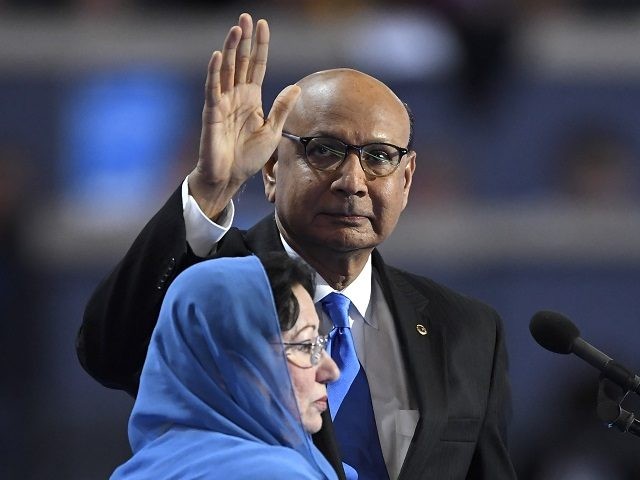
Khan and his wife Ghazala Khan both appeared on stage at the Democratic National Convention to attack, on Democratic presidential nominee Hillary Clinton’s behalf, Donald Trump—the Republican nominee for president. Their son, U.S. Army Captain Humayun Khan, was killed in Iraq in 2004. Khizr Khan, in his speech to the DNC, lambasted Donald Trump for wanting to temporarily halt Islamic migration to America from countries with a proven history of exporting terrorists.
Since then, Clinton operative George Stephanopoulos—who served as a senior adviser to the president in Bill Clinton’s White House and is a Clinton Foundation donor as well as a host on the ABC network—pushed Trump on the matter in an interview. Trump’s comments in that interview have sparked the same mini-rebellion inside his party, in the media and across the aisle that has happened many times before. The usual suspects inside the GOP, from former Florida Gov. Jeb Bush to Sen. Lindsey Graham (R-SC) to House Speaker Paul Ryan to Senate Majority Leader Mitch McConnell to Ohio Gov. John Kasich, have condemned Trump in one way or another. The media condemnation has been swift and Democrats, as well their friends throughout media, are driving the train as fast as they can.
Video: FBI interviews Clinton in email probe: campaign
But until now, it looked like the Khans were just Gold Star parents who the big bad Donald Trump attacked. It turns out, however, in addition to being Gold Star parents, the Khans are financially and legally tied deeply to the industry of Muslim migration–and to the government of Saudi Arabia and to the Clintons themselves.
Khan, according to Intelius as also reported by Walid Shoebat, used to work at the law firm Hogan Lovells, LLP, a major D.C. law firm that has been on retainer as the law firm representing the government of Saudi Arabia in the United States for years. Citing federal government disclosure forms, the Washington Free Beacon reported the connection between Saudi Arabia and Hogan Lovells a couple weeks ago.
“Hogan Lovells LLP, another U.S. firm hired by the Saudis, is registered to work for the Royal Embassy of Saudi Arabia through 2016, disclosures show,” Joe Schoffstall of the Free Beacon reported.
The federal form filed with the Department of Justice is a requirement under the Foreign Agents Registration Act of 1938, which makes lobbyists and lawyers working on behalf of foreign governments and other agents from abroad with interests in the United States register with the federal government.
The government of Saudi Arabia, of course, has donated heavily to the Clinton Foundation.
“The Kingdom of Saudi Arabia has given between $10 and $25 million to the foundation while Friends of Saudi Arabia has contributed between $1 and $5 million,” Schoffstall wrote.
Trump, of course, has called on Hillary Clinton to have the Clinton Foundation return the money.
“Saudi Arabia and many of the countries that gave vast amounts of money to the Clinton Foundation want women as slaves and to kill gays,” Trump wrote in a Facebook post back in June, according to Politico. “Hillary must return all money from such countries!”
“Crooked Hillary says we must call on Saudi Arabia and other countries to stop funding hate,” Trump posted in a separate Facebook posting at the time. “I am calling on her to immediately return the $25 million plus she got from them for the Clinton Foundation!”
Of course, to this day, Hillary Clinton and her Clinton Foundation has kept the money from the Saudi Arabian government.
Schoffstall’s piece in the Washington Free Beacon also notes how Hogan Lovells lobbyist Robert Kyle, per Federal Election Commission (FEC) records, has bundled more than $50,000 in donations for Clinton’s campaign this year.
Khan’s connections with the Hogan Lovells firm run deep, according to a report from Law.com written by Katelyn Polantz.
“Many lawyers at Hogan Lovells remember the week in 2004 when U.S. Army Capt. Humayun Khan lost his life to a suicide bomber,” Polantz wrote. “Then-Hogan & Hartson attorneys mourned the death because the soldier’s father, Khizr Khan, a Muslim American immigrant, was among their beloved colleagues.”
Polantz wrote that Khan worked at the mega-D.C. law firm for years.
“Khan spent seven years, from 2000 to 2007, in the Washington, D.C., office of then-Hogan & Hartson,” Polantz wrote. “He served as the firm’s manager of litigation technology. Although he did not practice law while at Hogan, Khan was well versed in understanding the American courts system. On Thursday night, he described his late son dreaming of becoming a military lawyer.”
But representing the Clinton Foundation backing Saudi Arabian government and having one of its lobbyists bundle $50,000-plus for Clinton’s campaign are hardly the only places where the Khan-connected Hogan Lovells D.C. mega-firm brush elbows with Clinton Cash. 
The firm also handles Hillary Clinton’s taxes and is deeply connected with the email scandal whereby when she was Secretary of State, Hillary Clinton set up a home-brew email server system that jeopardized classified information handling and was “extremely careless” according to FBI director James Comey.
“A lawyer at Hogan & Hartson [Howard Topaz] has been Bill and Hillary Clinton’s go-to guy for tax advice since 2004, according to documents released Friday by Hillary Clinton’s campaign,” The American Lawyer’s Nate Raymond wrote in 2008, as Hillary Clinton ran for president that year. “The Clintons’ tax returns for 2000-07 show combined earnings of $109 million, on which they paid $33 million in taxes. New York-based tax partner Howard Topaz has a broad tax practice, and also regularly advises corporations on M&A and executive compensation.”
Breitbart News’ Patrick Howley, in a deep investigative piece on Hillary Clinton’s email scandal, late last year uncovered how Topaz’s firm—which employed Khan while Topaz did Hillary Clinton’s taxes—is also connected to the email scandal.
“Topaz was a partner at Hogan & Hartson, which later merged to become known as Hogan Lovells, where Topaz continues to practice. The firm’s lawyers were major donors to Hillary Clinton’s first presidential campaign,” Howley wrote.
For her private email system, Clinton used a spam filtering program MX Logic.
“Hogan & Hartson handled the patent for MX Logic’s email-filtering program, which McAfee bought the small company for $140 million in 2009 in order to acquire,” Howley wrote. “The MX Logic company’s application for a trademark for its SPAMTRAQ program was filed in 2004 on Hogan & Hartson stationery and signed by a Hogan & Hartson attorney. Hogan & Hartson has been responsible for MX Logic annual reports. The email company’s Clinton links present more evidence that Clinton’s political and legal establishment was monitoring her private email use.”
If that all isn’t enough, that same Hogan & Hartson law firm—now Hogan Lovells—employed Loretta Lynch, the current Attorney General of the United States. Lynch infamously just a few weeks ago met with Bill Clinton, Hillary’s husband and the former president, on her private jet in Phoenix just before clearing Hillary Clinton of any wrongdoing when it came to her illicit private email server system.
Khan’s own website for his own personal law firm KM Khan Law Office shows he represents clients in the business of buying visas to enter the United States. One of his specific areas of practice, according to the website, is “E2 Treaty Investors, EB5 Investments & Related Immigration Services.”
Sen. Chuck Grassley, the chairman of the U.S. Senate’s Judiciary Committee, has detailed how the EB5 immigration program is “riddled with flaws and corruption.”
“Maybe it is only here on Capitol Hill—on this island surrounded by reality—that we can choose to plug our ears and refuse to listen to commonly accepted facts,” Grassley said in a statement earlier this year. “The Government Accountability Office, the media, industry experts, members of congress, and federal agency officials, have concurred that the program is a serious problem with serious vulnerabilities. Allow me to mention a few of the flaws.”
From there, Sen. Grassley listed out several of the “flaws” with the EB5 immigration program that Khan works in:
– Investments can be spent before business plans are approved. 
– Regional Center operators can charge exorbitant fees of foreign nationals in addition to their required investments.  
– Jobs created are not “direct” or verifiable jobs but rather are “indirect” and based on estimates and economic modeling.
– Jobs created by U.S. investors are counted by the foreign national when obtaining a green card, even if EB-5 money is only a fraction of the total invested.
– Investment funds are not adequately vetted. 
– Gifts and loans are acceptable sources of funds from foreign nationals.
– The investment level has been stagnant for nearly 25 years.
– There’s no prohibition against foreign governments owning or operating regional centers or projects.
– Regional centers can be rented or sold without government oversight or approval.
– Regional centers don’t have to certify that they comply with securities laws.  
– There’s no oversight of promoters who work overseas for the regional centers.
– There’s no set of sanctions for violations, no recourse for bad actors.
– There are no required background checks on anyone associated with a regional center.
– Regional centers draw Targeted Employment Area boundaries around poor areas in order to come in at a lower investment level, yet the jobs created are not actually created in those areas.
– Every Targeted Employment Area designation is rubberstamped by the agency.
– Adjudicators are pressured to get to a yes, especially for those politically connected. 
– Visas are not properly scrutinized. 
– Visas are pushed through despite security warnings.
– Files and applications lack basic and necessary information to monitor compliance.
– The agency does not do site visits for each and every project.
– There’s no transparency on how funds are spent, who is paid, and what investors are told about the projects they invest in.
That’s not to mention the fact that, according to Sen. Grassley, there have been serious national security violations in connection with the EB5 program that Khan works in and around already. In fact, the program—according to Grassley—was used by Middle Eastern operatives from Iran to attempt to illicitly enter the United States.
“There are also classified reports that detail the national security, fraud and abuse. Our committee has received numerous briefings and classified documents to show this side of the story,” Grassley said in the early February 2016 statement. “The enforcement arm of the Department of Homeland Security wrote an internal memo that raises significant concerns about the program. One section of the memo outlines concerns that it could be used by Iranian operatives to infiltrate the United States. The memo identifies seven main areas of program vulnerability, including the export of sensitive technology, economic espionage, use by foreign government agents and terrorists, investment fraud, illicit finance and money laundering.”
Maybe all of this is why–as Breitbart News has previously noted–the Democratic National Convention made absolutely no mention of the Clinton Foundation or Clinton Global Initiative. Hillary Clinton’s coronation ceremony spent exactly zero minutes of the four nights of official DNC programming talking about anything to do with perhaps one of the biggest parts of her biography.

Tuesday, May 31, 2016

The Fascinating Story Of How The Petrodollar Was Born And Lived In Secrecy For Over 40 Years

Tyler Durden's picture

http://www.zerohedge.com/news/2016-05-31/secret-story-how-saudi-petrodollar-deal-was-born
For decades, the story of Saudi Arabia recycling petrodollars, i.e., funding the US deficit by buying US Treasuries with proceeds of its crude oil sales (mostly to the US), while the US sweetened the deal by providing the Saudis with military equipment and supplies, remained entirely in the conspiracy realm, with no confirmation or official statement from the US Treasury department.
Now, that particular "theory" becomes the latest fact, thanks to a fascinating story by Bloomberg which gives the background and details of secret meeting between then-US Treasury secretary William Simon and his deputy, Gerry Parsky, and members of the Saudi ruling elite, and lays out the history of how the petrodollar was born.
Here is the background:
It was July 1974. A steady predawn drizzle had given way to overcast skies when William Simon, newly appointed U.S. Treasury secretary, and his deputy, Gerry Parsky, stepped onto an 8 a.m. flight from Andrews Air Force Base. On board, the mood was tense. That year, the oil crisis had hit home. An embargo by OPEC’s Arab nations—payback for U.S. military aid to the Israelis during the Yom Kippur War—quadrupled oil prices. Inflation soared, the stock market crashed, and the U.S. economy was in a tailspin.

Officially, Simon’s two-week trip was billed as a tour of economic diplomacy across Europe and the Middle East, full of the customary meet-and-greets and evening banquets. But the real mission, kept in strict confidence within President Richard Nixon’s inner circle, would take place during a four-day layover in the coastal city of Jeddah, Saudi Arabia.

The goal: neutralize crude oil as an economic weapon and find a way to persuade a hostile kingdom to finance America’s widening deficit with its newfound petrodollar wealth. And according to Parsky, Nixon made clear there was simply no coming back empty-handed. Failure would not only jeopardize America’s financial health but could also give the Soviet Union an opening to make further inroads into the Arab world.

It “wasn’t a question of whether it could be done or it couldn’t be done,” said Parsky, 73, one of the few officials with Simon during the Saudi talks
As noted above, the framework of the required deal was simple: the U.S. would buy oil from Saudi Arabia and provide the kingdom military aid and equipment. In return, the Saudis would plow billions of their petrodollar revenue back into Treasuries and finance America’s spending.
The man leading the US negotiation, US Treasury Secretary William Simon, had just done a stint as Nixon’s energy czar, and "seemed ill-suited for such delicate diplomacy. Before being tapped by Nixon, the chain-smoking New Jersey native ran the vaunted Treasuries desk at Salomon Brothers. To career bureaucrats, the brash Wall Street bond trader—who once compared himself to Genghis Khan—had a temper and an outsize ego that was painfully out of step in Washington. Just a week before setting foot in Saudi Arabia, Simon publicly lambasted the Shah of Iran, a close regional ally at the time, calling him a “nut.”
But Simon, better than anyone else, understood the appeal of U.S. government debt and how to sell the Saudis on the idea that America was the safest place to park their petrodollars. With that knowledge, the administration hatched an unprecedented do-or-die plan that would come to influence just about every aspect of U.S.-Saudi relations over the next four decades (Simon died in 2000 at the age of 72).
In the beginning it wasn't easy: "it took several discreet follow-up meetings to iron out all the details, Parsky said."
But at the end of months of negotiations, Bloomberg writes, there remained one small, yet crucial, catch: King Faisal bin Abdulaziz Al Saud demanded the country’s Treasury purchases stay “strictly secret,” according to a diplomatic cable obtained by Bloomberg from the National Archives database."
The secret remains... until May 16 when the US Treasury for the first time ever revealed the full extent of Saudi TSY holdings.


Bloomberg adds that with a handful of Treasury and Federal Reserve officials, the secret was kept for more than four decades—until now. "In response to a Freedom-of-Information-Act request submitted by Bloomberg News, the Treasury broke out Saudi Arabia’s holdings for the first time this month after “concluding that it was consistent with transparency and the law to disclose the data,” according to spokeswoman Whitney Smith. The $117 billion trove makes the kingdom one of America’s largest foreign creditors."
The TIC data released later that day confirmed the FOIA response.
To be sure, as we commented in mid-May, it is very likely that the Treasury report is incomplete, and that the Saudis also own hundreds of billions in Treasurys held in custody with offshore trading centers such as Euroclear. After all, the current tally represents just 20 percent of its $587 billion of foreign reserves, well below the two-thirds that central banks typically keep in dollar assets
What’s more, the commitment to the decades-old policy of “interdependence” between the U.S. and Saudi Arabia, which arose from Simon’s debt deal and ultimately bound together two nations that share few common values, is showing signs of fraying. America has taken tentative steps toward a rapprochement with Iran, highlighted by President Barack Obama’s landmark nuclear deal last year. The U.S. shale boom has also made America far less reliant on Saudi oil.
Needless to say, the real total notional amount of Saudi holdings will eventually become known, especially if the middle-eastern nation follows through with its threat of liquidating some or all of them.  What is more notable, however, is that with the first disclosure of this data since the birth of the petrodollar, something appears to have changed:
What’s more, the commitment to the decades-old policy of “interdependence” between the U.S. and Saudi Arabia, which arose from Simon’s debt deal and ultimately bound together two nations that share few common values, is showing signs of fraying. America has taken tentative steps toward a rapprochement with Iran, highlighted by President Barack Obama’s landmark nuclear deal last year. The U.S. shale boom has also made America far less reliant on Saudi oil.

“Buying bonds and all that was a strategy to recycle petrodollars back into the U.S.,” said David Ottaway, a Middle East fellow at the Woodrow Wilson International Center in Washington. But politically, “it’s always been an ambiguous, constrained relationship.”
One thing that certainly changed is that in a world where central banks are ravenously buying up each others' (and their own) debt, the need for Petrodollar recyclers such as Saudi Arabia is no longer there. But that was not always the case:
[B]ack in 1974, forging that relationship (and the secrecy that it required) was a no-brainer, according to Parsky, who is now chairman of Aurora Capital Group, a private equity firm in Los Angeles. Many of America’s allies, including the U.K. and Japan, were also deeply dependent on Saudi oil and quietly vying to get the kingdom to reinvest money back into their own economies.

"Everyone—in the U.S., France, Britain, Japan—was trying to get their fingers in the Saudis’ pockets,” said Gordon S. Brown, an economic officer with the State Department at the U.S. embassy in Riyadh from 1976 to 1978. For the Saudis, politics played a big role in their insistence that all Treasury investments remain anonymous.
America's reliance on Saudi Arabia to fund its deficit - and obtain a cheap price for oil - meant that the kingdom would be granted Platinum status in every form of interaction with the US.
Tensions still flared 10 months after the Yom Kippur War, and throughout the Arab world, there was plenty of animosity toward the U.S. for its support of Israel. According to diplomatic cables, King Faisal’s biggest fear was the perception Saudi oil money would, “directly or indirectly,” end up in the hands of its biggest enemy in the form of additional U.S. assistance.

Treasury officials solved the dilemma by letting the Saudis in through the back door. In the first of many special arrangements, the U.S. allowed Saudi Arabia to bypass the normal competitive bidding process for buying Treasuries by creating “add-ons.” Those sales, which were excluded from the official auction totals, hid all traces of Saudi Arabia’s presence in the U.S. government debt market.

“When I arrived at the embassy, I was told by people there that this is Treasury’s business,” Brown said. “It was all handled very privately.”

* * *
Another exception was carved out for Saudi Arabia when the Treasury started releasing monthly country-by-country breakdowns of U.S. debt ownership. Instead of disclosing Saudi Arabia’s holdings, the Treasury grouped them with 14 other nations, such as Kuwait, the United Arab Emirates and Nigeria, under the generic heading “oil exporters”—a practice that continued for 41 years.
Meanwhile, Saudi Arabia continued buying: by 1977, Saudi Arabia had accumulated about 20 percent of all Treasuries held abroad, according to The Hidden Hand of American Hegemony: Petrodollar Recycling and International Markets by Columbia University’s David Spiro.

The deal led to assorted headaches: "an internal memo, dated October 1976, detailed how the U.S. inadvertently raised far more than the $800 million it intended to borrow at auction. At the time, two unidentified central banks used add-ons to buy an additional $400 million of Treasuries each. In the end, one bank was awarded its portion a day late to keep the U.S. from exceeding the limit.
Most of these maneuvers and hiccups were swept under the rug, and top Treasury officials went to great lengths to preserve the status quo and protect their Middle East allies as scrutiny of America’s biggest creditors increased.

Over the years, the Treasury repeatedly turned to the International Investment and Trade in Services Survey Act of 1976—which shields individuals in countries where Treasuries are narrowly held—as its first line of defense.

The strategy continued even after the Government Accountability Office, in a 1979 investigation, found “no statistical or legal basis” for the blackout. The GAO didn’t have power to force the Treasury to turn over the data, but it concluded the U.S. “made special commitments of financial confidentiality to Saudi Arabia” and possibly other OPEC nations.

Simon, who had by then returned to Wall Street, acknowledged in congressional testimony that “regional reporting was the only way in which Saudi Arabia would agree” to invest using the add-on system.
Ultimately, Saudi dominance in the US Treasury market meant they were untouchable. "It was clear the Treasury people weren’t going to cooperate at all,” said Stephen McSpadden, a former counsel to the congressional subcommittee that pressed for the GAO inquiries. “I’d been at the subcommittee for 17 years, and I’d never seen anything like that."
Today, Parsky says the secret arrangement with the Saudis should have been dismantled years ago and was surprised the Treasury kept it in place for so long. But even so, he has no regrets. Doing the deal “was a positive for America”, he says cited by Bloomberg.
And with that the story of how the Petrodollar was born is now public information, something which Saudi Arabia may not be too happy with. For the sake of the US, it better have its ducks in order because the release of this story simply means that the US Treasury is confident it will no longer have a strategic need for its long-time Saudi partner. The Fed, which has implicitly stepped into the Saudi role, better not disappoint.

In Its First Ever Bond Sale, A Cash-Starved Saudi Arabia Is Looking To Issue $15 Billion

Tyler Durden's picture


http://www.zerohedge.com/news/2016-05-31/its-first-ever-bond-sale-cash-starved-saudi-arabia-looking-issue-15-billion
Last week the bond market was stunned by the unprecedented demand for sovereign paper issued by the middle-eastern nation of Qatar, which announced it would issue $9 billion in Eurobonds (in three maturities), more than double what had been originally expected by the market, and well below the total demand for Qatar sovereign paper: according to Reuters, the issue was massively oversubscribed, with over $23 billion in soft orders.
Some were concerned that this massive bond issuance would "reprice" the local bond market and put on hold any new incremental issuance by Qatar's neighbors, most notably Saudi Arabia, which has been very vocal about its own intentions to sell debt in the coming weeks and which, in light of its surging budget deficit ballooning as a result of persistently low oil prices, desperately needs an outside cash infusion.
We said that these concerns were materially overblown as Qatar was merely the latest example of the scramble for yield in the current "risk on" environment, and if anything Qatar's sale demonstrated that any attempt by Saudi Arabia to fund its budget needs would be ridiculously easy.
Sure enough, this was confirmed just days later when earlier today Bloomberg reported that Saudi Arabia is considering the sale of as much as $15 billion of bonds this year, "encouraged by investor demand for Qatar’s recent issue" citing people with knowledge of the matter said.
The details: Saudi Arabia is weighing a sale of $10 billion to $15 billion after the end of Ramadan in July, adding no final decision has been made and the discussions are still at a preliminary stage. It would be Saudi Arabia’s first bond sale in international capital markets. We think that absent another global market swoon, the final notional amount issued will be well greater than "only" $15 billion.
While Saudi Arabia is still sitting on nearly $600 billion in foreign-exchange reserves, the country has burned through $140 billion in reserves since the end of 2014. And the IMF warned the Saudis could eventually run out of cash.
This is not Saudi Arabia's first recent approach to capital markets: in April the kingdom raised a $10 billion loan from a group of banks, its first loan in 25 years. Last year, the Saudis tapped the local bond market for the first time in eight years, raising at least $4 billion.
But this would be the first time Saudi Arabia has issued international bonds. And it will be a whopper.
CNN also quotes John Sfakianakis, a former official in Saudi Arabia's Ministry of Finance who said the sale would likely take place over the next several months. "There is a need to cover the fiscal gap," said Sfakianakis, who is currently director of economic research at the Gulf Research Center in Riyadh, Saudi Arabia. "It's better for this money to come from other sources than reserve assets because as they get depleted that places a bigger risk over the medium to long-term."
Bloomberg adds that Saudi Arabia has invited banks to arrange the bond sale. The country expects to issue a “significant” amount, the people said at the time, without giving more details.
Saudi Arabia's move is hardly a surprise: the country is merely taking advantage of an unprecedented bond bubble inflated by global central banks, where $9.9 trillion in sovereign paper is now trading with negative yields.
As a result, governments in the six-nation Gulf Cooperation Council, which includes the two-biggest Arab economies of Saudi Arabia and the United Arab Emirates, are turning to public markets to raise funds after a plunge in oil prices led to higher budget deficits. Qatar last week attracted $23 billion in orders for its $9 billion sale, the biggest-ever bond issue from the Middle East. Abu Dhabi raised $5 billion from the sale of five and 10 year securities in April.
Some more:
The debut bond will follow the country’s first loan in at least 15 years as it seeks to fill a budget hole estimated at about $100 billion this year. Saudi Arabia sealed a $10 billion facility in April, three people with knowledge of the matter said at the time.

The country also hired HSBC Holdings Plc banker Fahad Al Saif to start a debt management office that will be responsible for the international bond sale, two separate people with knowledge of the matter said this week. Al Saif joined the Ministry of Finance on an open-ended secondment from HSBC’s Saudi British Bank, the people said.

The country is undergoing its biggest-ever economic shakeup, led by Deputy Crown Prince Mohammed bin Salman, as it prepares for the post-oil era following the plunge in crude prices that started in 2014. One of the government’s biggest challenges will be navigating the worst economic slowdown since the global financial crisis as authorities cut spending to plug a budget deficit that reached about 15 percent of gross domestic product in 2015.
The biggest irony here is that while Saudi Arabia has been implicitly fighting the Fed (and other central banks), who have generously funded the US shale industry with hundreds of billions in junk bonds over the past decade, the same industry of "high cost producers" that Saudi Arabia is eager to put out of business indefinitely, it is the same Fed that is coming to Saudi's rescue now by stoking demand for any deficit-funding paper Saudi Arabia may and will issue.
The good news for Saudi Arabia is that the new debt funds will be promptly used to address gaping fiscal holes in the Saudi economy: Moody's recently warned of the social impact of policy reforms in Saudi Arabia and other Gulf countries where "governments are under pressure to continue redistributing oil revenues to their populations to avoid economic-related civil unrest."
But what the inevitable record bond issuance out of Saudi Arabia means, is that the deflationary pressure on oil will persist, as the largest crude oil exporter will not need to rationalize oil supply for the foreseeable future by cutting supply to boost prices. Instead, Saudi can simply fund its budget shortfall by appealing to the same bond investors who are keeping shale afloat, while maintaining its strategy of keeping the oil market continuously oversupplied.

Wednesday, May 18, 2016

True Center of Radical Islamic Extremism - Close American Ally Saudi Arabia

The "U.S. and its allies ... have stimulated these radical Islamist developments throughout the Islamic world for a long time."
http://www.alternet.org/world/noam-chomsky-true-center-radical-islamic-extremism-close-american-ally-saudi-arabia
Photo Credit: Wikimedia Commons/jeanbaptisteparis
In an interview with Democracy Now, Chomsky says that Saudi Arabia is a "a source of not only funding for extremist radical Islam and the jihadi outgrowths of it, but also, doctrinally, mosques, clerics and so on, schools, you know, madrassas, where you study just Qur’an, is spreading all over the huge Sunni areas from Saudi influence."

AMY GOODMAN: We’re on the road in Chicago, Illinois. I’m Amy Goodman, as we continue Part 2 of our conversation with world-renowned political dissident, linguist, author, Noam Chomsky, institute professor emeritus at the Massachusetts Institute of Technology, where he’s taught for more than half a century. His latest book, Who Rules the World? I asked him to talk about Saudi Arabia’s role in the Middle East.
NOAM CHOMSKY: Well, there’s a long history. The basic story is that the United States, like Britain before it, has tended to support radical Islamism against secular nationalism. That’s been a consistent theme of imperial strategy for a long time. Saudi Arabia is the center of radical Islamic extremism. Patrick Cockburn, one of the best commentators and most knowledgeable commentators, has correctly pointed out that what he calls the Wahhibisation of Sunni Islam, the spread of Saudi extremist Wahhabi doctrine over Sunni Islam, the Sunni world, is one of the real disasters of modern—of the modern era. It’s a source of not only funding for extremist radical Islam and the jihadi outgrowths of it, but also, doctrinally, mosques, clerics and so on, schools, you know, madrassas, where you study just Qur’an, is spreading all over the huge Sunni areas from Saudi influence. And it continues. Saudi Arabia itself has one of the most grotesque human rights records in the world. The ISIS beheadings, which shock everyone—I think Saudi Arabia is the only country where you have regular beheadings. That’s the least of it. Women have no—can’t drive, so on and so forth. And it is strongly backed by the United States and its allies, Britain and France. Reason? It’s got a lot of oil. It’s got a lot of money. You can sell them a lot of arms, I think tens of billions of dollars of arms. And the actions that it’s carrying out, for example, in Yemen, which you mentioned, are causing an immense humanitarian catastrophe in a pretty poor country, also stimulating jihadi terrorism, naturally, with U.S. and also British arms. French are trying to get into it, as well.
This is a very ugly story. Saudi Arabia—Saudi Arabia itself, its economy—its economy is based not only on a wasting resource, but a resource which is destroying the world. There’s reports now that it’s trying to take some steps to—much belated steps; should have been 50 years ago—to try to diversify the economy. It does have resources that are not destructive, like sunlight, for example, which could be used, and is, to an extent, being used for solar power. But it’s way too late and probably can’t be done. But it’s a—it has been a serious source of major global problems—a horrible society in itself, in many ways—and the U.S. and its allies, and Britain before it, have stimulated these radical Islamist developments throughout the—throughout the Islamic world for a long time.
AMY GOODMAN: Do you think Obama has dealt with Saudi Arabia any differently than President Bush before him?
NOAM CHOMSKY: Not in any way that I can see, no. Maybe in nuances.

Tuesday, May 17, 2016

Senate Passes Bill That Would Expose Saudi Arabia's Role In Sept. 11: Obama Veto Imminent

Tyler Durden's picture

http://www.zerohedge.com/news/2016-05-17/obama-veto-imminent-after-senate-passes-bill-would-expose-saudi-arabias-role-sept-11
After a month-long scare campaign waged by Saudi Arabia, and in no small part the Obama administration, which went so far as to threaten it would dump its US Treasurys (which the NYT previously had quantified as $750 billion however which the Treasury just yesterday disclosed for the first time in 41 years as only $117 billion suggesting the Saudis would likely also have to sell US stocks and any other US-denominated assets), if the US were to pass a bill that would hold it legally liable for the Sept 11 attacks, it will be up to Obama to veto the bill because moments ago the Senate unanimously passed said bill, bringing Congress closer to a showdown with the White House, which has threatened to veto the legislation.
The Senate’s passage of the bill, which will now be taken up in the House, is another sign of escalating tensions in a relationship between the United States and Saudi Arabia that once received little scrutiny from lawmakers.
As reported a month ago, the Obama administration has urgently lobbied against the bill, and the Saudi government has warned that if the legislation passes it might begin liquidating its USD reserves. Adel al-Jubeir, the Saudi foreign minister, delivered the warning to lawmakers and administration officials while in Washington in March.
Many economists are skeptical that the Saudis would deliver on such a warning, saying that the sell-off would be hard to execute and would do more harm to the kingdom’s economy than to America’s.
As the NYT reports, questions about the role Saudi officials might have played in the terror plot have lingered for more than a decade, and families of the Sept. 11 victims have used various lawsuits to try to hold members of the Saudi royal family and charities liable for what they allege is financial support for terrorism. But these moves have been mostly blocked, in part because of a 1976 law that gives foreign nations some immunity from suits in American courts.
But the Senate bill carves out an exception to the law if foreign countries are found culpable for terrorist attacks that kill American citizens inside the United States. If the bill were to pass both houses of Congress and be signed by the president, it could clear a path for the role of the Saudi government to be examined in the Sept. 11 lawsuits.
The administration has warned that any weakening of the sovereign immunity law could put American troops, civilians and corporations at legal risk if other nations decide to retaliate with their own legislation. Josh Earnest, a White House spokesman, said last month that President Obama would veto the bill if it reached his desk in its current form.
Earnest repeated the same warning moments ago, which means that if the House endorses the Senate bill, Obama will be put in the unpleasant spot of having to veto a bill which to many Americans is a critical milestone in figuring out if Saudi Arabia was indeed behind the September 11 bombings, and further lead to questions why Obama is defending a Wahhabist regime which has been repeatedly implicated in the biggest terrorist attack on US soil, and flagrantly rejecting to follow the will of the US electorate.


The FBI Tried To Suppress 80,000 Documents On Saudi Ties To 9/11

Tyler Durden's picture

http://www.zerohedge.com/news/2016-05-17/fbi-tried-suppress-80000-documents-saudi-ties-911

Submitted by Carey Wedler via TheAntiMedia.org,
The classified 28-pages of the 9/11 report have made global headlines lately as a handful of lawmakers battle to release them to the public. Those pages are believed by activists and members of Congress — who have seen them — to expose the role of Saudi Arabia, including government officials, in the terrorist attacks.
But according to a new report based on years of investigative journalism, it turns out there are far more than 28 classified pages on Saudi Arabia and 9/11 — there are 80,000 kept secret by the FBI. And though not all 80,000 are expected to concern the Saudi family — and the FBI insists their investigation of the documents came up empty-handed — journalists, at least one lawmaker, and heavily-redacted documents suggest otherwise.
As the Daily Beast reported, the discovery of the 80,000 pages came when Irish investigative journalists Anthony Summers and Robbyn Swan were contacted by an unnamed counterterrorism official in 2011. The reporters were preparing to publish a book on the 10th anniversary of the terror attacks and were told  by the source that a Saudi family who had been living in Sarasota, Florida, prior to the attacks had connections to the attackers. Specifically, they were linked to Mohamed Atta, the Egyptian terrorist widely recognized as the ringleader of the attacks.
The unnamed official’s tip conflicted squarely with the FBI’s prior conclusions on that family. Abdulazzi al-Hiijjii, his wife Anoud, and their three small children lived in an upscale Sarasota community, along with Anoud’s father, Esam Ghazzawi, a financier and interior designer, who owned the home, and Ghazzawai’s American-born wife. The FBI had received multiple calls from the family’s neighbors expressing concerns over erratic behavior. Two weeks before 9/11, they left the house in a huge hurry, leaving dirty diapers and toys strewn about, a fully stocked refrigerator, and three cars in the driveway.
Though the FBI opened an investigation in April 2002, it still insists it never found any significant connection between the family and Atta. The agency acknowledged they had suspected a connection, but “not until after the Tampa field office opened an investigation that claimed to find ‘numerous connections’ between the family and the 9/11 hijackers,” the Daily Beast explained. The 80,000 classified pages in question stemmed from that investigation.
The FBI says “the bureau’s own agents did initially suspect the family was linked to some of the hijackers.” But “on further scrutiny, those connections proved unfounded, officials now say.”
But Summers and Swan contacted Dan Christensen, a veteran Florida reporter, and together they published an exposé on these connections in Sarasota in September 2011. As they reported, following the 9/11 attacks:
[L]aw enforcement agents not only discovered the home was visited by vehicles used by the hijackers, but phone calls were linked between the home and those who carried out the death flights — including leader Mohamed Atta — in discoveries never before revealed to the public.”
They were also never revealed to lawmakers. The 2011 story caught the attention of Bob Graham, a Florida Democrat who has since led the campaign to release the 28 pages on the Saudi connection, which are said to contain information showing Saudi government officials were involved in orchestrating the attack.
At the time, he said the journalists had “open[ed] the door to a new chapter of investigation as to the depth of the Saudi role in 9/11.” Graham attempted to view some of the documents, and told the Daily Beast (for a forthcoming article) they did show a connection between the family and three hijackers. He was soon after confronted by then-deputy director of the FBI, Sean Joyce. According to Graham, he said, “Basically everything about 9/11 was known and I was wasting my time and I should get a life.”
Christensen filed a Freedom of Information Act request in the hopes of either confirming or refuting their original reporting. Thomas Julin, his lawyer, said the FBI initially denied having any records. When Graham said he was willing to testify he had seen some, the Department of Justice conveniently admitted to having 35 relevant pages. They released them, but they were heavily redacted. In spite of the overt censorship guarding that information, they reportedly still made clear the FBI had suspicions about the family — and that they had found several connections between them and the hijackers. The pages also include the FBI’s dismissals of those suspicions.
U.S. District Court Judge William Zloch, who presided over the Freedom of Information case, was unconvinced and demanded the FBI conduct another search of its records. This time,“the FBI found some additional responsive documents which it produced,” Juline told the Daily Beast. “But it also found 80,266 pages of material in the Tampa Field Office of the FBI which had been marked with the file number for the FBI’s PENTTBOM investigation.”
PENTTBOM was the FBI term for its investigation into the 9/11 attacks. Though the New York Post had previously reported on these 80,000 pages, the DoJ’s small release of documents clarified suspicions. Zloch ordered the FBI to hand over all the documents in May 2014 — and he is still going through them to determine which pages can be released. He has given no indication of when he will be finished.
The Daily Beast explained “Zloch’s task is made all the more painstaking by the strict security rules governing review of classified documents, even for a sitting judge. The files are kept in a secure facility, and he can only remove a portion at a time.
It remains unclear how many of the 80,000 pages pertain directly to the Tampa FBI field office’s investigation of the family in Sarasota — and their ties to the attackers. Though Christensen says he’s ready to be proven wrong, he believes “those files will reveal the underlying reasons for the FBI’s early suspicions.
As the Daily Beast laid out:
The FBI, for instance, says that phone records searches showed no links to the house and the hijackers. Christensen’s confidential source says the opposite is true. If the FBI is right, Christensen asks, then why not just release the information and put the dispute to rest?
The FBI has attempted to discredit the pages, claiming the agent who filed the first reports on the family and their potential connection to the hijackers was “not a good writer and should not be taken as the last word,” according to Graham. However, that agent was promoted shortly after 9/11, casting doubt on assertions they were incompetent.
In a similar evasion of accountability, President Obama vowed to block a legislative effort to release the 28 pages amid pressure from the Saudi Arabian government, which threatened to remove $750 billion in American assets should the legislation pass. The president cited concerns that allowing families of 9/11 victims to sue a foreign government could, in turn, open the United States government up to prosecution, itself. The White House has since indicated it intends to release part of the 28 pages.
Though Julin says the 28 pages likely aren’t linked to the Sarasota Saudi family, he hopes their eventual release “might help Judge Zloch see the wider significance of the events in Sarasota and persuade him that some or all of the records have not been properly classified.
Last week, a former member of the 9/11 commission said he believes six Saudi officials supported the 9/11 hijackers. John F. Lehman said Wednesday,There was an awful lot of participation by Saudi individuals in supporting the hijackers, and some of those people worked in the Saudi government,” he said. “Our report should never have been read as an exoneration of Saudi Arabia.”
The FBI’s trove of documents also requires further examination. Julin dismissed suspicions Judge Zloch is intentionally lagging in his investigation of the 80,000 pages. “I believe this is not a stalling tactic at all,” he said. “The judge is doing what he has to comply” with the stringent rules surrounding the release of the classified documents. “But I would urge him to speed it up,” he said.

Tuesday, May 10, 2016

Disturbing Claim – FBI Interrogated Former Senator for Wanting “28 Pages” Declassified

Submitted by Mike Krieger via Liberty Blitzkrieg blog,
While extremely disturbing, I can’t say the following is particularly surprising.
Rep. Brad Sherman (D-Calif.) is criticizing the Obama administration as having tried to strong-arm a former senator who is pushing to declassify 28 pages of the 9/11 report dealing with Saudi Arabia.
He recounted how Rep. Gwen Graham (D-Fla.) and her father, former Senate Intelligence Committee Chairman Bob Graham (D-Fla.), were detained by the FBI in 2011 at Dulles International Airport outside Washington. The message from the agents, according to the Grahams, was to quit pushing for declassification of the 28 pages.The FBI “took a former senator, a former governor, grabbed him in an airport, hustled him into a room with armed force to try to intimidate him into taking different positions on issues of public policy and important national policy, and the fact that he wasn’t intimidated because he was calm doesn’t show that they weren’t trying to intimidate him,” Sherman said in an interview with The Hill’s Molly K. Hooper.
This actually makes perfect sense. As I highlighted in last year’s post, The New York Post Reports – FBI is Covering Up Saudi Links to 9/11 Attack:
Former Democratic Sen. Bob Graham, who in 2002 chaired the congressional Joint Inquiry into 9/11, maintains the FBI is covering up a Saudi support cell in Sarasota for the hijackers. He says the al-Hijjis’ “urgent” pre-9/11 exit suggests “someone may have tipped them off” about the coming attacks.

Graham has been working with a 14-member group in Congress to urge President Obama to declassify 28 pages of the final report of his inquiry which were originally redacted, wholesale, by President George W. Bush.
“The 28 pages primarily relate to who financed 9/11, and they point a very strong finger at Saudi Arabia as being the principal financier,” he said, adding, “I am speaking of the kingdom,” or government, of Saudi Arabia, not just wealthy individual Saudi donors.
Sources who have read the censored Saudi section say it cites CIA and FBI case files that directly implicate officials of the Saudi Embassy in Washington and its consulate in Los Angeles in the attacks — which, if true, would make 9/11 not just an act of terrorism, but an act of war by a foreign government.
This is Your Government: Protecting the criminals from the people.

Monday, May 9, 2016

Leaked: Saudi King financed Netanyahu’s 2015 election bid

Israeli Prime Minister Benjamin Netanyahu (L) and Saudi Arabia's King Salman bin Abdulaziz Al Saud © Reuters
A member of Israel's Knesset (parliament) has revealed that Saudi King Salman bin Abdulaziz Al Saud helped finance the election campaign of Israeli Prime Minister Benjamin Netanyahu in 2015.
Citing a massive leak of confidential documents dubbed the “Panama Papers,” Isaac Herzog, who is the chairman of the Israeli Labor party said, “In March 2015, King Salman has deposited eighty million dollars to support Netanyahu’s campaign via a Syrian-Spanish person named Mohamed Eyad Kayali.”
Panama Papers, which detail the offshore wealth of politicians and public figures across the globe, exposed more than 11.5 million financial and legal records earlier in April.
“The money was deposited to a company’s account in British Virgin Islands owned by Teddy Sagi, an Israeli billionaire and businessman, who has allocated the money to fund the campaign [of] Israeli Prime Minister Benjamin Netanyahu,” the lawmaker said.
In the recent past, Netanyahu has on several occasions talked of a budding relationship between Israel and Arab countries.
In March, Netanyahu said Israel's relations with regional Arab countries are “dramatically warming” in what analysts said was an acknowledgement of behind-the-scenes ties.
Moshe Ya’alon, Israel’s minister of military affairs, in February pointed to open channels between the regime and Arab states.
Ya’alon said he was unable to shake hands with Arab officials in public due to the “sensitive” political realities.
The Israeli minister later publicly shook the hand of Saudi Prince Turki bin Faisal al-Saud, who himself has openly met with a number of Israeli officials in the past.
Israel has covert ties with Arab states despite their claims that they would normalize relations with Tel Aviv only when it reaches a deal with the Palestinians. This is while the two sides “can meet in closed rooms,” according to Ya’alon.
Last month, the Jerusalem Post wrote that “rather than being isolated, Israel is being incorporated into the Saudi-led orbit.”
“Part of this includes the opening of a mission in Abu Dhabi and increasing contacts in the [Persian] Gulf States,” it said.
A former general in the Saudi military has also said recently that the kingdom would open an embassy in Tel Aviv if Israel accepted an Arab initiative to end the Israeli-Palestinian conflict.
Riyadh also maintains secret military ties with the Tel Aviv regime.
In April, Sheikh Naim Qassem, the deputy secretary general of Lebanon’s Hezbollah resistance movement, said Israel was training Saudi military forces under the framework of clandestine relations. 
Dozens of Saudi military officers were being trained following secret contacts that led to military cooperation, he said.
“The Saudis are currently fulfilling the cycle of the Israeli project in public and secret meetings,” he added.

Thursday, May 5, 2016

Why Saudi Arabia Is Suddenly in Serious Trouble

A major report is forcing Saudi Arabia to consider a future without its lifeblood: oil.
(Love and Blessings to the Common People of Saudi)
Photo Credit: Fedor Selivanov / Shutterstock.com
Saudi Arabia is in serious trouble. The Binladin Group, the kingdom’s largest construction company, has terminated the employment of fifty thousand foreign workers. They have been issued exit visas, which they have refused to honor. These workers will not leave without being paid back wages. Angry with their employer, some of the workers set fire to seven of the company’s buses.
Unrest is on the cards in the Kingdom. In April, King Salman fired the water and electricity minister Abdullah al-Hasin, who had come under criticism for high water rates, new rules over the digging of wells and cuts in energy subsidies. The restructured ministry was to save the Kingdom $30 billion—precious money for an exchequer that is spluttering from low oil prices. Eighty-six percent of Saudis say that they want the water and electricity subsidies to continue. They are not prepared to let these disappear. They see this as their right. Why, they say, should an energy rich country not provide almost free energy for its subjects?
When King Salman took over last year, he inherited a kingdom in dire straits.  Saudi Arabia’s Treasury relies upon oil sales for over ninety percent of its revenue. The population does not pay tax, so the only way to raise funds is from oil sales. As oil prices fell from $100/ barrel to $30/barrel, oil revenues for the Kingdom collapsed. Saudi Arabia lost $390 billion in anticipated oil profits last year. Its budget deficit came to $100 billion—much higher than it has been in memory. For the first time since 1991, Saudi Arabia turned to the world of private finance to raise $10 billion for a five-year loan. That this country, with a vast sovereign wealth fund, needs to borrow money to cover its bills is an indication of its fragile fundamentals.
What does a country do when it enters a period of crisis? It calls the consulting firm McKinsey. That is precisely what Saudi Arabia did. McKinsey sent its crack analysts to the Kingdom. They returned—in December 2015—with Saudi Arabia Without Oil: The Investment and Productivity Transformation. This report could have been written without a site visit. It carries all the clichés of neo-liberalism: transform the economy from a government-led to a market-led one, cut subsidies and transfer payments, and sell government assets to finance the transition. There is not one hint of the peculiar political economy and cultural context of Saudi Arabia. The report calls for a cut in Saudi Arabia’s public-sector employment and a cut in its three million low-wage foreign workers. But the entire political economy of Saudi Arabia and the culture of its Saudi subjects are reliant upon state employment for the subjects and low-wage subservience from the guest workers. To change these two pillars calls into question the survival of the monarchy. A Saudi Arabia without oil, McKinsey should have honestly said, is a Saudi Arabia without a monarchy.
What would the McKinsey transformation produce? “A productivity-led transformation,” wrote the eager analysts, “could enable Saudi Arabia to again double its [Gross Domestic Product] and create as many as six million new Saudi jobs by 2030.”
The King’s son, Mohammed Bin Salman (MbS), took McKinsey at its word. He then copied and pasted the report in his own Saudi Vision 2030. Little of Prince MbS’s statement differs from the McKinsey proposal. The eagerness of the Prince shows his lack of experience. It is unlikely that he has read Naomi Klein’s The Shock Doctrine, a full-scale assault on the idea of economic transformation. Even more unlikely that he has read Duff McDonald’s The Firm, an evisceration of McKinsey’s smoke and mirrors model. To base an entire country’s future on a McKinsey report seems reckless. But then Prince MbS has a streak of recklessness in him. He led the Saudi war on Yemen – and that has not turned out well at all. The peace talks over that war being held in Kuwait remain stalled. Saudi Arabia made almost no gains in Yemen. Should the man who led Saudi Arabia into humiliating failure in Yemen now be in charge of its economic transformation?
Saudi Arabia is a monarchy. Prince MbS has the King’s favor. His talents are measured by the King and not by the people. They will have to tolerate his shenanigans with the economy just as they have had to tolerate his failed war on Yemen.
What is Prince MbS’s Saudi Vision 2030? Despite the attempts to create some stability in the oil market, there is no indication that oil prices would be raised to safe levels anytime soon. If oil remains below $50/barrel, Saudi Arabia has to revise its own economic project. That means that Saudi Arabia will have to find new ways to create revenues. To shift from an oil-dependent economy to an industrial-tourism-finance economy will require a massive dose of investment. To secure that investment, Saudi Arabia plans to sell a small stake of its state-owned oil firm—ARAMCO. The plan is to raise at least $2 trillion from that sale and from the sale of other state assets. This money will bolster the depleted Sovereign Wealth Fund, which might otherwise run dry by 2017-2020.
The enhanced Sovereign Wealth Fund will be used to develop new industrial sectors such as petrochemicals, manufacturing at the medium scale and finance as well as tourism. Foreigners will be allowed to own property in the Kingdom and entrepreneurial activity will be encouraged by the state. How does all this happen by 2020 – the date proposed by Prince MbS—or even by 2030—the name of the Prince’s plan? Will Saudi Arabia be able to rapidly transform its population from being satisfied with receipts of oil revenues to being workers in an insecure market environment? History suggests a long period of dissatisfaction amongst the public during this kind of enormous transition. Can the Saudi royal family manage the level of anger and humiliation that this change will evoke?
The IMF’s director of Middle East and Central Asia—Masood Ahmed—is sure that the transition will work just fine. In fact, Ahmed believes that the McKinsey plan is perhaps a little too modest. What the Saudis need to do, said Ahmed, is to attract more private investment to help the diversification plan. Where will this private investment come from? Perhaps from China, which has already signed a large ($2.48 billion) nuclear deal with Saudi Arabia. The kingdom is China’s largest oil supplier. China’s Sinopec, PetroChina and Yunnan Yuntianhua work closely with ARAMCO to build oil refineries in the kingdom and on the Chinese coastline. Chinese construction companies are building the Haramain railroad that will eventually link Mecca and Madina. China is the largest trading partner of Saudi Arabia. The Binladin group will mothball some of its cranes, but that does not mean that cranes will hang over the skyline of the kingdom. Chinese construction firms are prepared to build the new infrastructural base in Saudi Arabia. Washington, if it is paying attention, must see the drift of its old ally—either into social chaos or into the Chinese orbit. No other alternative exists.

Vijay Prashad is professor of international studies at Trinity College in Hartford, Connecticut. He is the author of 18 books, including Arab Spring, Libyan Winter (AK Press, 2012), The Poorer Nations: A Possible History of the Global South (Verso, 2013) and the forthcoming The Death of a Nation and the Future of the Arab Revolution (University of California Press, 2016). His columns appear at AlterNet every Wednesday.

Monday, May 2, 2016

9/11 Commission Did Not Exonerate Saudis

By Kristen Breitweiser, one of the four 9/11 widows – known as the “Jersey Girls” – instrumental in forcing the government to form the 9/11 Commission to investigate the 2001 attacks. Follow Kristen Breitweiser on Twitter: .
Americans are not used to reading investigative pieces of journalism. We like to tweet and text in small bites. But here’s the thing. Sometimes, the most important things can’t be explained in 15 bites or less. Sometimes, it takes more space and time. And so I ask everyone who is reading this blog to please read it in its entirety — especially the bold parts. And, if you care about our country, if you care about peace, and keeping American lives safe from terrorists, pay attention to what is being said here — and never forget it.
The time has come to clarify some inaccuracies and misleading statements being made in the media regarding the 28 pages, the 9/11 attacks, the investigation of the 9/11 attacks, and the Kingdom of Saudi Arabia (KSA). In doing so, perhaps the American public will come to understand the importance of passing JASTA (Justice Against Sponsors of Terrorism Act) and releasing the 28 pages in their entirety.
The 9/11 Commission’s mandate was to not replicate, but rather to expand upon the investigation of the JICI. The JICI was the Joint Intelligence Committee’s Inquiry into the 9/11 attacks, headed by Senator Bob Graham and Congressman Porter Goss. The JICI is where the 28 pages originated. Furthermore, the JICI made a finding of fact and final recommendation that further investigation into the role of KSA and the 9/11 attacks needed to be done, immediately. Therefore, the 9/11 Commission should have carried out this further investigation of the KSA and 9/11. But, they did not. It is only the 9/11 families and intrepid journalists who have continued to investigate the Saudi role for the past twelve years.

As reported and documented in The New York Time’s national security correspondent Philip Shenon’s book, “The Commission,” Staff Director of the 9/11 Commission, Phil Zelikow, actively worked against any thorough investigation into the KSA and its role in the 9/11 attacks.
So, when two JICI staffers were brought over to the 9/11 Commission to continue their work on the links between the KSA and the 9/11 attacks, they were blocked by Zelikow. Zelikow fired one investigator when she tried to access the 28 pages as part of her further investigation and work for the commission. And, the second staffer (who was the person responsible for writing the 28 pages in the first place when he worked on the JICI) was actively thwarted from his investigation by Zelikow, as well. In fact, once the 9/11 Commission report was in its final draft form, Zelikow “re-wrote” the entire section that dealt with the Saudis—leaving out vital, highly pertinent, and extremely damning information.
Thus, when a person says the 9/11 Commission, “found no evidence linking the Saudis,” be wary of the cute context of the words. The 9/11 commission “found no evidence” because they were either never allowed to look for any evidence or whatever evidence they did find was conveniently written out of the final report, compliments of Phil Zelikow.
Why would Zelikow block his own investigation? No one knows for sure, but for starters, Zelikow was taking regular phone calls from Karl Rove whose job at the time was to ramp up the drumbeat for the war in Iraq—not a war with Saudi Arabia.
In addition, Zelikow was part of the Bush transition team and good friends with Condoleeza Rice. In fact, it was Zelikow’s job to brief the incoming Bush Administration about national security issues. It’s safe to say that the “sleeper cells” living inside the U.S., and the other facets of the Saudi nexus of help for the 9/11 hijackers was not something Zelikow was eager to delve into while on the Bush transition team or as Staff Director of the 9/11 Commission.
Had the information regarding the Saudis and 9/11 been properly and fully investigated by the 9/11 Commission, and had that investigation continued thereafter, the facts surrounding the FBI and CIA and their collective failure to prevent the 9/11 attacks, would have certainly come to further light. Let’s not forget the Director of the FBI’s unacceptable “handling” and “covering up” of several Saudi accomplices before and after the 9/11 attacks by permitting them to leave the country, evade arrest, and prosecution.
Suffice it to say, both the JICI and the 9/11 Commission clearly document that prior to the 9/11 attacks, the KSA was not as helpful as it could be with regard to providing access to al Qaeda prisoners, stopping the flow of money to UBL, and/or sharing information with regard to UBL.
But most importantly, both the JICI and the 9/11 Commission provide plenty of statements, facts, and findings that show KSA aided, abetted and had roots and connections to the 9/11 hijackers. In short, there’s likely a very good reason that the name “Saudi Arabia” appears more often in both reports than names like Iran, Syria, and Iraq.
The JICI Finding #15 states, “Regarding Saudi Arabia, the Committee heard testimony from U.S. government personnel that Saudi officials had been uncooperative and often did not act on information implicating Saudi nationals. According to a U.S. government official, it was clear from about 1996 that the Saudi government would not cooperate with the United States on matters relating to Osama bin Laden…a number of U.S. government officials complained to the Joint Inquiry about a lack of Saudi cooperation in terrorism investigations both before and after the September 11th attacks.
The JICI Finding #20 states, “Through its investigation, the Joint Inquiry developed information suggesting specific sources of foreign support for some of the September 11 hijackers while they were in the U.S. The Joint Inquiry’s review confirmed that the Intelligence Community also has information, much of which has yet to be independently verified, concerning these potential sources of support. In their testimony, neither CIA nor FBI officials were able to address definitively the extent of such support for the hijackers globally or within the U.S. or the extent to which such support, if it exists, is knowing or inadvertent in nature…This gap in U.S. intelligence coverage is unacceptable, given the magnitude and immediacy of the potential risk to U.S. national security. The Intelligence Community needs to address this area of concern as aggressively and quickly as possible.
The JICI’s Final Recommendation # 19, “The Intelligence Community and particularly the FBI and the CIA should aggressively address the possibility that foreign governments are providing support to or are involved in terrorist activity targeting the U.S. and U.S. interests. State sponsored terrorism substantially increases the likelihood of successful and more lethal attacks within the U.S. This issue must be addressed from a national standpoint and should not be limited in focus by the geographical and factual boundaries of individual cases. The FBI and CIA should aggressively and thoroughly pursue related matters developed through this Joint Inquiry that have been referred to them for further investigation by these Committees.
Commission Staff Statement #5, “Diplomacy” states, “the Saudis were reluctant or unable to provide much help.“ The Staff Statement concludes, “before 9/11 the Saudi and U.S. governments did not achieve full sharing of important intelligence information or develop an adequate joint effort to track and disrupt the finances of the al Qaeda organization.”
Commission Staff Statement #8, “National Policy Coordination” states, “in June 1999, National Security Adviser Berger and Clarke summarized for President Clinton what had been accomplished against bin Laden. An active program to disrupt al Qaeda cells around the world was underway and recording some success. The efforts to track bin Laden’s finances with help from Saudi Arabia had not yet been successful.”

Bush Administration National Security Advisor, Condoleeza Rice’s testimony before the commission states, “Under [Bush’s] leadership, the U.S. and our allies are disrupting terrorist operations, cutting off their funding and hunting down terrorists one by one. Their world is getting smaller. The terrorists have lost a home base and training camps in Afghanistan. The governments of Pakistan and Saudi Arabia now pursue them with energy and force.”
Upon questioning by 9/11 Commissioner John Lehman, Condoleeza Rice was asked, “Were you aware of the activities of the Saudi Ministry of Religious Affairs here in the United States during the transition? And Rice replied, “I believe that only after September 11th did the full extent of what was going on with the Ministry of Religious Affairs become evident.”
Lehman continued, “Were you aware of the extensive activities of the Saudi government in supporting over 300 radical teaching schools and mosques around the country, including right here in the United States?“ Rice replied, “I believe we’ve learned a great deal more about this and addressed it with the Saudi government since 9/11.”
Staff Statement #9, “Law Enforcement, Counterterrorism, and Intelligence Collection in the United States Prior to 9/11” in its “Terrorist Financing” section states, “Prior to September 11, these FBI offices had been able to gain a basic understanding of some of the largest and most problematic terrorist financing conspiracies that have since been identified. The agents understood that there was a network of extremist organizations operating within the U.S. supporting a global Islamic jihad movement. They did not know the degree to which these extremist groups were associated with al Qaeda…The FBI operated a web of informants, conducted electronic surveillance, and had opened investigations in a number of field offices. Numerous field offices including New York, San Diego, Minneapolis, Chicago, and Detroit had significant intelligence investigations into groups that appeared to be raising money for Islamic extremist groups. Many of these groups appeared to the FBI to have some connection to either al Qaeda or Osama bin Laden.”
The 9/11 Commission’s Final Report states, “When Bin Laden arrived in Afghanistan, he relied on the Taliban until he was able to reinvigorate his fund-raising efforts drawing on ties to wealthy Saudi individuals…Al Qaeda appears to have relied on a core group of financial facilitators who raised money from a variety of donors…particularly in Saudi Arabia. Some surely knew the ultimate destination of their donations. It does not appear that any government other than the Taliban financially supported al Qaeda before 9/11, although some governments may have contained al Qaeda sympathizers who turned a blind eye to al Qaeda’s fundraising activities. Saudi Arabia has long been considered the primary source of al Qaeda funding but we have found no evidence that the Saudi government individually funded the organization. This conclusion does not exclude the likelihood that charities with significant Saudi government sponsorship diverted funds to al Qaeda. Al Qaeda found fertile fund-raising ground in Saudi Arabia, where extreme religious views are common and charitable giving was both essential to the culture and subject to very limited oversight. To date, the U.S. government has not been able to determine the origin of the money used for the 9/11 attacks.“ (170-172)
Of particular note is footnote #86 from Chapter 6, “From Threat to Threat” that states, “CIA analytic reports, “Usama Bin Ladin: Some Saudi Financial Ties Probably Intact,” OTI IR 99-005CX, Jan 11, 1999, “How Bin Ladin Commands a Global Terrorist Network,” CTC 99-40003, Jan 27, 1999, “Islamic Terrorists: Using Nongovernmental Organizations Extensively,” CTC 99-40007, April 9, 1999.
Also of note, footnote #29 from Chapter 7, “The Attack Looms,” that details a description of the two San Diego hijackers Hazmi and al Mihdhar stating, “He recalled Hazmi and al Mihdar arriving at the mosque on their own and describing themselves as clerks employed by the Saudi Arabian government. The two said they needed help finding a school where they could study English which neither spoke well enough. The mosque administrator suspected that Mihdar might have been an intelligence agent of the Saudi government… We have no evidence contradicting the administrator’s account.
From these statements, it can be seen that there was clearly a “network of extremist organizations operating within the U.S. supporting a global Islamic Jihad movement.” In addition, it seems crystal clear that at least one foreign government was supporting these networks of extremist organizations. As stated by former Secretary of State Hillary Clinton, the world’s largest source of funds for Islamist militant groups is Saudi Arabia. Clinton stated, “More needs to be done since Saudi Arabia remains a critical financial support base for al Qaeda, the Taliban, and other terrorist groups.”
It’s my opinion that the 28 pages will clarify the network of Saudis that supported the 9/11 hijackers. This network will likely have links to the Saudi Islamic Affair Ministry—“well known in intelligence circles to be the Saudi’s fifth column in support of Muslim extremists.” In addition, clarification of the roles and connections to the 9/11 hijackers of several people will also likely happen with the release of the 28 pages. These people include: Fahad al Thumairy, Omar al Bayoumi, Osama Bassnan, Anwar Awlaki, and Eyad al Rababah. Go ahead and google them. The damning facts are plain to see.
More notably, the 28 pages will likely reveal that the FBI and CIA had open investigations with several of the aforementioned people both before and after the 9/11 attacks. This fact, alone, will prove to be uncomfortable since it will be difficult to explain why the 9/11 attacks were not prevented.
Furthermore, it will be difficult to understand why certain facts involving the aforementioned individuals were conveniently ignored and not fully investigated after the 9/11 attacks by the FBI, CIA, and the 9/11 Commission.
So, please do me a favor: when you hear someone shrieking about all the dangerous reciprocal lawsuits being created as a result of the 9/11 families wanting to hold funders of mass murder accountable, look carefully into those good people’s involvement with the Saudis or less than successful intelligence policies.
And when you hear about certain Senators who outright or secretly oppose legislation that would ensure nations like the Kingdom of Saudi Arabia are held accountable for their funding of mass terrorism attacks, check to see what their involvement with the KSA has been for the past fifteen years.
Finally, when you notice a person speaking out against ordinary citizens’ undeniable right to hold mass murderers accountable, look ever so closely and carefully because most likely there’s a reason they’re worried – and it’s got nothing to do with this nation’s well-being.
President Obama tells us we will have to wait another 60 days for the release of the 28 pages. I certainly hope that the President recognizes that anything less than the release of the full 28 pages will be seen as further proof of this government’s cover up of Saudi Arabia’s role in the 9/11 attacks.
The clock is ticking …and the 9/11 families, along with the rest of America, are paying close attention.
(9/11 widows Patty Casazza, Monica Gabrielle, Mindy Kleinberg, and Lorie Van Auken also sign their names to this blog)

Seymour Hersh Says Hillary Approved Sending Libya's Sarin To Syrian Rebels

Tyler Durden's picture

http://www.zerohedge.com/news/2016-05-01/seymour-hersh-says-hillary-approved-sending-libyas-sarin-syrian-rebels
Authored by Eric Zuesse via Strategic-Culture.org,
The great investigative journalist Seymour Hersh, in two previous articles in the London Review of Books ("Whose Sarin?" and "The Red Line and the Rat Line") has reported that the Obama Administration falsely blamed the government of Syria’s Bashar al-Assad for the sarin gas attack that Obama was trying to use as an excuse to invade Syria; and Hersh pointed to a report from British intelligence saying that the sarin that was used didn’t come from Assad’s stockpiles. Hersh also said that a secret agreement in 2012 was reached between the Obama Administration and the leaders of Turkey, Saudi Arabia, and Qatar, to set up a sarin gas attack and blame it on Assad so that the US could invade and overthrow Assad.
"By the terms of the agreement, funding came from Turkey, as well as Saudi Arabia and Qatar; the CIA, with the support of MI6, was responsible for getting arms from Gaddafi’s arsenals into Syria."
Hersh didn’t say whether these 'arms' included the precursor chemicals for making sarin which were stockpiled in Libya, but there have been multiple independent reports that Libya’s Gaddafi possessed such stockpiles, and also that the US Consulate in Benghazi Libya was operating a "rat line" for Gaddafi’s captured weapons into Syria through Turkey. So, Hersh isn’t the only reporter who has been covering this. Indeed, the investigative journalist Christoph Lehmann headlined on 7 October 2013, "Top US and Saudi Officials responsible for Chemical Weapons in Syria" and reported, on the basis of very different sources than Hersh used, that:
"Evidence leads directly to the White House, the Chairman of the Joint Chiefs of Staff Martin Dempsey, CIA Director John Brennan, Saudi Intelligence Chief Prince Bandar, and Saudi Arabia´s Interior Ministry."
And, as if that weren’t enough, even the definitive analysis of the evidence that was performed by two leading US analysts, the Lloyd-Postal report, concluded that:
"The US Government’s Interpretation of the Technical Intelligence It Gathered Prior to and After the August 21 Attack CANNOT POSSIBLY BE CORRECT."
Obama has clearly been lying.
However, now, for the first time, Hersh has implicated Hillary Clinton directly in this 'rat line'. In an interview with Alternet.org, Hersh was asked about the then-US-Secretary-of-State’s role in the Benghazi Libya US consulate’s operation to collect weapons from Libyan stockpiles and send them through Turkey into Syria for a set-up sarin-gas attack, to be blamed on Assad in order to ‘justify’ the US invading Syria, as the US had invaded Libya to eliminate Gaddafi. Hersh said:
"That ambassador who was killed, he was known as a guy, from what I understand, as somebody, who would not get in the way of the CIA. As I wrote, on the day of the mission he was meeting with the CIA base chief and the shipping company. He was certainly involved, aware and witting of everything that was going on. And there’s no way somebody in that sensitive of a position is not talking to the boss, by some channel".
This was, in fact, the Syrian part of the State Department’s Libyan operation, Obama’s operation to set up an excuse for the US doing in Syria what they had already done in Libya.
The interviewer then asked:
"In the book [Hersh’s The Killing of Osama bin Laden, just out] you quote a former intelligence official as saying that the White House rejected 35 target sets [for the planned US invasion of Syria] provided by the Joint Chiefs as being insufficiently painful to the Assad regime. (You note that the original targets included military sites only – nothing by way of civilian infrastructure.) Later the White House proposed a target list that included civilian infrastructure. What would the toll to civilians have been if the White House’s proposed strike had been carried out?"
Hersh responded by saying that the US tradition in that regard has long been to ignore civilian casualties; i.e., collateral damage of US attacks is okay or even desired (so as to terrorize the population into surrender) – not an ‘issue’, except, perhaps, for the PR people.
The interviewer asked why Obama is so obsessed to replace Assad in Syria, since "The power vacuum that would ensue would open Syria up to all kinds of jihadi groups"; and Hersh replied that not only he, but the Joint Chiefs of Staff, "nobody could figure out why". He said, "Our policy has always been against him [Assad]. Period". This has actually been the case not only since the Party that Assad leads, the Ba’ath Party, was the subject of a shelved CIA coup-plot in 1957 to overthrow and replace it; but, actually, the CIA’s first coup had been not just planned but was carried out in 1949 in Syria, overthrowing there a democratically elected leader, in order to enable a pipeline for the Sauds’ oil to become built through Syria into the largest oil market, Europe; and, construction of the pipeline started the following year. But, there were then a succession of Syrian coups (domestic instead of by foreign powers – 195419631966, and, finally, in 1970), concluding in the accession to power of Hafez al-Assad during the 1970 coup. And, the Sauds' long-planned Trans-Arabia Pipeline has still not been built. The Saudi royal family, who own the world’s largest oil company, Aramco, don’t want to wait any longer. Obama is the first US President to have seriously tried to carry out their long-desired "regime change" in Syria, so as to enable not only the Sauds’ Trans-Arabian Pipeline to be built, but also to build through Syria the Qatar-Turkey Gas Pipeline that the Thani royal family (friends of the Sauds) who own Qatar want also to be built there. The US is allied with the Saud family (and with their friends, the royal families of Qatar, Kuwait, UAE, Bahrain, and Oman). Russia is allied with the leaders of Syria – as Russia had earlier been allied with Mossadegh in Iran, Arbenz in Guatemala, Allende in Chile, Hussein in Iraq, Gaddafi in Libya, and Yanukovych in Ukraine (all of whom except Syria’s Ba’ath Party, the US has successfully overthrown).
Hersh was wrong to say that "nobody could figure out why" Obama is obsessed with overthrowing Assad and his Ba’ath Party, even if nobody that he spoke with was willing to say why. They have all been hired to do a job, which didn’t change even when the Soviet Union ended and the Warsaw Pact was disbanded; and, anyone who has been at this job for as long as those people have, can pretty well figure out what the job actually is – even if Hersh can’t.
Hersh then said that Obama wanted to fill Syria with foreign jihadists to serve as the necessary ground forces for his planned aerial bombardment there, and, "if you wanted to go there and fight there in 2011-2013, ‘Go, go, go… overthrow Bashar!’ So, they actually pushed a lot of people [jihadists] to go. I don’t think they were paying for them but they certainly gave visas".
However, it’s not actually part of America’s deal with its allies the fundamentalist-Sunni Arabic royal families and the fundamentalist Sunni Erdogan of Turkey, for the US to supply the salaries (to be "paying for them", as Hersh put it there) to those fundamentalist Sunni jihadists – that’s instead the function of the Sauds and of their friends, the other Arab royals, and their friends, to do. (Those are the people who finance the terrorists to perpetrate attacks in the US, Europe, Russia, Afghanistan, Pakistan, India, India, Nigeria, etc. – i.e., anywhere except in their own countries.) And, Erdogan in Turkey mainly gives their jihadists just safe passage into Syria, and he takes part of the proceeds from the jihadists’ sales of stolen Syrian and Iraqi oil. But, they all work together as a team (with the jihadists sometimes killing each other in the process – that’s even part of the plan) – though each national leader has PR problems at home in order to fool his respective public into thinking that they’re against terrorists, and that only the ‘enemy’ is to blame. (Meanwhile, the aristocrats who supply the "salaries" of the jihadists, walk off with all the money.)
This way, US oil and gas companies will refine, and pipeline into Europe, the Sauds’ oil and the Thanis’ gas, and not only will Russia’s major oil-and-gas market become squeezed away by that, but Obama’s economic sanctions against Russia, plus the yet-further isolation of Russia (as well as of China and the rest of the BRICS countries) by excluding them from Obama’s three mega-trade-deals (TTIP, TPP & TISA), will place the US aristocracy firmly in control of the world, to dominate the 21st Century, as it has dominated ever since the end of WW II.
Then, came this question from Hersh:
"Why does America do what it does? Why do we not say to the Russians, Let’s work together?"
His interviewer immediately seconded that by repeating it, "So why don’t we work closer with Russia? It seems so rational". Hersh replied simply: "I don’t know". He didn’t venture so much as a guess – not even an educated one. But, when journalists who are as knowledgeable as he, don’t present some credible explanation, to challenge the obvious lies (which make no sense that accords with the blatantly contrary evidence those journalists know of against those lies) that come from people such as Barack Obama, aren’t they thereby – though passively – participating in the fraud, instead of contradicting and challenging it? Or, is the underlying assumption, there: The general public is going to be as deeply immersed in the background information here as I am, so that they don’t need me to bring it all together for them into a coherent (and fully documented) whole, which does make sense? Is that the underlying assumption? Because: if it is, it’s false.
Hersh’s journalism is among the best (after all: he went so far as to say, of Christopher Stephens, regarding Hillary Clinton, "there’s no way somebody in that sensitive of a position is not talking to the boss, by some channel"), but it’s certainly not good enough. However, it’s too good to be published any longer in places like the New Yorker. And the reporting by Christof Lehmann was better, and it was issued even earlier than Hersh’s; and it is good enough, because it named names, and it explained motivations, in an honest and forthright way, which is why Lehmann’s piece was published only on a Montenegrin site, and only online, not in a Western print medium, such as the New Yorker. The sites that are owned by members of the Western aristocracy don’t issue reports like that – journalism that’s good enough. They won’t inform the public when a US Secretary of State, and her boss the US President, are the persons actually behind a sarin gas attack they’re blaming on a foreign leader the US aristocrats and their allied foreign aristocrats are determined to topple and replace.
Is this really a democracy?