Showing posts with label IMF. Show all posts

Thursday, October 29, 2015

The Federal Reserve: Illusion of Understanding, Illusion of Control

We live in an era of illusion: the illusion of understanding, and the illusion of control.

Few institutions reflect these illusions better than the Federal Reserve, though the Pentagon, Congress, the Imperial Presidency, the sick-care cartel and the higher education cartel are certainly giving it a run for its money.
The foundation of the illusion of understanding is data–Big Data. That the Fed has no idea of how the real economy actually functions is painfully apparent. But the state’s vast flood of data, neatly organized into slop-troughs that suggest precision, creates a very compellingillusion of understanding: media shills go to absurd lengths to treat bogus or marginal data as the equivalent of the tablets brought down by Moses.
Sorry, Corporate Media: the unemployment rate and the official rate of inflation are not real. They are illusions rigged to lull the masses and enrapture the simulacrum experts living high on the hog in academia, NGOs (non-governmental organizations) and think-tanks.
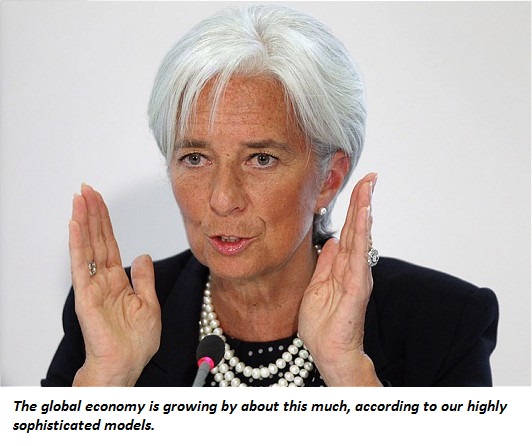
Here is the reality, as expressed by IMF Chairwoman Christine Lagarde: what passes for precise data is a guesstimate at best, and a carefully executed distortion at worst.

The net result is nonsensical policies that fail to achieve their stated objectives.Even more tragicomic, the spokespeople tasked with presenting this failure to the Great Unwashed are forced to speak gobbledigook that borders on the psychotic if taken at face value.
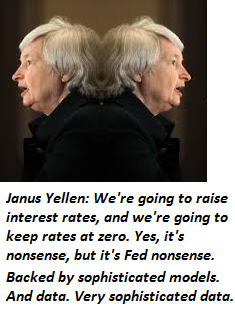
For example, Janus Yellen must claim she is planning to raise interest rates while also proclaiming that she’s keeping rates at zero for the indefinite future.If a non-Elite person rambled on in this fashion, they would be tossed in jail as a 51-50 (involuntary psychiatric hold).
Equally perverse is the illusion of control–the fantasy that the Federal Reserve controls the real economy. Note to Fed: hosting the financial feasting of the Power Elites for 7 long years had essentially zero positive effect on the real economy.
All the Fed’s QE and ZIRP (zero interest rate policy) accomplished was the inflating of multiple bubbles (housing, stocks, bonds, student loans, subprime auto loans, etc.) and chumming the feeding-frenzy of financiers gorging themselves on income-producing assets while the dwindling middle class has been mesmerized into accepting debt servitude as the acme of middle class membership.
The notion that the Fed or the IMF understands the real economy is pure illusion. So is the notion that they control the real economy. All they control is the level of exploitation of the many by the few.

Tuesday, October 27, 2015

Why A Russian Default Is A Very Real Scenario In 2016

Tyler Durden's picture

http://www.zerohedge.com/news/2015-10-27/why-russian-default-very-real-scenario-2016
Submitted by Marin Katusa via KatusaResearch.com,
Debt.
Everyone understands it pretty well when it comes to their personal finances. You borrow money, you have to pay it back. If you can’t, your creditor hounds you until you either come up with the cash or restructure your repayment schedule. Or, worst case, you eventually file for bankruptcy, thereby defaulting on your debt. Simple.
Yet people, especially in the West, seem blithely unaware that the same basic principles apply to countries, as well. Most of us tend to think that nations can’t or won’t default on their debt. Well … maybe Greece will. But surely not a big country.
Why we believe this is partly due to an ignorance of history, which features literally countless defaults, among nations great and small. Even the US has done it. More than once. It happened right at the beginning, in 1779, when the fledgling US nation defaulted on its first currency, the Continental (which led to widespread use of an early American pejorative phrase: “not worth a Continental.”) And a very recent example was when Nixon severed the tie between gold and the dollar in 1971; that was a default on the precious metal debt the country owed to France and others.
It’s also partly due to the current financial behavior of the American government, which acts as if the cure for a debt problem is more debt (do not try this at home, by the way).  As Congress raises the federal debt ceiling, and the Federal Reserve creates ever more currency units out of thin air, it creates the illusion of stability. All it’s really doing, though, is just kicking the can down the road.  The US has placed itself firmly on this path. But that doesn’t ensure that the rest of the world’s nations can or will follow the same one.
Particularly Russia.
In 2014, I published The Colder War, which became a New York Times Bestseller.  Vladimir Putin, Russia, oil and energy were all dissected in my book, which today is every bit as timely as it was when I wrote it in 2013.  Because of the decade I spent researching the book, I have a very unique Westerner’s perspective on Russia.
Here’s one of the things I learned: Russia is completely unafraid of a default on its debt.
Russia was a basket case in the 1990’s.  The first war in Chechnya was a disaster, both economically and psychologically for the Russians.  Russia not only lost that war, it had a disaster of an economy, ran a huge governmental budget deficit, and was stuck with a very unfavorable fixed exchange rate between the ruble and the currencies of all its trading partners. The country was barely staying afloat.
Then, on top of all that, came the two additional straws that finally broke the Bear’s back: the Asian financial crisis and a crash in oil prices.
But the West totally mis-guessed the eventual outcome. The World Bank and the IMF arrogantly assumed the Russians would continue to play by their rules.  In fact, years later it was leaked that billions in IMF relief funds had headed east, where they were “misplaced.” Or, in laymen’s terms, stolen before they even hit the Russian bank accounts.
On August 17, 1998, the so-called “Russian flu” infected world markets. Moscow announced that a moratorium would be placed on payments to foreign creditors. In addition, the ruble was devalued by 33% (from 7.1RUR/USD to 9.5RUR/USD).  Within a few months, the government allowed the ruble to float freely and the currency devalued by another 120% to 21RUR/USD.  There were bank closures, political fall guys and rabid inflation.
The Russian oligarchs, many of them ruthless criminals, made their moves—and consolidated their wealth at levels that would make the American robber barons blush.
Into this chaos, in 1999, entered Vladimir Putin—one of the most mischaracterized politicians on the planet. An archetypal Russian strong man, he brutally squashed the Chechen revolt and moved decisively to bring the oligarchs under state control, which meant killing or imprisoning them, or driving them into exile. Most importantly, he committed massive resources to reviving an energy sector that had fallen into disrepair, and made it quasi-public with companies headed up by his buddies and inner circle. As prices moved upwards, Russian crude oil output expanded like crazy to become #1 in the world and the economy boomed, as did Putin’s global agenda.
Through a series of deft political maneuverings, Putin still controls Russia 16 years later.  During that time, he has stayed enormously popular among his countrymen despite policies that Westerners (and some dissenting Russians) find reprehensible. His prolonged supremacy is quite a feat, given how the byzantine nature of Russian politics laid low any number of his predecessors.  But he’s done it by persuading the mass of the people that he always acts in what he sees as the best way to push Mother Russia to the head of the table among nations, and that in that pursuit he’s willing to let all manner of chips fall where they may.
Today, Russia is in crisis again, having been hit with the double whammy of plummeting energy prices and heavy sanctions laid on by the West over Putin’s foreign policy. Given the country’s struggling economy, it’s puzzling why the world is ignoring the risk of Russia defaulting on its debt. Again. And why it may be underestimating Putin. Again.
Why a Russian Default is a very real scenario in 2016
The IMF is loaning billions to Ukraine.  In addition, NATO is spending billions in Ukraine on a war that has lasted longer than any US or NATO official expected.  The West, led by the US, has put national sanctions on Russia, and personal ones on many of Putin’s associates—despite a clear historical record that shows sanctions almost never achieve their stated ends.
To understand how misguided this is, you just have to ask one question: Who holds the majority of the debt that would be at risk in a Russian default? Not China.  Not Iran.  Not Syria.  No, it’s the exact same nations, and banks and funds within those nations, that are applying the sanctions against Russia.
So, if Russia does default, what does it mean in terms of its political relationship with the West?
Nothing.
But what does it mean to its creditors?
Everything.
They’re the ones who will take the hit. And by the way, to anyone who thinks they will be able to enforce their nation’s debt laws on the Russian government or any Russian companies, I have this to say: I wish you the best of luck.
Don’t buy my story?
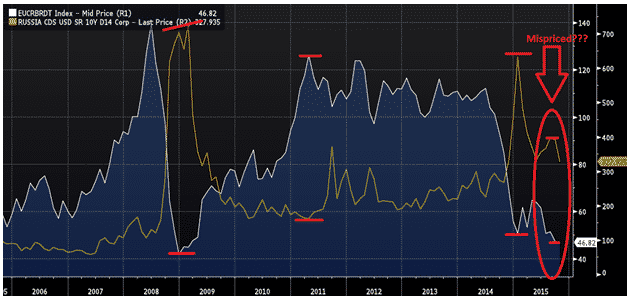
Here is a chart of Brent Oil pricing verses the 10-year Russian credit default swaps (CDS).
The market is completely mispricing the Russian CDS, by totally ignoring the potential for a Russian Default.
For comparison purposes, in the oil crash of late 2008 early 2009, Russian CDS popped 600% to over 7%. (The CDS market can be a bit complicated, but in general terms, the higher the rate, the more perceived risk is being priced into the market.)
Even earlier this year, with the Brent price of oil trading higher than it does now, the CDS were 100% more expensive. But they’ve since fallen to around 3%, which is absurd, as oil is lower now than when the CDS were at 100% higher rate—therefore if the market was paying attention, CDS should have a “higher” rate now than earlier this year.
10yrRuscds
The market is assuming that Putin will play by the western bankers’ rules; therefore there is no fear that the Russians might default on their debt.
Otherwise, there’s no reason Russian CDS would be 50% lower than earlier this year, given the fall in the price of oil, which is critical to their economy.
Has something else changed?
Are we in some better place globally now? I highly doubt it for many reasons, but how about I just mention one horrific fact: the world has never seen more displaced persons—ever— than we currently have at over 60 million.
Or has Putin merely distracted the Western world by diverting its interest to Ukraine and Syria?
Those are relatively small items on Russia’s policy agenda. Putin’s real focus is on strengthening his country’s economy by ramping up business with China and the emerging markets. That is where the future lies. If Putin can’t entirely eliminate all dependence on the West, he’s certainly moving forcefully to greatly diminish its influence.
The $400 billion natural gas deal he signed with China in 2014 is just one powerful indicator.
In a few words, if Putin believes that the benefits of a default outweigh the consequences to his country, he won’t hesitate to do it, no matter the international ruckus it might raise.
So … my advice is that if you are invested in any funds or banks that are exposed to debt in Russia, I would rethink your investment thesis. The rules of the game are apt to change quickly, and not to the foreign debt holders’ benefit.
And, if you like ironic coincidences, I’ll close with this one.
Donald Trump is the current leader for the Republican presidential nomination. During his business career, he’s helmed four companies that filed for Chapter 11. Which just happens to be the same number of Russian bankruptcies that have occurred during ‘The Donald’s’ lifetime.
Who knows, ‘The Donald’ and Putin might end up the best of friends…

Friday, September 4, 2015

The IMF Just Confirmed The Nightmare Scenario For Central Banks Is Now In Play

Tyler Durden's picture

http://www.zerohedge.com/news/2015-09-04/imf-just-confirmed-nightmare-scenario-central-banks-now-play
The most important piece of news announced today was also, as usually happens, the most underreported: it had nothing to do with US jobs, with the Fed's hiking intentions, with China, or even the ongoing "1998-style" carnage in emerging markets. Instead, it was the admission by ECB governing council member Ewald Nowotny that what we said about the ECB hitting a supply brick wall, was right. Specifically, earlier today Bloomberg quoted the Austrian central banker that the ECB asset-backed securities purchasing program "hasn’t been as successful as we’d hoped."
Why? "It’s simply because they are running out. There are simply too few of these structured products out there."
So six months later, the ECB begrudgingly admitted what we said in March 2015, in "A Complete Preview Of Q€ — And Why It Will Fail", was correct. Namely this:
... the ECB is monetizing over half of gross issuance (and more than twice net issuance) and a cool 12% of eurozone GDP. The latter figure there could easily rise if GDP contracts and Q€ is expanded, a scenario which should certainly not be ruled out given Europe’s fragile economic situation and expectations for the ECB to remain accommodative for the foreseeable future. In fact, the market is already talking about the likelihood that the program will be expanded/extended.

... while we hate to beat a dead horse, the sheer lunacy of a bond buying program that is only constrained by the fact that there simply aren’t enough bonds to buy, cannot possibly be overstated.

Among the program’s many inherent absurdities are the glaring disparity between the size of the program and the amount of net euro fixed income issuance and the more nuanced fact that the effects of previous ECB easing efforts virtually ensure that Q€ cannot succeed.
(Actually, we said all of the above first all the way back in 2012, but that's irrelevant.)
So aside from the ECB officially admitting that it has become supply*constrained even with security prices at near all time highs, why is this so critical?
Readers will recall that just yesterday we explained why "Suddenly The Bank Of Japan Has An Unexpected Problem On Its Hands" in which we quoted BofA a rates strategist who said that "now that GPIF’s selling has finished, the focus will be on who else is going to sell. Unless Japan Post Bank sells JGBs, the BOJ won’t be able to continue its monetary stimulus operations."
We also said this:
"in 6-9 months, following the next major market swoon when everyone is demanding more action from the BOJ, "suddenly" pundits will have discovered the biggest glitch in the ongoing QE monetization regime, namely that the BOJ simply can not continue its current QE program, let along boost QE as many are increasingly demanding, unless it finds willing sellers, and having already bought everything the single biggest holder of JGBs, the GPIF, had to sell, the BOJ will next shakedown the Post Bank, whose sales of JPY45 trillion in JGBs are critical to keep Japan's QQE going.

The sale of that amount, however, by the second largest holder of JGBs, will only last the BOJ for the next 3 months. What next? Which other pension fund will have the massive holdings required to keep the BOJ's going not only in 2016 but also 2017 and onward. The answer: less and less.
Once again to be accurate, the first time we warned about the biggest nightmare on deck for the BOJ (and ECB, and Fed, and every other monetizing central bank) was back in October 2014, when we cautioned that the biggest rish was a lack of monetizable supply.
We cited Takuji Okubo, chief economist at Japan Macro Advisors in Tokyo, who said that at the scale of its current debt monetization, the BOJ could end up owning half of the JGB market by as early as in 2018. He added that "The BOJ is basically declaring that Japan will need to fix its long-term problems by 2018, or risk becoming a failed nation."

This was our summary:
The BOJ will not boost QE, and if anything will have no choice but to start tapering it down - just like the Fed did when its interventions created the current illiquidity in the US govt market - especially since liquidity in the Japanese government market is now non-existant and getting worse by the day. All that would take for a massive VaR shock scenario to play out in Japan is one exogenous JGB event for the market to realize just how little actual natural buyers and sellers exist.
That said, our conclusion, which was not to "expect the media to grasp the profound implications of this analysis not only for the BOJ but for all other central banks: we expect this to be summer of 2016's business" may have been a tad premature.
The reason: overnight the IMF released a working paper written by Serkan Arslanalp and Dennis Botman (which was originally authored in August), which confirmed everything we said yesterday... and then some.
Here is Bloomberg's summary of the paper:
The Bank of Japan may need to reduce the pace of its bond purchases in a few years due to a shortage of sellers, said economists at the International Monetary Fund.

There is likely to be a “minimum” level of demand for Japanese government bonds from banks, pension funds, and insurance companies due to collateral needs, asset allocation targets, and asset-liability management requirements, said IMF economists Serkan Arslanalp and Dennis Botman.
Here are the excerpts from the paper:
We construct a realistic rebalancing scenario, which suggests that the BoJ may need to taper its JGB purchases in 2017 or 2018, given collateral needs of banks, asset-liability management constraints of insurers, and announced asset allocation targets of major pension funds.

... there is likely to be a “minimum” level of demand for JGBs from banks, pension funds, and insurance companies due to collateral needs, asset allocation targets, and asset-liability management (ALM) requirements. As such, the sustainability of the BoJ's current pace of JGB purchases may become an issue.
Back to Bloomberg:
While Governor Haruhiko Kuroda said in May that he expects no obstacles in buying government bonds, the IMF analysts join Nomura Securities Co. and BNP Paribas SA in questioning the sustainability of the unprecedented debt purchases.
Who in turn merely joined Zero Hedge who warned about precisely this in October of last year.
Back to the IMF paper, which notes that in Japan, where there is a limited securitization market, the only "high quality collateral" assets are JGBs, and as a result of the large scale JGB purchases by the JGB, "a supply-demand imbalance can emerge, which could limit the central bank’s ability to achieve its monetary base targets. Such limits may already be reflected in exceptionally low (and sometimes negative) yields on JGBs, amid a large negative term premium, and signs of reduced JGB market liquidity."
To the extent markets anticipate limits, the rise in inflation expectations could be contained, which may mitigate incentives for portfolio rebalancing and create a self-fulfilling cycle that undermines the BoJ’s objectives.
For those surprised by the IMF's stark warning and curious how it is possible that the BOJ could have put itself in such a position, here is the explanation:
So far, the BoJ’s share of the government bond market is similar to those of the Federal Reserve and still below the Bank of England (BOE) at the height of their QE programs. Indeed, the BoE held close to 40 percent of the conventional gilt market at one point without causing significant market impairment. Japan is not there yet, as the BoJ held about a quarter of the market at end-2014. But, at the current pace, it will hold about 40 percent of the market by end-2016 and close to 60 percent by end-2018. In other words, beyond 2016, the BoJ’s dominant position in the government bond market will be unprecedented among major advanced economies.

As we expanded yesterday, the biggest issue for the BOJ is not that it has problems buying paper, but that there are simply not enough sellers: "under QQE1, only around 5 percent of BoJ’s net JGB purchases from the market came from institutional investors. In contrast, under QQE2, close to 40 percent of net purchases have come from institutional investors between October 2014 and March 2015."


This is where things get back for the BOJ, because now that the BOJ is buying everything official institutions have to sell, the countdown has begun:
given the pace of BoJ purchases under QQE2 and projected debt issuance by the government (based on April 2015 IMF WEO projections of the fiscal deficit), we estimate that Japanese investors could shed some ¥220 trillion of JGBs until end-2018 (Table 2, Figure 4). In particular, Japanese insurance companies and pension funds could reduce their government bond holdings by ¥44 trillion, while banks could sell another ¥176 trillion by end-2018, which would bring their JGB holdings down to 5 percent of total assets. At that point, the BoJ may have to taper its JGB purchases.


Then there are the liquidity issues:
As the BoJ ascends to being a dominant player in the JGB market, liquidity is likely to be affected, implying that economic surprises may trigger larger volatility in JGB yields with potential financial stability implications. As noted in IMF (2012), demand-supply imbalances in safe assets could lead to deteriorating collateral quality in funding markets, more short-term volatility jumps, herding, and cliff effects. In an environment of persistent low interest rates and heightened financial market uncertainty, these imbalances can raise the frequency of volatility spikes and potentially lead to large swings in asset prices.
This, too, is precisely what we warned yesterday would be the outcome: "the BOJ will not boost QE, and if anything will have no choice but to start tapering it down - just like the Fed did when its interventions created the current illiquidity in the US govt market - especially since liquidity in the Japanese government market is now non-existant and getting worse by the day."
The IMF paper conveniently provides some useful trackers to observe just how bad JGB liquidity is in real-time.

The IMF is quick to note that the BOJ does have a way out: it can simply shift its monetization to longer-dated paper, expand collateral availability using tthe BOJ's Securited Lending Facility (which basically is a circular check kiting scheme, where the BOJ lends banks the securities it will then repurchase from them), or simply shift from bonds to other assets: "the authorities could expand the purchase of private assets. At the moment, Japan has a relatively limited corporate bond market (text chart). Hence, this would require jumpstarting the securitization market for mortgages and bank loans to small and medium-sized enterprises which could generate more private assets for BoJ purchases."
But the biggest risk is not what else the BOJ could monetize - surely the Japanese government can always create "monetizable" kitchen sinks... but what happens when the regime shifts from the current buying phase to its inverse:
As this limit approaches and once the BoJ starts to exit, the market could move from a situation of shortage to one with excess supply. The term premium could jump depending on whether the BoJ shrinks its balance sheet and on the fiscal deficit over the medium term.
When considering that by 2018 the BOJ market will have become the world's most illiquid (as the BOJ will hold 60% or more of all issues), the IMF's final warning is that "such a change in market conditions could trigger the potential for abrupt jumps in yields."
At that moment the BOJ will finally lose control. In other words, the long-overdue Kyle Bass scenario will finally take place in about 2-3 years, tops.
But ignoring the endgame for Japan, and recall that BofA triangulated just this when it said that "the BOJ is basically declaring that Japan will need to fix its long-term problems by 2018, or risk becoming a failed nation", what's worse for Abe is that the countdown until his program loses all credibility has begun.
What happens then? As BNP wrote in an August 28-dated report, "Once foreign investors lose faith in Abenomics, foreign outflows are likely to trigger a Japanese equities meltdown similar to the one observed during 2007-09."
And from there, the contagion will spread to the entire world, whose central banks incidentally, will be faced with precisely the same question: who will be responsible for the next round of monetization and desperately kicking the can one more time.
But before we get to the QE endgame, we first need to get the interim point: the one where first the markets and then the media realizes that the BOJ - the one central banks whose bank monetization is keeping the world's asset levels afloat now that the ECB has admitted it is having "problems" finding sellers - will have no choice but to taper, with all the associated downstream effects on domestic and global asset prices.
It's all downhill from there, and not just for Japan but all other "safe collateral" monetizing central banks, which explains the real reason the Fed is in a rush to hike: so it can at least engage in some more QE when every other central bank fails.
But there's no rush: remember to give the market and the media the usual 6-9 month head start to grasp the significance of all of the above.
Source: IMF

Tuesday, July 14, 2015

IMF Declares War On Germany: In "Secret" Report Lagarde Says Greece Will Need Massive Debt Relief

Tyler Durden's picture

http://www.zerohedge.com/news/2015-07-14/imf-declares-war-germany-secret-report-lagarde-says-greece-will-need-massive-debt-re
Update: Europe now looks to be in damage control mode. Here's Reuters:
  • EU SOURCE SAYS EURO ZONE LEADERS KNEW OF LATEST IMF DEBT ANALYSIS FOR GREECE BEOFRE AGREEING ON THIRD BAILOUT TERMS
A divide between the IMF and Europe (read: Germany), regarding writedowns on Greece’s debt to the EU has been brewing for quite some time and recently returned to the international spotlight when, a few months back, the Fund indicated debt relief was a precondition for its participation in any further aid for Athens.
More recently, the IMF released a report on Greece’s debt sustainability just prior to the referendum. The timing appeared to be strategic and may have helped secure the "no" vote for Tsipras.
Unfortunately, the IMF didn’t appear to anticipate the PM’s complete capitulation and now, the subject of debt relief has again been put off, this time until Greece officially passes the new "deal" through parliament and legislates its terms.
Today, another "secret" IMF document on the sustainability of Greece’s debt burden has surfaced and not surprisingly, the Fund is once again pounding the table on a haircut. One is certainly left to wonder if the US (and its veto power) are pulling the strings behind the scenes and orchestrating "leaks" at opportune times. Here’s more from Reuters:
Greece will need debt relief far beyond what euro zone partners have been prepared to consider due to the devastation of its economy and banks in the last two weeks, a confidential study by the International Monetary Fund seen by Reuters shows.

The updated debt sustainability analysis was sent to euro zone governments late on Monday, hours after Athens and its 18 partners agreed in principle to open negotiations on a third bailout programme of up to 86 billion euros in return for tougher austerity measures and structural reforms.

"The dramatic deterioration in debt sustainability points to the need for debt relief on a scale that would need to go well beyond what has been under consideration to date - and what has been proposed by the ESM," the IMF said, referring to the European Stability Mechanism bailout fund.

European countries would have to give Greece a 30-year grace period on servicing all its European debt, including new loans, and a very dramatic maturity extension, or else make explicit annual fiscal transfers to the Greek budget or accept "deep upfront haircuts" on their loans to Athens, the report said.


The updated debt sustainability analysis (DSA) was sent to euro zone governments late on Monday, hours after Athens and its 18 partners agreed in principle to open negotiations on a third bailout program of up to 86 billion euros in return for tougher austerity measures and structural reforms.

"The dramatic deterioration in debt sustainability points to the need for debt relief on a scale that would need to go well beyond what has been under consideration to date - and what has been proposed by the ESM," the IMF said, referring to the European Stability Mechanism bailout fund.

European countries would have to give Greece a 30-year grace period on servicing all its European debt, including new loans, and a very dramatic maturity extension, or else make explicit annual fiscal transfers to the Greek budget or accept "deep upfront haircuts" on their loans to Athens, the report said.

It was leaked as German Finance Minister Wolfgang Schaeuble disclosed that some members of the Berlin government thought Greece would have been better off taking "time-out" from the euro zone rather than receiving another giant bailout.

The IMF study said the closure of Greek banks and imposition of capital controls on June 29 was "extracting a heavy toll on the banking system and the economy, leading to a further significant deterioration in debt sustainability relative to what was projected in our recently published DSA".

The latest IMF study said Greek debt would now peak at close to 200 percent of economic output in the next two years, compared to a previously forecast high of 177 percent.

Even by 2022, the debt would stand at 170 percent of gross domestic product, compared to an estimate of 142 percent issued just two weeks ago. Gross financing needs would rise to above the 15 percent of GDP threshold deemed safe and continue rising in the long term, the updated IMF study said.

Moreover, the latest projections "remain subject to considerable downside risk", meaning that euro zone countries might have to provide even more exceptional financing.

The IMF study also appeared to challenge the assumption by some European officials that Greece will be able to meet some of its financing needs from the markets in 2018.

"Borrowing at anything but AAA rates in the near term will bring about an unsustainable debt dynamic for the next several decades," it said.
In other words, the IMF is now openly at war with Germany (and its sound money compatriots like Finland) over debt forgiveness, which futher underscores the split in Europe between the German bloc and the those who favored leniency for Greece, and, by extension, a relaxation of the doctrine of strict fiscal discipline that has dominated EU politics (in word if certainly not in deed in the periphery) since the onset of the European debt crisis.
Of course any debt haircut for Greece will only serve to embolden other periphery debtor states, especially those where Syriza sympathizers enjoy growing support ahead of elections. In short, if parties like Podemos in Spain perceive that Germany has blinked on debt relief they too will push for writedowns, something we outlined in detail after the last IMF "leak" in "Did IMF Just Open Pandora's Box."
*  *  *
Summing up the US/IMF message to Germany:

Friday, June 26, 2015

Of Bureaucrazies & Demoncracy: The People Must Be Overthrown

Tyler Durden's picture

http://www.zerohedge.com/news/2015-06-26/bureaucrazies-demoncracy-people-must-be-overthrown
Submitted by Raul Ilargi Meijer via The Automatic Earth blog,
Perhaps I should apologize for writing about Greece all the time. Thing is, not only have I just arrived in Athens last night (and been duly showered in ouzo), but Greece is the proverbial early harbinger of everything that’s wrong with the world (not to worry, I know that’s a hyperbole), and of everything that could be done about it.
That places a responsibility on the shoulders of Syriza leader Alexis Tsipras and his team that maybe they don’t want, and for all I know don’t deserve either. But they’re all we have, and besides, they’re all their own people have. In that sense, this is not about everything that’s wrong with the world, other than that’s the same as everything that’s wrong with Greece.
I was struck last night, talking to people here in Athens, by how much their appreciation of Tsipras, his overall composure and the way he handles the Troika talks, has increased over the past five months. They were doubtful about him before the Syriza election win; they no longer are.
Still, the negotiations are nice and all, but they’re not going anywhere, and they never will. The Troika side of the table is interested in one thing only: to humiliate Athens and force it into ultimate submission, along the lines of those photographs we’ve come to know of Abu Graibh.
Yanis Varoufakis labeled the Troika policies vis-a-vis Greece ‘fiscal waterboarding’ when he started out as finance minister, and here’s thinking he should have stuck with that image in a much more persistent and a much louder fashion.
Yes, we know, Syriza doesn’t have the mandate to take the country out of the eurozone. A daily dose of fear tactics in the domestic and international media still have Greeks, even Syriza voters, scared stiff about going it alone.
It’s time for Tsipras to turn to his people, on national TV, and say look, whatever we can discuss with the Troika, and whatever compromise we may be able to reach, there is no option on or off the table that would allow for you, the people of Greece, to not be debt slaves for the rest of your lives.
The European Union is merely a crude modern version of a feudal society (but without the debt jubilee older versions had), that’s all the morals that Brussels and Berlin can muster. And, Tsipras should say, if that is what you want, if you want to be slaves instead of a free people, tell me so. I will draw my conclusions from that.
But this is getting painful. We have an entire team of Greece’s brightest drawing up plan after plan, most of which are never even discussed by the Troika. It all comes down to you, the people, and we, your representatives, being rudely insulted every minute of the day by people whose only interest is their own personal careers and agendas.
I, Alexis Tsipras, think I deserve better than that, and much more importantly, I think my people deserve better than that. But in these negotiations, no matter how long they last, we will never get what we deserve. The Troika seeks to humiliate us, and force us on our knees with our pants down our ankles and a hood over our faces..
This will take courage on the part of Tsipras; it may well end his political career. But such courage is exactly what the Greek people need to see. They need a leader who is willing to put it all on the line, or else why would they themselves?
The threat of Armageddon following an exit from the euro is an abstract and unknown phenomenon akin to various bogeymen used to keep children in check, akin to the threat of drowning that makes waterboarding such an inhumane experience.
But whatever may or will happen, there is nothing that says or guarantees that a euro-less Greece will be worse off than it is now. Not even from a purely financial point of view (other than for an initial short period of time).
What the Greeks are sure to gain, though, is their independence, their dignity, their pride. Why on earth would they, once they understand the predicament, vote to stay on and pay their odious debts and kowtow to the five families in Brussels and Berlin for the rest of their lives?
It makes no sense at all, and it makes no sense for Tsipras and his team to keep on negotiating for a deal that will never do anything but humiliate them, and shackle the people who voted for them. There is no other possible option on the table, and there won’t be in the future.
As I was writing this in the early Athens morning, I saw an article by my dear friend Steve Keen come in, and I’m very pleased to see Steve think along the same lines I do, at the same time.
This belief that economists know better than politicians how to run an economy was enshrined in the Maastricht Treaty itself, which limited government deficits to 3% of GDP and government debt to 60% of GDP. It was a set of rules designed to shackle political freedom, so that the economy could flourish under the incorruptible leadership of experts.

Some experts. Firstly they designed a system which would only work if capitalism never had crises. Secondly, when a crisis hit, rather than backpedalling on their flawed rules, they doubled up on them. Then, when the people had the temerity to elect a government which opposed their agenda… Well it’s obvious, isn’t it? The people must be overthrown.

I know from personal conversations with Varoufakis and his advisors, as well as from the public record, that Syriza is willing to do almost anything to stay within the Euro. As Yanis put it at the INET conference in Paris in April, the Euro is a bit like the Hotel California: you should never check into it in the first place, but if you do, you can never leave.

But the conditions the IMF, EU and ECB are insisting upon here are so extreme, and their behaviour so counter to the very concept of democracy, that maybe the Greeks would do better to show them what a democratic government can do. Maybe they should leave the Euro, and default on all their debts—especially those to the Troika. The financial stimulus from throwing off the yoke of debt may counterbalance the initial chaos from re-instituting a national currency in a seriously damaged society.
It may also teach the bureaucrazies -and no, that is not a misprint- a lesson about the limits of bureaucratic power.
You know, it’s true that maybe it’s too much for outsiders such as Steve Keen and myself to ask of Alexis Tsipras, and the people of Greece, to jump into a big unknown. But it’s also too much to bear to watch the inane piece of theater being played out by quasi elected B movie protagonists.
And no, none of us get a free pass on this one. Your voice is long overdue. Because no matter where you are or who you are, whether you’re American or European, it’s still your government, acting in your name, that supports and magnifies the craziness unloaded upon the cradle of democracy.
All the Greek people know until now is that Europe and the IMF are attempting to strangle them. Still, so many among us don’t agree with that at all. Thing is, it’s time to let that be known. To the people of Greece, and to our own ‘leaders’ who if we don’t get vocal will continue to do as they please. Just because the people you’ve elected don’t have any morals doesn’t mean you don’t have to either.

Tuesday, June 23, 2015

The Unspoken Tragedy In The Upcoming Greek Bailout

Tyler Durden's picture

http://www.zerohedge.com/news/2015-06-23/unspoken-tragedy-upcoming-third-greek-bailout
A day after Tsipras stunned both his peers at the Eurogroup summit, and not to mention his fellow parliamentarians, many of which already voiced their opposition to what has been dubbed a "capitulation" by the Greek prime minister over threats of a financial system collapse if there is no deal within the week, many questions remain:
  • will the Troika come back with even more demands such as boosting the hotel and restaurant VAT even higher (economic suicide for a nation where tourism is the only viable industry)?
  • will the IMF concede that the Greek proposal will ever be sufficient if it does not incorporate the demanded pension cuts?
  • will the deal pass Greek parliament; will a deal come too late to save the insolvent Greek banks?
  • will Greece get a debt haircut (paradoxically as demanded by the same IMF which is also demanding spending cuts instead of tax hikes, over the objections of the ECB which holds the vast majority of Greek debt and is leery of impairments)?
  • will the German parliament agree to validate any deal that may end up splitting Syriza in two or more factions?
While stock markets are convinced a deal is inevitable, after all the can must be kicked as it has been for the past five years...


... that may be more problematic than the algos expect. Here are some quotes showing that despite Tsipras' capitulation, few if any are ready to follow in his footsteps:
For example Austria:
Austria's finance minister said on Tuesday there would be no agreement on new Greek budget proposals unless there was a concrete plan showing how they would be carried out. But he added: "If there is no programme for actions that says what measure will be implemented when , we will not agree to it." "It should not, cannot, must not happen that a third (bailout) programme is started so to speak through the back door," he said. (Source)
or Germany:
 Members of Chancellor Angela Merkel’s coalition said the International Monetary Fund’s backing for a financing plan for Greece is key to German parliamentary support for a deal.  “If there’s to be a payout, we need a detailed calculation by the IMF,” Antje Tillmann, the ranking Finance Committee member from Merkel’s Christian Democratic bloc, said by phone. “It has to add up to something sustainable.”

“For us, the IMF’s verdict is the benchmark for a credible, acceptable solution,” said Joachim Poss, deputy caucus leader in the lower house for the Social Democrats, Merkel’s junior coalition partner. (Source)
Or the IMF:

The IMF is still unhappy with key aspects of Greece’s new economic proposals and German officials were irritated by the speed with which the commission welcomed them, warning that much work needs to be done... IMF representatives have told European officials that they are also not satisfied yet by Greece’s broader economic overhaul plans beyond its budgetary promises. The IMF sees a wider, business-friendly shake-up of Greece’s economy as essential if the country is to improve its long-term economic growth. (Source)
Or impartial third parties:
“Very large problems remain for a solution,” said Jacob Funk Kirkegaard, a senior fellow at the Peterson Institute for International Economics in Washington. “The Greek government -- somewhat surprising for a self-professed reform and anti- austerity government -- seems to have merely agreed to impose a lot more austerity through higher taxes, but offers relatively little commitment to genuine economic reform.” (Source)
And certainly Greece:
“Personally, I cannot support such an agreement that is contrary to our election promises,” Dimitris Kodelas, a Syriza lawmaker associated with former Maoists, said in an interview. “I do not care about the consequences of my decision.” (Source)
The litany continues, and yet, somehow, we expect that in the next 48 hours, the machinery will be again in motion to kick the can once again for third time.
What happens then is basically a precursor to a third bailout package, one which according to previous reports, will be about €35 billion if and when a deal gets done.
At which point, assuming the funds are wired to Greece, the Athens government can congraulate itself on a job well done, even though, as some critics above pointed out, it "merely agreed to impose a lot more austerity through higher taxes, but offers relatively little commitment to genuine economic reform."
One can ask: why didn't any of the previous government impose higher taxes in the past 5 years? The answer is they did, and nobody paid them. And this is why this latest pre-bailout will also be a failure, followed perhaps by bailout #4, #5 and so on.
All of this is known to everyone.
What isn't, or perhaps merely needs refreshing, is that assuming all of the above is resolved in a satisfactory matter, what will be the use of funds of this latest and greatest bailout of Greece.
Sadly, the answer is also well known. We showed it first back in 2011 when we asked, rhetorically, "where does the Greek bailout money go?"
So for those who don't recall, here is a refresher from Macropolis, which a few months ago showed that of the €226.7 billion euros disbursed to Greece since the first Greek bailout, an equivalent to almost 125% of Greece 2014 GDP, "the combined allocation to the Greek state’s operating needs was just 11 percent of the total funding, at circa 27 billion euros."


That's right: hundreds of billions "spent" to rescue Greece... with the vast amount of proceeds used to promptly repay the very sources of these funds: the IMF and the ECB.
So will this time be any different, and will the Greeks receive anything extra? Alas no, because here are the near-term Greek debt interest and maturity payments...


... and the longer term.

So to emphasize, just in case there is any confusion: whatever money Greece receives as part of its third pre-bailout, followed by another full-scale bailout which according to SocGen will amount to another €60-80 billion or more, followed by another... until all Greek collateral - including its gold - finally runs out, will be used first and foremost to satisfy Troika, pardon, creditor claims.
Which means that of this widely touted €35 billion, Greece will be lucky to pocket a little over €3 billion. However, considering that is how much the Greek government has already extracted out of various public pensions and municipalities as part of its quasi-capital controls unrolled previously to preserve the illusion of solvency, after the hard fought "deal" finally is inked, the Greek population will be left with...
€0.
And that, sadly, is the unspoken tragedy in the upcoming Greek bailout. Because while it is one thing to bend over backwards to Troika interests if one at least gets something out of the deal, we completely fail to see why the Syriza government is risking its entire reputation, and doing what it is doing when in the end the Greek population which elected the "radical leftist" party with such wild hope and optimism has absolutely nothing to show for it.

Monday, March 24, 2014

Soros and Lagarde’s IMF vs Putin’s Russia – The Ukraine Coup and The War for the World…(interesting....)

Let’s call this an alternative take on the Russian/Ukraine  “crisis” to the Mainstream Media spoon fed version.  I have said little on the events for the simple reason I had not yet acquired enough information to adequately do so.  Well, that has changed, and what is happening is nothing like you’re being told.  So hold on reader, here we go…

IMF Director Christine Lagarde  has been working very hard behind the scenes coordinating the current conflict between Ukraine and Russia.
http://theulstermanreport.com/2014/03/23/soros-and-lagardes-imf-vs-putins-russia-the-ukraine-coup-and-the-war-for-the-world/
_______________________________
Longtime readers of this blog are already familiar with the name Christine Lagarde and her position as head of the International Monetary Fund.  So keep that knowledge handy as we now navigate the increasingly tumultuous dynamics taking place between Russian President Vladimir Putin, and seemingly, the rest of the “civilized” world.  This will be an abridged version, hopefully to provide both swifter “up to speed” understanding, and the all important ability to then share that understanding with others.  This is the all important battle - truth vs. manipulation.  Reality vs. force-fed perception.
First, regarding Ukraine.  What happened there was rule by mob – a legitimate, (though corrupt) government was overthrown.  Millions living in Ukraine consider themselves Russian, and not members of the Big Government European Union.  Crimea is a region where this population within Ukraine is at its most concentrated, and those people were, rightfully so, fearing for their well-being following the overthrow of a government that won the most recent election by nearly a million votes over the party that has now seized power.
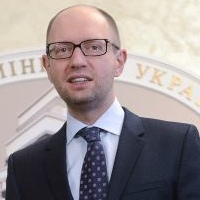
The current interim Ukraine Prime Minister is Arseniy Yatsenyuk. who ran for the position in 2009-2010 against former Ukraine leader Viktor Yanukovych.  Yanukovych represents the (majority) pro-Russian contingent within Ukraine, which won the most votes in the last election, while Yatsenyuk represents the (minority) ”embrace the global government” position, which overthrew Yanukovych.  Here is where we get into more detail reader, so please pay attention.
Ukraine who's who: Arseniy Yatsenyuk
A few years ago, Yatsenyuk publicly embraced what is called Front for Changes public initiative. This was a loosely cobbled together shared political interest organization in Ukraine that never held more than 11% public approval. (And yet now, runs the post-coup government.) Front for Change morphed into a newly named party in 2012 called the Fatherland Party or also called the All-Ukrainian Union.  2012 was the same year Fatherland positioned itself as the greatest power within the Ukraine Parliament – readying itself for the recent 2014 coup.
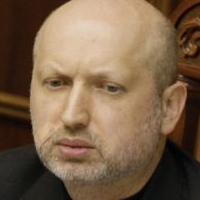
Yatsenyuk is not the head of the Fatherland Party though – that title goes to this man, Olexander Turchynov, former head of the Ukraine domestic security service [SBU].
Ukraine who's who: Oleksandr Turchinov
Fatherland has placed Yatsenyuk as its “public” face, while it is Turchynov who controls the real power behind the scenes as Interim President of Ukraine, but more importantly, as Deputy Leader of the Fatherland party, which controls the Ukraine parliament.  Now we go into the rabbit hole just a bit more.  In 2005, Turchynov, now the post-coup leader of Ukraine, was, as stated, head of the Ukraine domestic security service.  2005 is the very year, (no coincidence) a very important document was created and then disseminated within the Ukraine government titled, National Security and Defence. (that’s how they spell defense over there)  It is a very comprehensive document that at its core, pushes for progressive tax policies, open borders, and essentially, full participation within the European Union. It was widely distributed to most, if not all, government, business, and social justice leaders in Ukraine.  It is in fact, the document that outlines in detail, the very foundation for the recent Ukrainian coup that just took place.
I am going to repeat that for emphasis here:
It is in fact, the document that outlines in detail, the very foundation for the recent Ukrainian coup that just took place.
On the first page of this document, nearly hidden away from view, is a brief thank you to the sponsor(s) who made the study possible.  It reads as follows:
This publication was made possible through support
provided by the International Renaissance Foundation
and the Open Society Institute (BudapestLINK  (COPY THIS LINK BEFORE IT DISAPPEARS!)
The man who funds both the International Renaissance Foundation and the Open Society Institute, is, as many readers already know, this guy:

George Soros.
Now read this very recent quote from Mr. Soros himself, regarding the International Monetary Fund and Ukraine:
Now, after the Ukrainian people’s commitment to closer ties with Europe fueled a successful popular insurrection, the EU, along with the International Monetary Fund, is putting together a multibillion-dollar rescue package to save the country from financial collapse.”
LINK
That quote was from an article written by Soros and then published on February 27th.  Now look at a quote from an article involving Christine Lagarde and her IMF that came out the very same day:
“The IMF managing director, Christine Lagarde, said they were discussing how to help Ukraine with its international partners after Ukraine’s new finance minister, Oleksandr Shlapak, requested they send a mission.”   LINK
Both the IMF, and George Soros, signaling they will be propping up the post-coup government of Ukraine, and did so on the very same day.  Now guess what takes place just two weeks later following what was basically, a Soros-Lagarde shared announcement of post-coup Ukraine financial support?  Here’s a little photo op for you:

President Barack Obama meets with “public face” post-coup Ukraine Prime Minister Arseniy Yatsenyuk, or to put it another way, Soros and Lagarde tell Barack Obama to jump, and he happily replies, “how high?”
What this meeting did was signal legitimization of a government that came to power via a bloody and violent mob – a mob both motivated and funded by George Soros and the IMF.  A government that utilizes political tag lines so familiar to us in the United States following our own 2008 election/coup.  Phrases like “open borders”, “social justice”, and “fair share”.
Regarding two world leaders, one is a product of, and thus a staunch advocate for, the Soros agenda, while the other is now actively fighting against it.  One appears to love his nation, (however flawed that love might be) while the other stated from the outset the need to “fundamentally change” his country from within.  And while neither is a saint, one is certainly a sinner.
You can decide for yourself, who is who…