Showing posts with label Greece. Show all posts

Monday, April 4, 2016

Wikileaks Reveals IMF Plan To "Cause A Credit Event In Greece And Destabilize Europe"

Tyler Durden's picture

http://www.zerohedge.com/news/2016-04-02/wikileaks-reveals-imf-plan-cause-credit-event-greece-and-destabilize-europe
One of the recurring concerns involving Europe's seemingly perpetual economic, financial and social crises, is that these have been largely predetermined, "scripted" and deliberate acts.
This is something the former head of the Bank of England admitted one month ago when Mervyn King said that Europe's economic depression "is the result of "deliberate" policy choices made by EU elites.  It is also what AIG Banque strategist Bernard Connolly said back in 2008 when laying out "What Europe Wants"
To use global issues as excuses to extend its power:
  • environmental issues: increase control over member countries; advance idea of global governance
  • terrorism: use excuse for greater control over police and judicial issues; increase extent of surveillance
  • global financial crisis: kill two birds (free market; Anglo-Saxon economies) with one stone (Europe-wide regulator; attempts at global financial governance)
  • EMU: create a crisis to force introduction of “European economic government”
This morning we got another confirmation of how supernational organizations "plan" European crises in advance to further their goals, when Wikileaks published the transcript of a teleconference that took place on March 19, 2016 between the top two IMF officials in charge of managing the Greek debt crisis - Poul Thomsen, the head of the IMF's European Department, and Delia Velkouleskou, the IMF Mission Chief for Greece.

In the transcript, the IMF staffers are caught on tape planning to tell Germany the organization would abandon the troika if the IMF and the commission fail to reach an agreement on Greek debt relief. 
More to the point, the IMF officials say that a threat of an imminent financial catastrophe as the Guardian puts it, is needed to force other players into accepting its measures such as cutting Greek pensions and working conditions, or as Bloomberg puts it, "considering a plan to cause a credit event in Greece and destabilize Europe."
According to the leaked conversation, the IMF - which has been pushing for a debt haircut for Greece ever since last August's 3rd Greek bailout - believes a credit event as only thing that could trigger a Greek deal; the "event" is hinted as taking place some time around the June 23 Brexit referendum.
As noted by Bloomberg, the leak shows officials linking Greek issue with U.K. referendum risking general political destabilization in Europe.
The leaked transcript reveals how the IMF plans to use Greece as a pawn in its ongoing negotiation with Germany's chancelleor in order to achieve the desired Greek debt reduction which Germany has been pointedly against: in the leak we learn about the intention of IMF to threaten German Chancellor Angela Merkel to force her to accept the IMF's demands at a critical point.
From the transcript:
THOMSEN: Well, I don't know. But this is... I think about it differently. What is going to bring it all to a decision point? In the past there has been only one time when the decision has been made and then that was when they were about to run out of money seriously and to default. Right?

VELKOULESKOU: Right!

THOMSEN: And possibly this is what is going to happen again. In that case, it drags on until July, and clearly the Europeans are not going to have any discussions for a month before the Brexits and so, at some stage they will want to take a break and then they want to  start again after the European referendum.

VELKOULESKOU: That's right.

THOMSEN: That is one possibility. Another possibility is one that I thought would have happened already and I am surprised that it has not happened, is that, because of the refugee situation, they take a decision... that they want to come to a conclusion. Ok? And the Germans raise the issue of the management... and basically we at that time say "Look, you Mrs. Merkel you face a question, you have to think about what is more costly: to go ahead without the IMF, would the Bundestag say 'The IMF is not on board'? or to pick the debt relief that we think that Greece needs in order to keep us on board?" Right? That is really the issue.

* * *

VELKOULESKOU: I agree that we need an event, but I don't know what that will be. But I think Dijsselbloem is trying not to generate an event, but to jump start this discussion somehow on debt, that essentially is about us being on board or not at the end of the day.

THOMSEN: Yeah, but you know, that discussion of the measures and the discussion of the debt can go on forever, until some high up.. until they hit the July payment or until the leaders decide that we need to come to an agreement. But there is nothing in there that otherwise is going to force a compromise. Right? It is going to go on forever.
The IMF is also shown as continuing to pull the strings of the Greek government which has so far refused to compromise on any major reforms, as has been the case since the first bailout.
As the Guardian notes, Greek finance minister Euclid Tsakalotos has accused the IMF of imposing draconian measures, including on pension reform. The transcript quotes Velculescu as saying: “What is interesting though is that [Greece] did give in … they did give a little bit on both the income tax reform and on the … both on the tax credit and the supplementary pensions”. Thomsen’s view was that the Greeks “are not even getting close [to coming] around to accept our views”. Velculescu argued that “if [the Greek government] get pressured enough, they would … But they don’t have any incentive and they know that the commission is willing to compromise, so that is the problem.”
Below is Paul Mason's summary of what is shaping up as the next political scandal.
The International Monetary Fund has been caught, red handed, plotting to stage a “credit event” that forces Greece to the edge of bankruptcy, using the pretext of the Brexit referendum.

No, this is not the plot of the next Bond movie. It is the transcript of a teleconference between the IMF’s chief negotiator, Poul Thomsen and Delia Velculescu, head of the IMF mission to Greece. 

Released by Wikileaks, the discussion took place in Athens just before the IMF walked out of talks aimed at giving Greece the green light for the next stage of its bailout.

The situation is: the IMF does not believe the numbers being used by both Greece and Europe to do the next stage of the deal. It does not want to take part in the bailout. Meanwhile the EU cannot do the deal without the IMF because the German parliament won’t allow it.

* * *

Let me decode. An “event” is a financial crisis bringing Greece close to default. Just like last year, when the banks closed, millions of people faced economic and psychological catastrophe.

Only this time, the IMF wants to inflict that catastrophe on a nation holding tens of thousands of refugees and tasked with one of the most complex and legally dubious international border policing missions in modern history.

The Greek government is furious: “we are not going to let the IMF play with fire,” a source told me.

But the issue is out of Greek hands. In the end, as Thomsen hints in the transcript, only the European Commission and above all the German government can decide to honour the terms of the deal it did to bail Greece out last July.

The transcript, though received with fury and incredulity in Greece, will drop like a bombshell into the Commission and the ECB. It is they who are holding E300bn+ of Greek debt. It is the whole of Europe, in other words, that the IMF is conspiring to hit with the shock doctrine.
The Greeks are understandably angry and confused; As Bloomberg reported earlier, "Greece wants to know whether WikiLeaks report regarding IMF anticipating a Greek default at about the time of the U.K. June 23 referendum on its EU membership is the fund’s official position" government spokeswoman Olga Gerovasili says Saturday in e-mailed statement.  For its part, an IMF spokesman in e-mail Saturday said it doesn’t "comment on leaks or supposed reports of internal discussions."
Two side observations:
1. has a "Snowden" leaker now emerged at the IMF; if so we can expect many more such bombshell accounts in the coming weeks; or perhaps the reason for the leak is less nuanced: a bugged hotel.
2. it may be another turbulent summer in Europe.
Yannis Koutsomitis ‎@YanniKouts
Acc to leak, conf call was held March 19, when Velculescu was still in Athens, Hilton Hotel. Makes you wonder if Hilton is bugged.

Source

Tuesday, July 14, 2015

Varoufakis: Greek Deal Is "Coup", Turns Greece Into "Vassal" State, And Deals "Decisive Blow" To European Project

Tyler Durden's picture

http://www.zerohedge.com/news/2015-07-14/varoufakis-greek-deal-coup-turns-greece-vassal-state-and-deals-decisive-blow-europea
Yanis Varoufakis, fresh off a few relaxing days at his island getaway, will be back in the Greek parliament this week to weigh in on the "compromise" deal his successor Euclid Tsakalotos and PM Alexis Tsipras struck in Brussels over the weekend.
Considering the eyewitness accounts of the highly contentious Eurogroup meeting - out of which came the exceedingly punitive term sheet which would serve as the basis for Greece's agreement with creditors - one can only imagine what might have unfolded if Varoufakis had been present for the "crazy kindergarten" finance minister free-for-all which reportedly took place on Saturday night.
For those curious to know what Yanis thinks about the deal, below are some "impressionistic thoughts" from the man himself. Highlights include the characterization of the Greek deal as a "decisive blow against the Euorpean project", a "statement confirming that Greece acquiesces to becoming a vassal of the Eurogroup", and the "culmination of a coup".
*  *  *
On the Euro Summit’s Statement on Greece: First thoughts via Yanis Varoufakis
In the next hours and days, I shall be sitting in Parliament to assess the legislation that is part of the recent Euro Summit agreement on Greece. I am also looking forward to hearing in person from my comrades, Alexis Tsipras and Euclid Tsakalotos, who have been through so much over the past few days. Till then, I shall reserve judgment regarding the legislation before us. Meanwhile, here are some first, impressionistic thoughts stirred up by the Euro Summit’s Statement.
  • A New Versailles Treaty is haunting Europe – I used that expression back in the Spring of 2010 to describe the first Greek 'bailout' that was being prepared at that time. If that allegory was pertinent then it is, sadly, all too germane now.
  • Never before has the European Union made a decision that undermines so fundamentally the project of European Integration. Europe’s leaders, in treating Alexis Tsipras and our government the way they did, dealt a decisive blow against the European project.
  • The project of European integration has, indeed, been fatally wounded over the past few days. And as Paul Krugman rightly says, whatever you think of Syriza, or Greece, it wasn’t the Greeks or Syriza who killed off the dream of a democratic, united Europe.
  • Back in 1971 Nick Kaldor, the noted Cambridge economist, had warned that forging monetary union before a political union was possible would lead not only to a failed monetary union but also to the deconstruction of the European political project. Later on, in 1999, German-British sociologist Ralf Dahrendorf also warned that economic and monetary union would split rather than unite Europe. All these years I hoped that they were wrong. Now, the powers that be in Brussels, in Berlin and in Frankfurt have conspired to prove them right.
  • The Euro Summit statement of yesterday morning reads like a document committing to paper Greece’s Terms of Surrender. It is meant as a statement confirming that Greece acquiesces to becoming a vassal of the Eurogroup.
  • The Euro Summit statement of yesterday morning has nothing to do with economics, nor with any concern for the type of reform agenda capable of lifting Greece out of its mire. It is purely and simply a manifestation of the politics of humiliation in action. Even if one loathes our government one must see that the Eurogroup’s list of demands represents a major departure from decency and reason.
  • The Euro Summit statement of yesterday morning signalled a complete annulment of national sovereignty, without putting in its place a supra-national, pan-European, sovereign body politic. Europeans, even those who give not a damn for Greece, ought to beware.
  • Much energy is expended by the media on whether the Terms of Surrender will pass through Greek Parliament, and in particular on whether MPs like myself will toe the line and vote in favour of the relevant legislation. I do not think this is the most interesting of questions. The crucial question is: Does the Greek economy stand any chance of recovery under these terms? This is the question that will preoccupy me during the Parliamentary sessions that follow in the next hours and days. The greatest worry is that even a complete surrender on our part would lead to a deepening of the never-ending crisis.
  • The recent Euro Summit is indeed nothing short of the culmination of a coup. In 1967 it was the tanks that foreign powers used to end Greek democracy. In my interview with Philip Adams, on ABC Radio National’s LNL, I claimed that in 2015 another coup was staged by foreign powers using, instead of tanks, Greece’s banks. Perhaps the main economic difference is that, whereas in 1967 Greece’s public property was not targeted, in 2015 the powers behind the coup demanded the handing over of all remaining public assets, so that they would be put into the servicing of our un-payble, unsustainable debt.

Complete Humiliation: Greek Parliament Pressed To "Approve" German "Coup"

Tyler Durden's picture

http://www.zerohedge.com/news/2015-07-14/complete-humiliation-greek-parliament-pressed-approve-german-coup
Months ago we said the following about the future of Greek politics:
It is becoming increasingly clear that the Syriza show will ultimately have to be canceled in Greece (or at least recast) if the country intends to find a long-term solution that allows for stable relations with European creditors although it may be time for Greeks to ask themselves if binding their fate to Europe is in their best interests given that some EU officials seem to be perfectly fine with inflicting untold economic pain upon everyday Greeks if it means usurping the 'radical leftists.'
At the risk of overstating the case, that assessment has now proven to be almost entirely accurate.
Greeks did indeed ask themselves if they wished to bind their fate to European "partners" who seem bent on punishing the country for its decision at the ballot box in January and nearly two-thirds of Greeks said the terms of continued EMU membership as presented by creditors were unacceptable.
Despite that clear mandate, PM Alexis Tsipras declined what some (The Telegraph’s Abrose Evans-Pritchard for one) have suggested was a better option in German FinMin Wolfgang Schaeuble’s 5-year, Brussels managed, “time-out”, in favor of a deal so bad that it might have only been proposed because no one thought he would accept it.
Now, Tsipras must push that deal through a Greek parliament where Syriza party hardliners - who tabled a proposal to default and exit the euro months ago - are quite simply beside themselves. The likely result: a party reshuffle and a recasting of the Syriza show, exactly as we said. Here’s Bloomberg with more on the political infighting:
Greek Prime Minister Alexis Tsipras faces two days of parliamentary maneuvering in Athens to secure approval for a package of austerity measures that threatens to break his coalition apart.

With all 18 fellow euro-area governments looking on, Tsipras is set to submit a bill to parliament on Tuesday containing sales-tax increases and pension cuts that go against his own Syriza party’s pledges. The legislation, to be voted on Wednesday, is a precondition for creditors to begin talks on a new loan of as much as 86 billion euros ($94 billion).

Dozens of Syriza lawmakers have said they will rebel against the cuts, forcing Tsipras to rely on opposition support to carry the legislation needed to keep Greece in the euro. Panos Kammenos, the defense minister and leader of Tsipras’s Independent Greeks junior coalition partner, said his lawmakers will only back those measures agreed by Greek political leaders and not those imposed by creditors, which he denounced as an attempted "coup d’etat."

"Despite potential defections" among the coalition "we think the deal will be approved with the support of opposition parties," Roubini Global Economics analysts led by Nouriel Roubini said in a note to clients. Yet the legislation means Greece "will have to endure significant austerity measures and other types of reforms, all of which are hard to implement, hard to reinforce and possibly hard for the public to accept."
And more color from FT:
Greek prime minister, on Tuesday will seek to shore up support within his own government after he accepted the most intrusive programme ever mounted by the EU as the price for a new €86bn bailout to keep Greece in the eurozone.

Mr Tsipras looks set to be forced to rely on opposition support to pass a swath of economic reform measures by Wednesday’s EU-imposed deadline or face the country’s bankruptcy, as a growing number of far-left MPs voiced opposition to the deal. The ruling Syriza party’s extremist Left Platform called it a "humiliation of Greece".

The leader of the Independent Greeks, the rightwing coalition partner, also said that his party could not agree to the accord, calling it a "coup by Germany" and its hardline eurozone allies, the Netherlands and Finland.

Marina Chrysoveloni, the Independent Greeks spokeswoman, said on state TV on Tuesday there were “limits” to the party’s support for the government “that are shaped by the mandate of the Greek people, both in January’s elections and in the referendum”.

Greek political leaders said the legislation was not at risk of failing because it had wide support of mainstream opposition lawmakers, who would make up any government defections in the 300-member legislature.

But the insurrection called into question how long Mr Tsipras could survive as prime minister once the legislation was passed. Nikos Filis, Syriza’s parliamentary spokesman, called on any government MPs who did not back the plans to resign.

With 17 government MPs failing to support a far more limited plan offered by Mr Tsipras last week, the prime minister seemed almost certain to lose his parliamentary majority, which currently stands at 12. Some analysts believe that the number of rebels could swell to as many as 30. Already, 15 far-left Syriza MPs who voted for Mr Tsipras’s plan last week have said they would not make similar commitments in the future.

Panagiotis Lafazanis, the Syriza energy minister, on Tuesday branded the agreement "unacceptable". In an emailed statement he said the deal “cancels the popular mandate and the proud ‘NO’ of the Greek people in the referendum”.
As is clear from the above - and from Yanis Varoufakis' "impressionistic" first thoughts on the Greek deal which we posted here earlier - every lawmaker in Athens is now fully aware of the fact that what has happened to Greece is nothing short of a ruthless political coup executed by Germany. The writing has been on the wall for some time and indeed we outlined the entire plan in "Democracy Under Fire: Trokia Looks To Force Greece Political Reshuffle."
In short, we’ve said for months now that come hell, high water, or "Grimbo," Germany was going to extract its pension cuts and VAT hikes from Tsipras, and not because anyone seriously thinks it will make a difference in terms of putting the country on a 'sustainable' path, but because the EU simply cannot afford for Syriza sympathizers in more economically consequential countries like Spain to get any ideas about rolling back austerity (of 'fauxsterity' as it were) and using EMU membership as a bargaining chip.
And even as the IMF (with Washington's blessing) "suggests" that Germany "mark it zero," it may be too late to preserve democracy in the periphery because as you can see from the following, Schaeuble appears to have gotten his point across:
Greece and Spain are 2 different economies that require different strategies, Nacho Alvarez, Podemos’s economic policy chief, said Tuesday in Madrid. Alvarez says change doesn’t necessarily mean restructuring of public debt.

IMF Declares War On Germany: In "Secret" Report Lagarde Says Greece Will Need Massive Debt Relief

Tyler Durden's picture

http://www.zerohedge.com/news/2015-07-14/imf-declares-war-germany-secret-report-lagarde-says-greece-will-need-massive-debt-re
Update: Europe now looks to be in damage control mode. Here's Reuters:
  • EU SOURCE SAYS EURO ZONE LEADERS KNEW OF LATEST IMF DEBT ANALYSIS FOR GREECE BEOFRE AGREEING ON THIRD BAILOUT TERMS
A divide between the IMF and Europe (read: Germany), regarding writedowns on Greece’s debt to the EU has been brewing for quite some time and recently returned to the international spotlight when, a few months back, the Fund indicated debt relief was a precondition for its participation in any further aid for Athens.
More recently, the IMF released a report on Greece’s debt sustainability just prior to the referendum. The timing appeared to be strategic and may have helped secure the "no" vote for Tsipras.
Unfortunately, the IMF didn’t appear to anticipate the PM’s complete capitulation and now, the subject of debt relief has again been put off, this time until Greece officially passes the new "deal" through parliament and legislates its terms.
Today, another "secret" IMF document on the sustainability of Greece’s debt burden has surfaced and not surprisingly, the Fund is once again pounding the table on a haircut. One is certainly left to wonder if the US (and its veto power) are pulling the strings behind the scenes and orchestrating "leaks" at opportune times. Here’s more from Reuters:
Greece will need debt relief far beyond what euro zone partners have been prepared to consider due to the devastation of its economy and banks in the last two weeks, a confidential study by the International Monetary Fund seen by Reuters shows.

The updated debt sustainability analysis was sent to euro zone governments late on Monday, hours after Athens and its 18 partners agreed in principle to open negotiations on a third bailout programme of up to 86 billion euros in return for tougher austerity measures and structural reforms.

"The dramatic deterioration in debt sustainability points to the need for debt relief on a scale that would need to go well beyond what has been under consideration to date - and what has been proposed by the ESM," the IMF said, referring to the European Stability Mechanism bailout fund.

European countries would have to give Greece a 30-year grace period on servicing all its European debt, including new loans, and a very dramatic maturity extension, or else make explicit annual fiscal transfers to the Greek budget or accept "deep upfront haircuts" on their loans to Athens, the report said.


The updated debt sustainability analysis (DSA) was sent to euro zone governments late on Monday, hours after Athens and its 18 partners agreed in principle to open negotiations on a third bailout program of up to 86 billion euros in return for tougher austerity measures and structural reforms.

"The dramatic deterioration in debt sustainability points to the need for debt relief on a scale that would need to go well beyond what has been under consideration to date - and what has been proposed by the ESM," the IMF said, referring to the European Stability Mechanism bailout fund.

European countries would have to give Greece a 30-year grace period on servicing all its European debt, including new loans, and a very dramatic maturity extension, or else make explicit annual fiscal transfers to the Greek budget or accept "deep upfront haircuts" on their loans to Athens, the report said.

It was leaked as German Finance Minister Wolfgang Schaeuble disclosed that some members of the Berlin government thought Greece would have been better off taking "time-out" from the euro zone rather than receiving another giant bailout.

The IMF study said the closure of Greek banks and imposition of capital controls on June 29 was "extracting a heavy toll on the banking system and the economy, leading to a further significant deterioration in debt sustainability relative to what was projected in our recently published DSA".

The latest IMF study said Greek debt would now peak at close to 200 percent of economic output in the next two years, compared to a previously forecast high of 177 percent.

Even by 2022, the debt would stand at 170 percent of gross domestic product, compared to an estimate of 142 percent issued just two weeks ago. Gross financing needs would rise to above the 15 percent of GDP threshold deemed safe and continue rising in the long term, the updated IMF study said.

Moreover, the latest projections "remain subject to considerable downside risk", meaning that euro zone countries might have to provide even more exceptional financing.

The IMF study also appeared to challenge the assumption by some European officials that Greece will be able to meet some of its financing needs from the markets in 2018.

"Borrowing at anything but AAA rates in the near term will bring about an unsustainable debt dynamic for the next several decades," it said.
In other words, the IMF is now openly at war with Germany (and its sound money compatriots like Finland) over debt forgiveness, which futher underscores the split in Europe between the German bloc and the those who favored leniency for Greece, and, by extension, a relaxation of the doctrine of strict fiscal discipline that has dominated EU politics (in word if certainly not in deed in the periphery) since the onset of the European debt crisis.
Of course any debt haircut for Greece will only serve to embolden other periphery debtor states, especially those where Syriza sympathizers enjoy growing support ahead of elections. In short, if parties like Podemos in Spain perceive that Germany has blinked on debt relief they too will push for writedowns, something we outlined in detail after the last IMF "leak" in "Did IMF Just Open Pandora's Box."
*  *  *
Summing up the US/IMF message to Germany:

Friday, July 10, 2015

10 Very Strange Things That Have Happened In Just The Past Few Weeks

Tyler Durden's picture

http://www.zerohedge.com/news/2015-07-09/10-very-strange-things-have-happened-just-past-few-weeks
Submitted by Michael Snyder via The End of The American Dream blog,
Have you noticed that events have begun to accelerate?  Over the past few weeks, things have officially started to get very weird.  Chinese stocks are crashing, the Greek debt crisis is spiraling out of control, the New York Stock Exchange was down for about four hours on Wednesday thanks to a “technical glitch”, and global politicians have been acting very strangely.  After several years of relative calm, could it be possible that the second half of 2015 will usher in a time of chaos and confusion on a worldwide scale?  Personally, I have never been more concerned about a period of time as I am about the last six months of 2015.  And if I am right, what we have seen so far is just the tip of the iceberg.  The following are 10 very strange things that have happened in just the past few weeks…
#1 On Wednesday, the New York Stock Exchange, United Airlines and the Wall Street Journal were all taken down by unexpected “technical glitches“.  Authorities are assuring us that hackers were not responsible for any of this.
#2 In China, a full-blown stock market crash is unfolding.  The Shanghai Composite Index has plummeted more than 30 percent in less than a month, and the Chinese version of the NASDAQ has dropped by more than 40 percent.  The amount of “paper wealth” that has been lost in China is 15 times greater than the GDP of Greece.
#3 Just the other day, hackers were able to hack into a German surface-to-air missile battery
Well, this is absolutely terrifying. According to The Local, hackers attacked a German Patriot surface-to-air missile battery, like the one shown above, stationed along the Turkish-Syria border. The cyber attack caused the battery to carryout “unexplained” orders.

It’s believed that cyber attackers managed to exploit the Patriot battery in two different ways. The first exploit was through the Sensor-Shooter-Interoperability, which controls interactions between the actual, physical missile launcher and its control system, while the other was on the guidance chip. These weaknesses could have allowed the hackers to steal data or, more worryingly, actually take control of the battery.
#4 Earlier this week, Barack Obama told reports that “we’re speeding up training of ISIL forces“…
#5 Just a few days ago, the U.S. Mint announced that they were sold out of American Eagle silver coins on the exact same day that the price of silver hit a new low for 2015.  How does that make any sense?
#6 On June 30th, an unexpected blood moon was seen over a significant portion of the United States.  The following is an excerpt from a recent article by Caiden Cowger
On June 30, 2015, a surprise blood moon appeared in the sky, that was only seen in the United States.

According to the National Weather Service, large wildfires in Canada have been burning. Due to extremely high winds, smoke from these fires have traveled into the United States.

According to NBC-Chattanooga“the smoke should remain in the higher atmosphere and not affect air quality, it gives the moon and sun a rosy glow.

Here’s what causes the effect:

As light from the moon or sun enters the atmosphere it gets scattered by particles like water, aerosols, and in this case smoke. Green, blue, and purple colors are sent in all directions but colors with longer wavelengths like red, orange and yellow continue through the atmosphere and remain visible to the human eye.”
#7 Even though NASA recently stated that they know of “no asteroid or comet currently on a collision course with Earth” and that “no large object is likely to strike the Earth any time in the next several hundred years“,  NASA has teamed up with the National Nuclear Security Administration to try to figure out a way to use nuclear weapons to destroy asteroids that are threatening our planet.  If there is no threat, why spend so much time and energy on this?
#8 A couple of weeks ago, we learned that Barack Obama has issued 19 “secret directives“.  What is Obama planning, and why won’t he let the general public know about it?
#9 This week, Pope Francis called for the creation of “a new economic and ecological world order where the goods of the Earth are shared by everyone, not just exploited by the rich.”  So exactly what would such a “world order” look like?
#10 The Greek people just overwhelmingly voted to reject austerity, so EU officials have responded by giving the Greek government a one week deadline to come to an agreement that will include even more austerity for the Greek people.  If the Greek government does not submit, EU officials are threatening them with bankruptcy, the collapse of their banking system and expulsion from the euro.
Things promise to only get stranger from here.  One week from today, on July 15th, a massive military exercise known as “Jade Helm” begins.  More than 1,000 members of the U.S. military will be taking part in drills that will be conducted in the states of Texas, Colorado, New Mexico, Arizona, Nevada, Utah, California, Mississippi and Florida.
Then in September comes the end of the Shemitah year, the fourth blood moon of this tetrad, the launch of a radical new sustainable development agenda at the United Nations that is being endorsed by the Pope, and a vote on a UN Security Council resolution that would formally establish a Palestinian state.
And that is just the stuff that we know about.

The Real Reason the EU Is Finished

Phoenix Capital Research's picture

http://www.zerohedge.com/news/2015-07-09/real-reason-eu-finished
For three years now we’ve been repeatedly told that the Greek situation was “fixed.” Those were lies. And those lies have resulted in a gross misallocation of capital both financial and political.

From a macro perspective, anti-austerity/ anti-Euro political parties have seen a chance to capitalize on popular dissent. Simultaneously, pro-Euro groups have been forced deeper and deeper into the deception that somehow the Euro is a good thing for all involved. Distrust in politics and in the Euro is now higher than ever in Europe.

The impact of this will be severe. Europe as a whole is socialist with the percentage of the population employed by the Government ranging from 30% in Germany (the most free-market) to 56% in France (the most socialist).

You’re talking about a joint economy of $16 trillion in which 30%-56% of the population is employed b the Government and the Government is shredding democracy and the legal system. The cultural reactions will have financial repercussions for years to come.

The Euro has taken out its bull market trendline going back to 2003 (green line). It’s finding a little support at 105 but the chart suggests we’re going below parity to 85 or so in the coming months.


It’s not difficult to see why.

The EU was formed based on specific financial regulations (the Maastricht treaty) and border regulations (the Schengen treaty). The ECB and EU leaders have proven they are more than willing to break ALL of these in their efforts to maintain the status quo.

Even more disturbing is the fact that even basic tenants of common law have been destroyed in order to benefit the ruling classes. Private property, in the form of savings deposits, have been confiscated in order to prop up insolvent banks. Meanwhile no one responsible for the banking crisis has gone to jail… and connected insiders are warned weeks in advance to get their money out.

When you shred democracy and the central tenants of a legal system in order to benefit the very few, it’s only a matter of time before the whole system collapses.

The EU has already crossed the Rubicon in this regard. And this has laid the stages for the dissolution of the Euro in its current form. When this crisis hits, it will be entire countries going bust, not just banks.

Remember, NONE of the troubled PIIGS countries have actually lowered their debt levels during the "recovery" of the last two years.  All that happened was that their bond yields fell so their debt was more serviceable. So all of them will be entering new debt crises in the coming months.

Spain's Debt to GDP has risen from 69% to 98%.


Italy's Debt to GDP has risen from 116% to 132%.

Portugal's has risen from 111% to 130%.

In simple terms, the “problem” countries of the EU are in worse shape than they were in 2012 when the whole system almost collapsed. All we need is for their bond yields to start spiking.

They just did:


The clock is ticking... Greece is just the tip of the iceberg. When Spain and Italy come knocking asking for debt forgiveness... it's GAME OVER for the Euro.

Wednesday, July 8, 2015

Ragin’ Contagion: When Debtors Go Broke, So Do Mercantilist Exporters

Beneath the endless twists and turns of Greece’s debt crisis lie fundamental asymmetries that doom the euro, the joint currency that has been the centerpiece of European unity since its introduction in 1999.
The key imbalance is between export powerhouse Germany and its trading partners, which run large structural trade and budget deficits, particularly Portugal, Italy, Ireland, Greece and Spain.
Those outside of Europe may be surprised to learn that Germany’s exports ($1.5 trillion) are roughly equal to the exports of the U.S. (1.6 trillion), and compare favorably with China’s $2.3 trillion in exports, given that Germany’s population of 81 million is a mere 6% of China’s 1.3 billion and 25% of America’s population of 317 million.
German GDP in 2014: $3.82 trillion
Chinese GDP in 2014: $10.36 trillion
U.S. GDP in 2014: $17.42 trillion
Germany’s dependence on exports places it in the mercantilist camp, countries that depend heavily on exports for their growth and profits. Other (non-oil-exporting) nations that routinely generate large trade surpluses include China, Taiwan and the Netherlands.
While Germany’s exports rose an astonishing 65% from 2000 to 2008, its domestic demand flatlined near zero. Without strong export growth, Germany’s economy would have been at a standstill. The Netherlands is also a big exporter (trade surplus of $33 billion) even though its population is relatively tiny, at only 16 million. The “consumer” countries, on the other hand, run large current-account (trade) deficits and large government deficits. Italy, for instance, runs a structural trade deficit and its total public debt is a whopping 137% of GDP.
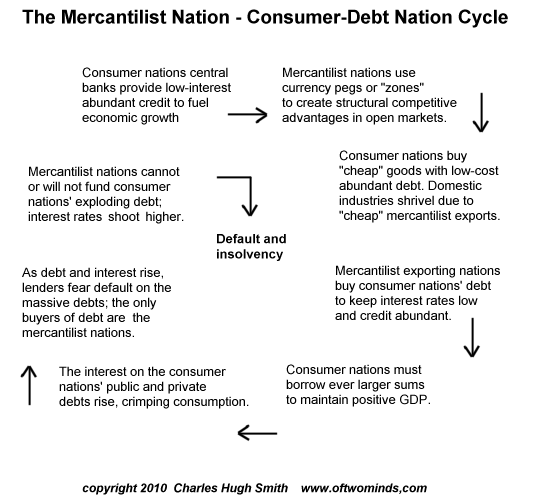
Here’s the problem when debtor/importer eurozone members such as Greece go broke and default: Who is left standing to buy all the mercantilist exporters’ goods? Ultimately, much of those goods were purchased with debt, and when debtor nations default, the credit spigot is turned off: no more borrowing, no more money to buy Dutch, German and Chinese exports.
This chart illustrates the dynamic between mercantilist and consumer nations:

Although the euro was supposed to create efficiencies by removing the costs of multiple currencies, it has had a subtly pernicious disregard for the underlying efficiencies of each eurozone economy.
Though German wages are generous, the German government, industry and labor unions have kept a lid on production costs even as exports leaped. As a result, the cost of labor per unit of output — the wages required to produce a widget — rose a mere 5.8% in Germany in the 2000-09 period, while equivalent labor costs in Ireland, Greece, Spain and Italy rose by roughly 30%.
The consequences of these asymmetries in productivity, debt and trade deficits within the eurozone are subtle. In effect, the euro gave mercantilist Germany a structural competitive advantage by locking the importing nations into a currency that makes German goods cheaper than the importers’ domestically produced goods.
Put another way: By holding down production costs and becoming more efficient than its eurozone neighbors, Germany engineered a de facto “devaluation” within the eurozone by lowering the labor-per-unit costs of its goods.
The euro has another deceptively harmful consequence: The currency’s overall strength enables debtor nations to rapidly expand their borrowing at low rates of interest. In effect, the euro masks the internal weaknesses of debtor nations running unsustainable deficits and those whose economies had become precariously dependent on the housing bubble (Ireland and Spain) for growth and taxes.
Prior to the euro, whenever overconsumption and overborrowing began hindering an importer-consumer economy, the imbalance was corrected by an adjustment in the value of the importer’s currency. This currency devaluation would restore the supply-demand and credit-debt balances between mercantilist and consumer nations.
Absent the euro today, the Greek drachma would fall in value versus the German mark, effectively raising the cost of German goods to Greeks, who would then buy fewer German products. Greece’s trade deficit would shrink, and lenders would demand higher rates for Greek government bonds, effectively forcing the government to reduce its borrowing and deficit spending.
But now, with all 16 nations locked into a single currency, devaluing currencies to enable a new equilibrium is impossible. And it leaves Germany facing with the unenviable task of bailing out its “customer nations” — the same ones that exploited the euro’s strength to overborrow and overconsume.
On the other side, residents of Greece, Italy, Spain, Portugal and Ireland now face the painful (and ultimately unworkable) effects of government benefit cuts aimed at realigning budgets with the productivity of the underlying national economy.
Either Germany and its export-surplus neighbors continue bailing out the eurozone’s importer/debtor consumer nations, or eventually the weaker nations will default or slide into insolvency. Greece is merely the first domino to fall.
Now an inescapable double-bind has emerged for Germany: If Germany lets its weaker neighbors default on their debts, the euro will be harmed, and German exports within Europe will slide. But if Germany becomes the “lender of last resort,” then its taxpayers end up footing the bill.
If public and private debt in the troubled nations keeps rising at current rates, it’s possible that even mighty Germany may be unable (or unwilling) to fund an essentially endless bailout. That would create pressure within both Germany and the debtor nations to jettison the single currency as a good idea in theory, but ultimately unworkable in a 16-nation bloc as diverse as the eurozone.
Despite endless assurances that the Greek debt crisis is contained, the reality is that the ragin’ contagion of debt crises will spread not just to other deeply indebted nations but to the mercantilist economies that depend on selling goods to borrowers. Strip out the borrowing, and you strip out most of the customers for German, Dutch and Chinese goods.

Tuesday, June 30, 2015

Greece: The Five Possible Paths Forward

Tyler Durden's picture

http://www.zerohedge.com/news/2015-06-30/these-are-greeces-5-possible-paths
Greece is poised between remaining a member of the eurozone or leaving it. In fact, as WSJ's Stephen Fidler explains, there are five possible future currency arrangements for Greece. Here they are...
1. Greece stays in the eurozone: This is the option likely to cause the smallest short-term disruption to the Greek economy.  The Greek central bank would retain access to liquidity from the European Central Bank, and the Greek banks would stay on life support. This looks increasingly likely to be accompanied by some kind of further negotiated debt relief. To get it, Greece would almost certainly have to agree to more conditions of the sort successive Greek governments have found it hard to accept.

2. Greece keeps the euro, but sits outside the eurozone: Jacob Funk Kierkegaard of the Peterson Institute for International Economics in Washington calls this the “Montenegro option” and argues this is the most likely outcome should Greece exit the eurozone.  This would not be “a new drachma, but Montenegro—i.e. Greece becomes just another relatively poor unilaterally euroized non-EU Balkan economy,” he writes here. In some ways, this would be the worst of all worlds because Greece would lose access to the ECB. Countries using a foreign currency as legal tender have no access to a lender-of-last-resort, which means that every bank liquidity crisis becomes a solvency crisis. They therefore tend to have stunted domestic financial sectors — which almost every academic study shows is bad for growth — or have a banking system owned by foreigners, which exports the lender-of-last resort role to other countries’ central banks. (Mexico didn’t adopt the dollar after the 1994-95 financial crisis — but in order to avoid an undue shrinkage of its banking sector, it allowed most of its banks to be bought by foreigners.)

3. A currency board: In this case, Greece would create a new currency but lock it to the euro  – as Estonia did with the German mark in 1992 after it gained independence from the Soviet Union. The amount of new drachmas in circulation would be limited by the size of Greece’s international reserves: about $5.8 billion at the last count. Advocates argue that this would impose discipline on the Greeks — poor economic policies lead to an outflow of reserves and therefore of the domestic monetary base, which pushes up drachma interest rates, while good policies have the reverse effect. The drawback is that again the central bank is limited in its lender-of-last resort powers because it cannot create money freely. It also imposes discipline that, for now, may make it look unappetizing to Greece’s current rulers. It’s not much talked about, has a few enthusiastic and long-standing cheerleaders, but is a theoretical possibility. Here’s Steve Hanke arguing in favor.

4. A dual system: Here the drachma and the euro would circulate side-by-side. This has many historical precedents going back centuries. In practice, a dual system is likely to emerge when the Greek government runs out of euros and has to pay its domestic bills in government IOUs. The IOUs could at some future date be redeemed in euros, or could be eventually redeemed in drachmas, but they would initially be euro-denominated obligations of the government that would have a lesser value in the public mind than euro notes or coins. This state of affairs could continue for a long time, but there is an economic tendency called Gresham’s Law: ”Bad money chases out good.” Over time, euros would disappear from circulation because people would hoard them as a store of value  – and people would spend the government IOUs. De facto, the drachma, whether or not it would so be called, would become the main means of exchange.

5. The new drachma: The move to the new drachma may well not come with a bang, but gradually — as described in 4 above. But an eventual formal switch of the currency would give Greece control over its own monetary policy.  However, a new currency — which would likely float against the euro and other major currencies — would likely create enormous short-term disruption, not least because a heavy devaluation would follow and the banks would in effect be insolvent. Longer-term, it could be a motor for future growth of the Greek economy — because it would stimulate demand for Greek exports by lowering in real-terms the price of goods and services produced in Greece.  Longer term, the effects of a devaluation depends on the quality of economic policies that accompany it. It will create inflation, by increasing the costs of imports. One important issue is how much the government raises wages and pensions to compensate for higher inflation. The more domestic wages and pensions are allowed to rise, the less impact the devaluation will have in simulating Greek exports longer term and the lower the benefits to economic growth.
*  *  *
Place your bets.

Friday, June 26, 2015

Of Bureaucrazies & Demoncracy: The People Must Be Overthrown

Tyler Durden's picture

http://www.zerohedge.com/news/2015-06-26/bureaucrazies-demoncracy-people-must-be-overthrown
Submitted by Raul Ilargi Meijer via The Automatic Earth blog,
Perhaps I should apologize for writing about Greece all the time. Thing is, not only have I just arrived in Athens last night (and been duly showered in ouzo), but Greece is the proverbial early harbinger of everything that’s wrong with the world (not to worry, I know that’s a hyperbole), and of everything that could be done about it.
That places a responsibility on the shoulders of Syriza leader Alexis Tsipras and his team that maybe they don’t want, and for all I know don’t deserve either. But they’re all we have, and besides, they’re all their own people have. In that sense, this is not about everything that’s wrong with the world, other than that’s the same as everything that’s wrong with Greece.
I was struck last night, talking to people here in Athens, by how much their appreciation of Tsipras, his overall composure and the way he handles the Troika talks, has increased over the past five months. They were doubtful about him before the Syriza election win; they no longer are.
Still, the negotiations are nice and all, but they’re not going anywhere, and they never will. The Troika side of the table is interested in one thing only: to humiliate Athens and force it into ultimate submission, along the lines of those photographs we’ve come to know of Abu Graibh.
Yanis Varoufakis labeled the Troika policies vis-a-vis Greece ‘fiscal waterboarding’ when he started out as finance minister, and here’s thinking he should have stuck with that image in a much more persistent and a much louder fashion.
Yes, we know, Syriza doesn’t have the mandate to take the country out of the eurozone. A daily dose of fear tactics in the domestic and international media still have Greeks, even Syriza voters, scared stiff about going it alone.
It’s time for Tsipras to turn to his people, on national TV, and say look, whatever we can discuss with the Troika, and whatever compromise we may be able to reach, there is no option on or off the table that would allow for you, the people of Greece, to not be debt slaves for the rest of your lives.
The European Union is merely a crude modern version of a feudal society (but without the debt jubilee older versions had), that’s all the morals that Brussels and Berlin can muster. And, Tsipras should say, if that is what you want, if you want to be slaves instead of a free people, tell me so. I will draw my conclusions from that.
But this is getting painful. We have an entire team of Greece’s brightest drawing up plan after plan, most of which are never even discussed by the Troika. It all comes down to you, the people, and we, your representatives, being rudely insulted every minute of the day by people whose only interest is their own personal careers and agendas.
I, Alexis Tsipras, think I deserve better than that, and much more importantly, I think my people deserve better than that. But in these negotiations, no matter how long they last, we will never get what we deserve. The Troika seeks to humiliate us, and force us on our knees with our pants down our ankles and a hood over our faces..
This will take courage on the part of Tsipras; it may well end his political career. But such courage is exactly what the Greek people need to see. They need a leader who is willing to put it all on the line, or else why would they themselves?
The threat of Armageddon following an exit from the euro is an abstract and unknown phenomenon akin to various bogeymen used to keep children in check, akin to the threat of drowning that makes waterboarding such an inhumane experience.
But whatever may or will happen, there is nothing that says or guarantees that a euro-less Greece will be worse off than it is now. Not even from a purely financial point of view (other than for an initial short period of time).
What the Greeks are sure to gain, though, is their independence, their dignity, their pride. Why on earth would they, once they understand the predicament, vote to stay on and pay their odious debts and kowtow to the five families in Brussels and Berlin for the rest of their lives?
It makes no sense at all, and it makes no sense for Tsipras and his team to keep on negotiating for a deal that will never do anything but humiliate them, and shackle the people who voted for them. There is no other possible option on the table, and there won’t be in the future.
As I was writing this in the early Athens morning, I saw an article by my dear friend Steve Keen come in, and I’m very pleased to see Steve think along the same lines I do, at the same time.
This belief that economists know better than politicians how to run an economy was enshrined in the Maastricht Treaty itself, which limited government deficits to 3% of GDP and government debt to 60% of GDP. It was a set of rules designed to shackle political freedom, so that the economy could flourish under the incorruptible leadership of experts.

Some experts. Firstly they designed a system which would only work if capitalism never had crises. Secondly, when a crisis hit, rather than backpedalling on their flawed rules, they doubled up on them. Then, when the people had the temerity to elect a government which opposed their agenda… Well it’s obvious, isn’t it? The people must be overthrown.

I know from personal conversations with Varoufakis and his advisors, as well as from the public record, that Syriza is willing to do almost anything to stay within the Euro. As Yanis put it at the INET conference in Paris in April, the Euro is a bit like the Hotel California: you should never check into it in the first place, but if you do, you can never leave.

But the conditions the IMF, EU and ECB are insisting upon here are so extreme, and their behaviour so counter to the very concept of democracy, that maybe the Greeks would do better to show them what a democratic government can do. Maybe they should leave the Euro, and default on all their debts—especially those to the Troika. The financial stimulus from throwing off the yoke of debt may counterbalance the initial chaos from re-instituting a national currency in a seriously damaged society.
It may also teach the bureaucrazies -and no, that is not a misprint- a lesson about the limits of bureaucratic power.
You know, it’s true that maybe it’s too much for outsiders such as Steve Keen and myself to ask of Alexis Tsipras, and the people of Greece, to jump into a big unknown. But it’s also too much to bear to watch the inane piece of theater being played out by quasi elected B movie protagonists.
And no, none of us get a free pass on this one. Your voice is long overdue. Because no matter where you are or who you are, whether you’re American or European, it’s still your government, acting in your name, that supports and magnifies the craziness unloaded upon the cradle of democracy.
All the Greek people know until now is that Europe and the IMF are attempting to strangle them. Still, so many among us don’t agree with that at all. Thing is, it’s time to let that be known. To the people of Greece, and to our own ‘leaders’ who if we don’t get vocal will continue to do as they please. Just because the people you’ve elected don’t have any morals doesn’t mean you don’t have to either.

Thursday, June 25, 2015

Collapse, Part 1: Greece

The theme this week is collapse. It’s a big, complex topic because there are as many types of collapse as there are systems. Some systems appear stable on the surface but collapse suddenly; others visibly decay for decades before finally slipping beneath the waves of history, and some go through stages of collapse.
The taxonomy of collapse is broad, and each unsustainable system (i.e. a system that will fail despite claims to the contrary) has its unique characteristics.
Which brings us to Greece.
I have written extensively about Greece and the doomed financial arrangement known as the euro for many years–for example: Greece, Please Do The Right Thing: Default Now (June 1, 2011).
When Debt is More Important Than People, The System Is Evil (February 18, 2012)
Greece at the Crossroads: the Oligarchs Blew It (January 27, 2015)
Greece and the Endgame of the Neocolonial Model of Exploitation(February 19, 2015)
When Europe Gets Greece’s Jingle Mail: Dealing with Default (May 15, 2015)
With the bankruptcy of Greece now undeniable, we’ve finally reached the endgame of the Neocolonial-Financialization Model. There are no more markets in Greece to exploit with financialization, and the fact that the mountains of debt are unpayable can no longer be masked.
Europe’s financial Aristocracy has an unsolvable dilemma: writing off defaulted debt also writes off assets and income streams, for every debt is somebody else’s asset and income stream. When all those phantom assets are recognized as worthless, collateral vanishes and the system implodes.
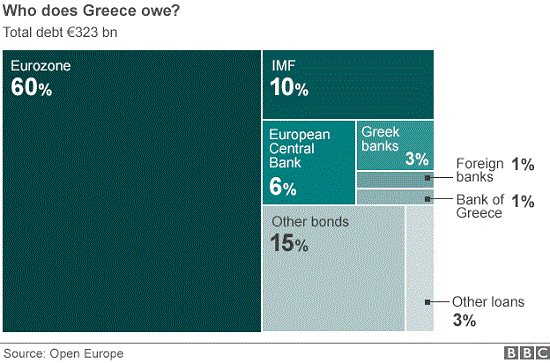
The peripheral nations of the EU are effectively neocolonial debtors of the core, and the taxpayers of the core nations are now feudal serfs whose labor is devoted to making good on any loans to the periphery that go bad. (see chart of Greece’s debtors below)
Greece’s financial/political Elites milked the entry into the EU for all it was worth, effectively destroying the Greek economy in their limitless looting: Misrule of the Few: How the Oligarchs Ruined Greece.
What has already collapsed is the faith that institutions within Greece and the European Union can effectively manage the inevitable Greek default. As noted in the essay linked above, Greece’s power structure is designed to do one thing: protect vested interests and dissipate accountability.
The same can be said of the European central Bank (ECB) and the European Union (EU). Both were sold as abstract financial magic: the Elitist power structures of every nation in the union–the ultimate source of the rot that is now emitting the foul stench of collapse–would be left intact while the economies of all member nations would magically produce more goods and services based on ever-expanding debt and leverage.
This leads to the critical question of the hour: who’s saving whom? Are last-ditch bailouts saving the Greek people and the integrity of their nation, or are they simply saving the political/financial Elites who benefited from EU membership and the systemic expansion of debt?

Here’s another key question: who’s being punished by the Troika’s “nobody defaults and gets away with it” policy? Clearly, the Greek people are being punished–but to what end? What about punishing the political/financial Elites who benefited from Greece’s entry into the EU and the banking Elites who profited from the irresponsible expansion of loans to Greece?
If Greece had defaulted four years ago when default was already visibly inevitable, the Greek citizenry would already have worked through the painful crisis of adjusting to a dearth of external credit and perhaps a new currency, and maybe they would have jettisoned their corrupt and self-serving Elites, clearing the way for sustainable growth and governance.
Instead, the Greek people have suffered for nothing. Default is still inevitable, as is the resulting EU-wide currency-political crises.
When systems are broke and broken, collapse is the only way forward. Only collapse breaks the grip of vested interests and opens the political process to non-Elite participation. By pushing default/collapse forward for four long years, the Greek Elites have punished their citizens for absolutely no yield on their immense suffering. Greece can no more escape the black hole of default than it could four years ago.
Central and private banking magic has failed. The idea that corrupt, self-serving Elites would magically create widespread prosperity by borrowing money that could never be paid back has collapsed, though the Power Elites of the Troika cling to this foolish fantasy because they have no other choice if they want to retain power.
The only faith remaining in the EU Elite is belief in the goddess TINA–there is no alternative. But there is always another alternative: collapse of the status quo and the assembly of an alternative arrangement that doesn’t concentrate power in the hands of a few at the expense of the many.

Tuesday, June 23, 2015

The Unspoken Tragedy In The Upcoming Greek Bailout

Tyler Durden's picture

http://www.zerohedge.com/news/2015-06-23/unspoken-tragedy-upcoming-third-greek-bailout
A day after Tsipras stunned both his peers at the Eurogroup summit, and not to mention his fellow parliamentarians, many of which already voiced their opposition to what has been dubbed a "capitulation" by the Greek prime minister over threats of a financial system collapse if there is no deal within the week, many questions remain:
  • will the Troika come back with even more demands such as boosting the hotel and restaurant VAT even higher (economic suicide for a nation where tourism is the only viable industry)?
  • will the IMF concede that the Greek proposal will ever be sufficient if it does not incorporate the demanded pension cuts?
  • will the deal pass Greek parliament; will a deal come too late to save the insolvent Greek banks?
  • will Greece get a debt haircut (paradoxically as demanded by the same IMF which is also demanding spending cuts instead of tax hikes, over the objections of the ECB which holds the vast majority of Greek debt and is leery of impairments)?
  • will the German parliament agree to validate any deal that may end up splitting Syriza in two or more factions?
While stock markets are convinced a deal is inevitable, after all the can must be kicked as it has been for the past five years...


... that may be more problematic than the algos expect. Here are some quotes showing that despite Tsipras' capitulation, few if any are ready to follow in his footsteps:
For example Austria:
Austria's finance minister said on Tuesday there would be no agreement on new Greek budget proposals unless there was a concrete plan showing how they would be carried out. But he added: "If there is no programme for actions that says what measure will be implemented when , we will not agree to it." "It should not, cannot, must not happen that a third (bailout) programme is started so to speak through the back door," he said. (Source)
or Germany:
 Members of Chancellor Angela Merkel’s coalition said the International Monetary Fund’s backing for a financing plan for Greece is key to German parliamentary support for a deal.  “If there’s to be a payout, we need a detailed calculation by the IMF,” Antje Tillmann, the ranking Finance Committee member from Merkel’s Christian Democratic bloc, said by phone. “It has to add up to something sustainable.”

“For us, the IMF’s verdict is the benchmark for a credible, acceptable solution,” said Joachim Poss, deputy caucus leader in the lower house for the Social Democrats, Merkel’s junior coalition partner. (Source)
Or the IMF:

The IMF is still unhappy with key aspects of Greece’s new economic proposals and German officials were irritated by the speed with which the commission welcomed them, warning that much work needs to be done... IMF representatives have told European officials that they are also not satisfied yet by Greece’s broader economic overhaul plans beyond its budgetary promises. The IMF sees a wider, business-friendly shake-up of Greece’s economy as essential if the country is to improve its long-term economic growth. (Source)
Or impartial third parties:
“Very large problems remain for a solution,” said Jacob Funk Kirkegaard, a senior fellow at the Peterson Institute for International Economics in Washington. “The Greek government -- somewhat surprising for a self-professed reform and anti- austerity government -- seems to have merely agreed to impose a lot more austerity through higher taxes, but offers relatively little commitment to genuine economic reform.” (Source)
And certainly Greece:
“Personally, I cannot support such an agreement that is contrary to our election promises,” Dimitris Kodelas, a Syriza lawmaker associated with former Maoists, said in an interview. “I do not care about the consequences of my decision.” (Source)
The litany continues, and yet, somehow, we expect that in the next 48 hours, the machinery will be again in motion to kick the can once again for third time.
What happens then is basically a precursor to a third bailout package, one which according to previous reports, will be about €35 billion if and when a deal gets done.
At which point, assuming the funds are wired to Greece, the Athens government can congraulate itself on a job well done, even though, as some critics above pointed out, it "merely agreed to impose a lot more austerity through higher taxes, but offers relatively little commitment to genuine economic reform."
One can ask: why didn't any of the previous government impose higher taxes in the past 5 years? The answer is they did, and nobody paid them. And this is why this latest pre-bailout will also be a failure, followed perhaps by bailout #4, #5 and so on.
All of this is known to everyone.
What isn't, or perhaps merely needs refreshing, is that assuming all of the above is resolved in a satisfactory matter, what will be the use of funds of this latest and greatest bailout of Greece.
Sadly, the answer is also well known. We showed it first back in 2011 when we asked, rhetorically, "where does the Greek bailout money go?"
So for those who don't recall, here is a refresher from Macropolis, which a few months ago showed that of the €226.7 billion euros disbursed to Greece since the first Greek bailout, an equivalent to almost 125% of Greece 2014 GDP, "the combined allocation to the Greek state’s operating needs was just 11 percent of the total funding, at circa 27 billion euros."


That's right: hundreds of billions "spent" to rescue Greece... with the vast amount of proceeds used to promptly repay the very sources of these funds: the IMF and the ECB.
So will this time be any different, and will the Greeks receive anything extra? Alas no, because here are the near-term Greek debt interest and maturity payments...


... and the longer term.

So to emphasize, just in case there is any confusion: whatever money Greece receives as part of its third pre-bailout, followed by another full-scale bailout which according to SocGen will amount to another €60-80 billion or more, followed by another... until all Greek collateral - including its gold - finally runs out, will be used first and foremost to satisfy Troika, pardon, creditor claims.
Which means that of this widely touted €35 billion, Greece will be lucky to pocket a little over €3 billion. However, considering that is how much the Greek government has already extracted out of various public pensions and municipalities as part of its quasi-capital controls unrolled previously to preserve the illusion of solvency, after the hard fought "deal" finally is inked, the Greek population will be left with...
€0.
And that, sadly, is the unspoken tragedy in the upcoming Greek bailout. Because while it is one thing to bend over backwards to Troika interests if one at least gets something out of the deal, we completely fail to see why the Syriza government is risking its entire reputation, and doing what it is doing when in the end the Greek population which elected the "radical leftist" party with such wild hope and optimism has absolutely nothing to show for it.

Monday, June 22, 2015

Goldman And SocGen Unleash The "C"-Word: ECB Alone Can't Contain Grexit Risks

Tyler Durden's picture

http://www.zerohedge.com/news/2015-06-21/new-greek-proposals-hit-socgen-goldman-unleash-c-word-fear-ecb-alone-cant-contain-gr
Unnamed "officials" have proclaimed a new set of Greek proposals received by Brussels tonight as "a good base," according to AFP, and thusly the Euro is very modestly bid. However, both Socgen (without a 3rd bailout of €60-80 billion over the next 3 years, Greek uncertainty remains high and leaves Grexit risk merely semi-stable) and Goldman (a deal will come only after the introduction of capital controls, a technical default on the IMF and issuance of IOUs/and a further build-up of arreas... and the damage resulting from a breaking of the integrity of the Euro would not be fixed by monetary policy alone) leave us wondering just who is buying Euros and US stocks and selling Swiss Francs as D(efault) Day looms and the 'C' word (contagion) spreads.
Sure why not...

A good early start to the rumor mill...
But SocGen remains unconvinced...
At best, a semi-stable agreement is in the making

In calling Monday’s emergency summit on Greece, European Council President Greece warned Friday that we are “close to the point where the Greek government will have to choose between accepting what I believe is a good offer of continued support or to head towards default”. He further added that “there is still time, but only a few days”. In Athens, the weekend saw a flurry of activity that concluded with a conference call with Prime Minister Tsipras, Chancellor Merkel, President Hollande and Commission President Juncker. Few details have emerged, however, on what was said on the call.

Back in early June, both Greece and its creditors presented proposals for an agreement. At the time, Prime Minister Tsipras was told that any measures replaced must deliver the same fiscal impact. The proposed alternatives have, however, so far not been deemed credible by Greece’s creditors.

Reducing tax exemptions: According to the news flow, the new proposal contains scrapping of a range of tax exemptions and a further reduction in early retirement schemes. The aim is to protect broader pensions from further cuts (the creditors want to see savings of 1% of GDP annually by 2016-17) and avoid a VAT increase on electricity. Furthermore, the creditors want no reversal of labour market reforms. Combined, Greek tax exemptions amount to around €3bn.

A six-month extension: Press reports suggest that in addition to unlocking the remaining €7.2bn of bailout funds, Greece’s creditors are preparing to offer a six-month extension of the current programme, allocating €10bn of bailout funds initially set aside to recapitalise banks to ensure that Greece has sufficient liquidity to meet its obligations until year-end. The Greek authorities fear that a short-term solution would leave the economy in a state of lingering uncertainty that would weigh further on confidence and thus growth. The next batch of PMI data will give an idea of how much damage the crisis has inflicted on business confidence. Meanwhile, bank lending rates remain high, and notably for SMEs (cf. charts below).

CHART

No talk yet of debt rescheduling: An important point for the Greek government is rescheduling of the debt. At the press conference after Thursday’s Eurogroup, President Dijsselbloem not that “We have not discussed this proposal, because the logical order of things is that we first reach an agreement on the terms of fiscal measures, reforms, etc. , before we look into the future. The Greek proposal was part of their vision of the future”. This confirms our view that there will be no “unconditional” debt rescheduling for Greece, i.e. this would come only after measures are delivered and is more likely to be part of the discussion of a third bailout programme.

At best semi stable: If agreement is reached along the lines outlined above, it would to our minds be only semi-stable. First, implementation risks and political risks would remain elevated. Second, negotiating a third bailout programme for Greece is likely to be a challenging exercise. As a result, uncertainty would remain high, leaving Greece at risk of further economic disappointment. We estimate that the country needs €60-80bn over the coming three years, and that is assuming a still fairly benign economic environment and no new bank recapitalisation programme. Given the frail stance of the economy, the risk to our estimate is very clearly biased to the upside.
And Goldman Sachs even less so...
Our central case that a deal will come only after (or thanks to) the introduction of capital controls, a technical default on the IMF and issuance of IOUs/and a further build-up of arreas. The logic is that it is only when the cash constraint is fully binding and associated economic and financial stresses escalate that the Greek authorities would be able return to the negotiating table and compromise with official creditors. With many precedents to point to, we recognize that going into Monday’s policy meetings risks are skewed in favour of a last minute appeasement. This would allow a partial disbursement of funds withheld under Greece’s 5th review upon the passage of new measures, avert a credit event on the IMF and the ECB and buy time for more strategic discussions, i.e. push the problems to a future date. Should this not occur, and the base case be realized, risk would flip in the direction of outright Grexit.
Mapping Market Response to Three Possible Scenarios
To start, it is important to recognize that the financial risk emanating from developments in Greece is very specific. An increase in the correlation between Greek public debt securities and those of other EMU peripherals has not given way to a decline in asset prices of the proportions seen during 2011-12. There are good reasons for this. The majority of Greece’s public sector exposure is now with the foreign official sector (the roughly EUR 40bn of government bonds held in private hands are for the most part marked-to-market). As tensions have increased since the new Greek government took power, private claims against Greek banks (deposits and credit lines) have declined, with the ECB filling the void. Finally, the ECB has also been active in the secondary government bond market, and is expected to absorb between 40 and 80% of the gross supply of Euro area government bonds this year. The main effect of Greece thus far has been on volumes, and market liquidity. This is particularly evident in fixed income, especially in Euro area corporate credit. In our view, Greek risk would materialize on broader asset prices in much more prominent way if the chances of Grexit were to increase.
Our market stance since the start of the second quarter has called for higher core rates and wider, more volatile peripheral spreads as the July bond redemptions approached. Here we map the three possible scenarios mentioned above to market responses, using the average spread between 10-yr Italian and Spanish government bonds to their German counterparts as a gauge (for brevity, we refer to this differential as the ‘bond spread’ henceforth).
The ‘base case’: Should the imposition of capital controls and the introduction of IOUs prove to be the only way to reach a compromise, we would expect the bond spread to drift wider from the current 150bp to eventually as much as 200-250bp. To be sure, a ‘default’ and ‘capital controls’ are now consensus (going by our client interactions, we would say that at least 2-in-3 investors expect these joint events to occur). But by the same token, those anticipating Grexit remain a minority, as most point to opinion polls suggesting that the Greek population still wants to stay in the single currency. The reasons we are more pessimistic are twofold. Capital controls in Cyprus were an integral part of a negotiated package designed to restructure an insolvent banking sector.

On the reverse, in the case of Greece, they would come because efforts to agree on a plan have repeatedly failed. Once cash is blocked and state payments are in other means than the EUR, the distinction between being part of the Euro system and not could start becoming more blurred. Also, the political and social reaction in Greece to a failure to find a compromise is unpredictable. After all, Europe has so far not offered a ‘growth strategy’ for its member states and too frequently remains a synonym for myopic austerity. As the base case unfolds, we think the market would adjust upwards the probability of Grexit.

The ‘accommodation’: Probably spurred by news of a gathering at the highest political level, investors have started to hope that an appeasement is in sight. After all, this would conform to the pattern of Euro area negotiations seen in the past. A compromise could be centred around the structure contained in the 5th program review (e.g., higher direct taxes, some changes to access to pensions, etc) and -conditional on the Greek government passing measures in Parliament - unlock just enough financial resources to allow the government to make payments to official sector creditors during the Summer months and pay wages and pensions. This would probably lead to more strategic discussions over the second half of the year, with no major concessions until after the Spanish election booths are closed. The market would likely salute another ‘kick to the can’ with a relief rally. This could take the bond spread 20-30bp tighter to the 120-130 area, as hedges are covered and quick gains are sought. German Bunds in this scenario would still stay in the 80-90bp range. But without indications on what the strategy for Greece entails, however, we doubt that intra-EMU capital flows and market liquidity would materially improve. The Greek government would still operate on a very tight cash constraints, deposits might continue to decline, and the economic contraction extend.

ECB President Draghi stated at a press conference on 03 June that a ‘strong agreement’ for Greece should have four characteristics: ‘produce growth’, have ‘social fairness’, be ‘fiscally sustainable’ and ‘address the remaining sources or factors of financial instability in the financial sector’. The order in which Mr Draghi chose to order these elements is significant. What, in our view, would meet the criteria for a strong deal is (i) an emphasis on deep structural adjustments and their timely implementation, (ii) realistic growth and primary balance targets and (iii) an explicit re-profiling of public debt, possibly going beyond the promises made to Greece in November 2012. Realistically, seeing this happen on Monday is far fetched, but a move in this direction in coming months could see the bond spread returning below 100bp by the end of the third quarter.

The Road to ‘Grexit’: As discussed previously there is a myriad of possible interim currency arrangements, including dual currency circulation, which would qualify Greece still being formally ‘in’ but de facto having a foot out the door. In the extreme event of Greece introducing a new currency and defaulting on its exposures vs the ECB and the other Euro area member countries, we have stated that the bond spread could widen to 350-400bp, involving yields on BTPs and Bonos of around 4.00%.

A widespread assumption is that if we were to head this way, the ECB would intervene to stem financial contagion in other EMU members. An effective way of doing so would be, for example, instructing national central banks in the core countries to purchase bonds issued by peripheral member states, signalling cross-country risk transfers (currently, each central bank is buying its own debt so that credit risk is not mutualized).

Provided they are pre-emptive, policy countermeasures of this sort would support financial asset prices. But the damage resulting from a breaking of the integrity of the Euro would not be fixed by monetary policy alone, in our view. For all its specificities, the failure to keep Greece in the Euro would highlight the limitations of the growth and fiscal arrangements of the current Euro area policy framework, offer a precedent to other governments (and their oppositions), and crystallize the convertibility risk on all Euro area securities. Institutional upgrades to the economic and monetary union, along the lines of those included in the Four Presidents Report which European leaders are to discuss at the end of this month, would be required to overcome the ‘shock’. A key dimension over which these upgrades would be judged is the degree of ex ante risk sharing among Member States they involve. Examples include Euro area-wide bank deposit guarantees or an embryonic Euro area Treasury.
*  *  *
Crucially - as we already noted - the most important factor tomorrow will be the ECB's decision and implicitly the potential collateral availability. Before talking heads spout their usual blather on last minute deals and how great they are, perhaps a detailed read of the collateral problems ahead is in order (or - quite simply - you are entirely unqualified to judge the next steps).