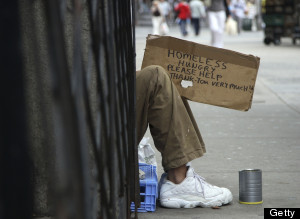
Submitted by Tyler Durden on 11/03/2015 13:00 -0500 http://www.zerohedge.com/news/2015-11-03/21-shocking-facts-about-explosive-growth-poverty-america Submitted by Michael Snyder via The Economic Collapse blog,
What you are about to see is more evidence that the growth of poverty in the United States is wildly out of control. It
turns out that there is a tremendous amount of suffering in “the
wealthiest nation on the planet”, and it is getting worse with each
passing year. During this election season, politicians of
all stripes are running around telling all of us how great we are, but
is that really true? As you will see below, poverty is reaching unprecedented levels in this country, and the middle class is steadily dying.
There aren’t enough good jobs to go around, dependence on the
government has never been greater, and it is our children that are being
hit the hardest. If we have this many people living on the edge of
despair now, while times are “good”, what are things going to look like
when our economy really starts falling apart? The following are 21 facts about the explosive growth of poverty in America that will blow your mind…
#2 Other numbers from the U.S. Census Bureau are
also very disturbing. For example, in 2007 about one out of every eight
children in America was on food stamps. Today, that number is one out of every five.
#3 According to Kathryn J. Edin and H. Luke Shaefer, the authors of a new book entitled “$2.00 a Day: Living on Almost Nothing in America“,
there are 1.5 million “ultrapoor” households in the United States that
live on less than two dollars a day. That number has doubled since
1996.
#446 million Americans
use food banks each year, and lines start forming at some U.S. food
banks as early as 6:30 in the morning because people want to get
something before the food supplies run out.
#5 The number of homeless children in the U.S. has increased by 60 percent over the past six years.
#6 According to Poverty USA, 1.6 million American children slept in a homeless shelter or some other form of emergency housing last year.
#7 Police in New York City have identified 80 separate homeless encampments in the city, and the homeless crisis there has gotten so bad that it is being described as an “epidemic”. #8 If you can believe it, more than half of all students in our public schools are poor enough to qualify for school lunch subsidies.
#9 According to a Census Bureau report that was released a while back, 65 percent of all children in the U.S. are living in a home that receives some form of aid from the federal government.
#10 According to a report that was published by UNICEF, almost one-third of all children in this country “live in households with an income below 60 percent of the national median income”.
#11 When it comes to child poverty, the United States ranks 36th out of the 41 “wealthy nations” that UNICEF looked at.
#13 An astounding 45 percent of all African-American children in the United States live in areas of “concentrated poverty”.
#1440.9 percent of all children in the United States that are being raised by a single parent are living in poverty.
#15 An astounding 48.8 percent of all 25-year-old Americans still live at home with their parents.
#16 There are simply not enough good jobs to go around anymore. It may be hard to believe, but 51 percent of all American workers make less than $30,000 a year.
#17 There are 7.9 million working age Americans that
are “officially unemployed” right now and another 94.7 million working
age Americans that are considered to be “not in the labor force”. When
you add those two numbers together, you get a grand total of 102.6 million working age Americans that do not have a job right now.
#18 Owning a home has traditionally been a signal
that you belong to the middle class. That is why it is so alarming that
the rate of homeownership in the United States has been falling for eight years in a row.
#19 According to a recent Pew survey, approximately 70 percent of all Americans believe that “debt is a necessity in their lives”.
#20 At this point, 25 percent
of all Americans have a negative net worth. That means that the value
of what they owe is greater than the value of everything that they own.
#21 The top 0.1 percent of all American families have about as much wealth as the bottom 90 percent of all American families combined.
If we truly are “the greatest nation on the planet”, then why can’t we even take care of our own people? Why are there tens of millions of us living in poverty?
Perhaps we really aren’t so great after all.
It would be one thing if economic conditions were getting better and
poverty was in decline. At least then we could be talking about the
improvement we were making. But despite the fact that we are stealing
more than a hundred million dollars from future generations of Americans
every single hour of every single day, poverty just continues to grow like an aggressive form of cancer. So what is wrong? Why can’t we get this thing fixed?
Nervously sitting in the WorkSource office in downtown Seattle,
a slip of paper with my number rapidly yellowing with sweat clenched
between my fingers, a man in filthy jeans and mismatched shoes turned to
me and asked what I was doing there.
“You don’t look poor enough to be here,” he told me.
He was right. I didn’t. Because what we collectively think of as “looking poor” does not, in fact, encompass the real face of poverty
in this country. As a white, 22-year-old college graduate in a
second-hand dress, I did not look like what we think of as “poor.”
Of course, at that exact moment, I had, yes, a college degree and a coveted unpaid (because, of course, it was unpaid) internship at a public radio station. But I also had a minimum wage
job to support myself, $17 in my bank account, $65,000 in debt to my
name, and $800 in rent due in 24 days. I was extremely hungry, worried
about my utilities being shut off, and 100 percent planning to hit up
the dumpster at the nearby Starbucks
when I was done there. I had no functional stove in my tiny apartment
because the gas it took to make it work was, at $10 per month, too
expensive. I was at WorkSource to find out if I qualified for literally
any program to make my finances less crushing.
I had, like millions of other working Americans and many, many millennials, no financial safety net.
In the United States, approximately 15 percent of residents live below the poverty line and another 10.4 million are considered “the working poor.” And yet, we have very, very concrete—and very incorrect—perceptions about how poverty actually looks. And it does not look like millennial college grads. So we kind of keep ignoring it.
The
disconnect is simple: Poverty doesn’t look the way we think it looks,
so we don’t think people who are, in fact, poor “look poor,” so we
assume that poverty isn’t really that bad. We also assume that by taking
steps that have traditionally been associated with improved economy
status, it will get better.
We are now seeing that it might not.
Through college debt, we are minting a new generation of people with less opportunity, rather than more
Even if you glossed right over the teachings of Thomas Piketty,
you probably know that those who start out poor are more likely to stay
poor. When you are constantly fighting your way up from zero (or
negative), you tend to stay that way. And when education
is supposed to be the path out, if it leads to more debt, it’s more
cyclical than linear. New grads no longer start from zero—they start
with a negative balance.
Consider what we’re setting up for our
future by thinking about poverty in terms of how it should be, and not
how it is. We are pushing education on everyone, then punishing
education and the pursuit of a higher income with so much debt that
there is no way to win.
There is an assumption about college students that, when they graduate,
they will be permitted a small amount of time to get back on their feet
by moving home with their parents. With no small amount of contempt, we
refer to these people as “boomerang kids.”
However, just as is the case with almost everything, ever, the
ability to move back home—to take an unpaid internship without batting
an eye—is, in and of itself, a huge privilege. And it is a privilege
that begets other privileges.
In 2012, nearly half of American households were just one emergency away from poverty or homelessness. Most Americans don’t have the savings for literally one—one—unexpected bill. There are more individuals considered “the working poor” than there are who are not considered as such. Over 1.5 million individuals were
estimated to have been homeless at some point in 2014. In a country
where people never agree on a damn thing, nearly three-quarters of
people can agree on the sentiment that the poor are getting poorer.
They aren’t just getting poorer, though. We are making them poorer.
In the U.S., about a third of college students are
first-generation attendees, meaning their parents did not go to
college. That percentage is much higher among people of color. Many of
them—and even many students whose parents did go to college, but it’s
worse for first-gen students—don’t have the ability to move home after
college, either because:
A) Their parents don’t have the means to support them
B) Their parents live in impoverished areas where, if they were to move home, they would be unable to find work.
OR
C) Some combination of the two.
Or, possibly, D) Maybe they are one of the 20,000 kids who age out of foster care each year and there is just nowhere else for them to go.
But
for many of those first-gen college students (and students whose
parents, too, are considered the “working poor” but might even have some
college), graduation puts them worse off than they were before. The
idea that there is a safety net—that boomeranging is the norm—is just
not true, and it is detrimental.
Saddled with student loans they statistically will not be able to pay off for at least a decade (the average debt is about $30,000; the average income for a recent new grad is only about $44,000, and the unemployment rate hovers around 8.5 percent),
which are due every month on top of rent and other expenses, many
college graduates are worse off than they would have been if they’d
directly entered the workforce debt-free. More college students live in
poverty—actual poverty, not just
“can’t-afford-pizza-better-call-the-parents” brokeness—than the overall population. One in five millennials is considered “in poverty” today, up from one in eight in 1980.
The cycle is predatory. From the Boston Globe, reporting on a study released by Crittenton Women’s Union:
The
study, based on a survey of more than 100 low-income individuals, found
that most of the debts resulted from stretches of unemployment, medical
costs, and student loans. The study also found that poor people are
often overwhelmed by high interest rates that make it nearly impossible
to pay down debts, then penalized again when prospective employers or
landlords conduct credit checks before hiring or renting to them.
And the prospects are not improving. Because as income increases for college grads (58 percent of millennials will
receive a bachelor’s degree), so does the cost of living. So do
interest rates. So does the rent. So do home prices. So does the cost of
doing literally everything.
“Good” jobs—those jobs you need a degree for—still don’t pay the bills. More new college grads use food stamps than ever before; in fact, the demand has doubled. And while millennials are arguably facing the brunt of it, it doesn’t end there; even seniors are being hit by lingering student debt.
So what do we do? Make college more affordable? Free, even? Nope, say some. That won’t work, either.
Earlier this year, President Obama floated the idea of offering two free years of community college to anyone; critics immediately raised their fingers to
point out that if that happens, some people of means might take
advantage of that offering. Or that maybe a college education isn’t even worth that much, anyway, so why go into deeper national debt to provide one to everyone?
When education is
supposed to be the path out, if it leads to more debt, it’s more
cyclical than linear. New grads no longer start from zero—they start
with a negative balance.
Almost no solution for this problem seems to please anyone—and almost all of them that do have some kind of bipartisan support rely on already having access to money and resources or settling for an education that could put you at a disadvantage (something I’ve written about before).
And
yet, when most people think about poverty, they think something else.
Maybe they think about a homeless man begging for change. Maybe they
think of the “welfare queen,” who bilks the government for money (when,
of course, it is actually the wealthiest who
take the most). Maybe they think about a family that looked a lot like
mine did growing up (one provider, too many kids, receiving WIC and food
stamps and every other kind of assistance we could and even then still
living precariously close to poverty).
Most likely, they imagine
brown faces. Because don’t forget, part of what a lot of people mean
what they talk about what poverty looks like is a statement on and race
in America. When the man at WorkSource told me I didn’t “look poor
enough,” my whiteness was probably a big part of that sentiment.
And
that is also inaccurate. Which is not to say that people of color (and
especially millennials of color) don’t experience disproportionate
unemployment—they do—but it is to say that poverty is an everybody issue.
“As it turns out, our deeply racialized view of poverty bears no resemblance to reality,” wrote Leonard Pitts, Jr. for the Miami Heraldlast
year. “Though it’s true that African Americans are disproportionately
likely to live below the poverty line, it is also true that the vast
majority of those in poverty are white: 29.8 million people. In fact,
there are more white poor than all other poor combined.”
Still,
the ongoing challenges that face millennials of color are real. They
face more and different struggles than white millennials when it comes
to even getting into college. Higher high school dropout rates, disproportionate rates of incarceration, and other factors all contribute to the difficulty of even making it to college. The paths to college for white and non-white millennials are very different. But to what end?
Often, college graduation rates among people of color are hailed as proof that thing are getting better (which, in some cases, is actually pretty hopeful), because, while millennials are seeing some closure in the race gap, graduation rates are still pretty unequal.
The
prospects are not improving. Because as income increases for college
grads (58 percent of millennials will receive a bachelor’s degree), so
does the cost of living.
Except that graduation is still
not a guarantee of wealth, success, or even improved economy status. We
should forget about the gender pay gap, which starts basically right after women—yes, even women in STEM—get their diplomas.
Whatever poverty looks like to the general population, it is clearly not very sympathetic; most people don’t think that the government should provide more assistance than they currently are. In a 2012 poll, the majority of Americans surveyed said they thought welfare is being abused by those who rely on it. And our lawmakers continue to make it harder to bail ourselves out, blocking bills that would help make education less bank-breaking.
But we also, collectively, tend to agree that
poor people do not face an even playing field and that the roots of
poverty are systemic, not a result of laziness or failings by those who
are poor. We support raising the minimum wage because the plain fact is that life is more expensive now than it was 10, 30, or 50 years ago, and the idea that everyone should be able to rise above the minimum is just not realistic.
I
have been poor more than I have been not-poor. I grew up poor. I went
to a university (something that neither of my parents did, through
choice, circumstance, and a systemic series of beliefs about who college
is for) to no longer be poor, because I believed, as I was told by
guidance counselors and the media and many adults and colleges
themselves, that that was the only way to be not-poor.
And yet,
going to college made me, at least in the years since I’ve graduated,
more poor. I was more financially strained than I ever could have
imagined, more crushed by the persistent weight of debt, and more driven
by income than almost anything else. This is not about a lack of fiscal
responsibility; this is the fallout of a culture that says there is
only one way to get ahead, and that way is a treacherous one.
When
we talk about millennials, we can’t not talk about the debt that keeps
us reigned in, and the difficulty in getting out of it.
We
don’t look poor. I don’t look poor. And most often, I find it too
uncomfortable to talk about how really easy it is to be poor, even when
you’re working and you went to college and you are doing everything
right.
So I have to wonder: What if we stopped trying to decide who was poor
based on appearance and actually looked at the financials of those who
were scraping by? What if we calculated poverty not based on those who
were literally already homeless (though to be honest we do a shit job of
that, too), but rather based on everyone who is one missed shift away
from being completely out of money and options?
What if
people with resources—people who went to college at a time when they
could pay for college without mountains of debt, or people whose parents
were fortunate enough to be able to save for them, on their
behalf—stopped chiding those without for their perceived poor decisions
and instead decided to actually address the problem, which is that this
is an economic climate wherein it is damn near impossible to get out of
poverty?
When we talk about
millennials, we can’t not talk about the debt that keeps us reigned in,
and the difficulty in getting out of it.
What if we
acknowledged that there are more poor people than we realize and that
even doing literally everything prescribed by those with wealth does not
guarantee wealth?
What if we stopped wringing our hands about the death of the middle class and did something to attempt to resuscitate it?
To
this day, I don’t “look poor.” I have a nice apartment, the right kind
of job, clothes that don’t look like I bought them all on clearance
years ago. But don’t let my appearance fool you—I’m that millennial who is ruining the economy with my choices.
I
don’t own a vehicle, and I likely won’t be anywhere near able to afford
homeownership until I’m well into my 30s (no matter how many people
tell me it’s “actually not that hard” to get together a down payment) in
no small part because I started my path to adulthood, as I was told to
do, at a five-figure deficit. And frequently, at the end of a pay
period, after paying rent and another $600 in student loans for the
privilege of becoming the first in my family to graduate from college,
I’m right back to being one unforeseen expense away from an overdraw.
I don’t look poor—most of us don’t—but that doesn’t mean a whole lot. This article originally appeared on Medium and was reposted with permission. Hanna
Brooks Olsen is a writer, small human, and a millennial. Her interests
are politics, podcasts, Pac-12 football, feminism, and Oxford commas.
She is curious to a fault.
“If people were really self-interested, they would stop trying to be individualistic.” – John B. Cobb, founder of Seizing an Alternative conference (and here, videos here)
Economic Hitman John Perkins’ 2-minutes on today’s neo-colonialism capitalism:
Demonocracy’s 2-minutes on what the US national debt looks like if shown in actual amounts of $100 bills:
Clarke and Dawe’s 2-minute comedy on European debt crisis:
Earth economics is upside down.
Accelerating technology can and should provide:
more personal freedom from labor,
more beauty in infrastructure and nature,
greater joy in our freedom to create and explore our beautiful,
powerful, and diverse virtues (something like “resource-based economics”
as researched by The Venus Project).
We know what we have is in contrived Orwellian opposition of what leadership should create. We know that what we receive is literal criminal fraud:
ongoing intentional poverty
that kills ~20,000 children world-wide in gruesome slow-motion daily
($1 to $3 trillion over ten years would end poverty while reducing
population growth rates),
I could go on to literally ~100 areas of crucial concern.
The first challenge for the 99.99% is to trust their own Emperor’s New Clothes
observations that Earth is truly in this tragic-comedy rather than
listen to the .01%’s lies attempting to cover naked facts anyone can
see.
Please understand that I represent likely hundreds of thousands of
professionals making factual claims with objective evidence anyone with a
high school-level of education can verify. For example, the June 2015 Seizing an Alternative conference (and here, videos here)
at the Claremont Colleges had hundreds of professionals presenting data
and solutions in over 80 areas of speciality. My paper and videos for
this conference is here.
The purpose of education since the “Age of Enlightenment”
is to present facts for public verification, and to seize the victory
of refuting lies by would-be dictators, especially when such lies are
obvious and of crucial public importance. The path forward as we build a critical mass of humans recognizing the Emperor’s New Clothes truth is to demand arrests and solutions, obviously:
ARRESTS: the first responsible action upon recognizing
massive crimes that annually kill millions, harm billions, and loot
trillions is to demand that law enforcement and military enact arrests of criminal leaders to stop the crimes and begin unwinding the truth of what happened in Earth’s tragic-comedy (four-part article series with videos on arrests as the obvious citizen response).
SOLUTIONS: the .01% with corporate media have suppressed
solutions documented beginning with Benjamin Franklin how government can
abundantly operate without taxes: monetary and credit reform allow the
public to have near-instant prosperity: full-employment, zero public
deficits and debt, the best infrastructure we can imagine, falling
prices, and release of public TRILLIONS held in “rainy day” accounts. Full documentation here.
Humanity’s choices:
Ongoing .01% Orwellian, upside-down, tragic-comic, Emperor’s New Clothes crimes with all the pain, fear, harm, death, debt, poverty, enslavement, crime, destruction, and despair.
Arrests to stop the crimes of the present, and ready-to-start solutions to build a brighter future.
Be your brightest light as the person you’ve always wanted to be.
Former World Bank economist Herman Daly and co-author John B. Cobb of For the Common Good discuss our condition and pathways forward in this 40-minute interview:
** Note: I make all factual assertions as a National Board Certified Teacher
of US Government, Economics, and History, with all economics factual
claims receiving zero refutation since I began writing in 2008 among Advanced Placement Macroeconomics teachers on our discussion board, public audiences of these articles, and international conferences.
I invite readers to empower their civic voices with the strongest
comprehensive facts most important to building a brighter future. I
challenge professionals, academics, and citizens to add their voices for
the benefit of all Earth’s inhabitants.
**
Carl Herman is a National Board Certified Teacher of US Government,
Economics, and History; also credentialed in Mathematics. He worked with
both US political parties over 18 years and two UN Summits with the
citizen’s lobby, RESULTS, for US domestic and foreign policy to end poverty. He can be reached at Carl_Herman@post.harvard.edu
The Charles Koch Foundation recently released a commercial that ranked a
near-poverty-level $34,000 family among the Top 1% of poor people in
the world. Bud Konheim, CEO and co-founder of fashion company Nicole
Miller, concurred:
"The guy that's making, oh my God, he's making $35,000 a year, why
don't we try that out in India or some countries we can't even name.
China, anyplace, the guy is wealthy."
Comments like these are
condescending and self-righteous. They display an ignorance of the needs
of lower-income and middle-income families in America. The costs of
food and housing and education and health care and transportation and
child care and taxes have been well-defined by organizations such as
the Economic Policy Institute, which calculated that a U.S. family of three would require an average of about $48,000 a year to meet basic needs; and by the Working Poor Families Project, which estimates the income required for basic needs for a family of four at about $45,000. The median household income is $51,000.
The following discussion pertains to the half of America that is in or near poverty, the people rarely seen by Congress.
1. The Official Poverty Threshold Should Be Much Higher
According to the Congressional Research Service (CRS), "The
poverty line reflects a measure of economic need based on living
standards that prevailed in the mid-1950s...It is not adjusted to
reflect changes in needs associated with improved standards of living
that have occurred over the decades since the measure was first
developed. If the same basic methodology developed in the early 1960s
was applied today, the poverty thresholds would be over three times
higher than the current thresholds."
The original poverty
measures were (and still are) based largely on the food costs of the
1950s. But while food costs have doubled since 1978, housing has more than tripled, medical expenses are six times higher, and college tuition is eleven times higher. The Bureau of Labor Statistics and the Census Bureau have
calculated that food, housing, health care, child care, transportation,
taxes, and other household expenditures consume nearly the entiremedian household income.
CRS provides some balance, noting that the threshold should also be impacted by safety net programs: "For
purposes of officially counting the poor, noncash benefits (such as the
value of Medicare and Medicaid, public housing, or employer provided
health care) and 'near cash' benefits (e.g., food stamps..) are not
counted as income."
But many American families near the
median are not able to take advantage of safety net programs. Almost
all, on the other hand, face the housing, health care, child care, and
transportation expenses that point toward a higher threshold of poverty.
2. Almost Half of Americans Own, on Average, NOTHING
The bottom half of America own just 1.1% of the country's wealth, or about $793 billion, which is the same amount owned by the 30 richest Americans. ZERO wealth is owned by approximately the bottom 47 percent.
This
nonexistent net worth is due in great part to the overwhelming burden
of debt for Americans, which now includes college graduates entering the
work force. The average student loan balance has risen 91 percent in the past ten years.
3. Half of Americans are "Poor" or "Low-Income"
This is based on the Census Department's Relative Poverty Measure(Table 4), which is "most commonly used in developed countries to measure poverty." The Economic Policy Institute uses
the term "economically vulnerable." With this standard, 18 percent of
Americans are below the poverty threshold and 32 percent are below twice
the threshold, putting them in the low-income category.
The official poverty rate increased by 25 percent between 2000 and 2011. Seniors and children feel the greatest impact, with 55 percent of the elderly and almost 60 percent of children classified as poor or low-income under the relative poverty measure. Wider Opportunities for Women reports
that "60% of women age 65 and older who live alone or live with a
spouse have incomes insufficient to cover basic, daily expenses."
4. It's Much Worse for Black Families
Incredibly, while America's total wealth has risen from $12 trillion to $77 trillion in 25 years, the median net worth for black households has GONE DOWN over approximately the same time, from $7,150 to $6,446, adjusted for inflation. State of Working America reports that almost half of black children under the age of six are living in poverty.
5. Nearly Half of American Households Don't Have Enough to Hold Them for 3 Months
That's according to the Corporation for Enterprise Development. Even more striking, a survey by Bankrate.com concluded that only one in four Americans has "six months' worth of expenses for use in emergency, the minimum recommended by many financial planning experts."
It Would Be Much Worse without the Safety Net..
The Center on Budget and Policy Priorities estimates that without food stamps and other safety net initiatives, the poverty rate would be double the official rate. Economist Jared Bernstein quantifies the importance of Social Security, arguing that without retirement benefits the elderly poverty rate would be five times the current rate.
The
Koch Foundation and Mr. Konheim need to look beyond their own circles
of privilege before making insulting comments about the lower-income
half of America.
A sobering report released by the United Nations Children’s Fund
(UNICEF) found that out of the top 35 developed nations in the world,
the United States comes 2nd to last in childhood poverty.
While
many of the Scandinavian and Western European countries (i.e. countries
with a robust social safety net) have very low rates of childhood
poverty, America only just narrowly beat Romania for the worst. Poverty
is a reality for at least 22 percent of American children (and
considerably higher by other estimates).
Friday, December 27, 2013
1% hide $21 trillion, US big banks hide $10 trillion; ending world poverty: $3 trillion
Using data from the BIS, IMF, World Bank, and governments, former Chief Economist at McKinsey, James Henry, reports the 1% have deposited $21 trillion to $32 trillion in tax havens to evade taxes. Related, the Federal Reserve reports the US top seven banks have over $10 trillion in assets recorded in over 14,000 created “subsidiaries” to avoid taxes.
The 1% hide more than total annual economic output of the US and
Japan combined. This is also 7 to 32 times the $1 to $3 trillion
estimated to end global poverty (here, here). Importantly, the 1% in US government have reneged on their promise to end poverty since the 1990 World Summit for Children, and even reject full support of microcredit to end poverty while earning a profit.
Global poverty kills a million children every month. Since the seven
US banks created the last 10,000 of their tax haven subsidiaries since
1991, more human beings have died from preventable poverty
than from all wars, murders, and violent deaths of any kind in all
human history. As you may know, ending poverty reduces population growth
rate in every historical case.
To understand the 1%, please read the last two paragraphs again, and then consider the “emperor has no clothes” obvious unlawful wars and full spectrum of economic parasitism. This is what Occupy is helping the 99% recognize.
As always, I suggest arrests of obvious 1% leaders for obvious crimes centering in war, money, and propaganda. This creates opening for obvious economic solutions to benefit 100% of Earth’s inhabitants.
Friday, December 20, 2013
Robert Reich: What Will It Take for Us to Get Back to Being a Decent Society?
. . . Now that we're second only to Romania for child poverty.
Photo Credit: Shutterstock.com
December 19, 2013 |
It’s the season to show concern for the less fortunate among us. We
should also be concerned about the widening gap between
the most fortunate and everyone else.
Although it’s still possible to win the lottery (your chance of
winning $636 million in the recent Mega Millions sweepstakes was one in
259 million), the biggest lottery of all is what family we’re born into.
Our life chances are now determined to an unprecedented degree by the
wealth of our parents.
That’s not always been the case. The faith that anyone could move
from rags to riches – with enough guts and gumption, hard work and nose
to the grindstone – was once at the core of the American Dream.
And equal opportunity was the heart of the American creed. Although
imperfectly achieved, that ideal eventually propelled us to overcome
legalized segregation by race, and to guarantee civil rights. It fueled
efforts to improve all our schools and widen access to higher education.
It pushed the nation to help the unemployed, raise the minimum wage,
and provide pathways to good jobs. Much of this was financed by taxes on
the most fortunate.
But for more than three decades we’ve been going backwards. It’s far
more difficult today for a child from a poor family to become a
middle-class or wealthy adult. Or even for a middle-class child to
become wealthy.
The major reason is widening inequality. The longer the ladder, the
harder the climb. America is now more unequal that it’s been for eighty
or more years, with the most unequal distribution of income and wealth
of all developed nations. Equal opportunity has become a pipe dream.
Rather than respond with policies to reverse the trend and get us
back on the road to equal opportunity and widely-shared prosperity,
we’ve spent much of the last three decades doing the opposite.
Taxes have been cut on the rich, public schools have deteriorated,
higher education has become unaffordable for many, safety nets have been
shredded, and the minimum wage has been allowed to drop 30 percent
below where it was in 1968, adjusted for inflation.
Congress has just passed a tiny bipartisan budget agreement, and the
Federal Reserve has decided to wean the economy off artificially low
interest rates. Both decisions reflect Washington’s (and Wall Street’s)
assumption that the economy is almost back on track.
But it’s not at all back on the track it was on more than three decades ago.
It’s certainly not on track for the record 4 million Americans now
unemployed for more than six months, or for the unprecedented 20 million
American children in poverty (we now have the highest rate of child
poverty of all developed nations other than Romania), or for the third
of all working Americans whose jobs are now part-time or temporary, or
for the majority of Americans whose real wages continue to drop.
How can the economy be back on track when 95 percent of the economic
gains since the recovery began in 2009 have gone to the richest 1
percent?
The underlying issue is a moral one: What do we owe one another as members of the same society?
Conservatives answer that question by saying it’s a matter of
personal choice – of charitable works, philanthropy, and individual acts
of kindness joined in “a thousand points of light.”
But that leaves out what we could and should seek to accomplish
together as a society. It neglects the organization of our economy, and
its social consequences. It minimizes the potential role of democracy in
determining the rules of the game, as well as the corruption of
democracy by big money. It overlooks our strivings for social justice.
In short, it ducks the meaning of a decent society.
Last month Pope Francis wondered aloud whether “trickle-down
theories, which assume that economic growth, encouraged by a free
market, will inevitably succeed in bringing about greater justice and
inclusiveness…”. Rush Limbaugh accused the Pope of being a Marxist for
merely raising the issue.
But the question of how to bring about greater justice and
inclusiveness is as American as apple pie. It has animated our efforts
for more than a century – during the Progressive Era, the New Deal, the
Great Society, and beyond — to make capitalism work for the betterment
of all rather merely than the enrichment of a few.
The supply-side, trickle-down, market-fundamentalist views that took
root in America in the early 1980s got us fundamentally off track.
To get back to the kind of shared prosperity and upward mobility we
once considered normal will require another era of fundamental reform,
of both our economy and our democracy.
Robert B. Reich has served in three national administrations, most
recently as secretary of labor under President Bill Clinton. He also
served on President Obama's transition advisory board. His latest book
is Aftershock: The Next Economy and America's Future. His homepage is www.robertreich.org. http://www.alternet.org/economy/robert-reich-what-will-it-take-us-get-back-being-decent-society
Tuesday, November 19, 2013
The Story Behind This Powerful Photo Of A Police Officer And A Student Protester
Imgur user plamentanev posted this image from Bulgaria on Wednesday. He described the scene:
This
photo really moved me so much that I decided to try and raise awarenes
to what is going on in my country. This girl was crying and begging the
policeman not to hit her or any of her friends. Then the policeman
started crying as well and he said to her: “You just hold on girl.”
The photo comes from protests happening
in Bulgaria right now. Students are protesting poverty and corruption
in Bulgaria’s Socialist-backed government, chaining themselves to the
doors of Sofia University and clashing with police outside of
parliament.
After the photo was taken it quickly went viral on Bulgarian Facebook, being shared thousands of times.