Showing posts with label recovery. Show all posts

Tuesday, April 26, 2016

No Energy Recovery In Sight: Freeport Fires 25% Of Its Oil And Gas Workers

Tyler Durden's picture

http://www.zerohedge.com/news/2016-04-26/no-energy-recovery-sight-freeport-fires-25-its-oil-and-gas-workers
One of the more important companies reporting today was commodity king Freeport McMoRan which in 2016 has seen its stock plunge then surge on hopes the Chinese bubble reflation will push commodities higher. So far it has worked, but far more important was what FCX' own assessment of the future was: was it preparing for a strong rebound, or instead, was it slashing costs and firing employees in another confirmation that the recent rally has been, as Bank of America's "smart money" clients admit for 13 consecutive weeks, nothing but fumes. It was the latter, because in addition to reporting poor earnings numbers that were largely in line with expectations, the company also announced that it would fire 25% of its oil and gas employees, hardly a ringing endorsement for the future prospects of the energy space.
From the report:
During first-quarter 2016, FCX conducted a formal process involving multiple third-party oil and gas industry and financial participants to evaluate alternatives for the oil and gas business. Further weakening in oil and gas prices and negative credit and financing market conditions during first-quarter 2016 had a significant unfavorable impact on the process. While the process did not identify a buyer for the entire oil and gas business, a number of parties have interest in select assets, and FCX continues to engage in discussions with parties interested in potential asset or joint venture transactions.

In the interim, FCX is taking immediate steps to reduce oil and gas costs further. In April 2016, FCX announced a new management structure and is instituting an approximate 25 percent oil and gas workforce reduction. The newly structured oil and gas management team is actively engaged in managing costs and developing plans to preserve and enhance asset values. FCX expects to record a charge of approximately $40 million in second-quarter 2016 associated with workforce reductions and other restructuring costs.
We fully expect these newly designated "waiters and bartenders" to be touted by the US Labor Secretary as yet another confirmation of Obama's great economic recovery.

Monday, January 11, 2016

China Warns No "V-Shaped" Recovery Is Coming; Says "There Will Be No Strong Economic Stimulus"

Tyler Durden's picture

http://www.zerohedge.com/news/2016-01-11/china-warns-no-v-shaped-recovery-coming-says-there-will-be-no-strong-economic-stimul
One week ago, many were shocked when an in an exclusive interview with China's official mouthpiece, the People’s Daily, an "authoritative insider" offered his interpretation of the details of China’s supply side structural reform.
This anonymous person who was important enough to be on the cover page of Xinhua and thus to set the expectations of over 1 billion Chinese citizens accordingly, said that China's proposed "reform was decided on after careful deliberation about China’s economic situation" adding that "new economic risks are emerging from falling economic growth, industrial commodity price, corporate profit and the growth rate of fiscal revenue. In addition, most of these problems are structural rather than cyclical."
His punchline: "against such a backdrop, China’s economy is unlikely to achieve a V-shape rebound, but instead an L-shape growth."
But his most dire warning was one which would make an already unhinged Paul Krugman even more unhinged: "To deal with the medium and long-term economic malaise, the traditional Keynesianism methodology does not work. A structural reform is thus needed to address the root cause."
Needless to say we liked said "authoritative insider" off the bat.
However, maybe because not enough people caught the dire warning the first time, moments ago Bloomberg reported that Han Jun, the deputy director of China’s office of the central leading group for financial and economic afairs, spoke at an event at the Chinese consulate in New York and practically reiterated the anonymous source's warning practically verbatim. To wit: 
"There won’t be a strong economic stimulus and people shouldn’t expect a V-shape recovery; instead long period of L-shape growth path is likely" said Han, who participated in the drafting of China’s latest five year plan.
One week ago we were confused just what "L-shaped growth" looks like. Seven days later we are just as confused. After all, there is, well, no growth in an L-shape.
Confusion aside, whether Han was the "authoritative insider" referenced one week ago is irrelevant, but what is notable is that China is making it very clear that the old way of growing the economy to higher artificial GDP rates is no longer be welcome. It remains to be seen if he is only jawboning, although every passing day in which China does not engage in some massive stimulus is probably a confirmation that China may be serious.
As if that news was not bad enough, Han also added that China has not manipulated yuan to gain unfair competitive advantage, begging the question just why it has manipulated the yuan in that case.
He concluded with the usual platitudes uttered by any country undergoing currency war, namely that the "Yuan faces pressure of depreciation, but this is temporary and longer term the currency can depreciate or appreciate as two-way volatility becomes new normal." Finally he noted that "China is not seeking devaluations yuan to stimulate exports but wants to promote basic stability of yuan and opposes currency war."
Considering the epic damage the recent PBOC actions have done, one can be excused to be a little skeptical.
Finally, if indeed China is now holding back on "massive stimulus", this will have dramatic implications for social stability as the original Xinhua interview hinted:
Q. Some people are concerned about the social impact brought by the reform. Can Chinese society sustain it?

A: During reform, especially when reducing excessive production capacity and shutting down “zombie companies,” it is likely that there could be an impact on society.

Turbulence cannot be entirely avoided, but it is worthwhile turbulence. If properly handled, the reforms will not cause long-term turmoil in society.
Which brings us back to an article we wrote in November laying out "The Biggest, And Most Underreported, Risk Facing China", which as we then noted (and which subsequently both the NYT and WSJ reported on) was social instability as a result of a dramatic - and very adverse - change in labor and employment conditions, one which judging by the soaring number of labor strikes, suggests that the "turbulence" noted above is anything but being "handled properly."


Keep a close eye on stories about Chinese worker strikes, revolts and uprisings because aside from a debt and stock market bubble, currency devaluation and capital controls, the Politburo may be very busy trying to avoid a working class insurrection in the coming months...

Thursday, October 8, 2015

Why This Feels Like A Depression For Most People

Tyler Durden's picture


http://www.zerohedge.com/news/2015-10-08/why-feels-depression-most-people 
“And the little screaming fact that sounds through all history: repression works only to strengthen and knit the repressed.”  John Steinbeck, The Grapes of Wrath

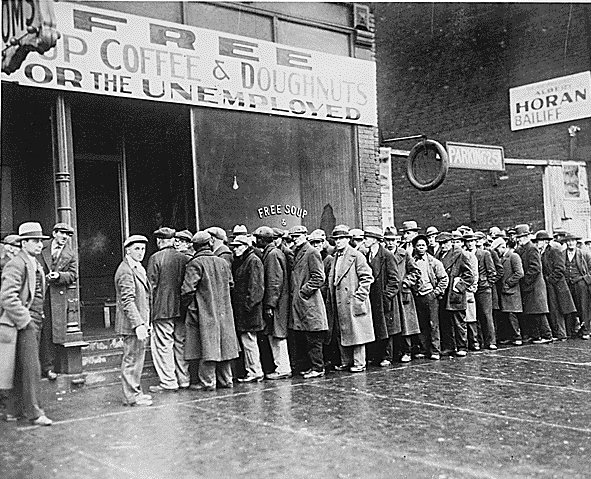
Everyone has seen the pictures of the unemployed waiting in soup lines during the Great Depression.When you try to tell a propaganda believing, willfully ignorant, mainstream media watching, math challenged consumer we are in the midst of a Greater Depression, they act as if you’ve lost your mind. They will immediately bluster about the 5.1% unemployment rate, record corporate profits, and stock market near all-time highs. The cognitive dissonance of these people is only exceeded by their inability to understand basic mathematical concepts.
The reason you don’t see huge lines of people waiting in soup lines during this Greater Depression is because the government has figured out how to disguise suffering through modern technology. During the height of the Great Depression in 1933, there were 12.8 million Americans unemployed. These were the men pictured in the soup lines. Today, there are 46 million Americans in an electronic soup kitchen line, as their food is distributed through EBT cards (with that angel of mercy JP Morgan reaping billions in profits by processing the transactions).
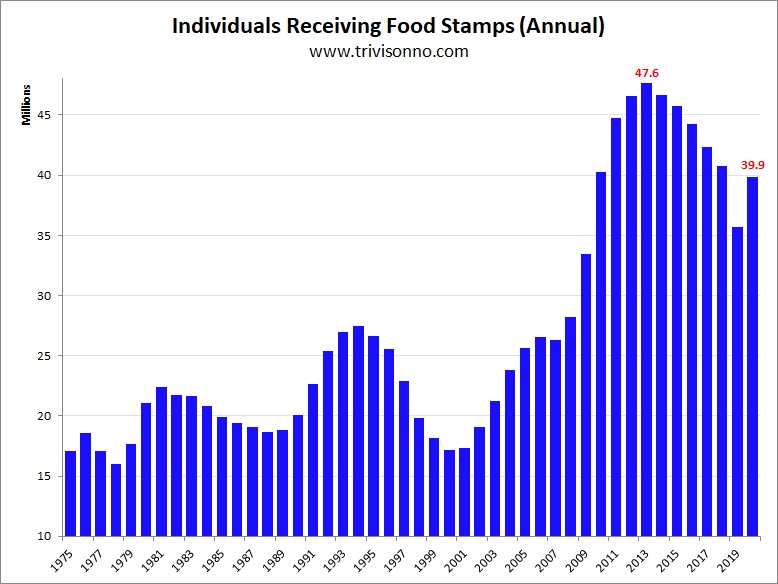
These 46 million people represent 14% of the U.S. population. There are 23 million households on food stamps in a nation of 123 million households. Therefore, 19% of all households in the U.S. are so poor, they require food assistance to survive. In 1933 there were approximately 126 million Americans living in 30 million households. The government didn’t keep official unemployment records until 1940, but the Department of Labor estimated 12.8 million people were unemployed during the worst year of the Great Depression or 24.9% of the labor force. By 1937 it had fallen to 14.3% or approximately 8 million people.
The number of people unemployed during the 1930’s is an excellent representation of the number of households on government assistance during the Great Depression because 79% of all households were occupied by married couples with 4 people per household versus 48% married couple households today with 2.5 people per household. The unemployment rate averaged 19% during the heart of the Great Depression. Therefore, approximately 19% of all the households in the U.S. needed government assistance to feed themselves. That happens to be the exact percentage of households currently needing food stamps to feed themselves.
We are now supposedly five years into an economic recovery. The unemployment rate, according to the government, has fallen from 10% to 5.1%. Maybe a comparison to the the Great Depression in 1937, five years after the worst of it, would reveal some truth. It is not easy to do an apples to apples comparison because very few women worked outside the home in 1937 and the average life expectancy in the 1930s was 60 years old. Today, the majority of women are theoretically in the work force and the average life expectancy is 78 years old. In 1937 only 5% of the population was over 65 years old versus 13% today.
There were approximately 55 million Americans in the labor force in 1937, according to the DOL, and approximately 47 million of them were employed. So 85% of the eligible work force was working. There was no BLS to massage, manipulate, seasonally adjust, or fake the data to make things appear better than they were in 1937. Edward Bernay’s Propaganda techniques and methodologies weren’t perfected for a few more years. According to Census information there were 52 million Americans between the ages of 18 and 44, along with another 21 million between the ages of 45 and 64 in 1937. So even considering that very few women worked and many people died by the age of 60, we had a workforce of 55 million out of an age eligible population of 73 million at a maximum. That yields a participation rate of 75%.
These facts reveal the utter falsity of the propaganda drenched duplicitous data dumped by the BLS on behalf of vested interests who have captured our government and have an agenda requiring the public to be kept in the dark regarding their own dire financial situation. No matter how you slice the data, it reveals an absolute parallel to the situation during the Great Depression. There are 251 million Americans of working age and only 149 million are employed, of which 20 million are part-time and 8 million are self employed. Only 59% of working age Americans actually work. The BLS has the cajones to declare that only 157 million of the 251 million working age Americans are actually in the labor force.
This outrageous assumption flies in the face of all reasonableness, facts, and truth. In 1937, even with women not working outside the home and very few people living past 65 years old, the participation rate was 75%. Today, with the majority of women capable and willing to work and older Americans working well into their 60s, the BLS actually expects a critical thinking person to believe the participation rate is only 62.4%, the lowest since 1977. It’s a pure and simple despicable lie. The true participation rate should exceed the rate in 1937, based on the facts. Using the 75% participation rate today, yields a true unemployment rate of 21%, not the preposterous 5.1% shoveled by the bullshit artists at the BLS. The 21% rate ties very closely to the figure arrived at by John Williams at Shadowstats. An unbiased assessment of the facts reveals unemployment numbers and people on government assistance numbers that match or exceed those of the Great Depression.
I also wonder whether the corporate mainstream media purposely chooses not to show pictures of the poor waiting in long lines to be fed because their function is not to report facts and truth, but to perpetuate the lie that all is well in America.  I pass the Grace Lutheran church at 36th and Haverford Avenue in West Philly everyday on my way to work. Every Thursday is when the church, in partnership with the Philabundance food bank, distributes free food to the people of West Philly. The line stretches around the block at 7:30 am awaiting the Philabundance truck to arrive. There are old, young, black, white, Latino, and Asian in the line. It looks exactly like the line pictured in the Great Depression above. I’m sure there are similar scenes across every city in America on a daily basis. People dependent on food banks and living in homeless shelters are at record levels. Where are the mainstream media pictures? How does that jive with Ben Bernanke’s self congratulatory book tour about how he saved America by secretly handing Wall Street and foreign bankers $16 trillion?
For the average American family, the US economy has been in recession since 2000, with the Greater Depression arriving in 2008. The working age population has grown by 40 million since 2000, with only 12 million jobs added over that time frame. Of those, 10 million were in the government controlled health, education, social services (HES) sectors, with millions of good paying manufacturing jobs destroyed, replaced by a couple million low paying services jobs. As David Stockman points out, Bernanke and the vested interests he serves continue to spew disingenuous propaganda  to cover up the fact average American households continue to experience depression-like conditions. When your real household income is lower than it was in 1989, while your basic living costs for food, energy, transportation, rent, housing, healthcare, taxes, and education have skyrocketed, you just might be experiencing a depression.
“The Fed’s balance sheet has grown from $500 billion to $4.5 trillion or 9X during that span, but job growth outside the HES Complex amounts to less than 2%. For crying out loud, that’s a 12,000 per month rounding error in an economy which has 250 million adults. Virtually every job gained since December 2009 shown in the chart below was not a “new” job at all; it was just a “born-again” job that Greenspan had claimed credit for a few years earlier. Yet Bernanke has the nerve to boast about the Fed’s success on jobs and claim that the “labor market is close to normal”!”
Edward Bernays wrote the book Propaganda in 1928. It was utilized quite well by Goebbels and Hitler over the next decade or so. But the corporate fascist oligarchy, disguised as American democracy, puts Goebbels efforts to shame. Bernays would be thrilled by the efficiency and professionalism with which the invisible Deep State governing power is able to utilize mass media, the internet, public schools, and academia to shape, mold, manipulate and alter the minds of the masses.The unholy alliance between shadowy billionaires, a private bank owned by Wall Street and controlling our currency, the military industrial complex, the sick care complex, mega-corporations peddling consumer goods, and politicians who are easily bought, has left a hollowed out rotting carcass of a nation, with the peasants experiencing a depression, while the lords of the manor feast like there is no tomorrow. But at least the 103 million peasants who aren’t working believe only 5.1% of them are unemployed. It’s a Bernaysian Miracle!!!
“The conscious and intelligent manipulation of the organized habits and opinions of the masses is an important element in democratic society. Those who manipulate this unseen mechanism of society constitute an invisible government which is the true ruling power of our country. …We are governed, our minds are molded, our tastes formed, our ideas suggested, largely by men we have never heard of. This is a logical result of the way in which our democratic society is organized. Vast numbers of human beings must cooperate in this manner if they are to live together as a smoothly functioning society. …In almost every act of our daily lives, whether in the sphere of politics or business, in our social conduct or our ethical thinking, we are dominated by the relatively small number of persons…who understand the mental processes and social patterns of the masses. It is they who pull the wires which control the public mind.”– Edward Bernays – Propaganda

Saturday, August 8, 2015

The $12 Trillion Fat Finger: How A "Glitch" Nearly Crashed The Global Financial System - A True Story

Tyler Durden's picture


http://www.zerohedge.com/news/2015-08-08/12-trillion-fat-finger-how-glitch-nearly-crashed-global-financials-system-true-story
Like what happened in the great quant blow up August 2007.
For those who may not recall the specific details of how the "quant crash" nearly wiped out all algo and quant trading hedge funds and strats in a matter of hours if not minutes, leading to tens of billions in capital losses, here is a reminder, and a warning that the official goalseeked crisis narrative "after" the fact is merely there to hide the embarrassment of just how close to total collapse the global financial system is at any given moment.
The following is a true story (courtesy of b3ta) from the archives, going all the way back to 2007:
I.T. is a minefield for expensive mistakes
There's so many different ways to screw up. The best you can hope for in a support role is to be invisible. If anyone notices your support team at all, you can rest assured it's because someone has made a mistake. I've worked for three major investment banks, but at the first place I witnessed one of the most impressive mistakes I'm ever likely to see in my career. I was part of the sales and trading production support team, but thankfully it wasn't me who made this grave error of judgement...
(I'll delve into obnoxious levels of detail here to add color and context if you're interested. If not, just skip to the next chunk, you impatient git)
This bank had pioneered a process called straight-through processing (STP) which removes the normal manual processes of placement, checking, settling and clearing of trades. Trades done in the global marketplace typically have a 5-day clearing period to allow for all the paperwork and book-keeping to be done. This elaborate system allowed same-day settlement, something never previously possible. The bank had achieved this over a period of six years by developing a computer system with a degree of complexity that rivalled SkyNet. By 2006 it also probably had enough processing power to become self-aware, and the storage requirements were absolutely colossal. It consisted of hundreds of bleeding edge compute-farm blade servers, several £multi-million top-end database servers and the project had over 300 staff just to keep it running. To put that into perspective, the storage for this one system (one of about 500 major trading systems at the bank) represented over 80% of the total storage used within the company. The equivalent of 100 DVD's worth of raw data entered the databases each day as it handled over a million inter-bank trades, each ranging in value from a few hundred thousand dollars to multi-billion dollar equity deals. This thing was BIG.
You'd think such a critically important and expensive system would run on the finest, fault-tolerant hardware and software. Unfortunately, it had grown somewhat organically over the years, with bits being added here, there and everywhere. There were parts of this system that no-one understood any more, as the original, lazy developers had moved company, emigrated or *died* without documenting their work. I doubt they ever predicted the monster it would eventually become.
A colleague of mine one day decided to perform a change during the day without authorisation, which was foolish, but not uncommon. It was a trivial change to add yet more storage and he'd done it many times before so he was confident about it. The guy was only trying to be helpful to the besieged developers, who were constantly under pressure to keep the wretched thing moving as it got more bloated each day, like an electronic ‘Mr Creosote’.
As my friend applied his change that morning, he triggered a bug in a notoriously crap script responsible for bringing new data disks online. The script had been coded in-house as this saved the bank about £300 per year on licensing fees for the official ‘storage agents’ provided by the vendor. Money that, in hindsight, would perhaps have been better spent instead of pocketed. The homebrew code took one look at the new configuration and immediately spazzed out. This monged scrap of pisspoor geek-scribble had decided the best course of action was to bring down the production end of the system and bring online the disaster recovery (DR) end, which is normal behaviour when it detects a catastrophic 'failure'. It’s designed to bring up the working side of the setup as quickly as possible. Sadly, what with this system being fully-replicated at both sites (to [cough] ensure seamless recovery), the exact same bug was almost instantly triggered on the DR end, so in under a minute, the hateful script had taken offline the entire system in much the same manner as chucking a spanner into a running engine might stop a car. The databases, as always, were flushing their precious data onto many different disks as this happened, so massive, irreversible data corruption occurred. That was it, the biggest computer system in the bank, maybe even the world, was down.
And it wasn't coming back up again quickly.
(OK, detail over. Calm down)
At the time this failure occurred there was more than $12 TRILLION of trades at various stages of the settlement process in the system. This represented around 20% of ALL trades on the global stock market, as other banks had started to plug into this behemoth and use its capabilities themselves. If those trades were not settled within the agreed timeframe, the bank would be liable for penalties on each and every one, the resulting fines would eclipse the market capital of the company, and so it would go out of business. Just like that.
My team dropped everything it was doing and spent 4 solid, brutal hours recovering each component of the system in a desperate effort to coax the stubborn silicon back online. After a short time, the head of the European Central Bank (ECB) was on a crisis call with our company CEO, demanding status updates as to why so many trades were failing that day. Allegedly (as we were later told), the volume of financial goodies contained within this beast was so great that failure to clear the tradeswould have had a significant negative effect on the value of the Euro currency. This one fuckup almost started a global economic crisis on a scale similar to the recent (and ongoing) sub-prime credit crash. With two hours to spare before the ECB would be forced to go public by adjusting the Euro exchange rate to compensate, the system was up and running, but barely. We each manned a critical sub-component and diverted all resources into the clearing engines. The developers set the system to prioritise trades on value. Everything else on those servers was switched off to ensure every available CPU cycle and disk operation could be utilised. It saturated those machines with processing while we watched in silence, unable to influence the outcome at all.
Incredibly, the largest proportion of the high-value transactions had cleared by the close of business deadline, and disaster was averted by the most "wafer-thin" margin. Despite this, the outstanding lower-value trades still cost the bank more than $100m in fines. Amazingly, to this day only a handful of people actually understand the true source of those penalties on the end-of-year shareholder report.Reputation is king in the world of banking and all concerned --including me-- were instructed quite explicitly to keep schtum. Naturally, I *can’t* identify the bank in question, but if you’re still curious, gaz me and I’ll point you in the right direction…
Epilogue… The bank stumped up for proper scripts pretty quickly but the poor sap who started this ball of shit rolling was fired in a pompous ceremony of blame the next day, which was rather unfair as it was dodgy coding which had really caused the problem. The company rationale was that every blaze needs a spark to start it, and he was going to be the one they would scapegoat. That was one of the major reasons I chose to leave the company (but not before giving the global head of technology a dressing down at our Christmas party… that’s another QOTW altogether). Even today my errant mate is one of the only people who properly understands most of that preposterous computer system, so he had his job back within six months -- but at a higher rate than before :-)
Conclusion: most banks are insane and they never do anything to fix problems until *after* it costs them uber-money. Did I hear you mention length? 100 million dollar bills in fines laid end-to-end is about 9,500 miles long according to Google calculator.
* * *
And here is Zero Hedge's conclusion: the next time you think all those paper reps and warranties to claims on billions if not trillions of assets, are safe and sound in some massively redundant hard disk array, think again.

Monday, June 15, 2015

Our Phantom Economy

Tyler Durden's picture

http://www.zerohedge.com/news/2015-06-15/our-phantom-economy
Submitted by Charles Hugh-Smith of OfTwoMinds blog,
Those who believe that phantom recoveries and phantom metrics can be substituted for reality are in for a shock in the next downturn. 
Stripped of artifice, there are only two kinds of media stories: those that support the status quo narrative, and those that are skeptical of that narrative.
What is the status quo narrative? Simply this: not only is this the best possible arrangement of labor, assets and money, it is the only possible arrangement of labor, assets and money.
 
It is impossible to challenge a system that is the only possible arrangement; the only option is to accept it.
 
In effect, the mainstream media is a vast Psychological Operation (PSYOPS) aimed at persuading the American public that the status quo Imperial system of predatory, debt-based crony-capitalism that benefits the few at the expense of the many is not just beneficial to all its debt-serfs and welfare recipients, but it is the only possible system--there is no alternative(TINA).
 
One of the greatest and most important PSYOPS of the Imperial State (U.S. Government) and its faithful lapdog the mainstream media is the unemployment rate. As I will show tomorrow, the real unemployment rate is between 20% and 40%, depending on whether you think someone earning $1,500 a year selling stuff on eBay and Etsy should be counted as "employed."
 
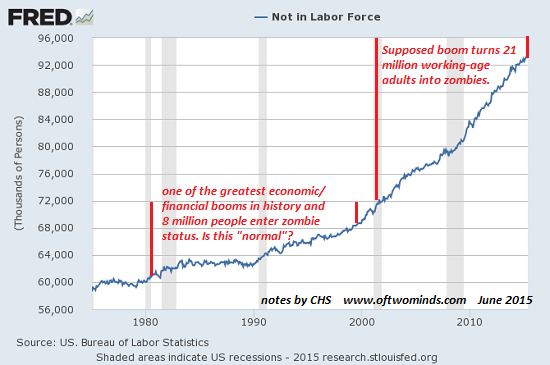
The federal government is delighted to count everyone earning $100 a year as employed, and equally delighted to label everyone without a job (even one paying $100/year) who doesn't qualify for unemployment insurance a job market zombie--a once living person who is no longer counted as among the living.
 
These zombies are non-participants in the labor market, i.e. not in the labor force. They might be able to work, and want to work, but they're considered zombies once they're no longer "actively seeking work." But is this the proper metric for measuring the unemployment rate? It is obvious that the unemployment rate should be calculated on the total work force (those of working age 18 - 65 who are not institutionalized or permanently disabled) and those with real jobs, i.e. ones that generate enough income to get close to the poverty line.
 
Here is our phantom economy on display: 93 million people are no longer counted as being in the work force. They are officially declared zombies, and that's how the federal government can claim an "official" employment rate of 5.6%.
 
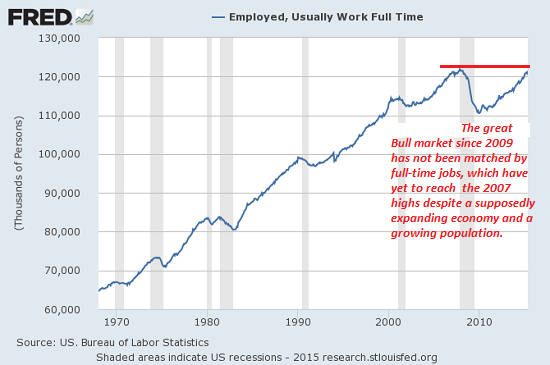
And here's the work force with full-time jobs, i.e. jobs that might support a household (or half a household) and that might pay substantial payroll and income taxes (unlike the forms of marginal employment that earn a few hundred or few thousand bucks annually).
 
Just as we have a phantom work force--the 93 million not in labor force almost equals the 120 million with full-time jobs--Imperial Rome in its final days had phantom legions. There were no longer any active-duty soldiers in the legions, but the officers and paymasters filed their payroll chits and collected the legion's pay from the out-of-touch remnants of the Imperial Core in Rome.
 
Just as Rome in terminal decline had its phantom legions, we have a phantom "recovery," phantom democracy, phantom GDP and phantom unemployment rate.Those who believe that phantom recoveries and phantom metrics can be substituted for reality are in for a shock in the next downturn.

Thursday, January 23, 2014

What recovery? U.S. retail stores now in grim death spiral

January 21, 2014ECONOMYTwo of the largest retailers in America are steamrolling toward bankruptcy.  Sears and J.C. Penney are both losing hundreds of millions of dollars each quarter, and both of them appear to be caught in the grip of a death spiral from which it will be impossible to escape. Once upon a time, Sears was actually the largest retailer in the United States, and even today Sears and J.C. Penney are “anchor stores” in malls all over the country. When I was growing up, my mother would take me to the mall when it was time to go clothes shopping, and there were usually just two options: Sears or J.C. Penney. When I got older, I actually worked for Sears for a little while. At the time, nobody would have ever imagined that Sears or J.C. Penney could go out of business someday. But that is precisely what is happening. They are both shutting down unprofitable stores and laying off employees in a desperate attempt to avoid bankruptcy, but everyone knows that they are just delaying the inevitable. These two great retail giants are dying, and they certainly won’t be the last to fall. This is just the beginning. Sales have declined at Sears for 27 quarters in a row, and the legendary retailer has been closing hundreds of stores and selling off property in a frantic attempt to turn things around. Unfortunately for Sears, it is not working. In fact, Sears has announced that it expects to lose “between $250 million to $360 million” for the quarter that will end on February 1st. Things have gotten so bad that Sears is even making commercials that openly acknowledge how badly it is struggling. 
For example, consider the following bit of dialogue from a recent Sears television commercial featuring two young women. “Wait, the movie theater is on the other side,” the passenger says. “But Sears always has parking!” the driver responds. Sears always has parking??? Of course the unspoken admission is that Sears always has parking because nobody shops there anymore. This week J.C. Penney announced that it is eliminating 2,000 jobs and closing 33 stores. It’s been a brutal year for J.C. Penney, its stock falling over 60% in the past 12 months. The company has been losing hundreds of millions of dollars per quarter, and is in the midst of another turnaround effort after ousting former Apple executive Ron Johnson last year. Overall, shares of J.C. Penney have fallen by an astounding 84 percent since February 2012.  And keep in mind that this decline has happened during one of the greatest stock market rallies of all-time. For now, J.C. Penney will continue to try to desperately raise more cash from investors that are foolish enough to give it to them, but all that is really accomplishing is just delaying the inevitable. If you would like to see some photos that graphically illustrate why J.C. Penney is falling apart, you can find some right here. And of course Sears and J.C. Penney are not the only large retailers that have fallen on hard times. This week the CEO of Best Buy admitted that sales declined at his chain during the holiday season. Best Buy shares skid on Thursday after the retailer said total revenue and sales at its established U.S stores fell in the all-important holiday season due to intense discounting by rivals, supply constraints for key products and weak traffic in December. –Zero Hedge