Showing posts with label Edward Snowden. Show all posts

Tuesday, August 16, 2016

Edward Snowden Explains The Historic NSA Hack: "This Escalation Could Get Messy Fast"

Yesterday we reported that in a historic first, an unknown group of hackers, the "Shadow Brokers" had hacked the NSA's cuberattack hacking division, "The Equation Group." Many were wondering what are the strategic implications of this dramatic escalation, which took place just as the US was accusing Russia of virtually every other recent prominent hacking, and whether it suggested something bigger was taking place behind the scenes.
Today, the most famous NSA (ex) employee, Edward Snowden, chimed in on this topic in a tweetstorm in which he tries to explain who did it:
Circumstantial evidence and conventional wisdom indicates Russian responsibility. I suspect this is more diplomacy than intelligence, related to the escalation around the DNC hack
... why they did it:
This leak is likely a warning that someone can prove US responsibility for any attacks that originated from this malware server.
... and the consequences:
That could have significant foreign policy consequences. Particularly if any of those operations targeted US allies. Particularly if any of those operations targeted elections. Accordingly, this may be an effort to influence the calculus of decision-makers wondering how sharply to respond to the DNC hacks.
and concludes as follows:
this leak looks like a somebody sending a message that an escalation in the attribution game could get messy fast.
In effect, Snowden suggest that Russia has either had enough of being accused for every hack in the US, or of being hacked itself, and is now retaliating. If he is correct, this is a far greater transgression by the Kremlin, and one which would absolutely necessitate a proportional US response to something which very well may have originated in Russia. The question is whether the administration, which has so far lobbed softballs as Putin for DNC hacks which may well have been done by 16 year old American hacker, will have the guts to retaliate to what is the first real act of global cyberagression.
Here is his full series of tweets on the topic (it can be found here in its original).
The hack of an NSA malware staging server is not unprecedented, but the publication of the take is. Here's what you need to know:
  • 1) NSA traces and targets malware C2 servers in a practice called Counter Computer Network Exploitation, or CCNE. So do our rivals.
  • 2) NSA is often lurking undetected for years on the C2 and ORBs (proxy hops) of state hackers. This is how we follow their operations.
  • 3) This is how we steal their rivals' hacking tools and reverse-engineer them to create "fingerprints" to help us detect them in the future.
  • 4) Here's where it gets interesting: the NSA is not made of magic. Our rivals do the same thing to us -- and occasionally succeed.
  • 5) Knowing this, NSA's hackers (TAO) are told not to leave their hack tools ("binaries") on the server after an op. But people get lazy.
  • 6) What's new? NSA malware staging servers getting hacked by a rival is not new. A rival publicly demonstrating they have done so is.
  • 7) Why did they do it? No one knows, but I suspect this is more diplomacy than intelligence, related to the escalation around the DNC hack.
  • 8) Circumstantial evidence and conventional wisdom indicates Russian responsibility. Here's why that is significant:
  • 9) This leak is likely a warning that someone can prove US responsibility for any attacks that originated from this malware server.
  • 10) That could have significant foreign policy consequences. Particularly if any of those operations targeted US allies.
  • 11) Particularly if any of those operations targeted elections.
  • 12) Accordingly, this may be an effort to influence the calculus of decision-makers wondering how sharply to respond to the DNC hacks.
A convenient summary:
13) TL;DR: This leak looks like a somebody sending a message that an escalation in the attribution game could get messy fast.
And a bonus take:
Bonus: When I came forward, NSA would have migrated offensive operations to new servers as a precaution - it's cheap and easy. So? So...
The undetected hacker squatting on this NSA server lost access in June 2013. Rare public data point on the positive results of the leak.
You're welcome, @NSAGov. Lots of love.
The ball is now in the NSA's court.

Wednesday, May 4, 2016

A Whistleblower Manifesto By Edward Snowden

Tyler Durden's picture

http://www.zerohedge.com/news/2016-05-03/whistleblower-manifesto-edward-snowden

Submitted by Mike Krieger via Liberty Blitzkrieg blog,
In the beginning of a change, the patriot is a scarce man, and brave, and hated and scorned. When his cause succeeds, the timid join him, for then it costs nothing to be a patriot.

The only rational patriotism, is loyalty to the nation all the time, loyalty to the government when it deserves it.

– Quotes by Mark Twain
Every time I hear from Edward Snowden I’m immediately reminded of how thoughtful, courageous and patriotic he is, and how fortunate we are that he followed his conscience and spilled the beans on a multitude of unaccountable and unconstitutional actions routinely committed by America’s deep state government.
Earlier today, The Intercept posted a piece written by Edward Snowden pulled from the recently published book Inside the Assassination Complex. It’s a short piece, but extremely powerful and to the point. I saw it as a whistleblower’s manifesto in which Mr. Snowden explains why he felt he had no other choice but to come forward, and why others in similar positions should consider doing the same should they find themselves in a position to defend the U.S. Constitution and inform the general public. We all know that the deep state will never voluntarily work to protect “we the people,” as such, leaking on behalf of the public interest is now a matter of national survival.
So without further ado, here are excerpts from Snowden’s latest piece, Whistleblowing is Not Just Leaking — It’s an Act of Political Resistance:
I’ve been waiting 40 years for someone like you.” Those were the first words Daniel Ellsberg spoke to me when we met last year. Dan and I felt an immediate kinship; we both knew what it meant to risk so much — and to be irrevocably changed — by revealing secret truths.

One of the challenges of being a whistleblower is living with the knowledge that people continue to sit, just as you did, at those desks, in that unit, throughout the agency, who see what you saw and comply in silence, without resistance or complaint. They learn to live not just with untruths but with unnecessary untruths, dangerous untruths, corrosive untruths. It is a double tragedy: What begins as a survival strategy ends with the compromise of the human being it sought to preserve and the diminishing of the democracy meant to justify the sacrifice.

A single act of whistleblowing doesn’t change the reality that there are significant portions of the government that operate below the waterline, beneath the visibility of the public. Those secret activities will continue, despite reforms. But those who perform these actions now have to live with the fear that if they engage in activities contrary to the spirit of society — if even a single citizen is catalyzed to halt the machinery of that injustice — they might still be held to account. The thread by which good governance hangs is this equality before the law, for the only fear of the man who turns the gears is that he may find himself upon them.

Hope lies beyond, when we move from extraordinary acts of revelation to a collective culture of accountability within the intelligence community. Here we will have taken a meaningful step toward solving a problem that has existed for as long as our government.

Not all leaks are alike, nor are their makers. Gen. David Petraeus, for instance, provided his illicit lover and favorable biographer information so secret it defied classification, including the names of covert operatives and the president’s private thoughts on matters of strategic concern. Petraeus was not charged with a felony, as the Justice Department had initially recommended, but was instead permitted to plead guilty to a misdemeanor. Had an enlisted soldier of modest rank pulled out a stack of highly classified notebooks and handed them to his girlfriend to secure so much as a smile, he’d be looking at many decades in prison, not a pile of character references from a Who’s Who of the Deep State.
In the above paragraph, Snowden highlights the most corrosive aspect of modern American society, the institutionalization of a barbaric and un-American two-tierd justice system. For more on the Petraeus angle referenced, see: Some Leaks Are More Equal Than Others – Hypocritical D.C. Insiders Line up to Defend General Petraeus from Prosecution.
Now back to Snowden.
This dynamic can be seen quite clearly in the al Qaeda “conference call of doom” story, in which intelligence officials, likely seeking to inflate the threat of terrorism and deflect criticism of mass surveillance, revealed to a neoconservative website extraordinarily detailed accounts of specific communications they had intercepted, including locations of the participating parties and the precise contents of the discussions. If the officials’ claims were to be believed, they irrevocably burned an extraordinary means of learning the precise plans and intentions of terrorist leadership for the sake of a short-lived political advantage in a news cycle. Not a single person seems to have been so much as disciplined as a result of the story that cost us the ability to listen to the alleged al Qaeda hotline.

If harmfulness and authorization make no difference, what explains the distinction between the permissible and the impermissible disclosure?

The answer is control. A leak is acceptable if it’s not seen as a threat, as a challenge to the prerogatives of the institution. But if all of the disparate components of the institution — not just its head but its hands and feet, every part of its body — must be assumed to have the same power to discuss matters of concern, that is an existential threat to the modern political monopoly of information control, particularly if we’re talking about disclosures of serious wrongdoing, fraudulent activity, unlawful activities. If you can’t guarantee that you alone can exploit the flow of controlled information, then the aggregation of all the world’s unmentionables — including your own — begins to look more like a liability than an asset.

At the other end of the spectrum is Manning, a junior enlisted soldier, who was much nearer to the bottom of the hierarchy. I was midway in the professional career path. I sat down at the table with the chief information officer of the CIA, and I was briefing him and his chief technology officer when they were publicly making statements like “We try to collect everything and hang on to it forever,” and everybody still thought that was a cute business slogan. Meanwhile I was designing the systems they would use to do precisely that. I wasn’t briefing the policy side, the secretary of defense, but I was briefing the operations side, the National Security Agency’s director of technology. Official wrongdoing can catalyze all levels of insiders to reveal information, even at great risk to themselves, so long as they can be convinced that it is necessary to do so.

Reaching those individuals, helping them realize that their first allegiance as a public servant is to the public rather than to the government, is the challenge. That’s a significant shift in cultural thinking for a government worker today.

At the heart of this evolution is that whistleblowing is a radicalizing event — and by “radical” I don’t mean “extreme”; I mean it in the traditional sense of radix, the root of the issue. At some point you recognize that you can’t just move a few letters around on a page and hope for the best. You can’t simply report this problem to your supervisor, as I tried to do, because inevitably supervisors get nervous. They think about the structural risk to their career. They’re concerned about rocking the boat and “getting a reputation.” The incentives aren’t there to produce meaningful reform. Fundamentally, in an open society, change has to flow from the bottom to the top.

And when you’re confronted with evidence — not in an edge case, not in a peculiarity, but as a core consequence of the program — that the government is subverting the Constitution and violating the ideals you so fervently believe in, you have to make a decision. When you see that the program or policy is inconsistent with the oaths and obligations that you’ve sworn to your society and yourself, then that oath and that obligation cannot be reconciled with the program. To which do you owe a greater loyalty?

As a result we have arrived at this unmatched capability, unrestrained by policy. We have become reliant upon what was intended to be the limitation of last resort: the courts. Judges, realizing that their decisions are suddenly charged with much greater political importance and impact than was originally intended, have gone to great lengths in the post-9/11 period to avoid reviewing the laws or the operations of the executive in the national security context and setting restrictive precedents that, even if entirely proper, would impose limits on government for decades or more. That means the most powerful institution that humanity has ever witnessed has also become the least restrained. Yet that same institution was never designed to operate in such a manner, having instead been explicitly founded on the principle of checks and balances. Our founding impulse was to say, “Though we are mighty, we are voluntarily restrained.”
For more on the judicial system as the “limitation of last resort,” see: Can You Say ‘Rubber Stamp?’ FBI and NSA Requests Never Denied by Secret Court.
When you first go on duty at CIA headquarters, you raise your hand and swear an oath — not to government, not to the agency, not to secrecy. You swear an oath to the Constitution. So there’s this friction, this emerging contest between the obligations and values that the government asks you to uphold, and the actual activities that you’re asked to participate in.

By preying on the modern necessity to stay connected, governments can reduce our dignity to something like that of tagged animals, the primary difference being that we paid for the tags and they’re in our pockets. It sounds like fantasist paranoia, but on the technical level it’s so trivial to implement that I cannot imagine a future in which it won’t be attempted. It will be limited to the war zones at first, in accordance with our customs, but surveillance technology has a tendency to follow us home.

Unrestrained power may be many things, but it’s not American. It is in this sense that the act of whistleblowing increasingly has become an act of political resistance. The whistleblower raises the alarm and lifts the lamp, inheriting the legacy of a line of Americans that begins with Paul Revere.

The individuals who make these disclosures feel so strongly about what they have seen that they’re willing to risk their lives and their freedom. They know that we, the people, are ultimately the strongest and most reliable check on the power of government. The insiders at the highest levels of government have extraordinary capability, extraordinary resources, tremendous access to influence, and a monopoly on violence, but in the final calculus there is but one figure that matters: the individual citizen.

And there are more of us than there are of them.
Amen and perfectly said. We can only hope a handful of government employees and contractors with a conscience and a real dedication to the U.S. Constitution will read this and act accordingly.

Thursday, November 12, 2015

Snowden Vindicated As Judge Slams "Unconstitutional, Orwellian" NSA Bulk Spying

Tyler Durden's picture

http://www.zerohedge.com/news/2015-11-11/snowden-vindicated-judge-slams-unconstitutional-orwellian-nsa-bulk-spying
Submitted by Claire Bernish via TheAntiMedia.org,
On Monday, a federal judge ordered a halt to the NSA’s bulk metadata collection program in a reiteration and confirmation of a previous ruling that found the practice “unconstitutional” — and even “Orwellian.”
“This court simply cannot, and will not, allow the government to trump the Constitution merely because it suits the exigencies of the moment,” stated Washington, D.C. District Court Judge Richard Leon in his mordant 43-page ruling.
Edward Snowden immediately hailed the decision, pointing out significant passages from the court to his millions of Twitter followers. Of particular importance — and, indeed, at the heart of both known and potentially unknown domestic spy programs — remains the impossible reckoning between Fourth Amendment protections and the government’s claims of a national security imperative.
“Moved by whatever momentary evil has aroused their fears, officials — perhaps even supported by a majority of citizens — may be tempted to conduct searches that sacrifice the liberty of each citizen to assuage the perceived evil. But the Fourth Amendment rests on the principle that a true balance between the individual and society depends on the recognition of ‘the right to be let [sic] alone — the most comprehensive of rights and the right most valued by civilized men,’” the ruling stated, with emphasis added by Snowden.
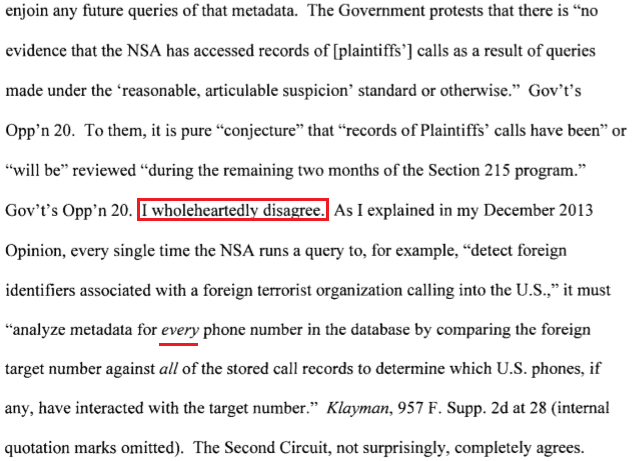
In another tweet, the whistleblower summarized the ruling: “Judge rejects government claim that so long as you aren’t targeted individually, dragnet searches of your life are OK.”
Court affirmed 4th Amendment protections against NSA's mass surveillance, defending "the right to be left alone." pic.twitter.com/JSgf3vpEYb
Judge rejects govt claim that so long as you aren't targeted individually, dragnet searches of your life are ok. pic.twitter.com/1tscV1hEXT
View image on Twitter
Though Leon’s judgment arrives mere weeks before metadata collection would naturally end under the USA Patriot Act’s Section 215 upon implementation of the newly passed USA Freedom Act, he emphasized potential implications of any undue delay in bringing such spying to a close, stating:
“In my December 2013 Opinion, I stayed my order pending appeal in light of the national security interests at stake and the novelty of the constitutional issues raised. I did so with the optimistic hope that the appeals process would move expeditiously. However, because it has been almost two years since I first found that the NSA’s Bulk Telephony Metadata Program likely violates the Constitution and because of the loss of constitutional freedoms for even one day is a significant harm […] I will not do that today.”
In other words, the judge harshly repudiated the government’s already poorly disguised emphasis on national security to justify bulk collection as wholly secondary to the individual’s right to privacy under the Constitution. Leon’s 2013 ruling was struck down in August this year, when an appeals court found the plaintiff in Klayman v. Obama had not established the legal standing necessary to dispute the constitutionality of the NSA program. Once amended appropriately, the judge was able to make a ruling on the original case and issue an injunction to halt bulk collection.
In this ruling, Leon sharply admonished the appeals court for its reversal, saying:
“Because the loss of constitutional freedoms is an ‘irreparable injury’ of the highest order, and relief to the two named plaintiffs would not undermine national security interests, I found that a preliminary injunction was not merely warranted — it was required.” [emphasis by the judge]
Seemingly irritated at the insult of the government maintaining its position on the necessity of bulk collection while ignoring the preceding twenty-two months to find less invasive means to achieve the same goal, Leon searingly stated:
“To say the least, it is difficult to give meaningful weight to a risk of harm created, in significant part, by the Government’s own recalcitrance.”
Pointing out the painfully obvious, Leon derided fictitious claims the government needs bulk data collection at all, considering the program thwarted exactly zero terror attacks throughout its entire duration. In rebuttal to claims the contentious NSA program remains reasonably effective, the judge flatly stated:
“This is a conclusion I simply cannot reach given the continuing lack of evidence that the Program has ever actually been successful as a means of conducting time-sensitive investigations in cases involving imminent threats of terrorism.”
Pulling no punches, Leon concludes with a scathing challenge to the naïveté and blind acceptance Congress mistakenly presumed the public and court would give the contentiously invasive program:
“To be sure, the very purpose of the Fourth Amendment would be undermined were this court to defer to Congress’s determination that individual liberty should be sacrificed to better combat today’s evil.”
Employing linguistic subtlety which, at times, borders on a verbal smackdown, Judge Richard Leon brilliantly sent the NSA, Congress, and rest of the government a message that couldn’t be denied this second time around: Nobody buys your bullshit.