Showing posts with label Fourth Amendment. Show all posts

Thursday, November 12, 2015

Snowden Vindicated As Judge Slams "Unconstitutional, Orwellian" NSA Bulk Spying

Tyler Durden's picture

http://www.zerohedge.com/news/2015-11-11/snowden-vindicated-judge-slams-unconstitutional-orwellian-nsa-bulk-spying
Submitted by Claire Bernish via TheAntiMedia.org,
On Monday, a federal judge ordered a halt to the NSA’s bulk metadata collection program in a reiteration and confirmation of a previous ruling that found the practice “unconstitutional” — and even “Orwellian.”
“This court simply cannot, and will not, allow the government to trump the Constitution merely because it suits the exigencies of the moment,” stated Washington, D.C. District Court Judge Richard Leon in his mordant 43-page ruling.
Edward Snowden immediately hailed the decision, pointing out significant passages from the court to his millions of Twitter followers. Of particular importance — and, indeed, at the heart of both known and potentially unknown domestic spy programs — remains the impossible reckoning between Fourth Amendment protections and the government’s claims of a national security imperative.
“Moved by whatever momentary evil has aroused their fears, officials — perhaps even supported by a majority of citizens — may be tempted to conduct searches that sacrifice the liberty of each citizen to assuage the perceived evil. But the Fourth Amendment rests on the principle that a true balance between the individual and society depends on the recognition of ‘the right to be let [sic] alone — the most comprehensive of rights and the right most valued by civilized men,’” the ruling stated, with emphasis added by Snowden.
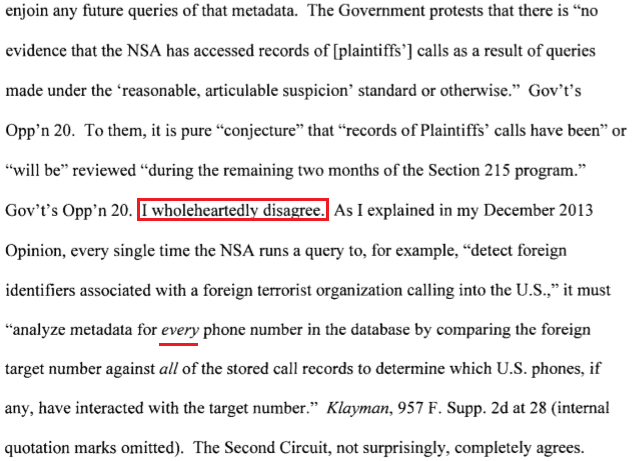
In another tweet, the whistleblower summarized the ruling: “Judge rejects government claim that so long as you aren’t targeted individually, dragnet searches of your life are OK.”
Court affirmed 4th Amendment protections against NSA's mass surveillance, defending "the right to be left alone." pic.twitter.com/JSgf3vpEYb
Judge rejects govt claim that so long as you aren't targeted individually, dragnet searches of your life are ok. pic.twitter.com/1tscV1hEXT
View image on Twitter
Though Leon’s judgment arrives mere weeks before metadata collection would naturally end under the USA Patriot Act’s Section 215 upon implementation of the newly passed USA Freedom Act, he emphasized potential implications of any undue delay in bringing such spying to a close, stating:
“In my December 2013 Opinion, I stayed my order pending appeal in light of the national security interests at stake and the novelty of the constitutional issues raised. I did so with the optimistic hope that the appeals process would move expeditiously. However, because it has been almost two years since I first found that the NSA’s Bulk Telephony Metadata Program likely violates the Constitution and because of the loss of constitutional freedoms for even one day is a significant harm […] I will not do that today.”
In other words, the judge harshly repudiated the government’s already poorly disguised emphasis on national security to justify bulk collection as wholly secondary to the individual’s right to privacy under the Constitution. Leon’s 2013 ruling was struck down in August this year, when an appeals court found the plaintiff in Klayman v. Obama had not established the legal standing necessary to dispute the constitutionality of the NSA program. Once amended appropriately, the judge was able to make a ruling on the original case and issue an injunction to halt bulk collection.
In this ruling, Leon sharply admonished the appeals court for its reversal, saying:
“Because the loss of constitutional freedoms is an ‘irreparable injury’ of the highest order, and relief to the two named plaintiffs would not undermine national security interests, I found that a preliminary injunction was not merely warranted — it was required.” [emphasis by the judge]
Seemingly irritated at the insult of the government maintaining its position on the necessity of bulk collection while ignoring the preceding twenty-two months to find less invasive means to achieve the same goal, Leon searingly stated:
“To say the least, it is difficult to give meaningful weight to a risk of harm created, in significant part, by the Government’s own recalcitrance.”
Pointing out the painfully obvious, Leon derided fictitious claims the government needs bulk data collection at all, considering the program thwarted exactly zero terror attacks throughout its entire duration. In rebuttal to claims the contentious NSA program remains reasonably effective, the judge flatly stated:
“This is a conclusion I simply cannot reach given the continuing lack of evidence that the Program has ever actually been successful as a means of conducting time-sensitive investigations in cases involving imminent threats of terrorism.”
Pulling no punches, Leon concludes with a scathing challenge to the naïveté and blind acceptance Congress mistakenly presumed the public and court would give the contentiously invasive program:
“To be sure, the very purpose of the Fourth Amendment would be undermined were this court to defer to Congress’s determination that individual liberty should be sacrificed to better combat today’s evil.”
Employing linguistic subtlety which, at times, borders on a verbal smackdown, Judge Richard Leon brilliantly sent the NSA, Congress, and rest of the government a message that couldn’t be denied this second time around: Nobody buys your bullshit.

Monday, December 16, 2013

Judge: NSA phone program likely unconstitutional

The NSA headquarters are pictured. | AP Photo
The ruling is the first significant legal setback for the NSA’s surveillance program. | AP Photo
A federal judge ruled Monday that the National Security Agency program which collects information on nearly all telephone calls made to, from or within the United States is likely unconstitutional.
U.S. District Court Judge Richard Leon found that the program appears to violate the Fourth Amendment ban on unreasonable searches and seizures. He also said the Justice Department had failed to demonstrate that collecting the information had helped to head off terrorist attacks.
Acting on a lawsuit brought by conservative legal activist Larry Klayman, Leon issued a preliminary injunction barring the NSA from collecting so-called metadata pertaining to the Verizon accounts of Klayman and one of his clients. However, the judge stayed the order to allow for an appeal.
(Also on POLITICO: NSA probe: Snowden can still do damage)
“I cannot imagine a more ‘indiscriminate’ and ‘arbitrary invasion’ than this systematic and high-tech collection and retention of personal data on virtually every single citizen for purposes of querying it and analyzing it without judicial approval,” wrote Leon, an appointee of President George W. Bush.
The preliminary injunction Leon granted Monday does not require him to make a definitive ruling on the constitutional questions in the case, but does take account of which side he believes is more likely to prevail.
Leon’s 68-page opinion is the first significant legal setback for the NSA’s surveillance program since it was disclosed in June in news stories based on leaks from former NSA contractor Edward Snowden. For seven years, the metadata program has been approved repeatedly by numerous judges on the Foreign Intelligence Surveillance Court and found constitutional by at least one judge sitting in a criminal case.
The Justice Department persuaded those courts that the collection of information on the time and length of calls, as well as the numbers called, did not amount to a search under the Fourth Amendment because that information is routinely available to telephone companies for billing purposes and is shared with those firms voluntarily.

Government lawyers and the judges who found the NSA program legal pointed to a 1979 Supreme Court ruling, Smith v. Maryland, which found no search warrant was needed by police to install a device which recorded the numbers dialed on a particular phone line.
But Leon said the three-decade-old precedent was not applicable to a program like the NSA’s because of its sophistication and because telephone use has become far more intense in recent years.
“The ubiquity of phones has dramatically altered the quantity of information that is now available and, more importantly, what that information can tell the Government about people’s lives,” the judge wrote. “I cannot possibly navigate these uncharted Fourth Amendment waters using as my North Star a case that predates the rise of cell phones.”

The judge went on to conclude that the searches involved in the NSA metadata program were likely not permissible under the Fourth Amendment in part because there was little evidence the program has actually prevented terrorism.
“I have significant doubts about the efficacy of the metadata collection program as a means of conducting time-sensitive investigations in cases involving imminent threats of terrorism,” Leon wrote. “The government does not cite a single instance in which analysis of the NSA’s bulk metadata collection actually stopped an imminent attack, or otherwise aided the Government in achieving any objective that was time-sensitive in nature.”
The judge’s ruling was issued just before White House press secretary Jay Carney took the podium for the daily press briefing. Carney said he was unaware of the decision and he referred inquiries to the Justice Department.
“We are reviewing the court’s decision,” DOJ spokesman Andrew Ames said.
Similar lawsuits challenging the program are pending in at least three other federal courts around the country. In addition, criminal defendants are beginning to challenge the program after the Justice Department disclosed it had played a role in investigating their cases.

At a hearing last month, Leon said he knew that his decision would be far from the last word on the issue, which is almost certain to wind up at the Supreme Court.
However, he added some flair to his opinion Monday, referring at one point to the Beatles and at another to Federalist Papers author James Madison, who later became president.
“Surely, such a program infringes on ‘that degree of privacy’ that the Founders enshrined in the Fourth Amendment. Indeed, I have little doubt that the author of our Constitution, James Madison, who cautioned us to beware ‘the abridgement of freedom of the people by gradual and silent encroachments by those in power’ would be aghast,” the judge wrote.

Read more: http://www.politico.com/story/2013/12/national-security-agency-phones-judge-101203.html#ixzz2nfms4uAL