Submitted by Tyler Durden on 09/10/2015 14:42 -0400http://www.zerohedge.com/news/2015-09-10/competing-gas-pipelines-are-fueling-syrian-war-migrant-crisisSubmitted by Mnar Muhawesh via MintPressNews.com,
Don’t let anyone fool you: As we have detailed since 2013, sectarian
strife in Syria has been engineered to provide cover for a war for
access to oil and gas, and the power and money that come along with it.
 Editor’s note: This article has been updated to reflect recent Wikileaks revelations of US State Department leaks
that show plans to destabilize Syria and overthrow the Syrian
government as early as 2006. The leaks reveal that these plans were
given to the US directly from the Israeli government and would be
formalized through instigating civil strife and sectarianism through
partnership with nations like Saudi Arabia, Turkey, Qatar and even Egypt
to break down the power structue in Syria to essentially to weaken Iran
and Hezbolla. The leaks also reveal Israeli plans to use this crisis to
expand it’s occupation of the Golan Heights for additional oil
exploration and military expansion.
Editor’s note: This article has been updated to reflect recent Wikileaks revelations of US State Department leaks
that show plans to destabilize Syria and overthrow the Syrian
government as early as 2006. The leaks reveal that these plans were
given to the US directly from the Israeli government and would be
formalized through instigating civil strife and sectarianism through
partnership with nations like Saudi Arabia, Turkey, Qatar and even Egypt
to break down the power structue in Syria to essentially to weaken Iran
and Hezbolla. The leaks also reveal Israeli plans to use this crisis to
expand it’s occupation of the Golan Heights for additional oil
exploration and military expansion.
* * *
Images of
Aylan Kurdi,
the three-year-old Syrian boy who washed up dead on Mediterranean
shores in his family’s attempt to flee war-torn Syria, have grabbed the
attention of people around the world, sparking outrage about the true
costs of war.
The heart-wrenching refugee crisis unfolding across the Middle East
and at European borders has ignited a much needed conversation on the
ongoing strife and instability that’s driving people from their homes in
countries like Syria, Libya and Iraq. It’s brought international
attention to the inhumane treatment these refugees are receiving if —
and it is a major “if” — they arrive at Europe’s door.
In Syria, for example, foreign
powers have sunk the nation into a nightmare combination of civil war,
foreign invasion and terrorism. Syrians are in the impossible position
of having to choose between living in a warzone, being targeted by
groups like ISIS and the Syrian government’s brutal crackdown, or faring
dangerous waters with minimal safety equipment only to be denied food,
water and safety by European governments if they reach shore.
Other Syrians fleeing the chaos at home have turned to neighboring
Arab Muslim countries. Jordan alone has absorbed over half a million
Syrian refugees; Lebanon has accepted nearly 1.5 million; and Iraq and
Egypt have taken in several hundred thousand.
Although it’s not an Arab nation or even part of the Middle East,
Iran sent 150 tons of humanitarian goods, including 3,000 tents and
10,000 blankets, to the Red Crescents of Jordan, Iraq and Lebanon via
land routes to be distributed among the Syrian refugees residing in the
three countries last year.
Turkey has taken in nearly 2 million refugees to date. Turkey’s Prime
Minister Recep Erdogan made international headlines for opening his
nation’s arms to migrants, positioning himself as a kind of savior in
the process.
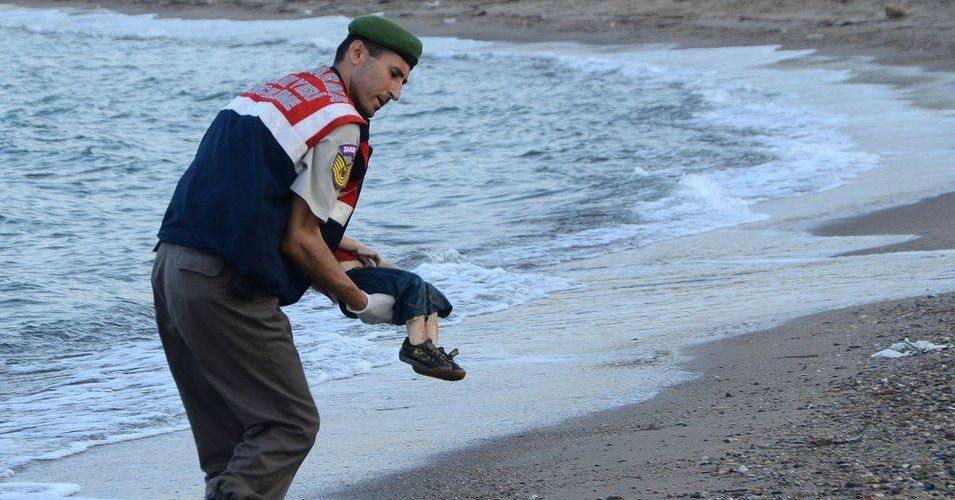
A paramilitary police officer carries the lifeless body of three-year-old Aylan Kurdi after he drowned when the
boat he and his family members were in capsized near the Turkish resort of Bodrum early Wednesday, Sept. 2, 2015.
(Photo: Nilüfer Demir/DHA)
Meanwhile, Gulf Arab nations like Saudi Arabia, Qatar, Kuwait and the
United Arab Emirates have provided refuge to zero Syrian refugees.
While there’s certainly a conversation taking place about refugees —
who they are, where they’re going, who’s helping them, and who isn’t —
what’s absent is a discussion on how to prevent these wars from starting
in the first place. Media outlets and political talking heads have
found many opportunities to point fingers in the blame game, but not one
media organization has accurately broken down what’s driving the chaos:
control over gas, oil and resources.
Indeed, it’s worth asking: How did demonstrations held by “hundreds”
of protesters demanding economic change in Syria four years ago devolve
into a deadly sectarian civil war, fanning the flames of extremism
haunting the world today and creating the world’s second largest refugee
crisis?
While the media points its finger to Syrian President Bashar Assad’s
barrel bombs and political analysts call for more airstrikes against
ISIS and harsher sanctions against Syria, we’re four years into the
crisis and most people have no idea how this war even got started.
This “civil war” is not about religion
Citing a lack of access on the ground, the United Nations stopped
regularly updating its numbers of casualties in the Syrian civil war in
January 2014. Estimates put the death toll between 140,200 and 330,380,
with as many as 6 million Syrians displaced, according to the U.N.
While there is no question that the Syrian government is responsible
for many of the casualties resulting from its brutal crackdown, this is
not just a Syrian problem.
Foreign meddling in Syria began several years before the Syrian revolt erupted. Wikieaks released leaked US
State Department cables from 2006
revealing US plans to overthrow the Syrian government through
instigating civil strife, and receiving these very orders straight from
Tel Aviv. The leaks reveal the United State’s partnership with nations
like Saudi Arabia, Turkey, Qatar and even Egypt to use sectarianism to
divide Syria through the Sunni and Shiite divide to destabilize the
nation to weaken Iran and Hezbolla. Israel is also revealed to attempt
to use this crisis to expand it’s occupation of the Golan Heights for
additional oil exploration.
According to major media outlets like the
BBC and the Associated Press, the demonstrations that supposedly swept Syria were comprised of only hundreds of people, but additional
Wikileaks cables reveal CIA involvement on the ground in Syria to instigate these very demonstrations as early as March 2011.
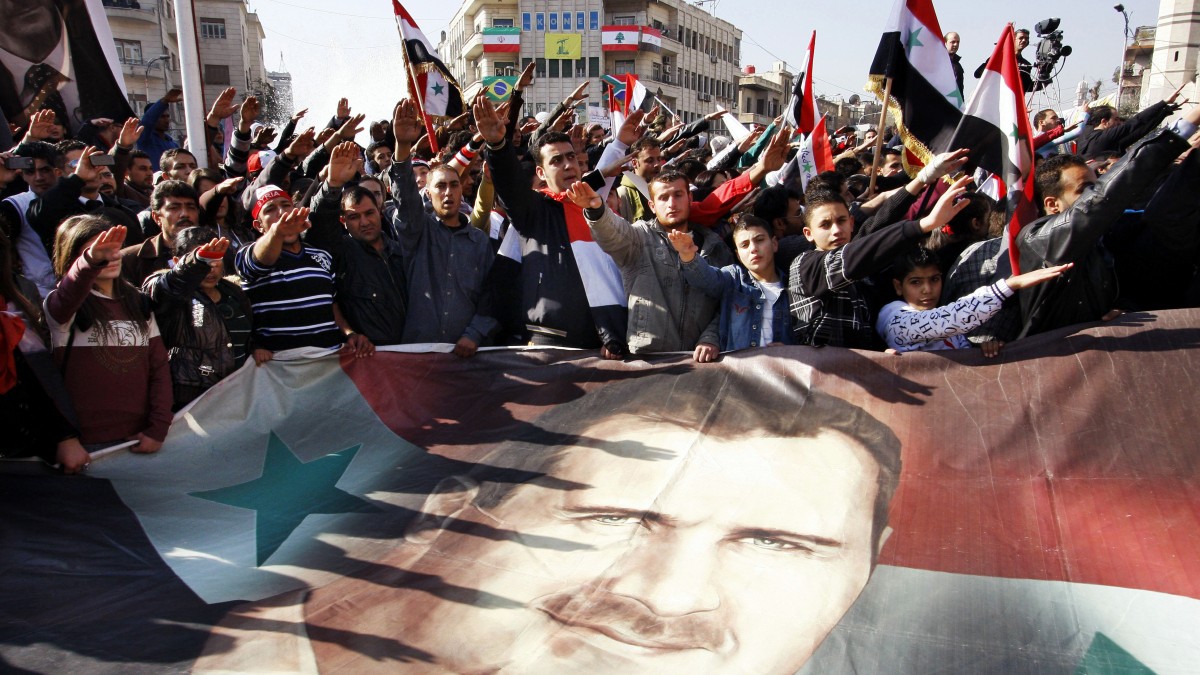
FILE – In this Monday, Dec. 19, 2011 file photo, Syrians hold a large poster depicting Syria’s President Bashar
Assad during a rally in Damascus, Syria. Some activists expressed regret that one year later their “revolution”
against President Bashar Assad’s rule had become mired in violence. (AP Photo/Muzaffar Salman, File)
Just a few months into the demonstrations which now consisted of
hundreds of armed protesters with CIA ties, demonstrations grew
larger, armed non-Syrian rebel groups swarmed into Syria, and a severe
government crackdown swept through the country to deter this foreign
meddling. It became evident that the United States, United Kingdom,
France, Qatar, Saudi Arabia and Turkey would be jumping on the
opportunity to organize, arm and finance rebels to form the Free Syrian
Army as outlined in the State Department plans to destabilize Syria.
(Just a few months ago,
WikiLeaks
confirmed this when it released Saudi intelligence that revealed
Turkey, Qatar and Saudi Arabia had been working hand in hand to arm and
finance rebels to overthrow the Syrian government since 2012.)
These foreign nations created a pact in 2012 called “The Group of
Friends of the Syrian People,” a name that couldn’t be further from the
truth. Their agenda was to divide and conquer in order to wreak havoc
across Syria in view of overthrowing Syrian President Bashar Assad.
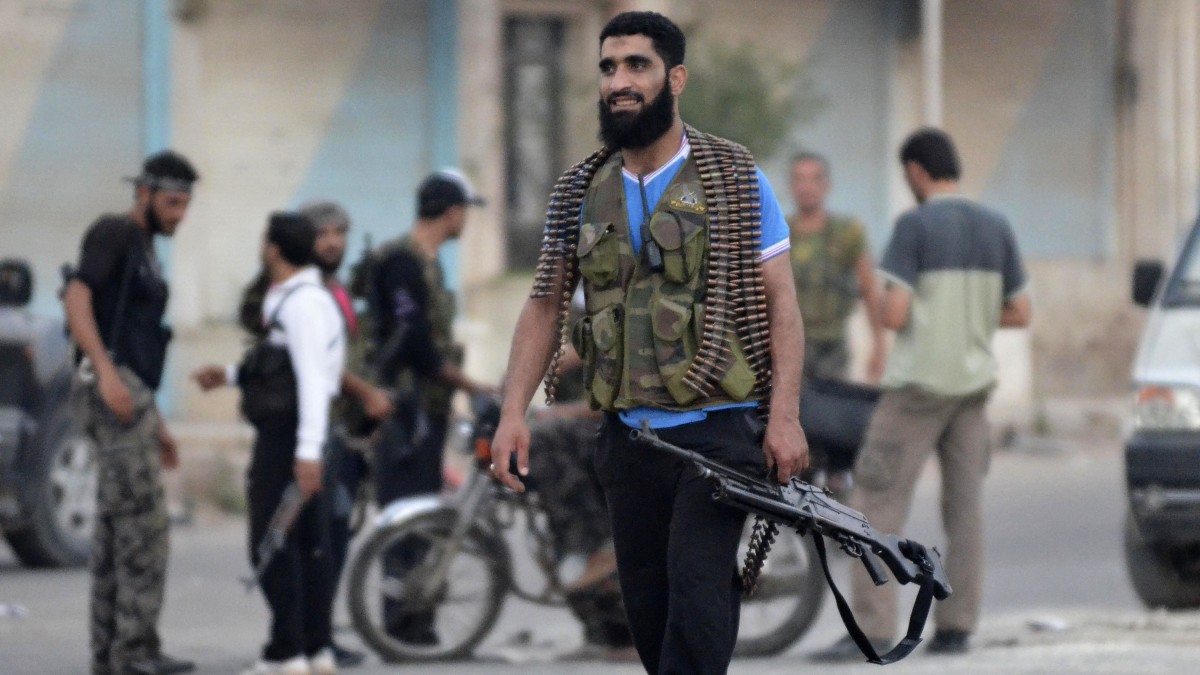
A Free Syrian Army soldier carries his weapon at the northern town of Sarmada, in Idlib province, Syria,
Wednesday, Aug. 1, 2012. (AP Photo)
The true agenda to hijack Syria’s revolt quickly became evident, with
talking heads inserting Syria’s alliance with Iran as a threat to the
security and interests of the United States and its allies in the
region. It’s no secret that Syria’s government is a major arms, oil and
gas, and weapons ally of Iran and Lebanon’s resistance political group
Hezbollah.
But it’s important to note the timing: This coalition and meddling in
Syria came about immediately on the heels of discussions of an
Iran-Iraq-Syria gas pipeline
that was to be built between 2014 and 2016 from Iran’s giant South Pars
field through Iraq and Syria. With a possible extension to Lebanon, it
would eventually reach Europe, the target export market.
Perhaps the most accurate description of the current crisis over gas, oil and pipelines that is raging in Syria
has been described by Dmitry Minin, writing for the Strategic Cultural Foundation in May 2013:
“A
battle is raging over whether pipelines will go toward Europe from east
to west, from Iran and Iraq to the Mediterranean coast of Syria, or
take a more northbound route from Qatar and Saudi Arabia via Syria and
Turkey. Having realized that the stalled Nabucco pipeline, and indeed
the entire Southern Corridor, are backed up only by Azerbaijan’s
reserves and can never equal Russian supplies to Europe or thwart the
construction of the South Stream, the West is in a hurry to replace them
with resources from the Persian Gulf. Syria ends up being a key link in
this chain, and it leans in favor of Iran and Russia; thus it was
decided in the Western capitals that its regime needs to change.
It’s the oil, gas and pipelines, stupid!
Indeed, tensions were building between Russia, the U.S. and the
European Union amid concerns that the European gas market would be held
hostage to Russian gas giant Gazprom. The proposed Iran-Iraq-Syria gas
pipeline would be essential to diversifying Europe’s energy supplies
away from Russia.
Turkey is Gazprom’s second-largest customer. The entire Turkish
energy security structure relies on gas from Russia and Iran. Plus,
Turkey was harboring Ottoman-like ambitions of becoming a strategic
crossroads for the export of Russian, Caspian-Central Asian, Iraqi and
Iranian oil and even gas to Europe.
The Guardian reported in August 2013:
“Assad refused to sign a proposed agreement with Qatar and Turkey that would run a pipeline from the latter’s North field,
contiguous with Iran’s South Pars field, through Saudi Arabia, Jordan,
Syria and on to Turkey, with a view to supply European markets – albeit
crucially bypassing Russia. Assad’s rationale was ‘to protect the
interests of [his] Russian ally, which is Europe’s top supplier of
natural gas.’”
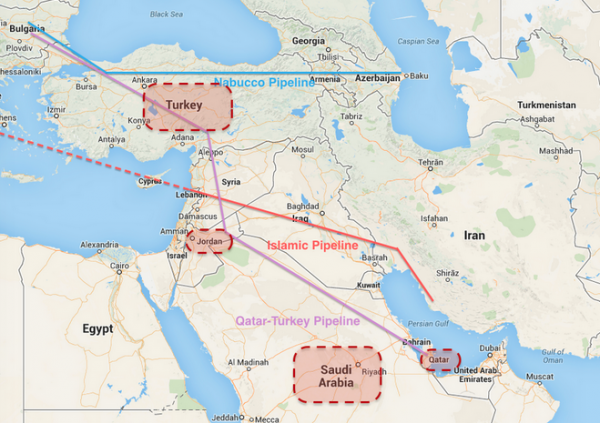
Note the purple line which traces the proposed Qatar-Turkey natural gas pipeline and note that all of the
countries highlighted in red are part of a new coalition hastily put together after Turkey finally (in exchange for
NATO’s acquiescence on Erdogan’s politically-motivated war with the PKK) agreed to allow the US to fly combat
missions against ISIS targets from Incirlik. Now note which country along the purple line is not highlighted in red.
That’s because Bashar al-Assad didn’t support the pipeline and now we’re seeing what happens when you’re a
Mid-East strongman and you decide not to support something the US and Saudi Arabia want to get done.
(Map: ZeroHedge.com)
Knowing Syria was a critical piece in its energy strategy, Turkey
attempted to persuade Syrian President Bashar Assad to reform this
Iranian pipeline and to work with the proposed Qatar-Turkey pipeline,
which would ultimately satisfy Turkey and the Gulf Arab nations’ quest
for dominance over gas supplies. But after Assad refused Turkey’s
proposal, Turkey and its allies became the major architects of Syria’s
“civil war.”
Much of the strategy currently at play was described back in a 2008
U.S. Army-funded RAND report, “Unfolding the Future of the Long War”:
“The
geographic area of proven oil reserves coincides with the power base of
much of the Salafi-jihadist network. This creates a linkage between oil
supplies and the long war that is not easily broken or simply
characterized. … For the foreseeable future, world oil production growth
and total output will be dominated by Persian Gulf resources. … The
region will therefore remain a strategic priority, and this priority
will interact strongly with that of prosecuting the long war.”
In this context, the report identifies the divide and conquer
strategy while exploiting the Sunni-Shiite divide to protect Gulf oil
and gas supplies while maintaining a Gulf Arab state dominance over oil
markets.
“Divide
and Rule focuses on exploiting fault lines between the various
Salafi-jihadist groups to turn them against each other and dissipate
their energy on internal conflicts. This strategy relies heavily on
covert action, information operations (IO), unconventional warfare, and
support to indigenous security forces. … the United States and its local
allies could use the nationalist jihadists to launch proxy IO campaigns
to discredit the transnational jihadists in the eyes of the local
populace. … U.S. leaders could also choose to capitalize on the
‘Sustained Shia-Sunni Conflict’ trajectory by taking the side of the
conservative Sunni regimes against Shiite empowerment movements in the
Muslim world…. possibly supporting authoritative Sunni governments
against a continuingly hostile Iran.”
The report notes that another option would be “to take sides in the
conflict, possibly supporting authoritative Sunni governments against a
continuingly hostile Iran.”
This framework crafted an interesting axis: Turkey, Qatar, Saudi Arabia, U.S., Britain and France vs. Syria, Iran and Russia.
Divide and conquer: A path to regime change
With the U.S., France, Britain, Qatar, Saudi Arabia and Turkey — aka,
the new “Friends of Syria” coalition — publicly calling for the
overthrow of Syrian President Bashar Assad between 2011 and 2012 after
Assad’s refusal to sign onto the gas pipeline, the funds and arms
flowing into Syria to feed the so-called “moderate” rebels were pushing
Syria into a humanitarian crisis. Rebel groups were being organized left
and right, many of which featured foreign fighters and many of which
had allied with al-Qaida.
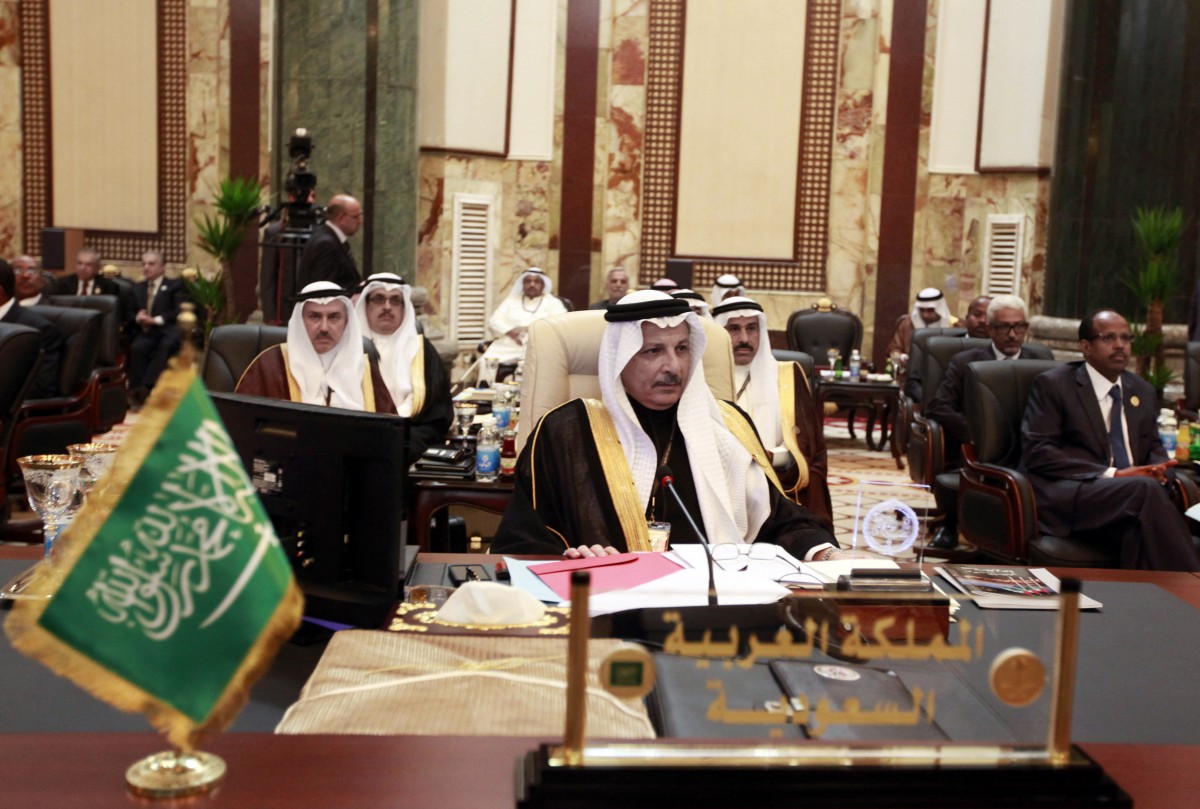
Saudi Arabia’s permanent representative to the League of Arab States Ahmad al-Qattan, center, attends the Arab
League summit in Baghdad, Iraq, Thursday, March, 29, 2012. (AP Photo)
The Syrian government responded with a heavy hand, targeting rebel held areas and killing civilians in the process.
Since Syria is religiously diverse, the so-called “Friends of Syria”
pushed sectarianism as their official “divide and conquer” strategy to
oust Assad. Claiming that Alawites ruled over a majority Sunni nation,
the call by the “moderate” U.S.-backed rebels became one about Sunni
liberation.
Although the war is being sold to the public as a Sunni-Shiite
conflict, so-called Sunni groups like ISIS, the Syrian al-Qaida
affiliate Jabhat al-Nusra (the Nusra Front) and even the “moderate” Free
Syrian Army have indiscriminately targeted Syria’s Sunnis, Shiites,
Christians and Jews. At the same time, these same foreign nations
supported and even armed the Bahraini government, which claims to be
Sunni, in its violent crackdown on the majority Shiite pro-democracy
demonstrations that swept the nation.
The Syrian government army itself is over 80 percent Sunni, which
indicates that the true agenda has been politically — not religiously —
motivated.
In addition to this, the Assad family is Alawite, an Islamic sect
that the media has clumped in with Shiites, though most Shiites would
agree that the two are unrelated. Further, the Assad family is described
as secular and running a secular nation. Counting Alawites as Shiites
was simply another way to push a sectarian framework for the conflict:
It allowed for the premise that the Syria-Iran alliance was based on
religion, when, in fact, it was an economic relationship.
This framework carefully crafted the Syrian conflict as a Sunni
revolution to liberate itself from Shiite influence that Iran was
supposedly spreading to Iraq, Syria and Lebanon.
But the truth is, Syria’s Sunni
community is divided, and many defected to join groups like the Free
Syrian Army, ISIS and al-Qaida. And as mentioned earlier, over 80
percent of Assad’s military is Sunni.
As early as 2012, additional rebels armed and financed by Arab Gulf
nations and Turkey like al-Qaida and the Muslim Brotherhood, declared
all-out war against Shiites. They even threatened to attack Lebanon’s
Hezbollah and Iraq’s government after they had overthrown the Assad
government.
Soon after, the majority of the Muslim Brotherhood rebels became part
of al-Qaida-affiliated groups. Together, they announced that they would
destroy all shrines — not just those ones which hold particular
importance to Shiites.
Hezbollah entered the scene in 2012 and allied itself with the Syrian
government to fight al-Nusra and ISIS, which were officially being
armed and financed by Qatar, Saudi Arabia and Turkey. And all the arms
were actively being sold to these nations by the United States. Thus, US
arms were falling into the hands of the same terror group the US claims
to be fighting in its broader War on Terror.
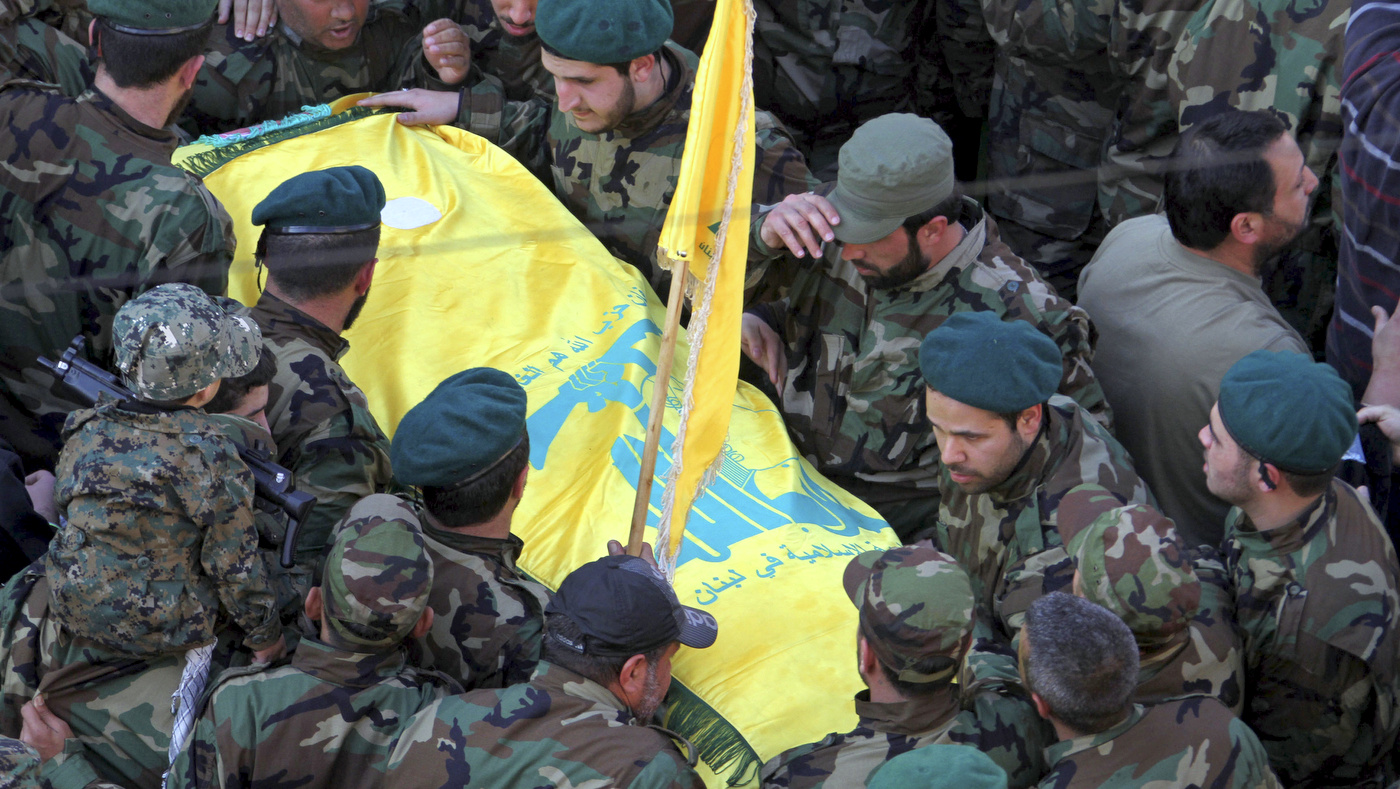
Hezbollah fighters carry the coffin of Hezbollah member Mohammad Issa who was killed in an airstrike that
killed six members of the Lebanese militant group and an Iranian general in Syria, during his funeral procession,
in the southern village of Arab Salim, Lebanon, Tuesday, Jan. 20, 2015. Hezbollah has accused Israel of carrying
out Sunday’s airstrike, which occurred on the Syrian side of the Golan Heights. Issa was the highest-ranking among
the group, and was among the senior cadres who headed the group’s operations in Syria against the Sunni-led
rebellion. (AP Photo/Mohammed Zaatari)
According to reports, Hezbollah was and has been been active in
preventing rebel penetration from Syria to Lebanon, being one of the
most active forces in the Syrian civil war spillover in Lebanon. Despite
this, the U.S. sanctioned both the Syrian government and Hezbollah in
2012.
Also that year, Russia and Iran sent military advisers to assist the
Syrian government in quelling the terror groups, but Iranian troops were
not on the ground fighting during this time.
What was once a secular, diverse and peaceful nation, was looking
more like it was on its way to becoming the next Afghanistan; its people
living under Taliban-style rule as jihadists took over more land and
conquered more cities.
Effects of foreign meddling outweigh self-determination
If you think that was hard to follow, you’re certainly not alone.
Most sectarian civil wars are purposely crafted to pit sides against
one another to allow for a “divide and conquer” approach that breaks
larger concentrations of power into smaller factions that have more
difficulty linking up. It’s a colonial doctrine that the British Empire
famously used, and what we see taking place in Syria is no different.
So, let’s get one thing straight: This is not about religion. It
might be convenient to say that Arabs or Muslims kill each other, and
it’s easy to frame these conflicts as sectarian to paint the region and
its people as barbaric. But this Orientalist, overly simplistic view of
conflict in the Middle East dehumanizes the victims of these wars to
justify direct and indirect military action.
If the truth was presented to the public from the perspective that
these wars are about economic interests, most people would not support
any covert funding and arming of rebels or direct intervention. In fact,
the majority of the public would protest against war. But when
something is presented to the public as a matter of good versus evil, we
are naturally inclined to side with the “good” and justify war to fight
off the supposed “evil.”
The political rhetoric has been carefully crafted to make lies sound
truthful and murder respectable. Ultimately, no matter the agendas, the
alliances or instability brought on by foreign meddling, the calls for
freedom, democracy and equality that erupted in 2011 were real then and
they’re real today. And let’s not forget that the lack of freedom,
democracy and equality have been brought on more by foreign meddling to
prop up brutal dictators and arm terror groups than by
self-determination.
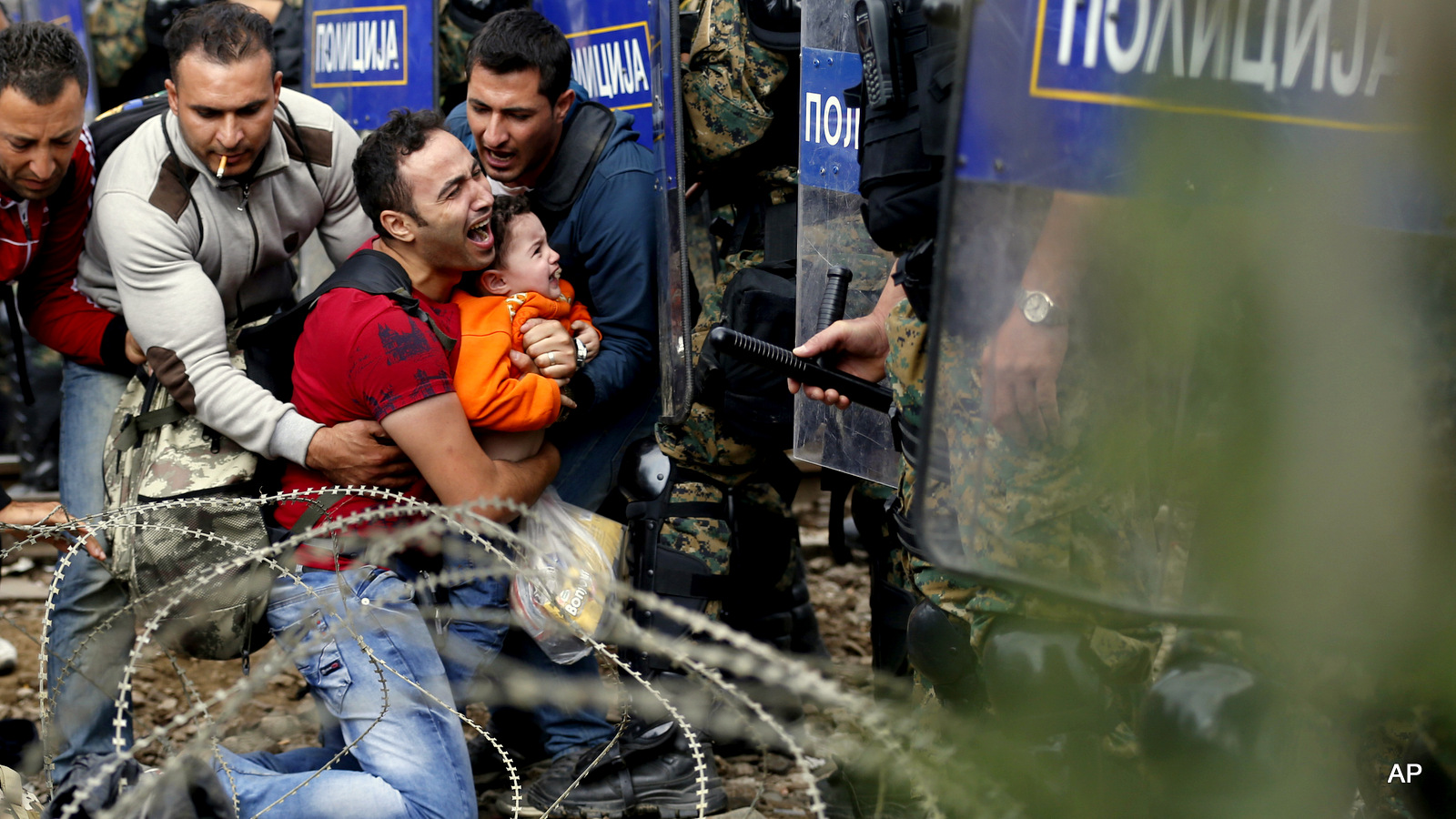
Refugee’s assist a fellow Refugee holding a boy as they are stuck between Macedonian riot police officers and
refugees during a clash near the border train station of Idomeni, northern Greece, as they wait to be allowed by
the Macedonian police to cross the border from Greece to Macedonia, Friday, Aug. 21, 2015. Macedonian special
police forces have fired stun grenades to disperse thousands of refugees stuck on a no-man’s land with Greece, a
day after Macedonia declared a state of emergency on its borders to deal with a massive influx of refugees heading
north to Europe. (AP Photo/Darko Vojinovic)
The people in the Middle East once stood united and strong together
against foreign meddling, exploitation and colonialism no matter their
religious or cultural background. But today, the Middle East is being
torn to shreds by manipulative plans to gain oil and gas access by
pitting people against one another based on religion. The ensuing chaos
provides ample cover to install a new regime that’s more amenable to
opening up oil pipelines and ensuring favorable routes for the highest
bidders.
And in this push for energy, it’s the people who suffer most. In
Syria, they are fleeing en masse. They’re waking up, putting sneakers on
their little boys and girls, and hopping on boats without life jackets,
hoping just to make it to another shore. They’re risking their lives,
knowing full well that they may never reach that other shore, because
the hope of somewhere else is better than the reality at home.