Showing posts with label Syria. Show all posts

Saturday, October 8, 2016

The Forgotten Libyan Lessons and the Syrian War

By Robert Parry. Originally published at Parry’s Consortium News (republished with permission).
Most intelligent Americans – Republicans as well as Democrats – now accept that they were duped into the Iraq War with disastrous consequences, but there is more uncertainty about the war on Libya in 2011 as well as the ongoing proxy war on Syria and the New Cold War showdown with Russia over Ukraine.
Today, many Democrats don’t want to admit that they have been manipulated into supporting new imperial adventures against Libya, Syria, Ukraine and Russia by the Obama administration as it pulls some of the same propaganda strings that George W. Bush’s administration did in 2002-2003.
Yet, as happened with Saddam Hussein in Iraq, we have seen a similar hysteria about the evil doings of the newly demonized foreign leaders with the predictable Hitler allusions and vague explanations about how some terrible misdeeds halfway around the world threaten U.S. interests.
Though people mostly remember the false WMD claims about Iraq, much of the case for the invasion was based on protecting “human rights,” spreading “democracy,” and eliminating a supporter of Palestinians who were violently resisting Israeli rule.
The justification for aggression against Iraq was not only to save Americans from the supposed risk of Iraq somehow unleashing poison gas on U.S. cities but to free the Iraqis from a brutal dictator, the argument which explained why Bush’s neocon advisers predicted that Iraqis would shower American troops with rose petals and candies.

Those same “humanitarian” arguments were out in force to justify the U.S.-European “regime change” in Libya eight years later. As former Secretary of State Hillary Clinton asserted – even this year – Muammar Gaddafi was a “genocidal” dictator bent on slaughtering the people of eastern Libya (though Gaddafi insisted that he was only interested in killing the “terrorists”).
After a frenzied media reaction to Gaddafi’s supposedly genocidal plans, Western nations argued that the world had a “responsibility to protect” Libyan civilians, a concept known as “R2P.” In haste, the United Nations Security Council approved a resolution to protect civilians by imposing a “no-fly zone” over eastern Libya.
But the subsequent invasion involved U.S.-coordinated air strikes on Gaddafi’s forces and European Special Forces on the ground working with anti-Gaddafi rebels. Before long, the “no-fly zone” had expanded into a full-scale “regime change” operation, ending in the slaughter of many young Libyan soldiers and the sodomy-with-a-knife-then-murder of Gaddafi.
As Western leaders celebrated — Secretary Clinton exulted  “We came, we saw, he died” — Libyans began the hard work of trying to restructure their political system amid roaming bands of heavily armed jihadist rebels. Soon, it became clear that restoring order would not be easy and that Gaddafi was right about the presence of terrorists in Benghazi (when some overran the U.S. consulate killing U.S. Ambassador Christopher Stevens and three other Americans.)
Libya, which once had an envious standard of living based on its oil riches, slid into the status of failed state, now with three governments competing for control and with jihadist militias, including some associated with the Islamic State and Al Qaeda, disrupting the nation. The result has been a far worse humanitarian crisis than existed before the West invaded.
Lessons from Libya
So, there should be lessons learned from Libya, just as there should have been lessons learned from Iraq. But the U.S. political/media establishment has refused to perform a serious autopsy of these monumental failures (U.S. inquiries only looked narrowly at the WMD falsehoods about Iraq and the attack on the U.S. consulate in Benghazi for Libya). So, it has fallen to the British to take a broader view.
The British inquiries have had their own limitations, but the Chilcot report on Iraq catalogued many of the flawed decisions that led Prime Minister Tony Blair to sign up for President George W. Bush’s “coalition of the willing” — and a recent parliamentary report revealed how Prime Minister David Cameron fell into a similar pattern regarding Libya and President Obama.
Of course, it’s always easier to detect the manipulations and deceptions in hindsight. In real time, the career pressures on politicians, bureaucrats and journalists can overwhelm any normal sense of skepticism. As the propaganda and disinformation swirl around them, all the “smart” people agree that “something must be done” and that usually means bombing someone.
We are seeing the same pattern play out today with the “group think” in support of a major U.S. military intervention in Syria (supposedly to impose the sweet-sounding goal of a “no-fly zone,” the same rhetorical gateway used to start the “regime change” wars in Iraq and Libya).
We are experiencing the same demonization of Syria’s Bashar al-Assad and Russia’s Vladimir Putin that we witnessed before those other two wars on Saddam Hussein and Muammar Gaddafi. Every possible allegation is made against them, often based on dubious and deceitful “evidence,” but it goes unchallenged because to question the propaganda opens a person to charges of being an “apologist” or a “stooge.”
Past Is Prologue
But looking back on how the disasters in Iraq and Libya unfolded is not just about the past; it’s about the present and future.
In that sense, the findings by the U.K. parliament’s foreign affairs committee regarding Libya deserved more attention than they received because they demonstrated that the Iraq case was not a one-off anomaly but rather part of a new way to rationalize imperial wars.
And the findings showed that these tactics are bipartisan, used by all four major parties in the U.S. and U.K.: Bush was a Republican; Blair was Labour; Obama a Democrat; and Cameron a Conservative. Though the nuances may differ slightly, the outcomes have been the same.
The U.K. report also stripped away many of the humanitarian arguments used to sell the Libyan war and revealed the crass self-interest beneath. For instance, the French, who helped spearhead the Libyan conflict, publicly lamented the suffering of civilians but privately were eager to grab a bigger oil stake in Libya and to block Gaddafi’s plans to supplant the French currency in ex-French colonies of Africa.
The report cited an April 2, 2011 email to Secretary of State Clinton from her unofficial adviser Sidney Blumenthal explaining what French intelligence officers were saying privately about French President Nicolas Sarkozy’s real motives for pushing for the military intervention in Libya:
“a. A desire to gain a greater share of Libya oil production, b. Increase French influence in North Africa, c. Improve his internal political situation in France, d. Provide the French military with an opportunity to reassert its position in the world, e. Address the concern of his advisors over Qaddafi’s long term plans to supplant France as the dominant power in Francophone Africa.”
Regarding France’s “humanitarian” public rationale, the U.K. report quoted then-French Foreign Minister Alain Juppé as warning the U.N. about the imminence of Gaddafi engaging in a mass slaughter of civilians: “We have very little time left — perhaps only a matter of hours.”
But the report added, “Subsequent analysis suggested that the immediate threat to civilians was being publicly overstated and that [Gaddafi’s] reconquest of cities had not resulted in mass civilian casualties.”
The report also found that “Intelligence on the extent to which extremist militant Islamist elements were involved in the anti-Gaddafi rebellion was inadequate,” including the participation of Abdelhakim Belhadj and other members of Al Qaeda’s affiliate, Libyan Islamic Fighting Group. A senior defense official said the jihadist danger was played down during the conflict but “with the benefit of hindsight, that was wishful thinking at best.”
The report stated: “The possibility that militant extremist groups would attempt to benefit from the rebellion should not have been the preserve of hindsight. Libyan connections with transnational militant extremist groups were known before 2011, because many Libyans had participated in the Iraq insurgency and in Afghanistan with al-Qaeda.”
(This year, Belhadj and his jihadist militia were enlisted by U.S. officials to protect the U.S.-U.N.-backed “Government of National Accord,” which has failed to win over the support of rival factions, in part, because more secular Libyan leaders distrust Belhadj and resent outsiders deciding who should run Libya.)
Hyperbolic Claims
The U.K. committee criticized the West’s hyperbolic claims about Gaddafi’s intent to slaughter civilians in eastern Libya when his actions were making clear that wasn’t happening.
The report said:  “Muammar Gaddafi’s actions in February and March 2011 demonstrated an appreciation of the delicate tribal and regional nature of Libya that was absent in UK policymaking. In particular, his forces did not take violent retribution against civilians in towns and cities on the road to Benghazi. [North Africa analyst] Alison Pargeter told us that any such reprisals would have ‘alienated a lot of the tribes in the east of Libya’ on which the Gaddafi regime relied. …
“Despite his rhetoric, the proposition that Muammar Gaddafi would have ordered the massacre of civilians in Benghazi was not supported by the available evidence. The Gaddafi regime had retaken towns from the rebels without attacking civilians in early February 2011. …
“During fighting in Misrata, the hospital recorded 257 people killed and 949 people wounded in February and March 2011. Those casualties included 22 women and eight children. Libyan doctors told United Nations investigators that Tripoli’s morgues contained more than 200 corpses following fighting in late February 2011, of whom two were female. The disparity between male and female casualties suggested that Gaddafi regime forces targeted male combatants in a civil war and did not indiscriminately attack civilians.”
The report added: “On 17 March 2011, Muammar Gaddafi announced to the rebels in Benghazi, ‘Throw away your weapons, exactly like your brothers in Ajdabiya and other places did. They laid down their arms and they are safe. We never pursued them at all.’ Subsequent investigation revealed that when Gaddafi regime forces retook Ajdabiya in February 2011, they did not attack civilians. Muammar Gaddafi also attempted to appease protesters in Benghazi with an offer of development aid before finally deploying troops.”
In another reprise from the Iraq War run-up, the U.K. inquiry determined that Libyan exiles played key roles in exaggerating the dangers from Gaddafi, much like the Iraqi National Congress did in fabricating supposed “evidence” of Saddam Hussein’s WMD. The report said:
“We were told that émigrés opposed to Muammar Gaddafi exploited unrest in Libya by overstating the threat to civilians and encouraging Western powers to intervene. In the course of his 40-year dictatorship Muammar Gaddafi had acquired many enemies in the Middle East and North Africa, who were similarly prepared to exaggerate the threat to civilians.”
Qatar’s Al-Jazeera satellite channel, which currently is hyping horror stories in Syria, was doing the same in Libya, the U.K. committee learned.
“Alison Pargeter told us that the issue of mercenaries was amplified [with her saying]: ‘I also think the Arab media played a very important role here. Al-Jazeera in particular, but also al-Arabiya, were reporting that Gaddafi was using air strikes against people in Benghazi and, I think, were really hamming everything up, and it turned out not to be true.’”
Allegations Debunked
The report continued: “An Amnesty International investigation in June 2011 could not corroborate allegations of mass human rights violations by Gaddafi regime troops. However, it uncovered evidence that rebels in Benghazi made false claims and manufactured evidence.
“The investigation concluded that much Western media coverage has from the outset presented a very one-sided view of the logic of events, portraying the protest movement as entirely peaceful and repeatedly suggesting that the regime’s security forces were unaccountably massacring unarmed demonstrators who presented no security challenge. …
“In short, the scale of the threat to civilians was presented with unjustified certainty. US intelligence officials reportedly described the intervention as ‘an intelligence-light decision’. We have seen no evidence that the UK Government carried out a proper analysis of the nature of the rebellion in Libya. …
“It could not verify the actual threat to civilians posed by the Gaddafi regime; it selectively took elements of Muammar Gaddafi’s rhetoric at face value; and it failed to identify the militant Islamist extremist element in the rebellion. UK strategy was founded on erroneous assumptions and an incomplete understanding of the evidence.”
If any of this sounds familiar – echoing the pre-coup reporting from Ukraine in 2013-2014 or the current coverage in Syria – it should. In all those cases, Western diplomats and journalists put white hats on one side and black hats on the other, presenting a simplistic, imbalanced account of the complicated religious, ethnic and political aspects of these crises.
The U.K. report also exposed how the original goal of protecting civilians merged seamlessly into a “regime change” war. The report said:
“The combination of coalition airpower with the supply of arms, intelligence and personnel to the rebels guaranteed the military defeat of the Gaddafi regime. On 20 March 2011, for example, Muammar Gaddafi’s forces retreated some 40 miles from Benghazi following attacks by French aircraft. If the primary object of the coalition intervention was the urgent need to protect civilians in Benghazi, then this objective was achieved in less than 24 hours.
“The basis for intervention: did it change? We questioned why NATO conducted air operations across Libya between April and October 2011 when it had secured the protection of civilians in Benghazi in March 2011. … We asked [former chief of defense staff] Lord Richards whether the object of British policy in Libya was civilian protection or regime change. He told us that ‘one thing morphed almost ineluctably into the other’ as the campaign developed its own momentum. … The UK’s intervention in Libya was reactive and did not comprise action in pursuit of a strategic objective. This meant that a limited intervention to protect civilians drifted into a policy of regime change by military means.”
Less destructive options were also ignored, the report found: “Saif Gaddafi is the second son of Muammar Gaddafi. He was a member of his father’s inner circle and exercised influence in Libya. … Former Prime Minister Tony Blair, who knew the Gaddafi regime better than most Western politicians, confirmed that Saif Gaddafi was ‘the best, if not the only prospect’ of effecting political change in Libya.” But that opportunity was rebuffed as was the possibility of arranging Gaddafi’s surrender of power and exile, the report said, adding:
“It was therefore important to keep the lines of communication open. However, we saw no evidence that the then Prime Minister David Cameron attempted to exploit Mr Blair’s contacts. Mr Blair explained that both Mr Cameron and former United States Secretary of State Hillary Clinton were aware that he was communicating with Muammar Gaddafi. We asked Mr Blair to describe Mr Cameron’s reaction to his conversations with Muammar Gaddafi. He told us that Mr Cameron ‘was merely listening’.
“Political options were available if the UK Government had adhered to the spirit of [U.N.] Resolution 1973, implemented its original campaign plan [to protect civilians] and influenced its coalition allies to pause military action when Benghazi was secured in March 2011. Political engagement might have delivered civilian protection, regime change and reform at lesser cost to the UK and to Libya.”
Spreading Disorder
There was also the consequence of the Libyan conflict, spreading disorder around the region because Libyan military stockpiles were plundered. The report said: “Libya purchased some £30 billion [or about $38 billion] of weapons and ammunition between 1969 and 2010. Many of those munitions were not issued to the Libyan Army and were instead stored in warehouses. After the collapse of the Gaddafi regime, some weapons and ammunition remained in Libya, where they fell into the hands of the militias. Other Libyan weapons and ammunition were trafficked across North and West Africa and the Middle East.
“The United Nations Panel of Experts appointed to examine the impact of Resolution 1973 identified the presence of ex-Libyan weapons in Algeria, Chad, Egypt, Gaza, Mali, Niger, Tunisia and Syria. The panel concluded that ‘arms originating from Libya have significantly reinforced the military capacity of terrorist groups operating in Algeria, Egypt, Mali and Tunisia.’ …
“The international community’s inability to secure weapons abandoned by the Gaddafi regime fuelled instability in Libya and enabled and increased terrorism across North and West Africa and the Middle East. The UK Government correctly identified the need to secure weapons immediately after the 2011 Libyan civil war, but it and its international partners took insufficient action to achieve that objective. However, it is probable that none of the states that intervened in Libya would have been prepared to commit the necessary military and political resources to secure stocks of weapons and ammunition. That consideration should have informed their calculation to intervene.”
Despite these findings, the Obama administration and its allies are considering an escalation of their military intervention in Syria, which already has involved arming and training jihadists who include Al Qaeda militants as well as supposedly “moderate” fighters, who have aligned themselves with Al Qaeda and handed over sophisticated American weaponry.
The U.S. military has spearheaded a bombing campaign against Al Qaeda’s spinoff, the Islamic State, inside Syria. But the Obama administration sometimes has put its desire to oust Assad ahead of its supposed priority of fighting the Islamic State, such as when U.S. air power pulled back from bombing Islamic State militants in 2015 as they were overrunning Syrian army positions at the historic city of Palmyra.
Now, with Syria and its Russian ally resorting to intense bombing to root Al Qaeda and its allies, including some of those U.S.-armed “moderates,” from their strongholds in eastern Aleppo, there is a full-throated demand from the West, including virtually all major media outlets, to impose a “no-fly zone,” like the one that preceded the “regime change” in Libya.
While such interventions may “feel good” – and perhaps there’s a hunger to see Assad murdered like Gaddafi – there is little or no careful analysis about what is likely to follow.
The most likely outcome from a Syrian “regime change” is a victory by Al Qaeda and/or its erstwhile friends in the Islamic State. How that would make the lives of Syrians better is hard to fathom. More likely, the victorious jihadists would inflict a mass bloodletting on Christians, Alawites, Shiites, secular Sunnis and other “heretics,” with millions more fleeing as refugees.
Among the Western elites – in politics and media – no lessons apparently have been learned from the disaster in Iraq, nor from the new British report on the Libyan fiasco.
Investigative reporter Robert Parry broke many of the Iran-Contra stories for The Associated Press and Newsweek in the 1980s. You can buy his latest book, America’s Stolen Narrative, either in print here or as an e-book (from Amazon and barnesandnoble.com).

Syria – Is The U.S. Preparing A “False Flag” Bombing?

http://www.washingtonsblog.com/2016/10/syria-u-s-preparing-false-flag-bombing.html#more-61662

By Moon of Alabama. Originally posted at Moon of Alabama under Syria – Is The U.S. Preparing A “False Flag” Bombing?.
There is a curious coincidence of a remark Secretary of State Kerry made to Syrian opposition activists and a new paint scheme applied to some U.S. military jets.
October 1 2016: Kerry in leaked audio: ‘I lost the argument’ for use of force in Syria

Washington (CNN) Secretary of State John Kerry’s frustration with the failure of American diplomacy was on display as he defended US efforts to help end the five-year civil war in Syria during a meeting last week with a group of Syrian civilians, according to an audio recording obtained by CNN.
…
Kerry’s comments came at a meeting that took place at the Dutch Mission to the United Nations on the sidelines the UN General Assembly, where Kerry was going from session to session in a frenzied effort to resuscitate a ceasefire that seemed poised to collapse.
A complete audio recording of the meeting between Kerry, some of his staff, and some Syrians is available on youtube.
Of interest is a short segment about alleged Russian bombing beginning at 11:18. The female Arab-English interpreter translates remarks by a Syrian, believed to be the Syrian front-man of the White Helmets scam Raed Saleh, about the difficulties of supervising ceasefires.

Interpreter (translating from a male Arabic speaker): We don’t believe that Russia can be the guarantor of the actions of the regime. We see Russia is a partner of the regime in bombing Syrians, Syrian civilians, market places, even our own team, the Syrian Civil Defense team. We documented since the start of the Russian intervention in Syria from day one until February of this year more than 17 of our Syrian Civil Defense personal have been killed by Russian airstrikes.
Kerry: Do you have any videos of the airplanes of these strikes?
(crosstalk interpreter and male Arab voice)
Kerry: Can we get that (unintelligible) videos the agents have been asking for?
(crosstalk interpreter and male Arab voice)
Kerry staff member: So can I just say – we get a lot of videos of the victims of these attacks, they are terrible, but they don’t help us. We need videos of the actual aircrafts and ammunition. And there is a lot of them on the internet but we don’t know whether they are real or not. Verified videos of the actual aircraft is the most useful thing. …
These men can be helped, though someone in the U.S. military – or not.
A Canadian journalist based in Eastern/Central Europe, Christian Borys tweeted yesterday:
Christian Borys @ItsBorysThe U.S is painting their F/A-18’s to match the paint schemes of Russian jets in #Syria. Standard training, but interesting nonetheless. pic.twitter.com/FVN6tMj2Ji
1:45 PM – 6 Oct 2016
This is the attached pic:
The first three pics are of an U.S. F/A-18 fighter and attack aircraft in Russian coloring. (The wingtips are raised for storage as this is a carrier enabled plane. The windows of the raised cockpit hood are covered with white sun protection sheets.) On the bottom right is a picture of a Russia SU-34 in the usual Russian color scheme as it is also used by the Russian contingent in Syria.
It would be extremely difficult to distinguish these like-colored planes from each other in a shaky fly-by and “bombing” video.
The U.S. regularly uses planes in “enemy” color schemes as “aggressor force” during training and maneuvers. It helps U.S. pilots to get used to “enemy” targets during air-to-air combat training. So this can all be, like Christian Borys assumes, “standard training”.
But there is also Kerry’s talk with the Syrian opposition and his explicit request for videos of “Russian” jets bombing in Syria.
This may be an innocent coincidence: Secretary Kerry is asking the scam artists of the White Helmets for video of Russian jets “bombing civilians” in Syria and, just by chance, the U.S. military is painting one of its jets to look like a “Russian” Su-34 strike fighter like those deployed in Syria.
But many incidents in Syria, the Ghouta gas attack, the recent aid convoy attack, get attributed to Russia or the Syrian government without any proof (or even despite contrary evidence). The media always eat these falsehoods up based simply on some official’s say-so, some unverified pictures or video and without asking any further questions. A “Russian attack” on some large civilian target like a refugee camp, documented on video!, would be a very easy sell. The propagandized “uproar” over such an attack could be easily used to launch a wider war. The attack on the Gleiwitz Radio tower, the Gulf of Tonkin incident and “Saddam’s WMDs” come to mind. Kerry is not shy of such lying. Today he invented a new hospital attack, said it was a war crime and that Russia and Syria should be investigated. No such attack happened.
The Russian parliament ratified an agreement with Syria about the indefinite stationing of Russian forces in Syria. Yesterday the Russian Ministry of Defense warned that Russian soldiers are embedded with Syrian units on the ground and that they would be defended against any attempt of air attacks by the Russian air-defense in Syria. U.S. media called such matter of course statement bellicose talk.
There is plenty of lose talk in U.S. media about attacking Syrian and Russian forces in Syria. The U.S. recently bombed a Syrian unit in a well known position it had held for many month. 82 Syrian soldier died and many more were wounded. The strike furthered the advance of ISIS on the besieged Deir Ezzor. That was no ‘mistake’ as the U.S. claimed.
Russia will defend its forces in Syria and it will defend Syria’s sovereignty. It is not alone. A Chinese navy frigate just arrived in the Syrian port Tartus. Should that trip-wire get touched 1.3 billion Chinese would join the Russians, Iranians and Syrians in waging war against the U.S. “regime change” attempt in Syria. Washington is warned. No cheap paint scheme trickery will be accepted as reason to hold back. Russia WILL hit back should the need arise.
Any attack on Russian or Syrian forces would be illegal. Kerry himself, in the above linked talk, says that the U.S. has absolutely no legal grounds for any such attack. It would be illegitimate and a crime. But the U.S. is not known for staying strictly within the framework of international law. Russia is well advised to warn of the eventual consequences of any breach. There is nothing “bellicose” about that.

Saturday, August 6, 2016

U.S. Delivers 3,000 Tons Of Weapons And Ammo To Al-Qaeda and Co. in Syria


Global Research, April 08, 2016
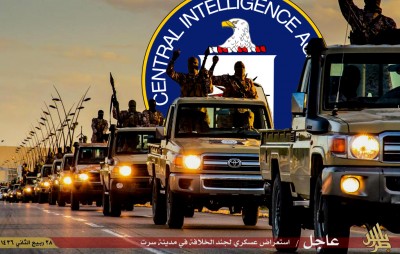
cia-isis
The United States via its Central Intelligence Service is still delivering thousands of tons of additional weapons to al-Qaeda and others in Syria.
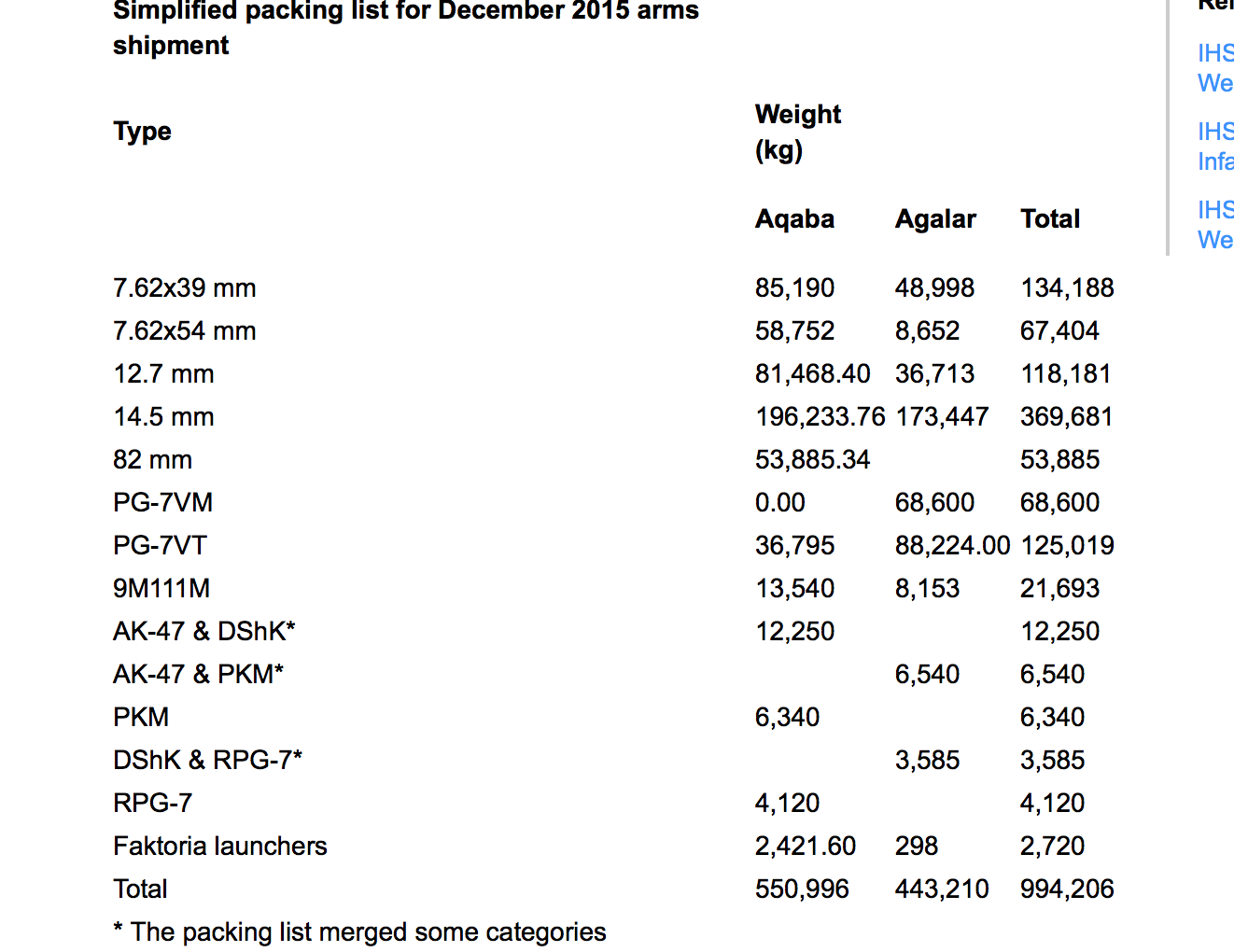
The British military information service Jane’s found the transport solicitation for the shipment on the U.S. government website FedBizOps.gov. Janes writes:
The FBO has released two solicitations in recent months looking for shipping companies to transport explosive material from Eastern Europe to the Jordanian port of Aqaba on behalf of the US Navy’s Military Sealift Command. Released on 3 November 2015, the first solicitation sought a contractor to ship 81 containers of cargo that included explosive material from Constanta in Bulgaria to Aqaba.
…
The cargo listed in the document included AK-47 rifles, PKM general-purpose machine guns, DShK heavy machine guns, RPG-7 rocket launchers, and 9K111M Faktoria anti-tank guided weapon (ATGW) systems. The Faktoria is an improved version of the 9K111 Fagot ATGW, the primary difference being that its missile has a tandem warhead for defeating explosive reactive armour (ERA) fitted to some tanks.
Screenshot of Jane’s Report
The Jane’s author tweeted the full article (copy here).
One ship with nearly one thousand tons of weapons and ammo left Constanta in Romania on December 5. The weapons are from Bulgaria, Croatia and Romania. It sailed to Agalar in Turkey which has a military pier and then to Aqaba in Jordan. Another ship with more than two-thousand tons of weapons and ammo left in late March, followed the same route and was last recorded on its way to Aqaba on April 4.
We already knew that the “rebels” in Syria received plenty of weapons during the official ceasefire. We also know that these “rebels” regularly deliver half of their weapon hauls from Turkey and Jordan to al-Qaeda in Syria (aka Jabhat al-Nusra):
Hard-core Islamists in the Nusra Front have long outgunned the more secular, nationalist, Western-supported rebels. According to FSA officers, Nusra routinely harvests up to half the weapons supplied by the Friends of Syria, a collection of countries opposed to Assad, ..
U.S. and Turkey supported “rebels” took part in the recent attack on Tal al-Eis against Syrian government forces which was launched with three suicide bombs by al-Qaeda in Syria. This was an indisputable breaking of the ceasefire agreement between Russia and the U.S. It is very likely that some of the weapons and ammunition the U.S. delivered in December were used in this attack.
Millions of rifle, machine-gun and mortar shots, thousands of new light and heavy weapons and hundreds of new anti-tank missiles were delivered by the U.S.. Neither Turkey nor Jordan use such weapons of Soviet providence. These weapons are going to Syria where, as has been reported for years by several independent sources, half of them go directly to al-Qaeda.
From historic experience we can be sure that the consequence of this weaponizing of takfiris will be not only be the death of “brown people” in the Middle East, but also attacks on “western” people and interests.
Skyscrapers falling in New York and hundreds of random people getting killed in Paris, Brussels, London and (likely soon) Berlin seem not be enough to deter the politicians and “experts” that actively support this criminal war on Syria and its people.
 

Friday, May 6, 2016

Why the Syrian Peace Talks Broke Down

Eric Zuesse, originally posted at strategic-culture.org
During the negotiations that had led to the Syrian peace talks, a key question was whether Russia and the Syrian army would be allowed to continue uninterrupted, their military actions against ISIS and Al Qaeda. (Al Qaeda in Syria is called “Al Nusra.”) Throughout the negotiations between U.S. Secretary of State John Kerry and Russian Foreign Minister Sergei Lavrov, there was agreement that ISIS (the U.S. Government calls it ‘ISIL’) has no place there, and must continue to be bombed and attacked without interruption until exterminated there; but Kerry opposed Lavrov’s demand to include Al Nusra’s (Al Qaeda’s) forces as also having no rightful place in Syria. Kerry finally accepted that Al Nusra should have no part in ruling Syria, and thus he reluctantly acceded to Russia’s demand. This agreement by Kerry enabled the peace talks to begin.

These talks broke down on April 18th because Al Nusra was facing imminent defeat in the key city of Aleppo, and because such a defeat was unacceptable to Mohammed Alloush, the Saudi agent, and head of the Saudi-Wahhabist group, the Army of Islam. He was selected by King Saud to lead the rebel side at Syria’s peace negotiations. “There was ‘no way’ the opposition could resume formal talks amid a military escalation and a worsening humanitarian situation, senior opposition negotiator Mohammed Alloush told Reuters,” on April 18th. 

Mohammed Alloush is allegedly a cousin of the recently deceased founder of the Army of Islam, Mohammed Zahran Alloush, who was called simply “Zahran Alloush.” Mohammed Alloush now runs it. The fathers of Zahran and Mohammed were allegedly brothers, and their father, Sheikh Abdullah Mohammed Alloush, had immigrated to Syria from Saudi Arabia, and he led the growing Saudi Wahhabist, fundamentalist Sunni, community, in the Damascus suburb of Ghouta, which is the place where the 21 August 2013 sarin gas attack that U.S. President Barack Obama has used as his excuse to invade Syria took place. Zahran Alloush had actually helped U.S. President Obama, and Turkey’s President Erdogan, and King Saud, and Qatar’s Emir Thani, to plan and to carry out that sarin attack, so as to blame it on Assad, in order that the U.S. President would then be enabled to mobilize public opinion in the U.S. to invade Syria and overthrow Assad — which is what they want; but, after this fraud started to become exposed, Obama temporarily backed down — and, yet, Saud, Thani, and Erdogan (all fundamentalist Sunnis allied with the U.S.), remained determined to overthrow the secular Shiite Assad (who allies with Russia and with Shiite Iran). The Sauds have the attitude that unless all Shiites die, the Sauds will die, that it’s an “existential” matter for them. And the American Government backs their war against Shia.
Obama will now need to decide whether Alloush’s ending the talks can serve as an excuse to blame Assad and Russia’s Putin for the breakdown of talks, and resume overt support of ‘the Syrian opposition’ (the U.S.-Sunni-backed jihadists, all of whom are fundamentalist Sunnis, like the Sauds), which one might more properly call the Saud-Thani-Obama invasion of Syria, to overthrow the secular Shiite Assad. 
Sometimes, the ways of hiding a foreign invasion of a country can become almost irrelevant, and the only thing that actually still matters is whether the time appears to be ripe, to resume, or escalate, a war that one remains determined to win. So it is with the U.S. Government under Barack Obama, who still remains determined to replace Bashar al-Aassad by a fundamentalist Sunni proponent of Shariah law.
During the peace talks period, the U.S. has sent to the Syrian rebels 3,000 tons of weapons, including surface-to-air missiles that can shoot down Russia’s planes. So, for the jihadist side in this war, the peace talks might turn out to have been the pause that refreshes.
On April 17th, the secular alliance, including Christians and Sunnis as well as Shiites, and also including many women, were re-elected, and newly elected, to constitute the next Syrian Parliament. Syria has the only non-sectarian government in the Middle East. Almost all of the fundamentalists are foreign mercenaries, salaried jihadists, paid by the Sauds and Thanis, and armed by the Americans.
—————

Thursday, May 5, 2016

Turkey PM To Quit, Handing Even More Power To Erdogan: What This Means For Turkey

Tyler Durden's picture

http://www.zerohedge.com/news/2016-05-05/turkey-pm-quit-handing-even-more-power-erdogan-what-means-turkey
Yesterday when we reported on the dramatic plunge in the Turkish Lira, which crumbled the most since 2008 on a report that a denied AKP party convention was going to take place, we predicted that this means a resignation of PM Davutoglu, who having been caught in a bitter power struggled with president Erdogan would likely resign, we said "if the convention is confirmed, it means that Turkey is about to be swallowed in yet another bitter political crisis, which will likely result in Erdogan concentrating even more power, unless of course he is stopped which in turn would meat more rioting, more civilian casulties, and even less media freedom to describe one nation's collapse into a despotic, authoritarian state."

An uneasy meeting between president and PM on Wednesday signalled the latest events
Moments ago Davutoglu's resignation was confirmed, and as BBC reports, "Turkey's Prime Minister Ahmet Davutoglu says he will stand down at an extraordinary congress of his ruling AK Party later this month."
The result has been a dramatic surge in Turkish Lira volatility, which as shown in the chart below just jumped the most in the past decade.

The BBC adds that speculation about his resignation has been rife since Mr Davutoglu met President Recep Tayyip Erdogan on Wednesday. He is long thought to have disapproved of Mr Erdogan's plans to move Turkey to a presidential system of government. He announced his resignation after holding talks with party leaders. The congress would be held on 22 May, he said.
Earlier on Thursday, presidential aide Cemil Ertem said there would be no snap elections following the appointment of a new leader. He also told Turkish TV that the country and its economy would stabilise further "when a prime minister more closely aligned with President Erdogan takes office". In other words, just as expected, this was merely Erdogan's latest move to concentrate even more power in his hands.
For those who have not been following this latest Turkish scandal, here are the basics.
Why is this happening now?
After he was elected president in 2014, Mr Erdogan hand-picked Mr Davutoglu to succeed him as head of the AK Party (Justice and Development Party). But the prime minister's unease with Mr Erdogan's plans to move to a presidential system, among other policies, has been evident in recent months.
In a sign of his weakening influence, Mr Davutoglu was stripped last week of the authority to appoint provincial AK Party officials.
What will this mean for Turkey?
The development comes at a time of increasing instability for Turkey, which is tackling an escalating conflict with the rebels of the Kurdistan Workers' Party (PKK), attacks by the so-called Islamic State, and an influx of migrants and refugees.
Turkey is also in the midst of implementing a key deal with the European Union, brokered by Mr Davutoglu, to limit the number of refugees flowing across its border in return for accelerated EU accession talks and financial aid.
The future of that agreement, which Mr Davutoglu was seen as having agreed with little input from the president, could be plunged into doubt by his departure.
Who will be his successor?
Among those tipped as successors to Mr Davutoglu are Transport Minister Binali Yildirim, who is close to Mr Erdogan, and Energy Minister Berat Albayrak, who is the president's son-in-law.
They will be formally elected at the party congress.
What has been the fall-out?
The political uncertainty has rattled the financial markets. The Turkish lira suffered its heaviest daily loss on Wednesday, down almost 4% against the US dollar. It rallied slightly on Thursday but was still well off its previous trading levels.
What does it mean for Erdogan?
Recep Tayyip Erdogan is arguably the most formidable politician since modern Turkey's founding father Ataturk. After 11 years as prime minister, he was elected president in 2014 - but under a parliamentary system, in which his role should be largely ceremonial.
The fiercely ambitious Mr Erdogan is intent on changing that to a presidential system, which he says would make Turkey function more effectively, but which would also significantly increase his powers.
As president, he chose a prime minister who he thought would be pliant: the ex-foreign minister and bookish former academic, Ahmet Davutoglu.
But it seems he miscalculated. Seeing wavering public support for a presidential system, realising that he would be significantly sidelined should it materialise and disagreeing with Mr Erdogan on a growing list of policies, the prime minister has quietly dissented.
There has been little public show of disobedience, no clear spat. That's not Mr Davutoglu's style. Nor is it likely, given the widespread fear of Mr Erdogan within the ruling AKP.

Tuesday, May 3, 2016

When Is A Boot On The Ground Not A Boot On The Ground?

Tyler Durden's picture

http://www.zerohedge.com/news/2016-05-03/when-boot-ground-not-boot-ground

Authored by AP's Lolita Baldor, via Military.com,
No one disputes that U.S. military forces are fighting in combat in Iraq and Syria -- except maybe President Barack Obama and some members of his administration.
The semantic arguments over whether there are American "boots on the ground" muddy the view of a situation in which several thousand armed U.S. military personnel are in Iraq and Syria. Obama has said more than a dozen times that there would be no combat troops in Iraq and Syria as the number of service members in those countries grows; last week, Defense Secretary Ash Carter acknowledged the military personnel there were in combat and "we should say that clearly."
So, when is a military boot on the ground? And what does it all mean?

Are U.S. military troops in Iraq?

Yes. More than 5,500 U.S. service members. The Pentagon, however, counts them in different ways. Obama recently authorized an increase in the number of troops that can deploy to Iraq to advise and assist Iraqi forces in fighting the Islamic State. The cap was increased last week from 3,870 to 4,087.
But a number of troops aren't counted against the cap because of the military's personnel accounting system. For example, troops assigned to the U.S. Embassy for security or those sent to Iraq for temporary, short-term assignments are there in addition to the 4,087.
Defense Secretary Ash Carter, in Stuttgart, Germany for a change-of-command ceremony Tuesday, revealed that a serviceman had been killed in combat near Irbil in Iraq. A U.S. military official, speaking on grounds of anonymity, said the American was killed while performing his duty as an adviser to Kurdish Peshmerga troops. He was killed by "direct fire" after Islamic State forces penetrated the Peshmerga's forward line. The official said the American was three to two to three miles behind the front line.

Are U.S. military troops in Syria?

Yes. Last week the Pentagon announced an increase in the number of U.S. forces working in Syria from 50 to 300. Those troops are working with local Syrian forces and are mainly Army special forces, but the latest increase will also include medical and logistics units.

So, that would mean there are U.S. "boots on the ground" in Iraq and Syria, wouldn't it?

Yes it would. In Iraq there are advisers, trainers, special operations forces and others stationed at Iraqi bases, working with the Iraqi forces. Last week, Defense Secretary Ash Carter announced that some advisers would begin working with Iraqis at the brigade and battalion level. They had been working with Iraqis at the division headquarters level. The change would embed those teams of advisers with smaller units, who would likely be closer to the fight.
In Syria, the U.S. has about 50 special operations forces going into Syria from a base in a neighboring country to meet with local Syrian opposition forces. They aren't based in Syria, so they travel in and out, sometimes staying in the country for several days at a time. According to officials, the additional 250 forces will do the same thing. They will not be based in Syria, but will instead work out of neighboring countries, such as Iraq or Turkey. And they are not there to fight alongside the Syrians, they are there to provide advice and other assistance.

What about air strikes? Aren't pilots flying combat missions?

Yes they are. Gen. Joseph Dunford, chairman of the Joint Chiefs of Staff, made it clear during a Senate hearing last week that U.S. fighter jets conducting airstrikes in Iraq and Syria are conducting combat missions.

Why does the administration say there are no U.S. boots on the ground?

Obama administration officials have consistently told the American public since 2013 that there will be no combat "boots on the ground" in Iraq and Syria. Their argument is based on the idea that there are no conventional U.S. ground forces in large units fighting the Islamic State militants in direct combat. Saying there are "no U.S. boots on the ground" — while inaccurate — is meant to convey the administration's view that U.S. troops are not on the front lines waging the war. Instead, U.S. troops are advising and assisting the Iraqi and Syrian forces, providing training, intelligence, and logistical support from behind the battlefront.
The parsing of words is meant to differentiate the latest Islamic State conflicts from earlier wars in Iraq and Afghanistan when thousands of U.S. troops were battling the enemy in small units and in close combat.
Carter told the Senate Armed Services Committee last week that U.S. troops are not going to war to substitute for the local forces, but are trying "to get them powerful enough that they can expel ISIL with our support. And when we provide that support, we put people in harm's way. We ask them to conduct combat actions."

Aren't special operations forces in direct combat in Iraq or Syria?

A: Probably. But the Pentagon doesn't talk about the often highly classified operations that U.S. commandos -- including Army Delta Force or Navy SEALs -- are doing no matter where they are. And Army special forces — or Green Berets — are in many war-torn countries providing training and assistance, because that's one of their key jobs.
In some cases, U.S. officials have acknowledged special operations missions to capture or kill high-value targets or to try and rescue hostages.
But those are not considered "boots on the ground" because they often move in and out quickly, and stay for short periods of time.

Tuesday, April 26, 2016

Russia signs contracts worth $950mn to rebuild Syria

© Ammar Abdullah
Damascus and Moscow have signed nearly a billion dollars worth of agreements to rebuild war-torn Syria, according to the Prime Minister Wael al-Halqi. The two countries intend to develop energy, trade, finance and other sectors of the economy.
"The Russian side has responded to the idea of restoring [Syrian] infrastructure. Therefore, a lot of deals were signed, including $675 million and $280 million agreements," said the Syrian prime minister.
According to al-Halqi, more than 60 percent of the power stations in Syria are shut down and need fuel to restart.
“Despite all the things Syria has undergone, it has managed to maintain the infrastructure. However, the production of electricity depends on fuel, and the oil sector has been more affected by terrorism than the electricity sector," said the prime minister.
Syria has offered Russia a chance to participate in exploring and developing oil and gas on land and offshore. In particular, Russia was invited to upgrade the Baniyas refinery and construct a refinery with Iran and Venezuela.
Damascus is also ready to discuss payment in national currencies with Russia. At the moment, Syria is negotiating a free trade zone with Russia, Belarus and Kazakhstan, if the treaty is signed and trade reaches a certain level, Damascus will then begin to pay in local currency.
Al-Halqi added Syria and Russia intend to open a bank to facilitate transfers between the countries. The bank would be controlled 50-50 by the countries’ central banks.
As for trade, Syria is interested in promoting Russian goods in the Middle East. “Syria has geographical advantages, making it capable of becoming a developed commercial and industrial center for Russian companies in Middle East markets," said al-Halqi.
Speaking about Syrian exports to Russia, he said that in the first quarter of 2016 Syria sold more goods to Russia than in all of 2015

No boots on ground in Syria, but US troops wearing boots & on ground are there ‒ State Dept

Despite repeated promises to the contrary, US troops are in Syria, and the Pentagon has sent 250 more. But the State Department says those American soldiers wearing boots in Syria aren’t actually “boots on the ground.”
President Barack Obama confirmed plans to dramatically increase the American troop presence in Syria by deploying an additional 250 personnel, bringing the total to 300. He said the troops would help drive out Islamic State (IS, formerly ISIS/ISIL).
In 2013, Obama promised not to put any “American boots on the ground in Syria.”
The president repeated that claim in a September 2014 interview on ‘Meet the Press’.
“The notion that the United States should be putting boots on the ground, I think would be a profound mistake. And I want to be very clear and very explicit about that," Obama said on September 7, 2014.
Three days later, he reiterated that point in an address to the American people, promising that US troops would not fight in Syria.
On Monday, however, State Department spokesman John Kirby admitted that the US has boots on the ground in Syria… but that they are not there as boots on the ground.
Associated Press reporter Matt Lee pressed Kirby on the issue.
“For months and months and months, the mantra from the president and everyone else in the administration has been the no boots on the ground, and how…” Lee said.
“That is not true,” Kirby replied, cutting him off.
“What?” Lee exclaimed.
“It’s just not true, Matt. It’s just not true,” Kirby said. “I just flatly, absolutely disagree with you,” the spokesman said while pounding his fist on the podium.
RT’s Gayane Chichakyan then joined the fray.

“Within 24 hours, we have seen two headlines, one of them being, ‘President Obama rules out ground troops to Syria’ and he told the BBC…” she said. “And then, shortly after, ‘President Obama to deploy 250 more special forces troops to Syria.’”
“My question is, what is the difference between the troops that the president ruled out and the troops that he’s going to send to Syria?”
“You know, that’s actually an intelligent question. That’s a good question, and I appreciate that you asked it because it’s very relevant,” Kirby responded, explaining that the first set ‒ what most people think of as “boots on the ground” ‒ would be conventional ground troops who would participate in large combat. Instead, what the US is sending an additional 250 troops for advisory and assistance purposes, joining the 50 such special forces already there.
“There is a big difference between saying, ‘no boots on the ground’ ‒ we’ve all recognized since almost the outset that we’ve had US troops in Iraq, which are very much on the ground ‒ and the colloquial meaning of the term, which is what many people when they say ‘no boots on the ground’ are referring to,” Kirby said, “which is large-scale, intentionally combat ground troops engaged in combat operations that they themselves are conducting independently” of the country’s “indigenous forces.”
“That’s not happening, and that’s not gonna happen,” he said.
“You guys are getting way wrapped around the actual on the phrase ‘boots on the ground’,” Kirby added later, noting that, among other things American pilots are flying combat missions above Iraq and Syria.
Lee took up the mantle of questioning once again.
“Why didn’t the administration come out and say, ‘There will be no large-scale combat’ instead of saying ‘no boots on the ground’?” Lee asked. “These people, unless they’re not wearing boots, are boots on the ground!”
“Listen, on this point, I totally agree with you,” Kirby replied. “They are wearing boots, and they are on the ground. But that doesn’t mean that they are in large-scale ground combat operations!”
And around and around they went again.

Wednesday, April 13, 2016

CIA ‘Plan B’ for Syria would give rebels MANPADs to 'counter Russia' - report

© Reuters
A covert ‘Plan B’ for Syria reserved for a “violation of ceasefire” is being pushed to the US president, anonymous officials told media. Arming “moderate” Syrian rebels with anti-aircraft weapons to fight the “Russia-backed regime” is again on the table.
Back in February, the Wall Street Journal first reported that President Barack Obama’s senior military and intelligence advisers were insisting that a back-up plan is necessary to “counter Russia” in Syria.
The fresh details obtained by the WSJ suggest the CIA has given “provisional assurances” to coalition members to expand support to Syrian armed opposition groups fighting troops of President Bashar Assad. Still, the White House reserved the right to define which weapons systems are to be introduced to the battlefield – if the truce fails and full-scale fighting resumes.
On the eve of the ceasefire agreement coming into effect in Syria at midnight on February 27, the heads of Middle East intelligence agencies met to lay out a plan for waging war after the truce. And consultations on the matter never stopped ever since.
Today Washington and its allies, such as Ankara and Riyadh, are discussing which weapon systems are to be delivered to “vetted” Syrian rebels under this secret program, the WSJ reports.
Experts agree that what the anti-government forces in Syria need the most are electronic means to ensure effective suppression of President Bashar Assad’s artillery batteries and take down fighter jets. For the latter purpose, man-portable air-defense systems (MANPADs) are on the table, with Turkey and Saudi Arabia eager to supply them to the Syrian rebels.
The WSJ claims that US officials have conveyed a “private message” to their Russian counterparts that a return to full-scale fighting could “end up putting more Russian pilots in danger.”
The rebels have already obtained a “small number” of MANPADs “through illicit channels,” the CIA hints, thus posing danger to civil aircrafts. The CIA is now busy preventing more MANPADs from “slipping uncontrollably” into the war zone.
"If the ceasefire collapses, if the negotiations don’t go anywhere, and we’re back to full throttle civil war, all bets will be off,” the WSJ cited a senior Obama administration official as saying in a message to Moscow. “The outside patrons will double and triple down, throwing everything they can into Syria, including much more lethal weaponry.”
Actually, the “full-scale fighting” the US warns of never ended in Syria, at least against some parties in the conflict: no armistice was signed with terrorist groups like Islamic State (IS, formerly ISIS/ISIL) and Al-Nusra Front.
Since the beginning of the ceasefire six weeks ago, dozens of local rebel groups throughout Syria joined the truce or even teamed up with the government forces against the terrorists. The armed formations that opted to side with terrorists are being bombed by Russian and Syrian air forces.
In the given conditions, the question about who would announce that the ceasefire has been violated remains open. Just as soon it could be voiced at the upcoming peace talks between Damascus and opposition groups that are set to resume this week in Geneva.
In the meantime, Washington’s Arab allies suggested high tech means to limit MANPADs’ operability by fitting them with “geographical sensors” to prevent them from being used outside designated areas, but the US remained silent to the proposal. Instead, Washington has been reportedly pressing main sponsors of the Syrian armed rebels, namely Qatar and Saudi Arabia, to use their influence to order the Syrian rebels to abide by the ceasefire.
The CIA’s covert program to provide the Syrian anti-government forces with “limited supplies” of small arms and ammunition was launched in 2013 and has been growing steadily. A year later, the CIA was already providing rebels with antitank TOW missiles today actively used on the battlefield against Assad troops and eventually rescue groups of the Russian task force deployed to Syria.

Tuesday, March 29, 2016

Putin & Assad Have Liberated Syria from the U.S.-&-Jihadist Alliance

Screen Shot 2016-03-27 at 1.39.25 PM copy

Eric Zuesse
It has been an alliance between the leaderships of U.S., Turkey, Saudi Arabia, Qatar, and UAE; but, regardless of whether it’s called “the U.S. alliance” or “the Saudi alliance,” or even (possibly) “the Turkish alliance” (and it could be called by any of those three names), it’s the jihadist alliance, and it now seems to be near its final defeat, by, quite clearly, the Russian alliance: Russian air power has enabled the Syrian army (called the SAA or “Syrian Arab Army”) of Bashar al-Assad, plus Lebanon’s Shiite warriors (called “Hezbollah”), plus organization by Iran’s generals, to exterminate thousands of ISIS jihadists. The pro-Syrian alliance, under Russian air-power, are now making final preparations to finish the job, in the Syrian headquarters of ISIS — the city of Raqqa, where ISIS’s “Caliph” is, who could soon be meeting his end.
This major military victory, in Palmyra — the center of the Jihadist-controlled region of Syria (and located south of Raqqa, separated from it only by desert) — was announced on Easter Sunday, 27 March 2016, by the website Syrian Perspective (one of the world’s two great news-sites covering the Syrian war, the other being Al Masdar News), as they headlined, “Palmyra Liberated! General Ayyoob Reviews Troops in Aftermath of Enormous Victory; What’s Next?” Reporter Ziad Fadel opened:

HOMS: The rats inside were finally given the go-ahead to withdraw to Al-Sukhna, Al-Raqqa and Dayr El-Zor, but not by the rodent commanders in Al-Raqqa. This was a desperate order by Abu-Ihaab Al-‘Iraaqi, the local commander who, evidently, values his life on earth a lot more than what was promised to him by the shamans of ISIS This morning at 5:00 a.m., the SAA had confirmation from sources inside the city that the piece-meal escape was taking place. The Syrian high command ordered troops to stand down until the last rodent had left, after which time the SAAF and RuAF would take to the skies to see how many of the stragglers could be exterminated. It’s over.
The Syrian and Russian Air Forces have been directed into the air to block any movement of terrorist ISIS rodents to any area considered a stronghold. This means that no deal was ever struck between the army and the murderers inside the city. Instead, what happened was the army was commanded to permit a withdrawal with the understanding that escaped rats would still be targets once the city was liberated. As I write, SAA engineers are everywhere inside the city removing IEDs, booby-traps and mines. It’s a thankless task replete with danger, but, it must be done in order to return the population to a safe city.
He went on to explain that the head of SAA’s Special Forces unit, called “Tiger Forces,” “is very keen on being the leader of the force which will liberate Al-Raqqa and his forces to the east of Aleppo are preparing for exactly that.”
The key question now is whether a deal can be reached with Abu Bakr al-Baghdadi, ISIS’s leader or “Caliph,” in Raqqa — a deal which won’t require the entire population of Raqqa to be massacred, in order for the Russian alliance to eliminate all of ISIS’s leadership, and all of its jihadists there. Ideally, some way will be found to salvage at least some of the civilian population who are being held, essentially as slaves, by ISIS. However, Russia’s leader, Vladimir Putin, has stated, on several occasions, that what’s most essential is for the jihadists in Syria, and in Iraq, to be killed where they are — not allowed to escape to become terrorist cells in Russia or anywhere else (as has been happening, though not on the huge scale that would result if Baghdadi and his jihadists are allowed to escape).
In a related event that also signals the defeat of the terrorist alliance, Middle East Eye, yet another of the key independent reporting sites regarding the war in Syria — and specializing on the entire Middle Eastern region — headlined on Friday the 25th of March, “Jordan’s King Accuses Turkey of Sending Terrorists to Europe,” and David Hearst reported:
King Abdullah of Jordan accused Turkey of exporting terrorists to Europe at a top level meeting with senior US politicians in January, the MEE can reveal. 
The king said Europe’s biggest refugee crisis was not an accident, and neither was the presence of terrorists among them: “The fact that terrorists are going to Europe is part of Turkish policy and Turkey keeps on getting a slap on the hand, but they are let off the hook.”
Asked by one of the congressmen present whether the Islamic State group was exporting oil to Turkey, Abdullah replied: ”Absolutely.”
In other words: the U.S. alliance is coming apart, at least at the edges, when the reality becomes revealed — despite the long hiding of this fact on the part of Western ‘news’ media — that the U.S.-Saudi-Qatari-Turkish-UAE-Israeli alliance has been supporting jihadist Sunni groups in order to weaken the only non-Sunni-run nations in the Middle East, Syria and Iran, both of which (and Syria’s government is more properly to be called non-sectarian  than Shiite, because the Ba’athist Party, which has been leading Syria since the 1950s, is ideologically committed to secularism and against sectarianism of any type, neither Shiite nor Sunni nor any) have allied themselves with Russia, instead of with the U.S.
The origin of the CIA aspect of this operation was well covered in an extraordinary BBC documentary in 1992, and the broader aristocratic operation was reported in my article, “The Two Contending Visions of World Government.” During Obama’s Presidency, one of the major physical battlefields in this global war has been in Syria; another, in Ukraine, Obama’s coup there, was well covered here.
—————

Wednesday, March 9, 2016

Western Reporter in Syria Finds U.S.-Backed Fighters Are Jihadists

Posted on  by Eric Zuesse.

Eva Bartlett, an independent journalist who is the first Western reporter who has travelled through the areas of Syria that have been freed from jihadist control by the Syrian government with Russian air-support, is reporting, at the sott.net website, that everyone she speaks with has stories of horror to tell, and that in many instances the jihadists who were inflicting the horrors were U.S.-armed and backed, basically supported by Saudi Arabia, Qatar, and Turkey — often “al-Nusra,” the Syrian branch of Al Qaeda. As Seymour Hersh and others have reported, the U.S. has worked with the Sauds, Qatar, and Turkey, to get men and weapons to al-Nusra.
For example:
In Latakia, many of the the over 1 million Internally Displaced Persons from Idlib, Aleppo and surrounding areas who are being housed and supported by the Syrian government spoke of the same heinous kidnappings, beheadings, and other crimes that most media currently only associate with Da’esh (ISIS), but which were perpetrated (with Turkish support) by the so-called FSA  [that’s the Free Syrian Army, the people that the Obama Administration backs and calls ‘moderates’] and other terrorist factions. 
A man from Harem, near the Turkish border, spoke of being kidnapped by FSA terrorists, and of the decapitations of Harem residents, heads sent home in boxes. 
“The terrorists attacked us, terrorists from Turkey, from Chechnya, and from Arab and other foreign countries. They had tanks and guns, like an army, just like an army. [The Sauds had bought those from the U.S.; the equipment is sent into Syria via Turkey.] For 73 days we were surrounded in the citadel of Harem. They hit us with all kinds of weapons. We had women and children with us. They showed no mercy. When they caught any of us, they slaughtered him, and then send his head back to us. They killed over 100 people, and kidnapped around 150… children, civilians, soldiers. Until now, we don’t know what’s happened to them,” he said. 
People from the village of Kassab spoke of the joint Turkish-Nusra attack on their village in March 2014, of escaping with the help of Syrian soldiers, of the over 80 who were slaughtered, including 13 who were beheaded, and of the raping and plunder of their people and homes. “They raped our older women because they couldn’t find any girls,” one resident told me.
She said that in the city of Homs, when she was there in April 2014 (before the recent liberation of Homs by Syrian government forces):
Others spoke of the sectarian slogans in the early protests in Homs, including the slaughtering of Alawis and the driving out of Christians. 
In other words, the jihadists who were occupying Homs were killing non-Sunnis: Alawites are Shiites; and, of course, Christians are also non-Sunnis. Bartlett reports that when she visited Homs again in December 2015 (after the Russian bombing campaign — which President Assad had invited into Syria — started on September 30th), the locals “were preparing to celebrate Christmas for the first time in years.”
She also reports that:
In Sweida, a Druze [non-Islamic, not merely non-Sunni] area southeast of Damascus which has largely fought off the attacks of militants since the beginning of the crisis in 2011, residents told me they had from very early on recognized the ‘revolution’ as a foreign plot against Syria. Druze leader, Sheikh Hammoud al-Hanawi (known as Sheikh al-Aqel) reiterated what residents had said about this plot, and spoke of how Sweida’s young and old men have protected the region and stand with the Syrian Arab Army. 
Near the close she says:
Wherever I’ve gone in Syria (as well as many months in various parts of Lebanon, where I’ve met Syrians from all over Syria) I’ve seen wide evidence of broad support for President al-Assad. The pride I’ve seen in a majority of Syrians in their President surfaces in the posters in homes and shops, in patriotic songs and Syrian flags at celebrations and in discussions with average Syrians of all faiths. Most Syrians request that I tell exactly what I have seen and to transmit the message that it is for Syrians to decide their future, that they support their president and army and that the only way to stop the bloodshed is for Western and Gulf nations to stop sending terrorists to Syria, for Turkey to stop warring on Syria, for the West to stop their nonsense talk about “freedom” and “democracy” and leave Syrians to decide their own future.
What she says is supported by Western-sponsored polls that have been taken of the Syrian public. It’s not merely the people she has met in Syria. This — the fact that the Syrian people support overwhelmingly Assad’s leadership of their country — is the reason why the Obama Administration has been insistent that Assad must be overthrown and excluded from being a candidate, before there can be any elections to determine who should be Syria’s President. The U.S. regime is the enemy of democracy in Syria (and the Syrian public resent this); the U.S. backs the Sunni Arabic royal families, and they’re unalterably opposed to democracy, because they fear their public. The American political system is far more sophisticated than theirs. For example, Obama said on 2 October 2015, “They’ve been propping up a regime that is rejected by an overwhelming majority of the Syrian population because they’ve seen that he has been willing to drop barrel bombs on children and on villages indiscriminately.” He blatantly lied. The American people trust their leaders’ lies. Consequently, America’s leaders aren’t nearly as afraid of their public as are the Arabic royal families of their public — not even if America’s leaders actually represent those royal families more than they do the U.S. public. America’s leaders have PR; they don’t even need to post severed heads as warnings to their public. In the U.S., deceiving the public (such as inthis example) achieves the desired degree of control.
—————