Showing posts with label Iraq. Show all posts

Tuesday, May 3, 2016

When Is A Boot On The Ground Not A Boot On The Ground?

Tyler Durden's picture

http://www.zerohedge.com/news/2016-05-03/when-boot-ground-not-boot-ground

Authored by AP's Lolita Baldor, via Military.com,
No one disputes that U.S. military forces are fighting in combat in Iraq and Syria -- except maybe President Barack Obama and some members of his administration.
The semantic arguments over whether there are American "boots on the ground" muddy the view of a situation in which several thousand armed U.S. military personnel are in Iraq and Syria. Obama has said more than a dozen times that there would be no combat troops in Iraq and Syria as the number of service members in those countries grows; last week, Defense Secretary Ash Carter acknowledged the military personnel there were in combat and "we should say that clearly."
So, when is a military boot on the ground? And what does it all mean?

Are U.S. military troops in Iraq?

Yes. More than 5,500 U.S. service members. The Pentagon, however, counts them in different ways. Obama recently authorized an increase in the number of troops that can deploy to Iraq to advise and assist Iraqi forces in fighting the Islamic State. The cap was increased last week from 3,870 to 4,087.
But a number of troops aren't counted against the cap because of the military's personnel accounting system. For example, troops assigned to the U.S. Embassy for security or those sent to Iraq for temporary, short-term assignments are there in addition to the 4,087.
Defense Secretary Ash Carter, in Stuttgart, Germany for a change-of-command ceremony Tuesday, revealed that a serviceman had been killed in combat near Irbil in Iraq. A U.S. military official, speaking on grounds of anonymity, said the American was killed while performing his duty as an adviser to Kurdish Peshmerga troops. He was killed by "direct fire" after Islamic State forces penetrated the Peshmerga's forward line. The official said the American was three to two to three miles behind the front line.

Are U.S. military troops in Syria?

Yes. Last week the Pentagon announced an increase in the number of U.S. forces working in Syria from 50 to 300. Those troops are working with local Syrian forces and are mainly Army special forces, but the latest increase will also include medical and logistics units.

So, that would mean there are U.S. "boots on the ground" in Iraq and Syria, wouldn't it?

Yes it would. In Iraq there are advisers, trainers, special operations forces and others stationed at Iraqi bases, working with the Iraqi forces. Last week, Defense Secretary Ash Carter announced that some advisers would begin working with Iraqis at the brigade and battalion level. They had been working with Iraqis at the division headquarters level. The change would embed those teams of advisers with smaller units, who would likely be closer to the fight.
In Syria, the U.S. has about 50 special operations forces going into Syria from a base in a neighboring country to meet with local Syrian opposition forces. They aren't based in Syria, so they travel in and out, sometimes staying in the country for several days at a time. According to officials, the additional 250 forces will do the same thing. They will not be based in Syria, but will instead work out of neighboring countries, such as Iraq or Turkey. And they are not there to fight alongside the Syrians, they are there to provide advice and other assistance.

What about air strikes? Aren't pilots flying combat missions?

Yes they are. Gen. Joseph Dunford, chairman of the Joint Chiefs of Staff, made it clear during a Senate hearing last week that U.S. fighter jets conducting airstrikes in Iraq and Syria are conducting combat missions.

Why does the administration say there are no U.S. boots on the ground?

Obama administration officials have consistently told the American public since 2013 that there will be no combat "boots on the ground" in Iraq and Syria. Their argument is based on the idea that there are no conventional U.S. ground forces in large units fighting the Islamic State militants in direct combat. Saying there are "no U.S. boots on the ground" — while inaccurate — is meant to convey the administration's view that U.S. troops are not on the front lines waging the war. Instead, U.S. troops are advising and assisting the Iraqi and Syrian forces, providing training, intelligence, and logistical support from behind the battlefront.
The parsing of words is meant to differentiate the latest Islamic State conflicts from earlier wars in Iraq and Afghanistan when thousands of U.S. troops were battling the enemy in small units and in close combat.
Carter told the Senate Armed Services Committee last week that U.S. troops are not going to war to substitute for the local forces, but are trying "to get them powerful enough that they can expel ISIL with our support. And when we provide that support, we put people in harm's way. We ask them to conduct combat actions."

Aren't special operations forces in direct combat in Iraq or Syria?

A: Probably. But the Pentagon doesn't talk about the often highly classified operations that U.S. commandos -- including Army Delta Force or Navy SEALs -- are doing no matter where they are. And Army special forces — or Green Berets — are in many war-torn countries providing training and assistance, because that's one of their key jobs.
In some cases, U.S. officials have acknowledged special operations missions to capture or kill high-value targets or to try and rescue hostages.
But those are not considered "boots on the ground" because they often move in and out quickly, and stay for short periods of time.

Wednesday, March 23, 2016

Revelation of Secret Iraq Base Belies Claim of 'No Boots on the Ground'

Published on Tuesday, March 22, 2016

A marine's death forced the Pentagon to acknowledge a secret marine base in Northern Iraq—and it also announced plans to quietly deploy another detachment
Marines in Iraq in 2003. The Pentagon revealed Sunday that marines were secretly deployed in the country earlier this month, despite President Obama's 'no boots on the ground' promise. (Photo: mtfrazier/flickr/cc)
A 27-year-old U.S. marine was killed this weekend by an ISIS rocket attack on a base that the American public didn't know existed.
The death forced the Pentagon to reveal on Sunday—the 13th anniversary of the start of the Iraq War—that it was in the process of setting up a base for marines in Northern Iraq. The Pentagon had supposedly "planned to acknowledge" this escalation of U.S. forces in Iraq later this week, an unnamed defense official told CNN.
The base was attacked a second time on Monday, CNN reported.

Peter Van Buren ‎@WeMeantWell
So now the U.S. has Marine artillery in combat in Iraq even as we pretend no boots on ground. We're so full of sh*t. https://www.washingtonpost.com/news/checkpoint/wp/2016/03/22/what-the-marines-new-fire-base-means-for-the-fight-against-the-islamic-state-and-the-battle-of-mosul/ 

The New York Times reported:
In a conference call with reporters, Colonel Warren said the Marines were not combat forces because they were positioned at the outpost to provide "force protection" to American military advisers working alongside Iraqi troops.
"They won’t kind of go off and conduct any type of mission on their own," he said, referring to the Marines. "They don’t really have that capability anyways. They’re just providing coverage, right? They’re providing fire support coverage for the several thousand Iraqi soldiers and the several hundred advisers."
"Force protection" is military jargon for providing security. But the U.S. military has long contracted out its security in Iraq to foreign workers—a policy that has been met with harsh criticism from human rights and labor activists, among many others.
Observers have noted that the DoD's hiring of private contractors in Iraq has only increased under President Obama's watch. Indeed, a glance at Department of Defense contracts reveals that as recently as January the Pentagon hired a private contractor to provide security to the Balad Iraqi Air Force base.
It remains unclear why marines would be deployed to provide security, when the Pentagon appears to continue to rely almost solely on private contractors instead of American soldiers to do that particular job.
Moreover, two defense officials characterized the marines' mission very differently in comments to Daily Beast: these particular marines "were deployed near the front lines of what is expected be the biggest battle of the war...tasked to launch a mission that signaled the U.S. was again furtively expanding its mission in Iraq," the officials said.
Just as with prior escalations of force, the Obama administration continues to argue that the president has still not broken his promise not to put "boots on the ground" in Iraq.
And yet the U.S. Central Command also quietly announced Sunday that it would be deploying an additional detachment of marines to Iraq. It did not state how many troops would be in this new deployment.
Currently, more than 4,000 American soldiers are deployed in the country, according to Military.com. It remains unclear at what point the Department of Defense would describe the U.S. military presence in Iraq as "boots on the ground."
It's funny how "no boots on the ground in Iraq" has quietly turned into 5,000 boots on the ground
Troubling that Marine killed, others wounded in Iraq comes amid policy in which WH won't acknowledge policy is in fact "boots on the ground"

Monday, March 21, 2016

Iraqi Shiite militias say US troops ‘forces of occupation,’ demand withdrawal

U.S. Marines, Iraq © Gunnery Sgt. Mark Oliva
Iran-backed Shiite militia forces in Iraq have strongly opposed new US troops deployed in the country. The militias warned that if Washington does not withdraw its forces "immediately," they will deal with them "as forces of occupation."
The US military are "making a new suspicious attempt to restore their presence in the country under the pretext of fighting their own creation, Daesh [acronym for Islamic State, IS, formerly ISIS/ISIL]," the Asaib Ahl al-Haq militia said on its TV channel, al-Ahd on Monday, as quoted by Reuters.
The Shiite group added that "if the US administration doesn't withdraw its forces immediately, we will deal with them as forces of occupation."
Additional troops deployed by Washington on Sunday were also strongly objected to by Iraqi Hezbollah on Monday.
The Hezbollah movement in Iraq said the new deployment of US marines is a plot to help IS terrorists.
Stressing its resistance against Washington's "occupation of the regional states," Hezbollah said the US has sent its forces to Iraq to further assist IS, the Iranian Fars news agency reported, citing the al-Mayadeen news channel.
Despite Baghdad saying it doesn't need foreign assistance in fighting jihadists, the Pentagon announced the new deployment on Sunday, saying it has sent a detachment of US Marines to Iraq to bolster the fight against IS.
A group of Marines from the 26th Marine Expeditionary Unit (MEU), was on the ground in Iraq, the US military said, without specifying exactly how many personnel have been sent to Iraq. The move followed the killing of a US marine in an IS rocket attack last week.

Saturday, January 23, 2016

Iran, Saudi Arabia "Clash" Over Syria At "Secret", Closed-Door Meeting In Davos

Tyler Durden's picture


http://www.zerohedge.com/news/2016-01-23/iran-saudi-arabia-clash-over-syria-secret-closed-door-meeting-davos
In case you might have missed it, Saudi Arabia and Iran are teetering on the edge of open war.
For years, the two regional powers have been engaged in at least three proxy wars across the Mid-East.
In Syria, the Quds and the IRGC have been fighting to bolster Bashar al-Assad’s depleted forces since at least 2012, while the Saudis and the other Gulf monarchies have lent assistance to the various Sunni rebel groups fighting to destabilize the government in Damascus.
In Yemen, Iran-backed Houthi militiamen drove President Abd Rabbuh Mansur Hadi from the country last year, prompting Riyadh to intervene in order to prevent Tehran from establishing what would amount to an Iranian colony on the kingdom’s southern border.
And in Iraq, the sectarian strife is as divisive as ever, with Iran dominating politics in Baghdad and the Ayatollah’s Shiite militias stoking fear in the hearts of the country’s Sunni minority even as the fighters function as the most effective force battling ISIS.
Through it all, Riyadh and Tehran haven’t yet squared off directly. That is, where Saudi Arabia has troops and planes Iran fights by proxy and where Iran has ground troops, the Saudis are fighting through their own proxies.
Saudi Arabia’s move to execute prominent Shiite cleric Nimr al-Nimr has the potential to change all of that.
The Sheikh was a leading voice among Saudi Arabia’s dissident Shiite minority and his death sparked outrage and street protests across the Shiite community. Riyadh cut diplomatic ties with Tehran after the Saudi embassy was torched in Iran and the Sunni monarchies quickly followed suit.
Now, the stage is set for a potentially disastrous sectarian conflict that could reverberate for decades to come. Underscoring just how contentious the situation has become, Iran foreign minister Javad Zarif and Saudi Prince Turki al-Faisal were reportedly involved in a “clash” at a closed-door meeting at the World Economic Forum in Davos on Wednesday.
“The barbed exchange between Saudi Prince Turki al-Faisal and Iranian Foreign Minister Javad Zarif at an invitation-only meeting on Wednesday underlined the hostility between the two Gulf rivals, who are waging proxy wars in Syria, Yemen and Iraq,” Reuters reports before recounting the spat. "It was a dialogue of the deaf," on witness recalls. Here’s more:
U.N. special envoy on Syria Staffan de Mistura, former U.N. Secretary-General Kofi Annan, former Arab League Secretary-General Amr Moussa of Egypt, the foreign ministers of Italy and Austria and officials from Turkey and several other Western nations were also around the table.

De Mistura opened the meeting by saying the time was ripe for the Geneva peace talks because outside powers all wanted a political solution to the five-year-old civil war in Syria, the participants said.

However, several speakers questioned Russia's motives for intervening in the conflict since September with air strikes in support of President Bashar al-Assad. They cast doubt on whether Moscow and Tehran wanted any deal that would involve Assad's eventual departure.

Zarif said Iran supported a political solution and had set out a four-point peace plan when it was finally invited to join international diplomacy on Syria last year. It had been excluded for years at U.S. and Saudi insistence.

Without naming any country, he took a veiled swipe at Riyadh by condemning those, he said, who fanned and exploited sectarian differences between Sunni and Shi'ite Muslims across the region.

At his news conference, Zarif accused Saudi Arabia of having spent millions of dollars to lobby the U.S. Congress against an international deal on Iran's nuclear program. An agreement with Iran led to the lifting of U.N. sanctions on the country this week.

He said Riyadh had panicked after the embassy attack and the Saudis needed to "come to their senses".

Prince Turki hit back in the closed session, blasting Iran's role in the Syria conflict, the participants said. Quoting an Arabic saying, he told Zarif:
"I really like what you say but when I look at what you do, I wonder."

Prince Turki, the 70-year-old youngest son of the late King Faisal, accused Iran of having 10,000 fighters on the ground in Syria supporting Assad, participants said. He described the Syrian leader as a "terrorist killing his own people" who was directly kept in power by Tehran, the participants said.

One participant said the prince's remarks were sharper than expected and shocked some of those attending the meeting.
There were already doubts as to whether John Kerry and Sergei Lavrov would succeed in bringing the "moderate" Syrian opposition to the bargaining table in Geneva next week and the verbal jousting match between Zarif and Prince Turki suggests that diplomacy may be impossible given the current hostilities between Riyadh and Tehran. 
Meanwhile, Pentagon chief Ash Carter just can't seem to understand why the Sunni powers aren't more helpful in fighting ISIS. “It’s strange that a Sunni extremist group running rampant in Iraq and Syria should attract as little Sunni Arab counterweight as it has so far,” Carter told Bloomberg TVon Friday.
No, Mr. Carter, it is not "strange", nor is it a coincidence.
There is no "Sunni Arab counterweight" because Saudi Arabia promotes a similar brand of ultra puritanical Islam as that espoused by ISIS. Once again, if the US wants help in defeating Islamic State, Ash Carter may want to look to the nations that actually have a vested interest in bringing about the group's demise, namely Iran and Russia. As long as Washington insists on keeping up this charade wherein everyone pretends to be mystified as to why the Gulf monarchies and Turkey don't seem all that interested in seeing ISIS destroyed, this ridiculous dog and pony show will continue, and Javad Zarif's contention that it is in fact the Saudis that are fomenting sectarian discord will continue to fall on deaf ears.
For those who missed it, this is now the most important map in geopolitics:

Monday, January 18, 2016

The 21st Century: An Era Of Fraud — Paul Craig Roberts

The 21st Century: An Era Of Fraud
http://www.paulcraigroberts.org/2016/01/18/the-21st-century-an-era-of-fraud-paul-craig-roberts/#.Vp0HtQMwwtc
In the last years of the 20th century fraud entered US foreign policy in a new way.  On false pretenses Washington dismantled Yugoslavia and Serbia in order to advance an undeclared agenda.  In the 21st century this fraud multiplied many times. Afghanistan, Iraq, Somalia, and Libya were destroyed, and Iran and Syria would also have been destroyed if the President of Russia had not prevented it.  Washington is also behind the current destruction of Yemen, and Washington has enabled and financed the Israeli destruction of Palestine.  Additionally, Washington operated militarily within Pakistan without declaring war, murdering many women, children, and village elders under the guise of “combating terrorism.”  Washington’s war crimes rival those of any country in history.
I have documented these crimes in my columns and books (Clarity Press).
Anyone who still believes in the purity of Washington’s foreign policy is a lost soul.
Russia and China now have a strategic alliance that is too strong for Washington. Russia and China will prevent Washington from further encroachments on their security and national interests. Those countries important to Russia and China will be protected by the alliance.  As the world wakes up and sees the evil that the West represents, more countries will seek the protection of Russia and China.
America is also failing on the economic front.  My columns and my book, The Failure of Laissez Faire Capitalism, which has been published in English, Chinese, Korean, Czech, and German, have shown how Washington has stood aside, indeed cheering it on, while the short-term profit interests of management, shareholders, and Wall Street eviscerated the American economy, sending manufacturing jobs, business know-how, and technology, along with professional tradeable skill jobs, to China, India, and other countries, leaving America with such a hollowed out economy that the median family income has been falling for years. Today 50% of 25 year-old Americans are living with their parents or grandparents because they cannot find employment sufficient to sustain an independent existance. http://www.zerohedge.com/news/2015-10-27/why-are-half-all-25-year-olds-still-living-their-parents-federal-reserve-answers This brutal fact is covered up by the presstitute US media, a source of fantasy stories of America’s economic recovery.
The facts of our existence are so different from what is reported that I am astonished. As a former professor of economics, Wall Street Journal editor and Assistant Secretary of the Treasury for Economic Policy, I am astonished at the corruption that rules in the financial sector, the Treasury, the financial regulatory agencies, and the Federal Reserve.  In my day, there would have been indictments and prison sentences of bankers and high government officials.
In America today there are no free financial markets.  All the markets are rigged by the Federal Reserve and the Treasury. The regulatory agencies, controlled by those the agencies are supposed to regulate, turn a blind eye, and even if they did not, they are helpless to enforce any law, because private interests are more powerful than the law.
Even the government’s statistical agencies have been corrupted. Inflation measures have been concocted in order to understate inflation. This lie not only saves Washington from paying Social Security cost-of-living adjustments and frees the money for more wars, but also by understating inflation, the government can create real GDP growth by counting inflation as real growth, just as the government creates 5% unemployment by not counting any discouraged workers who have looked for jobs until they can no longer afford the cost of looking and give up.  The official unemployment rate is 5%, but no one can find a job.  How can the unemployment rate be 5% when half of 25-year olds are living with relatives because they cannot afford an independent existence?  As John Williams (shadowfacts) reports, the unemployment rate that includes those Americans who have given up looking for a job because there are no jobs to be found is 23%.
The Federal Reserve, a tool of a small handful of banks, has succeeded in creating the illusion of an economic recovery since June, 2009, by printing trillions of dollars that found their way not into the economy but into the prices of financial assets.  Artificially booming stock and bond markets are the presstitute financial media’s “proof” of a booming economy.
The handful of learned people that America has left, and it is only a small handful, understand that there has been no recovery from the previous recession and that a new downturn is upon us.  John Williams has pointed out that US industrial production, when properly adjusted for inflation, has never recovered its 2008 level, much less its 2000 peak, and has again turned down.
The American consumer is exhausted, overwhelmed by debt and lack of income growth. The entire economic policy of America is focused on saving a handful of NY banks, not on saving the American economy.
Economists and other Wall Street shills will dismiss the decline in industrial production as America is now a service economy. Economists pretend that these are high-tech services of the New Economy, but in fact waitresses, bartenders, part time retail clerks, and ambulatory health care services have replaced manufacturing and engineering jobs at a fraction of the pay, thus collapsing effective aggregate demand in the US. On occasions when neoliberal economists recognize problems, they blame them on China.
It is unclear that the US economy can be revived. To revive the US economy would require the re-regulation of the financial system and the recall of the jobs and US GDP that offshoring gave to foreign countries. It would require, as Michael Hudson demonstrates in his new book, Killing the Host, a revolution in tax policy that would prevent the financial sector from extracting economic surplus and capitalizing it in debt obligations paying interest to the financial sector.
The US government, controlled as it is by corrupt economic interests, would never permit policies that impinged on executive bonuses and Wall Street profits.  Today US capitalism makes its money by selling out the American economy and the people dependent upon it.
In “freedom and democracy” America, the government and the economy serve interests totally removed from the interests of the American people. The sellout of the American people is protected by a huge canopy of propaganda provided by free market economists and financial presstitutes paid to lie for their living.
When America fails, so will Washington’s vassal states in Europe, Canada, Australia, and Japan.  Unless Washington destroys the world in nuclear war, the world will be remade, and the corrupt and dissolute West will be an insignificant part of the new world.

Monday, January 11, 2016

10 Dead As Gunmen Attack Baghdad Mall, Take 75 Hostages

Tyler Durden's picture

http://www.zerohedge.com/news/2016-01-11/10-dead-gunmen-attack-baghdad-mall-take-75-hostages
Last week, two attacks on Sunni mosques in Iraq suggested a violent sectarian backlash may be in the cards for the war-torn country on the heels of Saudi Arabi's move to execute prominent Shiite cleric Nimr al-Nimr.
As we noted in "Iraq Says Mosque Bombings Were False Flag ISIS Attacks," the sectarian issue is particularly divisive in post-Ba’thist Iraq and thus it wouldn't exactly be a surprise if the country' Shiite majority lashed out at Sunnis following al-Nimr's rather untimely demise.
Iraqi officials however, said the attacks were likely false flags staged by ISIS in an effort to exploit the Sheikh's execution and derail efforts to unite Sunni tribesman and Iran's powerful Shiite militias in a coordinated effort to drive Islamic State from the country.
Now, gunmen have taken some 75 hostages at a mall in a Shiite neighborhood in eastern Baghdad. 
"Police and medical officials, who spoke on condition of anonymity because they were not authorized to brief reporters, say the gunmen set off a car bomb at the entrance to the mall on Monday before moving in," AP reports, adding that "the officials say another 25 people were wounded in the attack and that three police are among the dead."
"When the security forces got too close, [the attackers] killed three hostages… We are taking a cautious approach now. We want this attack to end with the lowest possible number of casualties," a source told AFP.
Here's an image from the scene:

"At least" 10 are reported dead.
Although no one has yet taken "credit" for the attack, one has to believe this is Islamic State and if so, it marks an incursion into the Iraqi capital and a serious escalation in hostilities just as the country marked its first real "victory" in Ramadi last month.
Earlier today, the group set off a car bomb in Baquba, which is a mere 40 miles from the capital.
If this is in fact ISIS, it's worth asking which of Islamic State's regional Sunni benefactors ordered an attack on Shiite civilians.

Monday, January 4, 2016

Iraq Says Mosque Bombings Were False Flag ISIS Attacks

Tyler Durden's picture

http://www.zerohedge.com/news/2016-01-04/iraq-says-mosque-bombings-were-false-flag-isis-attacks
Earlier today, in the course of documenting the Mid-East melee that’s set to unfold amid a worsening diplomatic crisis between Iran and Saudi Arabia, we noted that two Sunni mosques were attacked in Iraq on Sunday.
“The attack on the Ammar bin Yasir mosque in central Hilla destroyed its dome and several walls,” Reuters reported. “Another mosque in Hilla's northern outskirts, al-Fath al-Mubeen, was also attacked,” sources said.

The most obvious explanation for the attacks seemed to be that angry Shiites were retaliating for the execution of Sheikh Nimr al-Nimr, whose death triggered protests from Bahrain to Pakistan and now threatens to plunge the region into sectarian strife.
Iraqi officials however, tell a different story.
“An Iraqi official blamed the Islamic State group on Monday for the bombing of two Sunni mosques in a predominantly Shiite city in southern Iraq the previous night, saying the militant group seeks to stoke sectarian tensions,” AP reports. ISIS "did this to inflame sectarian strife in the country,”  provincial security official Falah al-Khafaji contends.  
As a reminder, the issue is a particularly sensitive one in Iraq. In the recent operation to retake Ramadi from Islamic State, Baghdad deliberately excluded Iran’s powerful Shiite militias from the battle for fear of alienating the local population. Ramadi is in the country’s Sunni heartland and the Iraqi army believed it would be in the best interest of peace and stability if Sunni tribal fighters were used to assist in the fight rather than Tehran’s proxy militias.
Many prominent Shiite lawmakers are regarded with deep suspicion among Iraqi Sunnis. Take Hakim al-Zamili for instance, who recently called for direct military intervention from Russia in the fight against ISIS. Al-Zamili was arrested in 2007 by Iraqi and American troops while holding a high ranking office in the Health Ministry. Zamili was charged with sending millions of dollars to Shiite militants who subsequently kidnapped and killed Iraqi civilians. Sunni civilians. More specifically, the US suspected Zamili “of using his position to run a rogue unit of the Mahdi Army, the Shiite militia that claims loyalty to the cleric Moktada al-Sadr,” The New York Times reported at the time, adding that he was accused of “flooding the Health Ministry's payroll with militants, embezzling American money meant to pay for Iraq's overworked medical system and using Health Ministry 'facilities and services for sectarian kidnapping and murder.''
And then there's Hanan Al-Fatlawi, who distrusts the American effort to rout ISIS from Iraq and suspects the US may be working with rather than against the militants. Fatlawi famously said that “for every seven Shiites killed, we want seven Sunnis [killed] in their place," on live TV and in a subsquent on air appearance was accused of being an Iranian puppet by a Sunni tribal leader from Anbar.
The point is, the sectarian issue is particularly divisive in post-Ba’thist Iraq and because conditions are ripe for a violent Shiite backlash in the wake of Sheikh al-Nimr's execution, it's only logical to assume that the mosque bombings were the work of angry Iraqis. ISIS knows this and what the official quoted by AP is suggesting is that Islamic State staged a false flag attack in order to mobilize Iraqi Sunnis against the Shiite government and against the Shiite militias which have thus far proven to be one of the most effective forces when it comes to countering the group. Here's more from AP:
However Khafaji said he doesn't believe that the Hilla bombings were carried out by Shiites seeking revenge, instead blaming IS for seeking to exploit the current Sunni-Shiite tensions. Authorities are beefing up security around the two targeted mosques and other Sunni mosques in the city, he said.

After years of violent armed struggles between Sunnis and Shiites in Iraq, the government seems eager to defuse the situation and prevent Shiite militias from attacking Sunni communities or institutions.

Following local media reports claiming the Hilla bombings were revenge for al-Nimr's execution, Iraq's Ministry of Interior released a statement saying the attacks were aimed at exploiting regional tensions to "alienate Iraq's communities from one another."
Taking it a step further, one has to wonder whether there's a larger plan here. That is, if we assume ISIS, like the multitude of other Sunni extremist groups operating in the region, is taking its cues from handlers and benefactors, it's not difficult to imagine that "someone" could be attempting to create an excuse for an intervention in Iraq.
That is, an intervention ostensibly aimed at "protecting" Iraqi Sunnis from sectarian violence on the excuse that the Shiite government in Baghdad is unwilling to provide security. Who would intervene you ask? Why Sunni Saudi Arabia and Sunni Turkey of course and wouldn't you know it, Turkey already has boots on the ground. Of course Iran doesn't recognize the legitimacy of any foreign troops in Iraq other than its own, which means that in relatively short order, Iraq would become yet another theatre for what is rapidly becoming one giant war in the Mid-East and as always, everyone would claim to be fighting ISIS.
On that note, we close with the following quote from the abovementioned Hanan Al-Fatlawi:
“A hundred thousand foreign troops, including 90,000 from Saudi Arabia, the UAE, Qatar and Jordan, and 10,000 troops from America will be deployed in western regions of Iraq."

"During a meeting in Baghdad on November 27, John McCain told Prime Minister Haider Abadi and a number of senior Iraqi cabinet and military officials that the decision was ‘non-negotiable’."

Sunday, January 3, 2016

Protesters Storm, Set Fire To Saudi Embassy In Iran

Tyler Durden's picture


http://www.zerohedge.com/news/2016-01-02/protesters-storm-set-fire-saudi-embassy-iran
Earlier today, Saudi Arabia announced it had staged its largest mass execution in 25 years. 
43 al-Qaeda conspirators were killed along with 4 Shiites accused of shooting policemen in the anti-government protests which broke out during the Arab Spring. Among the Shiites killed: prominent cleric Nimr al-Nimr.
His death drew sharp criticism from Iran and Hezbollah with the latter calling the execution a “grave mistake.” Here's WSJ:
Lebanese militant group Hezbollah called Mr. al-Nemer’s execution a “stain that would haunt this regime,” while former Iraqi Prime Minister Nouri al-Malki, another ally of Iran, said the execution “will topple the Saudi regime.”

Arab Gulf allies of the kingdom such as Bahrain and the United Arab Emirates said they supported steps taken by Saudi Arabia to “confront terrorism.”

Mr. al-Nemer was sentenced to death in October 2014 and charged with crimes including disobeying the ruler, inciting sectarian strife and bearing arms against security forces.

Mr. al-Nemer wasn’t widely known outside Qatif before 2011, when he emerged as a leading voice behind Shiite protests that rocked the oil-rich eastern part of Saudi Arabia for two years.

He was arrested after a car chase near his family’s farm in their hometown of Awwamiya in July 2012. Authorities said he opened fire at security forces. His family has denied this and said he was unarmed.
“We condemn a deplore this unjust killing and consider it an example of killing wisdom and moderation,” Mr. al-Nemer’s family said in a statement.
"The Saudi government supports terrorists and takfiri [heretic] extremists, while executing and suppressing critics inside the country," Iran's Foreign Ministry declared. These are "hostile statements," Riyadh responded, adding that Iran's comments constitute "a blatant intervention in the kingdom’s affairs.”
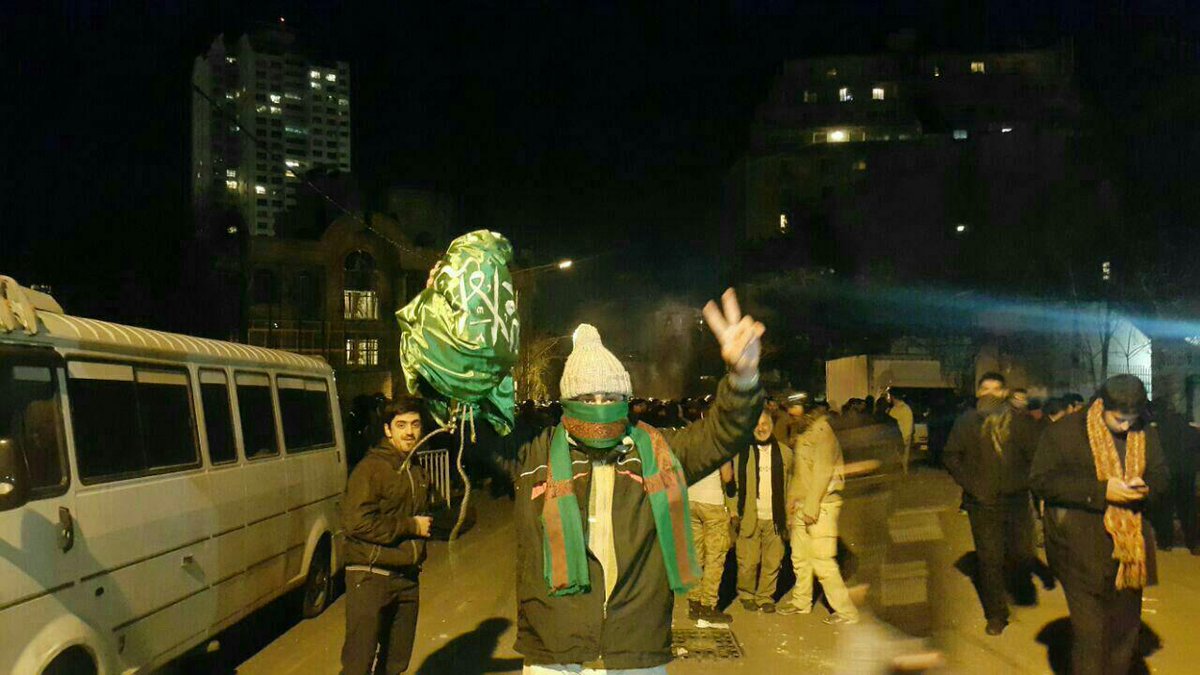
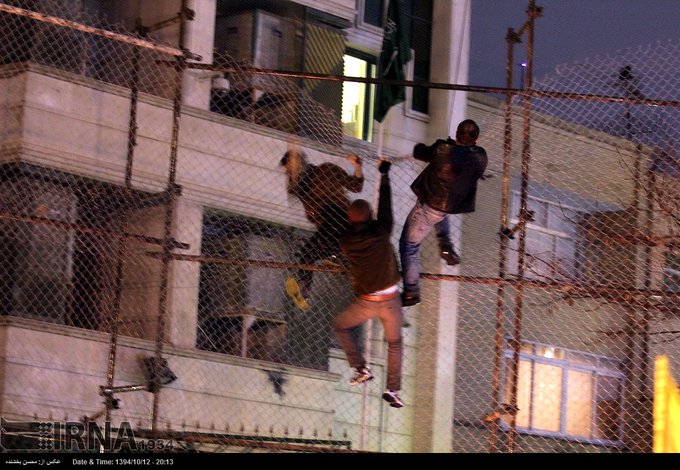
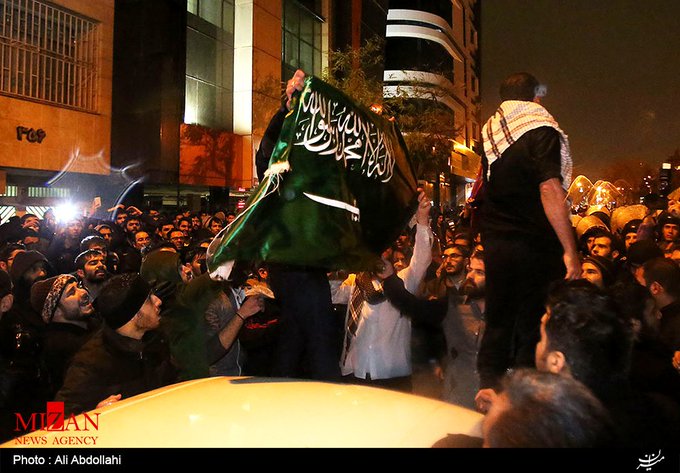
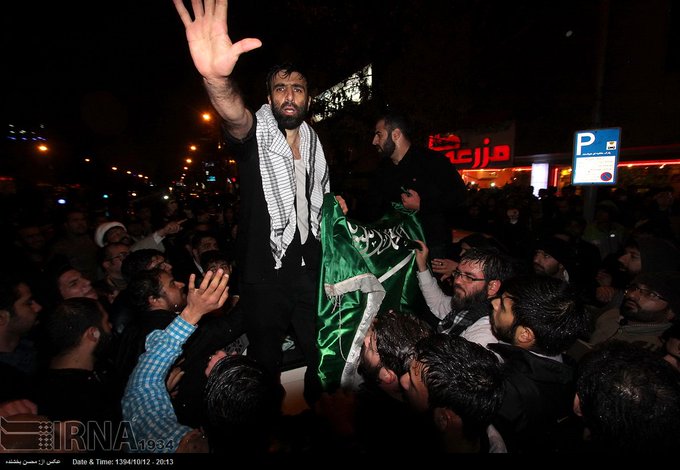
Protests erupted in the Qatif district of Saudi Arabia's Eastern Province as well as in Bahrain, where hundreds took to the streets, burning tires and braving tear gas fired by police. As we reported earlier today, protesters had also converged on the Saudi embassy in Iran. 
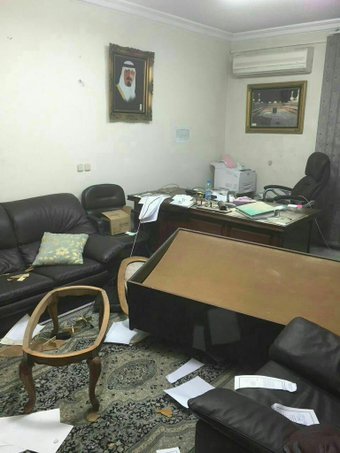
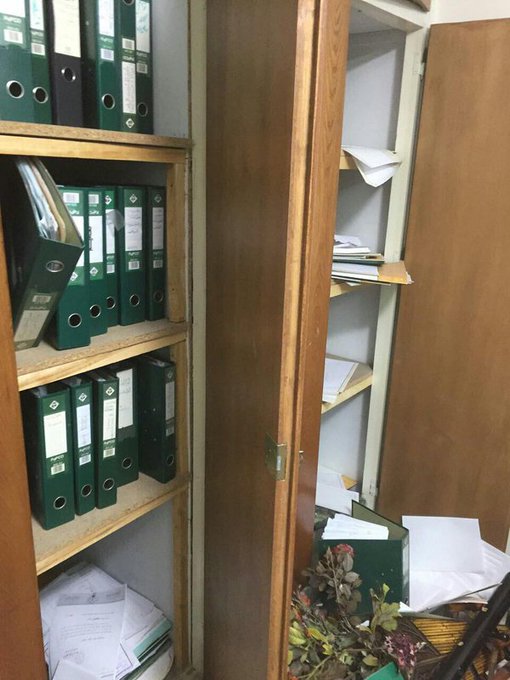
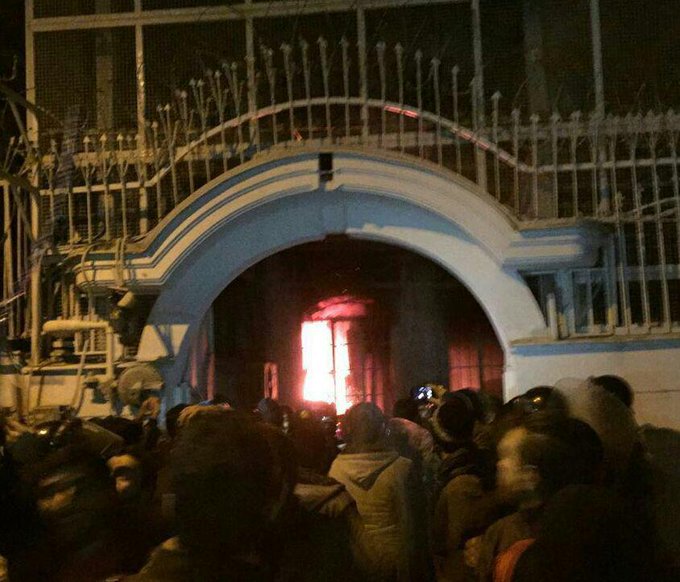
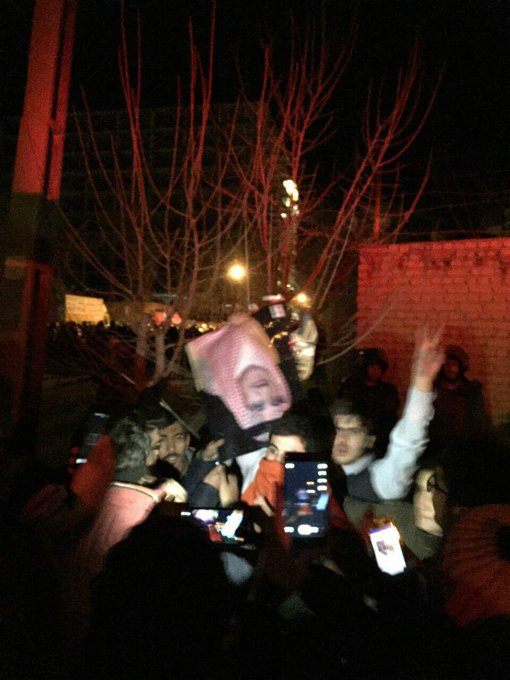
Now, in what looks like a repeat of the Iran Hostage Crisis, the protesters in Tehran have reportedly broken into the Saudi embassy and set it ablaze with Molotov cocktails. 
"Images shared on social media early on Sunday morning appeared to show Iranian protesters breaking into Saudi Arabia's embassy in Tehran and starting fires, after gathering there to denounce the kingdom's execution of a Shi'ite cleric," Reuters reports. "One photograph, posted on Twitter, showed protesters outside the embassy building with small fires burning inside, while another showed a room with smashed furniture purportedly inside the building."

Sobhan Hassanvand 
It's 23:50 here in Tehran, seems protest agnst Nimr execution continues outside Saudi embassy in Tehran right now pic.twitter.com/5LLj89FhYn
View image on Twitter

: Angry protesters storm Saudi embassy in Tehran
Police disperse protesters at Saudi embassy in Tehran
Saudi Arabia flag brought down at embassy in Tehran pic.twitter.com/7ptL0gV0ZF
View image on Twitter

PHOTOS: Saudi consulate in Mashhad protected w/ fence, angry protesters at consulate over al-Nimr execution pic.twitter.com/3MxFFxMbXX
Protesters in Mashhad bring down Saudi flag at consulate following al-Nimr execution pic.twitter.com/2abn4V2KgW
View image on TwitterView image on TwitterView image on Twitter
As a reminder, the Sheikh was a prominent voice in the anti-government movement in Saudi Arabia. Riyadh effectively killed (literally) two birds with one stone with his execution: 1) a dissident voice was forever silenced, 2) a message was sent to Tehran, whose regional influence is expanding in Iraq and Yemen and whose forces have served to shore up the Assad government in its fight against Sunni extremists in Syria.
Now, the Iranians look set to send a message back to Riyadh as the sectarian divide once again rears its ugly head.
Meanwhile, Iran's foreign ministry is calling for "calm." Here's Reuters:
Iran's Foreign Ministry called for calm in the early hours of Sunday after police dispersed angry protesters who had stormed Saudi Arabia's embassy in Tehran.

Demonstrators broke into the embassy and started fires before being cleared away by the police, Iran's ISNA news agency reported, after gathering there to denounce the kingdom for executing a prominent Shi'ite cleric on Saturday.

The ministry issued a statement calling on protesters to respect the diplomatic premises, according to the Entekhab news website.
If this situation escalates, clearly crude oil will be well bid on Sunday afternoon.