Showing posts with label heroin. Show all posts

Sunday, July 24, 2016

The War In Afghanistan Is A Good Thing (If You're A Drug-Dealer)

Submitted by Mnar Muhawesh via MintPressNews.com,
The “War on Drugs” and the “War on Terror” are more intertwined than that media and our elected officials would like us to think.
And this became full front and center when the U.S.-led global crusades overlapped in Afghanistan, leaving in their wake a legacy of death, addiction and government corruption tainting Afghan and American soil.
In the U.S., the War in Afghanistan is among the major contributing factors to the country’s devastating heroin epidemic.
Over 10,000 people in America died of heroin-related overdoses in 2014 alone– an epidemic fuelled partly by the low cost and availability of one of the world’s most addictive, and most deadly, drugs.
Despite our promises to eradicate the black market, the U.S. actually enables the illegal drug trade. As journalist Abby Martin writes, the U.S. government has had a long history of facilitating the global drug trade: In the 1950s, it allowed opium to be moved, processed and trafficked throughout the Golden Triangle in Southeast Asia while it trained Taiwanese troops to fight Communist China. In the 80s, the CIA provided logistical and financial support to anti-Communist Contras in Nicaragua who were also known international drug traffickers.
Since the DEA got the boot from the Bolivian government in 2008, cocaine production in that country has steadily fallen year after year.
And in 2012, a Mexican government official claimed that rather than fighting drug traffickers, the CIA and other international security forces are actually trying to “manage the drug trade.”
“It’s like pest control companies, they only control,” Guillermo Terrazas Villanueva, the Chihuahua spokesman, told Al Jazeera. “If you finish off the pests, you are out of a job. If they finish the drug business, they finish their jobs.”
While there is no conclusive proof that the CIA is physically running opium out of Afghanistan,  Martin notes:
“[I]t’s hard to believe that a region under full US military occupation – with guard posts and surveillance drones monitoring the mountains of Tora Bora – aren’t able to track supply routes of opium exported from the country’s various poppy farms (you know, the ones the US military are guarding).”
Ironically, it was the U.S. mission to obliterate the Taliban in the “War on Terror” that turned Afghanistan into a “narco state.”
Prior to the War in Afghanistan, the Taliban actually offered subsidies to farmers to grow food crops not drugs.
In the summer of 2000, Taliban leader Mullah Mohammad Omar announced a total ban on the cultivation of opium poppy, the plant from which heroin is made. Those caught planting poppies in Taliban-controlled parts of the country were beaten and marched through villages with motor oil on their faces.
The only opium harvest the following spring was in the northeast, in an area controlled by the Taliban’s rivals, the Northern Alliance. That year, as Matthieu Aikins reported for Rolling Stone in 2012, “Opium production fell from an estimated 3,276 tons in 2000 to 185 tons in 2001.”
But then 9/11 hit and the Bush administration pushed into Afghanistan once again, carrying the banner of the “War on Terror.”
“When the Taliban fled or went into hiding, the farmers lost their financial support to grow food, and returned to growing heroin, a crop that thrives in regions of Afghanistan,” as Dr. Steven Kassels noted in a 2015 piece for Social Justice Solutions.
Seeking a “light footprint” in Afghanistan, the U.S. and our allies teamed up with what Aikins describes as “anti-Taliban warlords.” Aikins reported: “Within six months of the U.S. invasion, the warlords we backed were running the opium trade, and the spring of 2002 saw a bumper harvest of 3,400 tons.”
That’s right: The War in Afghanistan saw the country’s practically dead opium industry expanded dramatically. By 2014, Afghanistan was producing twice as much opium as it did in 2000. By 2015, Afghanistan was the source of 90 percent of the world’s opium poppy.
Since 2001, the U.S. has poured billions into counternarcotics programs in Afghanistan. How could this industry flourish right under the nose of the U.S. and our allies? Well, quite simply, because we let it: Aikins alleges that the DEA, FBI, the Justice Department and the Treasury ALL knew about their corrupt allies in the country, but did nothing to pursue them because it would have derailed the troop surge.
“The drug is entwined with the highest levels of the Afghan government and the economy in a way that makes the cocaine business in Escobar-era Colombia look like a sideshow,” Aikins writes, later noting: “On the ground, American commanders’ short-term imperatives of combat operations and logistics trumped other advisers’ long-term concerns over corruption, narcotics and human rights abuses, every time.”
But where did it all go? Well, as Aikins reported, Afghanistan’s “borders leak opium like sieves into five neighboring countries.”
The increased supply flooded European, Asian and Middle Eastern markets. And with Europe no longer reaching out to opium producers in South America and Mexico, that excess flooded the American market. Prices fell everywhere, making heroin dangerously cheap and dangerously accessible.
And this is where we find ourselves today: Heroin, one of the most addictive and deadly substances on Earth, can be found for as little a $4 a bag in some American cities.
Between 2002 and 2013, heroin-related overdose deaths quadrupled. In 2014, more than 10,000 people died of heroin overdoses in America. Should we add these casualties to the 3,504 U.S. and coalition soldiers who died in the war, or the 26,000 dead Afghan civilians?
And heroin use is up across the entire population. Age, sex, race, income, location — it doesn’t matter. And, as the CDC notes, “Some of the greatest increases occurred in demographic groups with historically low rates of heroin use: women, the privately insured, and people with higher incomes.”
Unfortunately, it’s not just the U.S. suffering under the weight of a heroin addiction that’s hit epidemic proportions: Afghanistan, which has a long cultural tradition of smoking opium, is dealing not just with its status as a “narco state,” as Aikins described it, but also with the health and social ills stemming from increased heroin use.
In the process of waging a “War on Terror,” we lost the “War on Drugs.” Both wars deal in corruption and violence, and they put real human lives on the line — not just on the battlefield, but in the fields where farmers cultivate crops and in the neighborhoods where people live.

Monday, April 25, 2016

Obama Gives a “Green Light” to the “Heroin Epidemic”

By William Edstrom.
http://www.washingtonsblog.com/2016/04/obama-gives-green-light-heroin-epidemic.html
Barack Obama ended opium eradication efforts in Afghanistan in 2009, effectively green lighting Afghan opium production and the Afghan heroin trade. By 2010, all US efforts to eradicate Afghan opium ceased. It has been US policy to allow Afghan opium growing and the heroin trade since. US heroin deaths tripled from 3,036 in 2010 to 10,574 in 2014 as a result.
Vanda Felbab-Brown at the Brookings Institution. a liberal think tank that often writes reports supporting the Obama Administration, penned “No Easy Exit: Drugs and Counternarcotics Strategies in Afghanistan” in advance of the April 2016 UN Summit on Drugs (UNGASS). No way out for Uncle Sam is more like it. The report is notable for what it omits, which is any mention of the heroin epidemic, the deadliest illicit drug epidemic in history, or any of the tens of thousands of Americans killed by heroin since Obama took office.
The Bush Administration had an Afghan opium eradication program in effect, carried out by DynCorp. Obama didn’t renew DynCorp’s eradication contracts, effectively ending all US efforts to eradicate opium. (Afghan government eradication efforts in 2014, resulted in 1.1% of the Afghan opium crop being eradicated. The NY Times reported that the Afghan government will no longer eradicate opium crops as of 2016.) Heroin is made from opium.

Ms. Felbab-Brown might as well have said “let them eat cake” to the tens of thousands of Americans killed by heroin since 2009, the millions now hooked on heroin and the tens of millions living in terror because of loved ones now hooked on this deadly poison.
US policy changed to permit opium growing and the heroin trade during Obama’s first year in office, as a way to minimize US troop casualties in Afghanistan. And to maximize US civilian casualties in the US from heroin.
The CIA defines blowback as the ‘consequences at home of operations overseas.’
Since ending eradication efforts, US heroin deaths shot up from 3,036 (2010) to 5,925 (2012) to 10,574 in 2014. The heroin death toll continues to shoot up as does the number of heroin users, from the 1,500,000 US heroin users in 2010 to 4,500,000 users in 2015. As heroin deaths under Obama tripled, so has heroin usage.
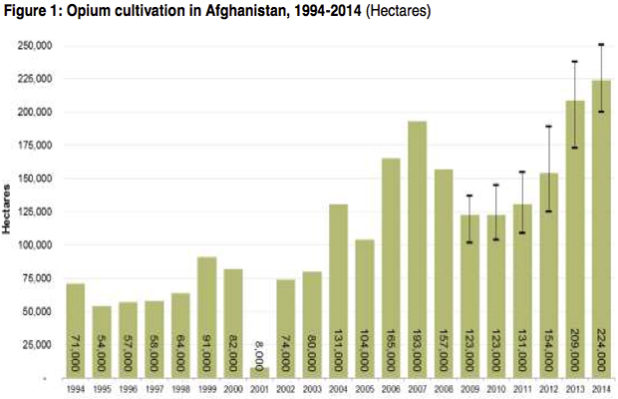
There were 7,600 hectares of Afghan opium poppies when the War in Afghanistan began in 2001. (1 hectare = 2.5 US acres.) In 2009, there were 123,000 hectares. By 2014, Afghan poppy fields spread to 224,000 hectares resulting in a bumper crop of 6,400 tons of opium, enough to make 640,000 kilograms of heroin, thanks to Obama. Opium yields far greater profit than foods like wheat or corn, so opium production will continue to rise without serious eradication efforts.
Afghanistan is by far the number one producer of opium and heroin. Total worldwide opium production was 7,554 tons in 2014, of which 85% came from Afghanistan. The remaining 1,154 tons are primarily from Myanmar, Laos, Mexico, Thailand and Vietnam.
Mexico produced 162 tons of opium in 2014, enough to make 16,200 kilograms of heroin. An average heroin addict takes 0.15 kg of heroin a year, meaning Mexican heroin could only supply 108,000 heroin addicts. Heroin from Mexico cannot supply even 10% of US heroin demand.
Yet the DEA claims most heroin in the US is from Mexico. I asked Barbara Carreno and Russell Baer at the DEA questions like how such a mathematical impossibility was told by the DEA. They dodged many questions, claiming only 4% of heroin is from Afghanistan and the rest is mostly from Mexico. Carreno and Baer acknowledged 90% of heroin in Canada is from Afghanistan, but wouldn’t acknowledge that the USA has a border with Canada, only with Mexico.
We’re getting hit with the largest ever illicit drug epidemic in American history and the DEA is asleep at the wheel.
USA’s now #1 for heroin use. US heroin demand is 415,000 kilograms a year. The whole world, except Afghanistan, could only produce 115,400 kilograms of heroin (2014), not enough for even a third of the mushrooming US demand. Most heroin in the US is coming from US-occupied Afghanistan, there is no other mathematical possibility. There is no other physical possibility.
Carreno and Baer stated “we are a small press office with many queries to answer, and your line of questioning is expanding. I’m sorry to have to say that we will not able to assist you further.” I filed a Freedom of Information Act (FOIA) request for information about what the DEA has been doing (if anything) about Afghan opium and heroin.
I also asked the DEA people if they know how bad the heroin epidemic’s gotten or have any sense of urgency about it, they dodged these questions too. An American now gets killed every 32 minutes by heroin. Carreno and Baer seemed like they couldn’t care less and they don’t feel like answering most questions asked.
Perhaps the DEA people would answer questions (or plead the 5th) at Congressional Hearings.
Basic math shows that Mexico cannot produce enough heroin for even 1/10th of US demand. Besides 4,500,000 American heroin users (2,500,000 addicts and 2,000,000 casual users) and 10,000+ US heroin deaths a year, are the tens of millions of loved ones and neighbors living through hell because of this biggest ever drug epidemic in history.
One New Yorker summed it up “with heroin addicts on every block now, it’s like a zombie invasion.” One small American town has 190 HIV+ people due to IV narcotics use. The War in Afghanistan is the longest ever war in US history and the “collateral damage” of Americans being killed by Afghan heroin is shooting up.
Afghanistan has been known as the Graveyard of the Empires since Alexander the Great. Afghan heroin may yet destroy the American Empire. Since Obama green lighted Afghan opium and heroin, crime’s been shooting up in many places like Baltimore, considered to be ground zero for the heroin epidemic and the canary in the coal mine for the rest of the nation.
False narratives have proliferated recently about the heroin epidemic. One such narrative is ‘the Mexicans did it.’ Mexico, producing enough opium for 16.2 tons of heroin (2014), has enough for only 4% of current US heroin demand. The Mexicans didn’t do the heroin epidemic. (Colombia produced 2 tons of heroin in 2014, not enough for even 1% of the US heroin market.)
Another false narrative, ‘the doctors did it’ alleges patients got hooked on painkillers then turned to heroin. Not true. Only 3.6% of patients taking narcotic painkillers go on to take heroin.
‘Myanmar did it.’ Myanmar, a distant 2nd for heroin production, produced enough opium for 67 tons of heroin (2014), not enough for even 1/4th of US demand. Plus, Myanmar’s heroin goes to Asia, Australia and Europe. Not US.
“Genetics did it” which says ‘10% of people are prone to addiction, so genetics is the reason for the heroin epidemic.’ Human genetics hasn’t changed much the past 15 years. What has changed is Afghan opium production shot up from 7,600 hectares (2001) to 224,000 hectares (2014), a 29-fold increase.
‘Treatment is the solution.’ Treatment is a few fingers in a dyke that has sprung millions of holes. As Afghan heroin floods in, heroin use shoots up.
In Afghanistan, where heroin’s been as readily available as Coca-Cola since 2009, 8% of the people are addicted to narcotics. Following the footsteps of US policy in Afghanistan would mean 8% of the US population, 25,500,000 Americans, becoming addicted, which would be more like a zombie victory than a zombie invasion and would solidify Obama’s legacy as Heroin Dealer In Chief.
‘Decriminalize’ and “marijuana is like heroin” are additional narratives, about marijuana legalization in some places and Portugal’s decriminalization of personal possession of all drugs in 2001. Heroin’s not marijuana and trafficking tons of heroin is not personal possession. Apples and oranges.
Heroin is physically addictive within 30 days of daily use. Heroin kills 40x more than cocaine does and over 100x more than marijuana. Just as there are vast differences between swallowing a pint-size OJ, a Heineken or 3 liters of rum, so too there are vast differences between drugs. Decriminalizing personal possession of drugs is not comparable to decriminalizing trafficking tons of heroin.
Heroin traffickers no doubt want decriminalization instead of life imprisonment just as the makers of the world’s #1 narco state, Afghanistan, want people confused and distracted away from what they did.
The latest DEA narratives: ‘W-18 did it’ and ‘heroin deaths are over-reported’. Synthetics like W-18 are a drop in the overflowing heroin epidemic bucket. Heroin breaks down to morphine in the body within hours, gets recorded by American coroners as morphine (prescription drug) overdoses, resulting in under-reporting of heroin deaths by as much as 100%. The real US heroin death count in 2014 was closer to 20,000 than to 10,574.
It’s as if the recent media flurry of false narratives and distracting narratives have been to try to confuse and distract people away from the most lethal ever illicit drug epidemic (the heroin epidemic 2009-present), Afghanistan (source of 85% of all heroin) and how the heroin is getting to US. It appears as if certain elements within the US government are afraid of the epidemic of Afghan heroin being discussed and Congressional Hearings, sanctions (or worse) for what they did in making Afghanistan into the deadliest narco state ever in human history.
The Taliban ruled Afghanistan until Fall 2001. In mid-2000, the Taliban outlawed opium, within a year it was all but gone, from 91,000 hectares (1999) to 7,600 hectares (2001). Since the Taliban effectively outlawed opium within a year, then why hasn’t the latest US-supported Afghan regime and US Administration done the same?
If serious efforts are not made to eradicate heroin at it’s source, then the heroin epidemic will get worse.
Besides prioritizing eradication first, which will take a year if done in earnest, there are additional solutions.
Second, outlaw precursor chemicals, like acetic anhydride, needed to make heroin from opium. The chemicals to make methaqualone were outlawed in the 1980s. Methaqualone overdoses then stopped.
Third, US government and government-chartered planes can be searched.
Fourth, buying opium for medical morphine in the meantime, until eradication is complete, will alleviate this surge of heroin shocking and awing America.
Fifth, millions of addicts need treatment. There aren’t enough inpatient beds or outpatient seats for even 1/8th of the surge in narcotic users. $25 billion constructs 100,000 inpatient treatment beds and $10 billion annually provides another million seats in outpatient treatment. So far, Obama has ponied up less than 1% of the money needed for treatment, only $0.116 billion, for the heroin disaster he made. Day late, dollar short.
Sixth, decriminalizing personal possession in order to focus on big heroin traffickers would result in lower overall prison costs and fewer non-violent drug users serving expensive lengthy sentences.
US government agencies and departments involved in Afghanistan, 2000 to present, can come clean and tell all about Afghan opium and heroin.
One giant step forward would be Congressional Hearings to determine facts:
1)how did Afghan opium surge from 7,600 hectares to 224,000 hectares, 2) why did annual heroin deaths surge from 1,779 to 10,574 on up,
3)how did the Taliban effectively eradicate Afghan opium within a year, 4) why hasn’t the current Administration done likewise,
5)what exactly have the DEA, CIA and DoD been doing about Afghan opium and heroin, and
6) why did Obama green light the Afghan opium trade and heroin trade leading to the most lethal illicit drug epidemic ever.
The UN has been given the power to hold inquiries focusing on getting honest answers to honest questions and voting on censure or sanctions against the US government and current Afghanistan regime until opium is eradicated as it was under the Taliban in 2001.
Obama green lighted the end of US eradication efforts against Afghan opium in 2009, which green lighted the Afghan opium and heroin trade, which green lighted the deadliest illicit drug epidemic ever. The 10,000+ Americans getting killed every year by heroin, that’s just “collateral damage” to “the little people” from the lingering War in Afghanistan, Mr. President?
Eradicate the Afghan opium crops, stat, the way the Taliban eradicated the Afghan opium crops, within a year. No need to re-invent the wheel on this one.

Saturday, April 9, 2016

White House Makes a Big Deal of New Heroin Efforts — But Says Nothing about Stemming the Flow or Why We’re Still at War in Narco-State Afghanistan

Posted on  by WashingtonsBlog

By Meryl Nass, M.D.  Dr. Nass is  a board-certified internist and a biological warfare epidemiologist and expert in anthrax. Nass publishes Anthrax Vaccine.
On March 29, 2016 the White House issued a press release on its new heroin initiative.  The Washington Post described how much Obama proposed to do.  The long list of fixes and new public-private partnerships concern treatment almost exclusively, with a small amount for increased policing.  The 1 billion dollars, Obama said, will treat “tens of thousands” of addicts.
Additional treatment is desperately needed, but the money won’t go far.  The White House and RANDsaid in 2014 that the US had 800,000–2.4 million heroin addicts. Treatment requires many months or years, and costs tens of thousands of dollars per person. The new funding will support less than 10% of those needing treatment.
Speaking at the National Prescription Drug Abuse and Heroin Summit in Atlanta, Obama … called addiction a “heartbreaking” issue that’s costing lives and devastating communities across the country.But he said: “I’m very optimistic that we can solve it.” Yeah right.  Till you get it off the street, bro, you ain’t done shit.
And can you be as glib, Mr. President, at explaining why you completely left out efforts to reduce the heroin supply?
From Wired, we learn that Obama ended (yes, ended) Afghan opium eradication soon after taking office:
In 2009, in one of his first major war policy decisions since becoming president, Barack Obama oversaw an end to U.S. poppy eradication… Without American support, Afghan government counternarcotic operations withered to a merely symbolic scale. Kabul’s agents would raze one acre of a 10-acre plot and call it “eradicated.” And that’s when the US heroin epidemic really took off, according to the National Institute on Drug Abuse:
National Overdose Deaths—Number of Deaths from Heroin.
Aerial poppy eradication is off the table, according to the State Department, and the US no longer supports Afghan national counter-narcotics efforts. Hello?
Mr. President:  Please explain how and why you pulled the wool over the eyes of the American people by claiming the Taliban are in charge of Afghan opium?  Why didn’t you tell the truth: that they tax the acreage used to grow the crop?  (As do anti-Taliban militias in areas they control.) This is akin to property taxes.
Somebody else actually buys the opium, converts it to heroin, and brings it to the US, where it sells for over 1,000 times what the Taliban received in taxes.
Who, Mr. President, collects the big money?  Who buys the opium harvest, protects the movement of opium, its conversion to heroin, and ships it over here, undetected? Last I heard, the US installed much of the Afghan government and patrolled a lot of poppy fields.  Afghanistan is where between 75% and 93% of the world’s illicit opium is grown each year, on 500,000 (undisturbed) acres.
Funny, too, is that big question mark… why are we still in Afghanistan?  I thought we went to get Bin Laden.  Well, he’s history.
Can someone explain our military objective for Afghanistan?  How do we justify this longest war in the 240 year history of our nation?
Writing about the Afghanistan war in National Defense magazine in 2009, Lawrence P. Farrell noted,
“Seldom do we hear or read a discussion of what the “political objective” should be or even whether anyone has articulated the political aims for the use of military force in that country.”
our military’s operational objective [was] nation-building, euphemistically called counterinsurgency…”
Nation-building?  Back during the Vietnam war, we used a different expression to say the same thing:  “We had to destroy the village in order to save it.”  During the Vietnam war, most US heroin came from poppies grown in Southeast Asia.
Some of this heroin arrived in the US on military planes, inside the body bags of fallen soldiers. It was loaded onto planes at US military bases in Vietnam, and unloaded at military bases in the US. Somebody in the government knew what was going on.
At fourteen years into the Afghan war, in October 2015, USAT reported,
“The president said he does not believe in “endless war,” but there remains an opportunity to forge a stable country that can prevent the emergence of future threats, an effort in which more than 2,200 Americans have given their lives.” Let’s face it.  The expressed reasons for our continuing adventure in Afghanistan are smoke and mirrors, nothing more.
Vietnam was another war in which the number of US soldiers who had lost their lives was oft-repeated as a justification to keep the war going. Vietnam was another war with fuzzy objectives, supposedly fought for a discredited “Domino Theory.” But perhaps there are good reasons why the lessons of Vietnam seem to have been ignored.
Few people know that Afghanistan hides immense underground wealth. But first it must be wrested from the Afghans. Heroin aside, two financial blockbusters are just waiting to be tapped.
1.  The value of Afghanistan’s mineral wealth was estimated at one trillion dollars by NPR, and at 1-3 trillion dollars by Bloomberg.  This almost certainly played a part in Russia’s decade-long, failed invasion of Afghanistan through the 1980s.
“Afghanistan, with certainty I can say, in 20 years is going to be a mining country,” Paul Brinkley, head of a Pentagon group called the Task Force for Business Stability Operations, tells NPR’s Rachel Martin. “That is going to happen.”
And from LiveScience in 2014:
Over the past four years, the US Geological Survey and  Department of Defense’s Task Force for Business and Stability Operations have embarked on dozens of excursions in the war zone to collect and analyze mineral samples… The researchers’ work has helped develop what are essentially treasure maps that let mining companies know what minerals are there, how much is there, and where they are, all to attract bids on the rights to the deposits…
2.   Pipeline construction, which has been on the table for the last 20 years, would move oil and gas from the Caspian basin to the Arabian Sea.  The region’s proven gas and oil reserves are huge, and equal to those in the US.  To finally reach the ocean, an oil or gas pipeline must cross through Afghanistan, or else through Iran.
From The Diplomat comes a telling quote:
“It is, therefore, little surprise that some experts contend that the country is not transitioning from “war to peace,” but rather from “military conflict to resource conflict.’”  Here’s the thing.  Obama needs to “forge a stable country” to prevent pipelines from being tapped or blown up, and protect future mining operations.
3.  Don’t forget that Afghanistan’s half million acres of poppy fields generate heroin worth roughly $200 billion dollars on the street, year after year. Unlike minerals and gas, this is a truly renewable resource.
Is the Afghan war–the longest American war–just about opium, minerals and pipelines? I could be missing some of the picture. Maybe I have oversimplified things. But phenomenal resources, still untapped, have to count as the lurking, almost-never-discussed elephant in the Afghan war room.
If the US government had reasonable political and military objectives, wouldn’t the government have provided a coherent account of its objectives by now?  In the absence of any meaningful explanation for this war, the only reason we remain there, with no prospect of getting out, is to secure control of Afghanistan’s resources for the US.  Or, more correctly, for the oligarchs who control US policy and who will reap the benefits–while the people of the US (and Afghanistan, much more so) pay the costs.
FACT:  Ground was broken for Afghanistan’s first gas pipeline in December 2015.
Connect the dots.  As the pipeline project grows, so will our military commitment.
But there is one little bright spot.  It is a Presidential election year, and the candidates do have to answer questions.  I’m going to try and put their feet to the fire.  Will you do the same?
Ask the Presidential candidates to explain what we are doing in Afghanistan.
Who owns Afghan mineral rights?  Who is invested in Afghan pipelines?
Will the next President change course, and get seriously behind drug interdiction and eradication in Afghanistan?  How will the US government act to get Afghan (and all) heroin off our streets? How many soldiers must continue to die to protect the right to loot Afghanistan?
The huge tide of addiction blows right back from our rapacious Afghan policy. Over 10,000 Americans were lost to heroin in 2014. Deaths continue to climb.  In my state, Maine, deaths from heroin surpassed deaths from prescription drugs for the first time in 2015.
Even children of the rich and powerful are being fed to the demon heroin. Will the costs of our Afghan policy ever be too high for our policymakers to bear?
————–
The 2 earlier pieces I wrote regarding the heroin epidemic are here and here and they add to these ideas and documentation.  My mentors in this effort are Peter Dale Scott, Alfred McCoy, Michel Chossudovsky and Sibel Edmonds. Thanks also to William Edstrom for reminding me we can fight back.

Monday, September 28, 2015

Rumors Persist That The CIA Helps Export Opium From Afghanistan

Tyler Durden's picture

http://www.zerohedge.com/news/2015-09-26/rumors-persist-cia-helps-export-opium-afghanistan
Submitted by Kit O'Connell via TheAntiMedia.org,
Despite billions spent to eradicate opium crops in Afghanistan, the crop is more popular than ever there, leading many to wonder whether some U.S. forces may actually be encouraging its growth and the heroin it later becomes.
In July, the Centers for Disease Control warned of record-breaking numbers of heroin deaths in the United States. “Heroin use more than doubled among young adults ages 18–25 in the past decade,” the CDC reported.
In the same month, it was reported that opium production is stronger than ever in Afghanistan, which now produces 90 percent of the world’s supply of the plant that’s refined to create heroin. This rise in production would have been impossible prior to the U.S.-led invasion, and it comes despite some $8.4 billion spent in counternarcotics efforts by the U.S., specifically designated to wipe out opium production in Afghanistan.
In fact, as Global Post reported in October, under the watchful eye of the U.S., opium use expanded to new parts of Afghanistan and growers now make use of modern, advanced agricultural technologies.
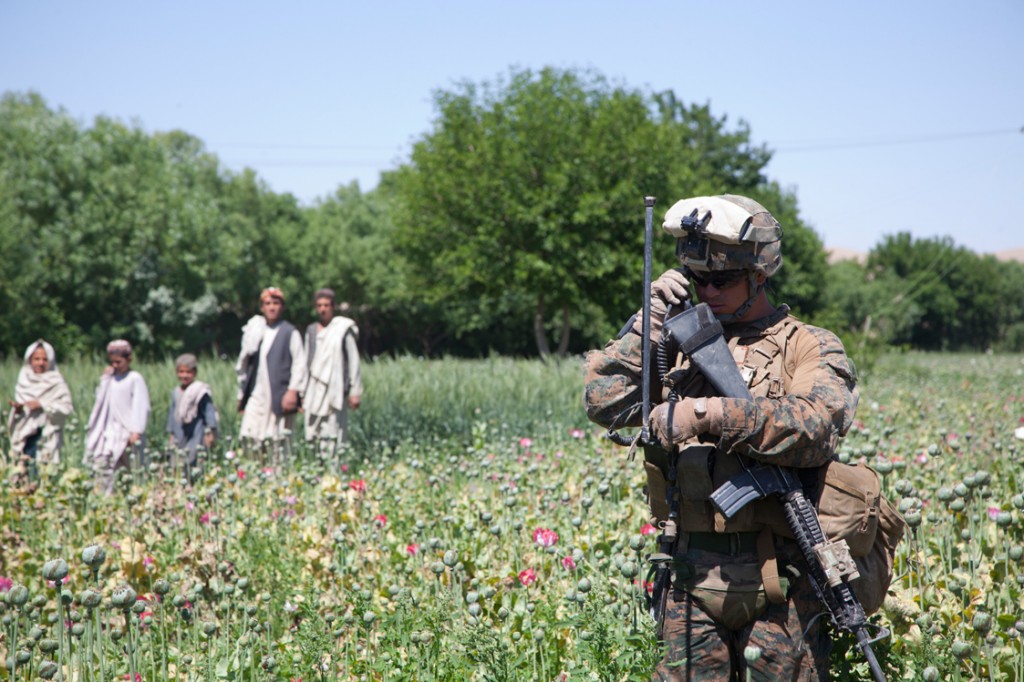
With photos circulating in 2010 that show U.S. soldiers patrolling opium fields, questions remain about what America’s real involvement may be in the opium trade. As Abby Martin noted in a 2014 investigation for Media Roots, while the Taliban had all but eradicated opium, it began to thrive just months after American forces replaced the Taliban-led government in 2001.
Martin noted that the CIA has long been tied to the global drug trade, where it’s accused of putting more effort into controlling rather than eradicating illicit substances. She added,
“Circumstantial evidence aside, there is no conclusive proof that the CIA is physically running opium out of Afghanistan. However, it’s hard to believe that a region under full US military occupation – with guard posts and surveillance drones monitoring the mountains of Tora Bora – aren’t able to track supply routes of opium exported from the country’s various poppy farms (you know, the ones the US military are guarding).”
According to a January report from Mother Jones, the DEA agent formerly in charge of the agency’s efforts in Afghanistan reported repeated conflict between DEA eradication efforts and CIA agents:
“[Edward] Follis says the DEA and CIA often bumped heads in Afghanistan. … While hinting that the CIA sometimes turned a blind eye to the Afghan drug trade, Follis won’t get into specifics. In his book, [‘The Dark Art: My Undercover Life in Global Narco-Terrorism,’] he writes, ‘Almost everywhere in the world I worked, I had static with the CIA. We’re often working the same terrain, but with different legal and moral parameters … They exist completely in the shadows.’”
Among the groups profiting off the Afghan opium trade — and the failed efforts to eradicate it — is the mercenary group Academi, better known by its former name, Blackwater. In April, RT reported that Academi earned $569 million from counternarcotics contracts in Afghanistan.
“[T]he notorious company has been the biggest beneficiary of counternarcotics expenditure in the war-torn country,” RT wrote.
Watch “The Worst Narco-State in History? After 13-Year War, Afghanistan’s Opium Trade Floods the Globe” below:

Wednesday, September 16, 2015

The Real Afghanistan Surge is in Heroin Production and Tripled Opium Cultivation since the US military arrived/ UN and US Government documents

Posted on by WashingtonsBlog    
http://www.washingtonsblog.com/2015/09/the-real-afghanistan-surge-is-in-heroin-production-and-tripled-opium-cultivation-since-the-us-military-arrived-un-and-us-government-documents.html
By Meryl Nass, M.D.  Dr. Nass is  a board-certified internist and a biological warfare epidemiologist and expert in anthrax. Nass publishes Anthrax Vaccine.
Recently I worked in another Maine city and was astonished at the number of patients I encountered who were using heroin.  I had never seen anything like it, during a lifetime practicing medicine. In New Hampshire, it was said, deaths from heroin now exceed deaths from car accidents.  Nationwide, CDC noted, “Between 2002 and 2013, the rate of heroin-related overdose deaths nearly quadrupled, and more than 8,200 people died in 2013.”  Massachusetts (population under 7 million) had 1,000 deaths related to (all) opioids in 2014,the highest ever recorded.
I’ve heard stories on NPR about insufficient state funding of heroin treatment facilities. I’ve heard about plans to make Narcan injections available to iv drug users, for overdoses. Another popular angle I’ve seen repeated multiple times (and one currently pushed by the US Drug Enforcement Agency) claims prescription narcotics became harder to get, so users switched to heroin, instead.
However, the DOJ-DEA 2014 National Drug Threat Assessment Summary notes that cocaine availability “remains stable at historically low levels throughout most domestic markets along the East Coast.”  So users are switching to heroin, but not switching to cocaine from prescription narcotics. Hmmm. Might this be because we have no large military-CIA presence currently in cocaine-trafficking areas, as we did during the 1980s Contra war in Nicaragua, when cocaine use was at high levels? (Coca leaves are only grown in Latin America.) According to a 2010 UN document“Based on seizure figures, it appears that cocaine markets grew most dramatically during the 1980s, when the amounts seized increased by more than 40% per year”.  (See this 1987 Senate hearing and this for evidence of CIA and State Dept. connivance with cocaine trafficking by the Contras.)
You can frame stories about the current heroin problem in many ways.  But the real heroin story isn’t being discussed–which is that since the US military entered Afghanistan in 2001, its opium production doubled, per the UN Afghanistan Opium Survey, 2014 , p.34.  The area under opium cultivation in Afghanistan tripled. And the resulting heroin appears to more easily make its way deep into our rural, as well as urban communities. The graph below is from the 2014 UN Opium Survey:

The world supply of opium increased 5-fold between 1980 and 2010according to the UN.“Afghanistan account[s] for around 90% of global illicit opium production in recent years. By itself, Afghanistan provides 85% of the estimated global heroin and morphine supply, a near monopoly.”(see pp 37-38). 
“The narcotics trade poisons the Afghan financial sector and undermines the Afghan state’s legitimacy by stoking corruption, sustaining criminal networks, and providing significant financial support to the Taliban and other insurgent groups,” John F. Sopko, the Special Inspector General for Afghanistan reconstruction, said in an October 2014 letter to the heads of the Departments of Defense, State and Justice, which have all played major roles in the failed drug intervention effort. “Despite spending over $7 billion to combat opium poppy cultivation and to develop the Afghan government’s counter-narcotics capacity, opium poppy cultivation levels in Afghanistan hit an all-time high in 2013.”
Despite the (now) US $8.4 billion spent to defeat this trade, it just keeps growing.  The costs of US reconstruction efforts in Afghanistan total “$110 billion, after adjusting for inflation, [which] exceeds the value of the entire Marshall Plan effort to rebuild Western Europe after World War II” according to the Special Inspector General for Afghanistan Reconstruction, speaking in May 2015.

The Special Inspector General noted elsewhere that, US reconstruction projects, particularly those devoted to “improved irrigation, roads, and agricultural assistance” were probably leading to the explosion in opium cultivation.
Only 1.2% of the acreage used for Afghan opium production (est. 224,000 hectares) was eradicated in 2014, according to the UN. Also according to the UN, Burma is the world’s second largest producer of opium, currently growing only about 10% as much as Afghanistan. But Mexico has been increasing production.
According to the UN World Drug Report, in the 1990’s Afghanistan supplied opium that was converted into half the world’s heroin production.  By 2010, it supplied 90% of the total.
But the DEAWhite House and other official US sources claim that US heroin derives almost entirely (96%) from Latin American opium (based on seizures of shipments); the DEA in 2014 claimed that Latin America was the source for the vast majority of US heroin, with southwest Asia (i.e., Afghanistan) accounting for only 4% of US heroin in 2012.
This is highly unlikely.  In 2008, the UN estimated that the US and Canada accounted for 13% of global heroin use.  With about 95% of global heroin derived from Afghanistan, Burma, Thailand and Laos, Latin America (mainly Mexico with a small amount from Colombia) does not produce enough to supply the majority of US heroin, let alone 96%. In fact, the White House Office of National Drug Control Policy undercuts this claim when it says Mexico had 10,500 hectares under poppy cultivation in 2012, while Afghanistan alone had 154,000 hectares in 2012 and 224,000 hectares in 2014, per UN estimates.
This DEA claim, based on heroin interdiction, suggests a different explanation.  Perhaps heroin shipments from Afghanistan are at lower risk of being seized than heroin coming from Latin America. Might some be entering through government channels, when so much materiel and so many personnel (soldiers, aid workers, diplomats and contractors) fly directly between the US and Afghanistan?
Putting aside the issue of the provenance of the US heroin supply for the moment, surely we can look at heroin as we would any other global commodity.
Congruent with the US occupation of Afghanistan, Afghanistan expanded its opium production, and the global supply of heroin increased dramatically. The price dropped as a result. New buyers entered the market. And the US now has several hundred thousand new addicts.  Russia and Europe have even more. The resulting social problems are hugely tragic and hugely costly for millions of families, and for our societies as a whole.
If we start being honest about why there is a major heroin epidemic, maybe we can get serious about solving the problem with meaningful eradication and interdiction. Aerial spraying of crops with herbicides or similar methods has been prohibited in Afghanistan, but it works. In 2014, Britain’s former Ambassador to Afghanistan (2010-2012) called for legalization and regulation of illicit drugs as one means of attacking the problem.
Looking beyond the Mexican border for heroin, and inspecting all flights from southwest Asia, including military and CIA flights, could have a large impact on supply as well.
Serious measures are needed.  Total world production of opiates always gets consumed: historically, the market for opiates has been extremely elastic.  Land under poppy cultivation (in Afghanistan, Southeast Asia’s Golden Triangle and Mexico) continues to increase. Without meaningful efforts to reduce opium production and entry of narcotics into the US, the epidemic of heroin addiction may become a considerably bigger problem than it is today.
UPDATE:  From the Sept 7 Wall Street Journal, we learn that a US “friendly fire” airstrike in southern Afghanistan on Sept 6 “hit a 30 member elite counternarcotics police unit as they were on a mission…
At least 11 died in “one of the deadliest friendly fire incidents in the country in recent years.Here is the Reuters story. The US denied the strike in Helmand province, but admitted to airstrikes in the adjacent province of Kandahar. According to the Guardian, “The US is the only member of the NATO coalition known to have carried out bombing raids in Afghanistan this year.” The AP/WaPo on 9/8/15 reported that, “Brigadier General Shoffner [Deputy Chief of Staff for Communications in Afghanistan] said ‘based on information we received [on 9/8], we feel it is prudent to investigate the airstrike our forces conducted in Kandahar.’
The airstrike killed approximately as many people as died in counternarcotics efforts in all Afghanistan throughout 2014.
I will have more to say about the subject of heroin in a later post.

Monday, June 22, 2015

America’s drug overdose problem—and what states can do to help fight it

More people die from drugs than vehicles in 36 states. In fact, in half of all states, drugs are the leading cause of any injury-related death.
That’s according to a new, nearly 90-page report on injury prevention from the Trust for America’s Health and the Robert Wood Johnson Foundation, which grades states and offers recommendations on injury prevention policy based on the advice of an expert committee. The rankings were based on everything from seat belt laws to child abuse and neglect protections to drug monitoring policies.
The latest data show that drug overdose is not only the leading cause of injury-related death nationwide, but also in more than two thirds of states. Yet, the overdose death rate varies dramatically by state: In West Virginia, the leader in overdose fatalities, the rate is more than 12 times greater than in bottom-ranked North Dakota. West Virginia was followed by Kentucky, New Mexico, Nevada and Utah — the five states with overdose fatality rates of more than 20 per 100,000 people.

The overdose death rate has surged in recent years, with 28 states and Washington, D.C., seeing rates rise between the three-year periods ending in 2009 and 2013. At the same time, the rates fell in just four states: Alabama, Arkansas, Florida and Maine.
Roughly half of the nearly 44,000 annual drug-related deaths result from prescription drugs, with the death rate related to such drugs rising dramatically over the last 15 years. From 1999 to 2011, sales of prescription painkillers quadrupled, while the number of related fatalities nearly quadrupled as well.

So, what can states do to help offset the rising drug abuse death rate?
The report advisory group issued a number of recommendations aimed at curbing prescription abuse, making it easier to help those who are overdosing, and improving poison control centers.
To rein in prescription drug abuse, all states should implement prescription drug monitoring programs — databases that track the prescription and distribution of such drugs, which are in place in only half the states. The authors also argued for improved prevention, education and access to treatment.
In order to help those who are overdosing, the report’s authors argue that states should pass more laws easing access to rescue drugs like nalaxone — which counters the effects of prescription painkillers, heroin and other opioids — and pass Good Samaritan laws protecting bystanders who call for medical assistance.
Access to nalaxone has been facilitated — in some form — in 34 states and D.C., while 26 states and D.C. have passed Good Samaritan laws.
Niraj Chokshi reports for GovBeat, The Post's state and local policy blog.