Showing posts with label Afghanistan. Show all posts

Sunday, July 24, 2016

The War In Afghanistan Is A Good Thing (If You're A Drug-Dealer)

Submitted by Mnar Muhawesh via MintPressNews.com,
The “War on Drugs” and the “War on Terror” are more intertwined than that media and our elected officials would like us to think.
And this became full front and center when the U.S.-led global crusades overlapped in Afghanistan, leaving in their wake a legacy of death, addiction and government corruption tainting Afghan and American soil.
In the U.S., the War in Afghanistan is among the major contributing factors to the country’s devastating heroin epidemic.
Over 10,000 people in America died of heroin-related overdoses in 2014 alone– an epidemic fuelled partly by the low cost and availability of one of the world’s most addictive, and most deadly, drugs.
Despite our promises to eradicate the black market, the U.S. actually enables the illegal drug trade. As journalist Abby Martin writes, the U.S. government has had a long history of facilitating the global drug trade: In the 1950s, it allowed opium to be moved, processed and trafficked throughout the Golden Triangle in Southeast Asia while it trained Taiwanese troops to fight Communist China. In the 80s, the CIA provided logistical and financial support to anti-Communist Contras in Nicaragua who were also known international drug traffickers.
Since the DEA got the boot from the Bolivian government in 2008, cocaine production in that country has steadily fallen year after year.
And in 2012, a Mexican government official claimed that rather than fighting drug traffickers, the CIA and other international security forces are actually trying to “manage the drug trade.”
“It’s like pest control companies, they only control,” Guillermo Terrazas Villanueva, the Chihuahua spokesman, told Al Jazeera. “If you finish off the pests, you are out of a job. If they finish the drug business, they finish their jobs.”
While there is no conclusive proof that the CIA is physically running opium out of Afghanistan,  Martin notes:
“[I]t’s hard to believe that a region under full US military occupation – with guard posts and surveillance drones monitoring the mountains of Tora Bora – aren’t able to track supply routes of opium exported from the country’s various poppy farms (you know, the ones the US military are guarding).”
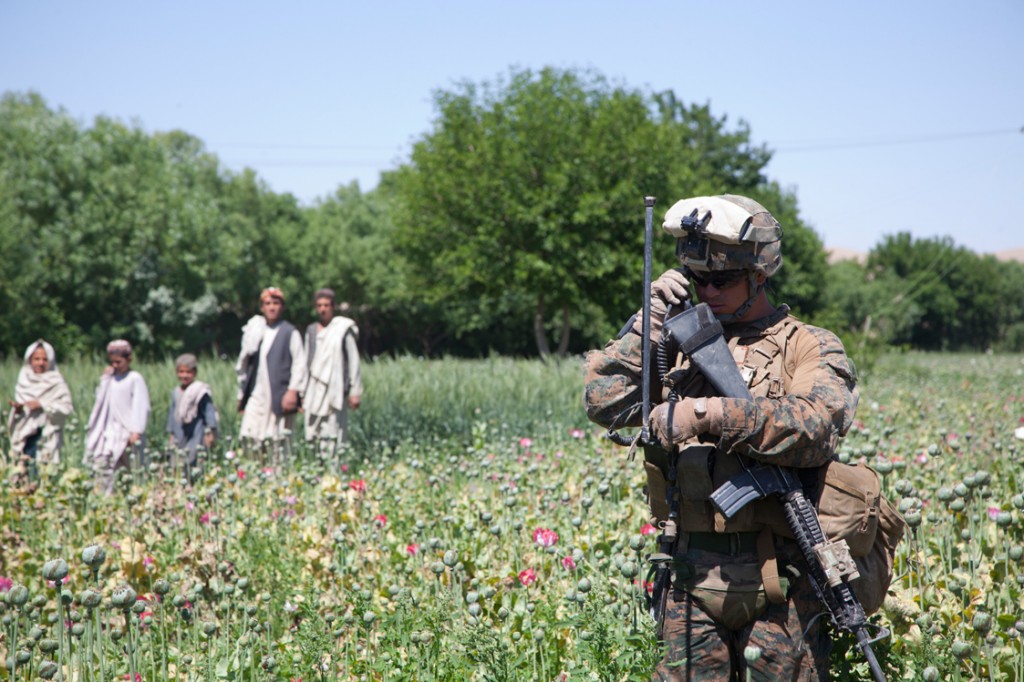
Ironically, it was the U.S. mission to obliterate the Taliban in the “War on Terror” that turned Afghanistan into a “narco state.”
Prior to the War in Afghanistan, the Taliban actually offered subsidies to farmers to grow food crops not drugs.
In the summer of 2000, Taliban leader Mullah Mohammad Omar announced a total ban on the cultivation of opium poppy, the plant from which heroin is made. Those caught planting poppies in Taliban-controlled parts of the country were beaten and marched through villages with motor oil on their faces.
The only opium harvest the following spring was in the northeast, in an area controlled by the Taliban’s rivals, the Northern Alliance. That year, as Matthieu Aikins reported for Rolling Stone in 2012, “Opium production fell from an estimated 3,276 tons in 2000 to 185 tons in 2001.”
But then 9/11 hit and the Bush administration pushed into Afghanistan once again, carrying the banner of the “War on Terror.”
“When the Taliban fled or went into hiding, the farmers lost their financial support to grow food, and returned to growing heroin, a crop that thrives in regions of Afghanistan,” as Dr. Steven Kassels noted in a 2015 piece for Social Justice Solutions.
Seeking a “light footprint” in Afghanistan, the U.S. and our allies teamed up with what Aikins describes as “anti-Taliban warlords.” Aikins reported: “Within six months of the U.S. invasion, the warlords we backed were running the opium trade, and the spring of 2002 saw a bumper harvest of 3,400 tons.”
That’s right: The War in Afghanistan saw the country’s practically dead opium industry expanded dramatically. By 2014, Afghanistan was producing twice as much opium as it did in 2000. By 2015, Afghanistan was the source of 90 percent of the world’s opium poppy.
Since 2001, the U.S. has poured billions into counternarcotics programs in Afghanistan. How could this industry flourish right under the nose of the U.S. and our allies? Well, quite simply, because we let it: Aikins alleges that the DEA, FBI, the Justice Department and the Treasury ALL knew about their corrupt allies in the country, but did nothing to pursue them because it would have derailed the troop surge.
“The drug is entwined with the highest levels of the Afghan government and the economy in a way that makes the cocaine business in Escobar-era Colombia look like a sideshow,” Aikins writes, later noting: “On the ground, American commanders’ short-term imperatives of combat operations and logistics trumped other advisers’ long-term concerns over corruption, narcotics and human rights abuses, every time.”
But where did it all go? Well, as Aikins reported, Afghanistan’s “borders leak opium like sieves into five neighboring countries.”
The increased supply flooded European, Asian and Middle Eastern markets. And with Europe no longer reaching out to opium producers in South America and Mexico, that excess flooded the American market. Prices fell everywhere, making heroin dangerously cheap and dangerously accessible.
And this is where we find ourselves today: Heroin, one of the most addictive and deadly substances on Earth, can be found for as little a $4 a bag in some American cities.
Between 2002 and 2013, heroin-related overdose deaths quadrupled. In 2014, more than 10,000 people died of heroin overdoses in America. Should we add these casualties to the 3,504 U.S. and coalition soldiers who died in the war, or the 26,000 dead Afghan civilians?
And heroin use is up across the entire population. Age, sex, race, income, location — it doesn’t matter. And, as the CDC notes, “Some of the greatest increases occurred in demographic groups with historically low rates of heroin use: women, the privately insured, and people with higher incomes.”
Unfortunately, it’s not just the U.S. suffering under the weight of a heroin addiction that’s hit epidemic proportions: Afghanistan, which has a long cultural tradition of smoking opium, is dealing not just with its status as a “narco state,” as Aikins described it, but also with the health and social ills stemming from increased heroin use.
In the process of waging a “War on Terror,” we lost the “War on Drugs.” Both wars deal in corruption and violence, and they put real human lives on the line — not just on the battlefield, but in the fields where farmers cultivate crops and in the neighborhoods where people live.

Monday, April 25, 2016

Obama Gives a “Green Light” to the “Heroin Epidemic”

By William Edstrom.
http://www.washingtonsblog.com/2016/04/obama-gives-green-light-heroin-epidemic.html
Barack Obama ended opium eradication efforts in Afghanistan in 2009, effectively green lighting Afghan opium production and the Afghan heroin trade. By 2010, all US efforts to eradicate Afghan opium ceased. It has been US policy to allow Afghan opium growing and the heroin trade since. US heroin deaths tripled from 3,036 in 2010 to 10,574 in 2014 as a result.
Vanda Felbab-Brown at the Brookings Institution. a liberal think tank that often writes reports supporting the Obama Administration, penned “No Easy Exit: Drugs and Counternarcotics Strategies in Afghanistan” in advance of the April 2016 UN Summit on Drugs (UNGASS). No way out for Uncle Sam is more like it. The report is notable for what it omits, which is any mention of the heroin epidemic, the deadliest illicit drug epidemic in history, or any of the tens of thousands of Americans killed by heroin since Obama took office.
The Bush Administration had an Afghan opium eradication program in effect, carried out by DynCorp. Obama didn’t renew DynCorp’s eradication contracts, effectively ending all US efforts to eradicate opium. (Afghan government eradication efforts in 2014, resulted in 1.1% of the Afghan opium crop being eradicated. The NY Times reported that the Afghan government will no longer eradicate opium crops as of 2016.) Heroin is made from opium.

Ms. Felbab-Brown might as well have said “let them eat cake” to the tens of thousands of Americans killed by heroin since 2009, the millions now hooked on heroin and the tens of millions living in terror because of loved ones now hooked on this deadly poison.
US policy changed to permit opium growing and the heroin trade during Obama’s first year in office, as a way to minimize US troop casualties in Afghanistan. And to maximize US civilian casualties in the US from heroin.
The CIA defines blowback as the ‘consequences at home of operations overseas.’
Since ending eradication efforts, US heroin deaths shot up from 3,036 (2010) to 5,925 (2012) to 10,574 in 2014. The heroin death toll continues to shoot up as does the number of heroin users, from the 1,500,000 US heroin users in 2010 to 4,500,000 users in 2015. As heroin deaths under Obama tripled, so has heroin usage.
There were 7,600 hectares of Afghan opium poppies when the War in Afghanistan began in 2001. (1 hectare = 2.5 US acres.) In 2009, there were 123,000 hectares. By 2014, Afghan poppy fields spread to 224,000 hectares resulting in a bumper crop of 6,400 tons of opium, enough to make 640,000 kilograms of heroin, thanks to Obama. Opium yields far greater profit than foods like wheat or corn, so opium production will continue to rise without serious eradication efforts.
Afghanistan is by far the number one producer of opium and heroin. Total worldwide opium production was 7,554 tons in 2014, of which 85% came from Afghanistan. The remaining 1,154 tons are primarily from Myanmar, Laos, Mexico, Thailand and Vietnam.
Mexico produced 162 tons of opium in 2014, enough to make 16,200 kilograms of heroin. An average heroin addict takes 0.15 kg of heroin a year, meaning Mexican heroin could only supply 108,000 heroin addicts. Heroin from Mexico cannot supply even 10% of US heroin demand.
Yet the DEA claims most heroin in the US is from Mexico. I asked Barbara Carreno and Russell Baer at the DEA questions like how such a mathematical impossibility was told by the DEA. They dodged many questions, claiming only 4% of heroin is from Afghanistan and the rest is mostly from Mexico. Carreno and Baer acknowledged 90% of heroin in Canada is from Afghanistan, but wouldn’t acknowledge that the USA has a border with Canada, only with Mexico.
We’re getting hit with the largest ever illicit drug epidemic in American history and the DEA is asleep at the wheel.
USA’s now #1 for heroin use. US heroin demand is 415,000 kilograms a year. The whole world, except Afghanistan, could only produce 115,400 kilograms of heroin (2014), not enough for even a third of the mushrooming US demand. Most heroin in the US is coming from US-occupied Afghanistan, there is no other mathematical possibility. There is no other physical possibility.
Carreno and Baer stated “we are a small press office with many queries to answer, and your line of questioning is expanding. I’m sorry to have to say that we will not able to assist you further.” I filed a Freedom of Information Act (FOIA) request for information about what the DEA has been doing (if anything) about Afghan opium and heroin.
I also asked the DEA people if they know how bad the heroin epidemic’s gotten or have any sense of urgency about it, they dodged these questions too. An American now gets killed every 32 minutes by heroin. Carreno and Baer seemed like they couldn’t care less and they don’t feel like answering most questions asked.
Perhaps the DEA people would answer questions (or plead the 5th) at Congressional Hearings.
Basic math shows that Mexico cannot produce enough heroin for even 1/10th of US demand. Besides 4,500,000 American heroin users (2,500,000 addicts and 2,000,000 casual users) and 10,000+ US heroin deaths a year, are the tens of millions of loved ones and neighbors living through hell because of this biggest ever drug epidemic in history.
One New Yorker summed it up “with heroin addicts on every block now, it’s like a zombie invasion.” One small American town has 190 HIV+ people due to IV narcotics use. The War in Afghanistan is the longest ever war in US history and the “collateral damage” of Americans being killed by Afghan heroin is shooting up.
Afghanistan has been known as the Graveyard of the Empires since Alexander the Great. Afghan heroin may yet destroy the American Empire. Since Obama green lighted Afghan opium and heroin, crime’s been shooting up in many places like Baltimore, considered to be ground zero for the heroin epidemic and the canary in the coal mine for the rest of the nation.
False narratives have proliferated recently about the heroin epidemic. One such narrative is ‘the Mexicans did it.’ Mexico, producing enough opium for 16.2 tons of heroin (2014), has enough for only 4% of current US heroin demand. The Mexicans didn’t do the heroin epidemic. (Colombia produced 2 tons of heroin in 2014, not enough for even 1% of the US heroin market.)
Another false narrative, ‘the doctors did it’ alleges patients got hooked on painkillers then turned to heroin. Not true. Only 3.6% of patients taking narcotic painkillers go on to take heroin.
‘Myanmar did it.’ Myanmar, a distant 2nd for heroin production, produced enough opium for 67 tons of heroin (2014), not enough for even 1/4th of US demand. Plus, Myanmar’s heroin goes to Asia, Australia and Europe. Not US.
“Genetics did it” which says ‘10% of people are prone to addiction, so genetics is the reason for the heroin epidemic.’ Human genetics hasn’t changed much the past 15 years. What has changed is Afghan opium production shot up from 7,600 hectares (2001) to 224,000 hectares (2014), a 29-fold increase.
‘Treatment is the solution.’ Treatment is a few fingers in a dyke that has sprung millions of holes. As Afghan heroin floods in, heroin use shoots up.
In Afghanistan, where heroin’s been as readily available as Coca-Cola since 2009, 8% of the people are addicted to narcotics. Following the footsteps of US policy in Afghanistan would mean 8% of the US population, 25,500,000 Americans, becoming addicted, which would be more like a zombie victory than a zombie invasion and would solidify Obama’s legacy as Heroin Dealer In Chief.
‘Decriminalize’ and “marijuana is like heroin” are additional narratives, about marijuana legalization in some places and Portugal’s decriminalization of personal possession of all drugs in 2001. Heroin’s not marijuana and trafficking tons of heroin is not personal possession. Apples and oranges.
Heroin is physically addictive within 30 days of daily use. Heroin kills 40x more than cocaine does and over 100x more than marijuana. Just as there are vast differences between swallowing a pint-size OJ, a Heineken or 3 liters of rum, so too there are vast differences between drugs. Decriminalizing personal possession of drugs is not comparable to decriminalizing trafficking tons of heroin.
Heroin traffickers no doubt want decriminalization instead of life imprisonment just as the makers of the world’s #1 narco state, Afghanistan, want people confused and distracted away from what they did.
The latest DEA narratives: ‘W-18 did it’ and ‘heroin deaths are over-reported’. Synthetics like W-18 are a drop in the overflowing heroin epidemic bucket. Heroin breaks down to morphine in the body within hours, gets recorded by American coroners as morphine (prescription drug) overdoses, resulting in under-reporting of heroin deaths by as much as 100%. The real US heroin death count in 2014 was closer to 20,000 than to 10,574.
It’s as if the recent media flurry of false narratives and distracting narratives have been to try to confuse and distract people away from the most lethal ever illicit drug epidemic (the heroin epidemic 2009-present), Afghanistan (source of 85% of all heroin) and how the heroin is getting to US. It appears as if certain elements within the US government are afraid of the epidemic of Afghan heroin being discussed and Congressional Hearings, sanctions (or worse) for what they did in making Afghanistan into the deadliest narco state ever in human history.
The Taliban ruled Afghanistan until Fall 2001. In mid-2000, the Taliban outlawed opium, within a year it was all but gone, from 91,000 hectares (1999) to 7,600 hectares (2001). Since the Taliban effectively outlawed opium within a year, then why hasn’t the latest US-supported Afghan regime and US Administration done the same?
If serious efforts are not made to eradicate heroin at it’s source, then the heroin epidemic will get worse.
Besides prioritizing eradication first, which will take a year if done in earnest, there are additional solutions.
Second, outlaw precursor chemicals, like acetic anhydride, needed to make heroin from opium. The chemicals to make methaqualone were outlawed in the 1980s. Methaqualone overdoses then stopped.
Third, US government and government-chartered planes can be searched.
Fourth, buying opium for medical morphine in the meantime, until eradication is complete, will alleviate this surge of heroin shocking and awing America.
Fifth, millions of addicts need treatment. There aren’t enough inpatient beds or outpatient seats for even 1/8th of the surge in narcotic users. $25 billion constructs 100,000 inpatient treatment beds and $10 billion annually provides another million seats in outpatient treatment. So far, Obama has ponied up less than 1% of the money needed for treatment, only $0.116 billion, for the heroin disaster he made. Day late, dollar short.
Sixth, decriminalizing personal possession in order to focus on big heroin traffickers would result in lower overall prison costs and fewer non-violent drug users serving expensive lengthy sentences.
US government agencies and departments involved in Afghanistan, 2000 to present, can come clean and tell all about Afghan opium and heroin.
One giant step forward would be Congressional Hearings to determine facts:
1)how did Afghan opium surge from 7,600 hectares to 224,000 hectares, 2) why did annual heroin deaths surge from 1,779 to 10,574 on up,
3)how did the Taliban effectively eradicate Afghan opium within a year, 4) why hasn’t the current Administration done likewise,
5)what exactly have the DEA, CIA and DoD been doing about Afghan opium and heroin, and
6) why did Obama green light the Afghan opium trade and heroin trade leading to the most lethal illicit drug epidemic ever.
The UN has been given the power to hold inquiries focusing on getting honest answers to honest questions and voting on censure or sanctions against the US government and current Afghanistan regime until opium is eradicated as it was under the Taliban in 2001.
Obama green lighted the end of US eradication efforts against Afghan opium in 2009, which green lighted the Afghan opium and heroin trade, which green lighted the deadliest illicit drug epidemic ever. The 10,000+ Americans getting killed every year by heroin, that’s just “collateral damage” to “the little people” from the lingering War in Afghanistan, Mr. President?
Eradicate the Afghan opium crops, stat, the way the Taliban eradicated the Afghan opium crops, within a year. No need to re-invent the wheel on this one.

Saturday, April 9, 2016

White House Makes a Big Deal of New Heroin Efforts — But Says Nothing about Stemming the Flow or Why We’re Still at War in Narco-State Afghanistan

Posted on  by WashingtonsBlog

By Meryl Nass, M.D.  Dr. Nass is  a board-certified internist and a biological warfare epidemiologist and expert in anthrax. Nass publishes Anthrax Vaccine.
On March 29, 2016 the White House issued a press release on its new heroin initiative.  The Washington Post described how much Obama proposed to do.  The long list of fixes and new public-private partnerships concern treatment almost exclusively, with a small amount for increased policing.  The 1 billion dollars, Obama said, will treat “tens of thousands” of addicts.
Additional treatment is desperately needed, but the money won’t go far.  The White House and RANDsaid in 2014 that the US had 800,000–2.4 million heroin addicts. Treatment requires many months or years, and costs tens of thousands of dollars per person. The new funding will support less than 10% of those needing treatment.
Speaking at the National Prescription Drug Abuse and Heroin Summit in Atlanta, Obama … called addiction a “heartbreaking” issue that’s costing lives and devastating communities across the country.But he said: “I’m very optimistic that we can solve it.” Yeah right.  Till you get it off the street, bro, you ain’t done shit.
And can you be as glib, Mr. President, at explaining why you completely left out efforts to reduce the heroin supply?
From Wired, we learn that Obama ended (yes, ended) Afghan opium eradication soon after taking office:
In 2009, in one of his first major war policy decisions since becoming president, Barack Obama oversaw an end to U.S. poppy eradication… Without American support, Afghan government counternarcotic operations withered to a merely symbolic scale. Kabul’s agents would raze one acre of a 10-acre plot and call it “eradicated.” And that’s when the US heroin epidemic really took off, according to the National Institute on Drug Abuse:
National Overdose Deaths—Number of Deaths from Heroin.
Aerial poppy eradication is off the table, according to the State Department, and the US no longer supports Afghan national counter-narcotics efforts. Hello?
Mr. President:  Please explain how and why you pulled the wool over the eyes of the American people by claiming the Taliban are in charge of Afghan opium?  Why didn’t you tell the truth: that they tax the acreage used to grow the crop?  (As do anti-Taliban militias in areas they control.) This is akin to property taxes.
Somebody else actually buys the opium, converts it to heroin, and brings it to the US, where it sells for over 1,000 times what the Taliban received in taxes.
Who, Mr. President, collects the big money?  Who buys the opium harvest, protects the movement of opium, its conversion to heroin, and ships it over here, undetected? Last I heard, the US installed much of the Afghan government and patrolled a lot of poppy fields.  Afghanistan is where between 75% and 93% of the world’s illicit opium is grown each year, on 500,000 (undisturbed) acres.
Funny, too, is that big question mark… why are we still in Afghanistan?  I thought we went to get Bin Laden.  Well, he’s history.
Can someone explain our military objective for Afghanistan?  How do we justify this longest war in the 240 year history of our nation?
Writing about the Afghanistan war in National Defense magazine in 2009, Lawrence P. Farrell noted,
“Seldom do we hear or read a discussion of what the “political objective” should be or even whether anyone has articulated the political aims for the use of military force in that country.”
our military’s operational objective [was] nation-building, euphemistically called counterinsurgency…”
Nation-building?  Back during the Vietnam war, we used a different expression to say the same thing:  “We had to destroy the village in order to save it.”  During the Vietnam war, most US heroin came from poppies grown in Southeast Asia.
Some of this heroin arrived in the US on military planes, inside the body bags of fallen soldiers. It was loaded onto planes at US military bases in Vietnam, and unloaded at military bases in the US. Somebody in the government knew what was going on.
At fourteen years into the Afghan war, in October 2015, USAT reported,
“The president said he does not believe in “endless war,” but there remains an opportunity to forge a stable country that can prevent the emergence of future threats, an effort in which more than 2,200 Americans have given their lives.” Let’s face it.  The expressed reasons for our continuing adventure in Afghanistan are smoke and mirrors, nothing more.
Vietnam was another war in which the number of US soldiers who had lost their lives was oft-repeated as a justification to keep the war going. Vietnam was another war with fuzzy objectives, supposedly fought for a discredited “Domino Theory.” But perhaps there are good reasons why the lessons of Vietnam seem to have been ignored.
Few people know that Afghanistan hides immense underground wealth. But first it must be wrested from the Afghans. Heroin aside, two financial blockbusters are just waiting to be tapped.
1.  The value of Afghanistan’s mineral wealth was estimated at one trillion dollars by NPR, and at 1-3 trillion dollars by Bloomberg.  This almost certainly played a part in Russia’s decade-long, failed invasion of Afghanistan through the 1980s.
“Afghanistan, with certainty I can say, in 20 years is going to be a mining country,” Paul Brinkley, head of a Pentagon group called the Task Force for Business Stability Operations, tells NPR’s Rachel Martin. “That is going to happen.”
And from LiveScience in 2014:
Over the past four years, the US Geological Survey and  Department of Defense’s Task Force for Business and Stability Operations have embarked on dozens of excursions in the war zone to collect and analyze mineral samples… The researchers’ work has helped develop what are essentially treasure maps that let mining companies know what minerals are there, how much is there, and where they are, all to attract bids on the rights to the deposits…
2.   Pipeline construction, which has been on the table for the last 20 years, would move oil and gas from the Caspian basin to the Arabian Sea.  The region’s proven gas and oil reserves are huge, and equal to those in the US.  To finally reach the ocean, an oil or gas pipeline must cross through Afghanistan, or else through Iran.
From The Diplomat comes a telling quote:
“It is, therefore, little surprise that some experts contend that the country is not transitioning from “war to peace,” but rather from “military conflict to resource conflict.’”  Here’s the thing.  Obama needs to “forge a stable country” to prevent pipelines from being tapped or blown up, and protect future mining operations.
3.  Don’t forget that Afghanistan’s half million acres of poppy fields generate heroin worth roughly $200 billion dollars on the street, year after year. Unlike minerals and gas, this is a truly renewable resource.
Is the Afghan war–the longest American war–just about opium, minerals and pipelines? I could be missing some of the picture. Maybe I have oversimplified things. But phenomenal resources, still untapped, have to count as the lurking, almost-never-discussed elephant in the Afghan war room.
If the US government had reasonable political and military objectives, wouldn’t the government have provided a coherent account of its objectives by now?  In the absence of any meaningful explanation for this war, the only reason we remain there, with no prospect of getting out, is to secure control of Afghanistan’s resources for the US.  Or, more correctly, for the oligarchs who control US policy and who will reap the benefits–while the people of the US (and Afghanistan, much more so) pay the costs.
FACT:  Ground was broken for Afghanistan’s first gas pipeline in December 2015.
Connect the dots.  As the pipeline project grows, so will our military commitment.
But there is one little bright spot.  It is a Presidential election year, and the candidates do have to answer questions.  I’m going to try and put their feet to the fire.  Will you do the same?
Ask the Presidential candidates to explain what we are doing in Afghanistan.
Who owns Afghan mineral rights?  Who is invested in Afghan pipelines?
Will the next President change course, and get seriously behind drug interdiction and eradication in Afghanistan?  How will the US government act to get Afghan (and all) heroin off our streets? How many soldiers must continue to die to protect the right to loot Afghanistan?
The huge tide of addiction blows right back from our rapacious Afghan policy. Over 10,000 Americans were lost to heroin in 2014. Deaths continue to climb.  In my state, Maine, deaths from heroin surpassed deaths from prescription drugs for the first time in 2015.
Even children of the rich and powerful are being fed to the demon heroin. Will the costs of our Afghan policy ever be too high for our policymakers to bear?
————–
The 2 earlier pieces I wrote regarding the heroin epidemic are here and here and they add to these ideas and documentation.  My mentors in this effort are Peter Dale Scott, Alfred McCoy, Michel Chossudovsky and Sibel Edmonds. Thanks also to William Edstrom for reminding me we can fight back.

Tuesday, March 8, 2016

12 Ways Your Tax Dollars Were Squandered In Afghanistan

Tyler Durden's picture


http://www.zerohedge.com/news/2016-03-07/12-ways-your-tax-dollars-were-squandered-afghanistan
Everyone knows America’s campaign in Afghanistan has been an enormous foreign policy success.
The Taliban harbored al-Qaeda before and after 9/11 so naturally, the US had to oust Mullah Omar and company on the way to chasing Osama bin Laden through the mountains whilst laying waste to whatever civilization existed prior to the American invasion.
But the $133.1 billion spent on the war was well worth it. Bin Laden was captured in a matter of months, the Taliban was driven into relative obscurity, a stable government was elected by the people for the people in Kabul, and today, Afghanistan stands as a democratic oasis in an otherwise strife-ridden wasteland.
Oh, wait.
Actually it took a decade to find Bin Laden, the country is still mired in violence, Mullah Omar finally died with his one eye but it wasn’t part of some dramatic US raid, the Taliban is resurgent and now controls more territory than it has since before 9/11, and in October, Obama had to backtrack on his pledge to pull American troops out of the country.
Accoring to Afghan government sources there was a "secret" meeting in Doha in February between the Taliban and officials from Kabul where, according to the government, "they [the Taliban] wouldn’t simply reject that they’re going to meet [us] face to face [for the talks in March]." If that doesn't sound promising to you, you're a pragmatist and should be praised for it.
So that of course means more taxpayer dollars will continue to be plowed into this misadventure and before you know it, American boots will have been on Afghan ground for longer than some of the soldiers fighting there will have been alive.
For those who enjoy seeing how their tax dollars are wasted on Washington’s perpetually wrong-footed Mid-East foreign policy, NBC has the following hilarious (and remarkably candid, considering the source) tribute to utter military frivolity.
*  *  *
NBC News spoke to SIGAR's Special Inspector General John F. Sopko about 12 of the most bizarre and baffling cases highlighted by his team's investigations.
1. $486 million for 'deathtrap' aircraft that were later sold for $32,000
"These planes were the wrong planes for Afghanistan," Sopko told NBC News. "The U.S. had difficulty getting the Afghans to fly them, and our pilots called them deathtraps. One pilot said parts started falling off while he was coming into land." Sopko called the planes "one of the biggest single programs in Afghanistan that was a total failure."

2. $335 million on a power plant that used just 1 percent of its capacity

The "modern" diesel plant exported just 8,846 megawatt hours of power between February 2014 and April 2015, SIGAR said in a letter to USAID last August. This output was less than 1 percent of the plant's capacity and provided just 0.35 percent of power to Kabul, a city of 4.6 million people.

3. Almost $500,000 on buildings that 'melted' in the rain

U.S. officials directed and oversaw the construction of an Afghan police training facility in 2012 that was so poorly built that its walls actually fell apart in the rain. The $456,669 dry-fire range in Wardak province was "not only an embarrassment, but, more significantly, a waste of U.S. taxpayers' money," SIGAR's report said in January 2015.

4. $34.4 million on a soybean program for a country that doesn't eat soybeans (WTF! thqat's a lot of soybeans!)

"They didn't grow them, they didn't eat them, there was no market for them, and yet we thought it was a good idea," Sopko told NBC News.

5. One general's explanation why 1,600 fire-prone buildings weren't a problem

The U.S. Army Corps of Engineers built some 2,000 buildings to be used as barracks, medical clinics and fire stations by the Afghan National Army as part of a $1.57-billion program. When two fires in October and December 2012 revealed that around 80 percent of these structures did not meet international building regulations for fire safety, Sopko said he was "troubled" by the "arrogant" response from a senior USACE chief.
6. A $600,000 hospital where infants were washed in dirty river water
"Because there was no clean water, staff at the hospital were washing newborns with untreated river water," SIGAR's report said in January 2014. It added that the "poorly constructed" building was also at increased "risk of structural collapse during an earthquake."

7. $36 million on a military facility that several generals didn't want

The so-called "64K" command-and-control facility at Afghanistan's Camp Leatherneck cost $36 million and was "a total waste of U.S. taxpayer funds," SIGAR's report said in May 2015.

8. $39.6 million that created an awkward conversation for the U.S. ambassador

A now-defunct Pentagon task force spent almost $40 million on Afghanistan's oil, mining and gas industry — but no one remembered to tell America's diplomats in Kabul, according to SIGAR, citing a senior official at the U.S. embassy in the city.
In fact, the first the U.S. ambassador knew about the multi-billion-dollar spend was when Afghan government officials thanked him for his country's support, SIGAR said.

9. $3 million for the purchase — and then mystery cancellation — of eight boats (375,000 per boat!!)

SIGAR said the U.S. military has been unable to provide records answering "the most basic questions" surrounding the mystery purchase and cancellation of eight patrol boats for landlocked Afghanistan.

10. $7.8 billion fighting drugs — while Afghans grow more opium than ever

Despite the U.S. plowing some $7.8 billion into stopping Afghanistan's drug trade," Afghan farmers are growing more opium than ever before," SIGAR reported in December 2014.

11. $7.8 million on a nearly-empty business park

After the military withdrew in mid-2014, the investigators were told that at least four Afghan businesses had moved into the industrial park. However, SIGAR said that it could not complete a thorough inspection because USAID's contract files were "missing important documentation."

12. $81.9 million on incinerators that either weren't used or harmed troops

The DOD spent nearly $82 million on nine incineration facilities in Afghanistan — yet four of them never fired their furnaces, SIGAR said in February 2015. These four dormant facilities had eight incinerators between them and the wastage cost $20.1 million.
*  *  *
The good news is, now that Obama is set to keep all 9,800 troops that are currently in the country deployed through this year and 5,500 troops through 2017, they'll be plenty more opportunities to waste money. 
Maybe Kabul will mercifully pass the baton to the Russians who - if Syria is any indication - seem to have learned something from their experience fighting the Mujahideen in the 80s.

Saturday, January 23, 2016

Mitch McConnell Moves To Grant The President Unlimited War Powers With No Expiration Date

Tyler Durden's picture


http://www.zerohedge.com/news/2016-01-22/mitch-mcconnell-moves-grant-president-unlimited-war-powers-no-expiration-date
The essential act of war is destruction, not necessarily of human lives, but of the products of human labour. War is a way of shattering to pieces, or pouring into the stratosphere, or sinking in the deths of the sea, materials which might otherwise be used to make the masses too comfortable, and hence, in the long run, too intelligent.

– From George Orwell’s, 1984
This morning, I came across an extremely important story with tremendous long-term negative implications for freedom in these United States. It relates to the fact that the always shady Senate Majority Leader Mitch McConnell is moving to fast track an Authorization of Military Force (AUMF) for the President that would allow for unrestricted warfare against ISIS. There would be no time or geographic restrictions on this authorization. Rather than being a favor to President Obama, this is primarily a means to ensure that whoever takes control in 2017 receives a blank check for unrestrained militarism with no expiration date. This is terrifying.
Before I get into the issue at hand, some background is necessary. Many legal scholars, and indeed, even many members of Congress have admitted that Obama’s war against ISIS is illegal and unconstitutional. One of the best articles I’ve read on why this is the case, was published in the New York Times in 2014, which I covered in the post, Obama’s ISIS War is Not Only Illegal, it Makes George W. Bush Look Like a Constitutional Scholar. Here are a few excerpts:
President Obama’s declaration of war against the terrorist group known as the Islamic State in Iraq and Syria marks a decisive break in the American constitutional tradition. Nothing attempted by his predecessor, George W. Bush, remotely compares in imperial hubris.

Mr. Bush gained explicit congressional consent for his invasions of Afghanistan and Iraq. In contrast, the Obama administration has not even published a legal opinion attempting to justify the president’s assertion of unilateral war-making authority. This is because no serious opinion can be written.

This became clear when White House officials briefed reporters before Mr. Obama’s speech to the nation on Wednesday evening. They said a war against ISIS was justified by Congress’s authorization of force against Al Qaeda after the Sept. 11, 2001, attacks, and that no new approval was needed.

But the 2001 authorization for the use of military force does not apply here. That resolution — scaled back from what Mr. Bush initially wanted — extended only to nations and organizations that “planned, authorized, committed or aided” the 9/11 attacks.

Not only was ISIS created long after 2001, but Al Qaeda publicly disavowed it earlier this year. It is Al Qaeda’s competitor, not its affiliate.

Mr. Obama may rightly be frustrated by gridlock in Washington, but his assault on the rule of law is a devastating setback for our constitutional order. His refusal even to ask the Justice Department to provide a formal legal pretext for the war on ISIS is astonishing.
It’s been almost two years since that Op-ed was written, and Obama is still carrying out his illegal war on ISIS with barely a peep from our incredibly corrupt and useless Congress. Indeed, the only thing Congress is scheming to do is to ensure the next President receives a blank check for perpetual war.
Sen­ate Ma­jor­ity Lead­er Mitch Mc­Con­nell offered mem­bers a snow-week­end sur­prise late Wed­nes­day night: Quietly tee­ing up a po­ten­tial de­bate on the leg­al un­der­pin­ning for the fight against IS­IS.

After months of wor­ry­ing that such a res­ol­u­tion—known as an au­thor­iz­a­tion for the use of mil­it­ary force—would tie the next pres­id­ent’s hands, Mc­Con­nell’s move to fast-track the meas­ure sur­prised even his top deputy, Sen­ate Ma­jor­ity Whip John Cornyn, who was un­aware that Mc­Con­nell had set up the au­thor­iz­a­tion.

The AUMF put for­ward by Mc­Con­nell would not re­strict the pres­id­ent’s use of ground troops, nor have any lim­its re­lated to time or geo­graphy. Nor would it touch on the is­sue of what to do with the 2001 AUMF, which the Obama ad­min­is­tra­tion has used to at­tack IS­IS des­pite that au­thor­iz­a­tion’s in­struc­tions to use force against those who planned the 9/11 ter­ror­ist at­tacks. By con­trast, the leg­al au­thor­ity put for­ward by the ad­min­is­tra­tion last Feb­ru­ary wouldn’t au­thor­ize “en­dur­ing of­fens­ive ground com­bat op­er­a­tions” and would have ended three years after en­act­ment, un­less reau­thor­ized.
Read that over and over and over until you get how incredibly dangerous it is.
Don Stew­art, Mc­Con­nell’s spokes­man, said Thursday in an email that the new AUMF “is not the one the [p]res­id­ent asked for” and “not one that would tie the [p]res­id­ent’s hands.”
Exactly. It’s not the one the President asked for, it’s far more aggressive and dangerous.
Stew­art ad­ded that the pro­cess Mc­Con­nell used to set up the AUMF, known as “Rule XIV,” merely sets up the au­thor­iz­a­tion for a fu­ture vote, but does not put it on the cal­en­dar—mean­ing a vote could come at any time, or not at all. The res­ol­u­tion already has four Re­pub­lic­an co­spon­sors: Sens. Lind­sey Gra­ham, Daniel Coats, Joni Ernst, and Or­rin Hatch.
If war monger Lindsey Graham is a co-sponsor you know for sure it’s an unmitigated disaster for liberty.
Sen­ate For­eign Re­la­tions Chair­man Bob Cork­er said that there is still a “wide di­versity” of opin­ions on the is­sue. Some Demo­crats were crit­ic­al of even the pres­id­ent’s own draft AUMF, warn­ing that they’d need ad­di­tion­al re­stric­tions from the ad­min­is­tra­tion on troop levels and geo­graph­ic bound­ar­ies be­fore they could sup­port any au­thor­iz­a­tion. Re­pub­lic­ans, mean­while, wor­ried deeply about re­strict­ing the pres­id­ent as this ad­min­is­tra­tion, and the next one, work to com­bat IS­IS.

“This is the right thing,” said Gra­ham, a co­spon­sor on the new AUMF res­ol­u­tion. “This is the right in­fra­struc­ture to have.”

“If our Demo­crat­ic friends don’t want to give this pres­id­ent and oth­er pres­id­ents the abil­ity to go after IS­IS without lim­it­a­tion to geo­graphy, time and means—be on the re­cord,” he added.
Indeed, I’d like to see every member of Congress go on the record as to the issue of perpetual war to fight an enemy created by our government’s own foreign policy and our “allies'” funding and armaments.
Kaine said that al­though he and the vast ma­jor­ity of Con­gress sup­port com­batting IS­IS, he dis­agrees with the ad­min­is­tra­tion that the pres­id­ent is with­in his au­thor­ity to do so. “I be­lieve the war is il­leg­al,” Kaine said Thursday. “I don’t think there’s a leg­al jus­ti­fic­a­tion for it. And I think the greatest danger we end up do­ing is al­low­ing the pres­id­ent to wage a war without Con­gress weigh­ing in.”

Cornyn, who in Decem­ber said that Re­pub­lic­ans would not present an AUMF of their own un­til the pres­id­ent out­lined a strategy, said that he non­ethe­less wel­comed de­bate on the is­sue.

“I don’t think we should be afraid of that de­bate, but we need a co­her­ent strategy from the pres­id­ent which we still don’t have and we also don’t need to tie the hands of the next pres­id­ent by re­strict­ing what the pres­id­ent can do,” Cornyn said.
Sorry, but wasn’t the entire idea of a legislative branch to precisely restrict what the President can do. Congress is purely ceremonial at this point. What an utter embarrassment.

Monday, January 18, 2016

Mission Accomplished? The U.S. Spent Half A Billion On Mining In Afghanistan With "Limited Progress"

Tyler Durden's picture


http://www.zerohedge.com/news/2016-01-18/mission-accomplished-us-spent-half-billion-mining-afghanistan-limited-progress
The United States has spent nearly half a billion dollars and five years developing Afghanistan’s oil, gas and minerals industries — and has little to show for it, a government watchdog reported today.
The project’s failings are the result of poorly planned programs, inadequate infrastructure and a challenging partnership with the Afghan government, the Special Inspector General for Afghanistan Reconstruction wrote in its newest damning assessment of U.S. efforts in the war-torn country. The finding comes after some 200 SIGAR reports have detailed inefficient, unsuccessful or downright wasteful reconstruction projects. A recent ProPublica analysis of the reports found that there has been at least $17 billion in questionable spending.
The United States Agency for International Development and a Pentagon task force were in charge of developing a so-called “extractive” industry in Afghanistan - basically a system for getting precious resources out of the ground and to the commercial market. SIGAR called out both USAID and the Defense Department last year for their failures to coordinate and to ascertain the ability of Afghans to sustain the project, which unsurprisingly is not promising. In fact, when international aid stopped supporting the Afghan office responsible for oversight of the petroleum and natural gas industries, two-thirds of the staff were fired.
Exploiting these resources, which are estimated to be worth as much as $1 trillion, is pivotal to Afghanistan’s economic future. SIGAR noted that the Afghan government has shown progress under USAID’s tutelage in regulating and developing the commercial export of the resources. But the report said the project was still hampered by corruption, structural problems and a lack of infrastructure for the mining industry, such as reliable roads. Many of the mines operate illegally, with some profit going to the insurgency, SIGAR said.
When it came to individual extractive projects, there was little progress made, the IG found.
The controversial Pentagon task force in charge of much of the effort, the Task Force for Business Stability Operations, spent $215 million on 11 extractive programs, but “after operating in Afghanistan for 5 years, TFBSO left with nearly all of its extractive projects incomplete,” SIGAR found. Three of the programs technically met objectives, but one of those is of questionable value at best. The task force built a gas station for an outrageously inflated cost and in the end it didn’t have any customers. So while the objective to create the station was achieved, SIGAR doubted it was a worthwhile venture.
The task force, made up of mostly civilian business experts and designed to develop the Afghan economy, has come under fire from SIGAR and Congress for demanding unusual and expensive accommodations in the country, allegedly punishing a whistleblower, and lacking overall accountability. The Senate is holding a hearing on the task force next week.
In today’s report, SIGAR highlighted that the task force spent $46.5 million to try to convince companies to agree to develop the resources, but not one ended up signing a contract. About $122 million worth of task force programs had mixed results, SIGAR said.
The Defense Department declined SIGAR’s request to comment on its findings. In its response, USAID said it has helped Afghanistan “enact investor-friendly extractive legislation, improve the ability to market, negotiate and regulate contracts, and generate geological data to identify areas of interest to attract investors.” Any conclusions and criticisms, USAID told SIGAR, “need to be substantially tempered by the reality that mining is a long-term endeavor.”

The 21st Century: An Era Of Fraud — Paul Craig Roberts

The 21st Century: An Era Of Fraud
http://www.paulcraigroberts.org/2016/01/18/the-21st-century-an-era-of-fraud-paul-craig-roberts/#.Vp0HtQMwwtc
In the last years of the 20th century fraud entered US foreign policy in a new way.  On false pretenses Washington dismantled Yugoslavia and Serbia in order to advance an undeclared agenda.  In the 21st century this fraud multiplied many times. Afghanistan, Iraq, Somalia, and Libya were destroyed, and Iran and Syria would also have been destroyed if the President of Russia had not prevented it.  Washington is also behind the current destruction of Yemen, and Washington has enabled and financed the Israeli destruction of Palestine.  Additionally, Washington operated militarily within Pakistan without declaring war, murdering many women, children, and village elders under the guise of “combating terrorism.”  Washington’s war crimes rival those of any country in history.
I have documented these crimes in my columns and books (Clarity Press).
Anyone who still believes in the purity of Washington’s foreign policy is a lost soul.
Russia and China now have a strategic alliance that is too strong for Washington. Russia and China will prevent Washington from further encroachments on their security and national interests. Those countries important to Russia and China will be protected by the alliance.  As the world wakes up and sees the evil that the West represents, more countries will seek the protection of Russia and China.
America is also failing on the economic front.  My columns and my book, The Failure of Laissez Faire Capitalism, which has been published in English, Chinese, Korean, Czech, and German, have shown how Washington has stood aside, indeed cheering it on, while the short-term profit interests of management, shareholders, and Wall Street eviscerated the American economy, sending manufacturing jobs, business know-how, and technology, along with professional tradeable skill jobs, to China, India, and other countries, leaving America with such a hollowed out economy that the median family income has been falling for years. Today 50% of 25 year-old Americans are living with their parents or grandparents because they cannot find employment sufficient to sustain an independent existance. http://www.zerohedge.com/news/2015-10-27/why-are-half-all-25-year-olds-still-living-their-parents-federal-reserve-answers This brutal fact is covered up by the presstitute US media, a source of fantasy stories of America’s economic recovery.
The facts of our existence are so different from what is reported that I am astonished. As a former professor of economics, Wall Street Journal editor and Assistant Secretary of the Treasury for Economic Policy, I am astonished at the corruption that rules in the financial sector, the Treasury, the financial regulatory agencies, and the Federal Reserve.  In my day, there would have been indictments and prison sentences of bankers and high government officials.
In America today there are no free financial markets.  All the markets are rigged by the Federal Reserve and the Treasury. The regulatory agencies, controlled by those the agencies are supposed to regulate, turn a blind eye, and even if they did not, they are helpless to enforce any law, because private interests are more powerful than the law.
Even the government’s statistical agencies have been corrupted. Inflation measures have been concocted in order to understate inflation. This lie not only saves Washington from paying Social Security cost-of-living adjustments and frees the money for more wars, but also by understating inflation, the government can create real GDP growth by counting inflation as real growth, just as the government creates 5% unemployment by not counting any discouraged workers who have looked for jobs until they can no longer afford the cost of looking and give up.  The official unemployment rate is 5%, but no one can find a job.  How can the unemployment rate be 5% when half of 25-year olds are living with relatives because they cannot afford an independent existence?  As John Williams (shadowfacts) reports, the unemployment rate that includes those Americans who have given up looking for a job because there are no jobs to be found is 23%.
The Federal Reserve, a tool of a small handful of banks, has succeeded in creating the illusion of an economic recovery since June, 2009, by printing trillions of dollars that found their way not into the economy but into the prices of financial assets.  Artificially booming stock and bond markets are the presstitute financial media’s “proof” of a booming economy.
The handful of learned people that America has left, and it is only a small handful, understand that there has been no recovery from the previous recession and that a new downturn is upon us.  John Williams has pointed out that US industrial production, when properly adjusted for inflation, has never recovered its 2008 level, much less its 2000 peak, and has again turned down.
The American consumer is exhausted, overwhelmed by debt and lack of income growth. The entire economic policy of America is focused on saving a handful of NY banks, not on saving the American economy.
Economists and other Wall Street shills will dismiss the decline in industrial production as America is now a service economy. Economists pretend that these are high-tech services of the New Economy, but in fact waitresses, bartenders, part time retail clerks, and ambulatory health care services have replaced manufacturing and engineering jobs at a fraction of the pay, thus collapsing effective aggregate demand in the US. On occasions when neoliberal economists recognize problems, they blame them on China.
It is unclear that the US economy can be revived. To revive the US economy would require the re-regulation of the financial system and the recall of the jobs and US GDP that offshoring gave to foreign countries. It would require, as Michael Hudson demonstrates in his new book, Killing the Host, a revolution in tax policy that would prevent the financial sector from extracting economic surplus and capitalizing it in debt obligations paying interest to the financial sector.
The US government, controlled as it is by corrupt economic interests, would never permit policies that impinged on executive bonuses and Wall Street profits.  Today US capitalism makes its money by selling out the American economy and the people dependent upon it.
In “freedom and democracy” America, the government and the economy serve interests totally removed from the interests of the American people. The sellout of the American people is protected by a huge canopy of propaganda provided by free market economists and financial presstitutes paid to lie for their living.
When America fails, so will Washington’s vassal states in Europe, Canada, Australia, and Japan.  Unless Washington destroys the world in nuclear war, the world will be remade, and the corrupt and dissolute West will be an insignificant part of the new world.