by Tyler Durden
Jul 23, 2016 4:40 PM
Submitted by Mnar Muhawesh via MintPressNews.com,
The “War on Drugs” and the “War on Terror” are more intertwined than that media and our elected officials would like us to think.
And this became full front and center when the U.S.-led global crusades overlapped in Afghanistan, leaving in their wake a legacy of death, addiction and government corruption tainting Afghan and American soil.
In the U.S., the War in Afghanistan is among the major contributing factors to the country’s devastating heroin epidemic.
Despite our promises to eradicate the black market, the U.S. actually enables the illegal drug trade. As journalist Abby Martin writes,
the U.S. government has had a long history of facilitating the global
drug trade: In the 1950s, it allowed opium to be moved, processed and
trafficked throughout the Golden Triangle in Southeast Asia while it
trained Taiwanese troops to fight Communist China. In the 80s, the CIA
provided logistical and financial support to anti-Communist Contras in
Nicaragua who were also known international drug traffickers.
Since the DEA got the boot from the Bolivian government in 2008, cocaine production in that country has steadily fallen year after year.
And in 2012, a Mexican government official claimed that rather than fighting drug traffickers, the CIA and other international security forces are actually trying to “manage the drug trade.”
“It’s like pest control companies, they only control,” Guillermo Terrazas Villanueva, the Chihuahua spokesman, told Al Jazeera. “If you finish off the pests, you are out of a job. If they finish the drug business, they finish their jobs.”
While there is no conclusive proof that the CIA is physically running opium out of Afghanistan, Martin notes:
Prior to the War in Afghanistan, the Taliban actually offered subsidies to farmers to grow food crops not drugs.
In the summer of 2000, Taliban leader Mullah Mohammad Omar announced a total ban on the cultivation of opium poppy, the plant from which heroin is made. Those caught planting poppies in Taliban-controlled parts of the country were beaten and marched through villages with motor oil on their faces.
The only opium harvest the following spring was in the northeast, in
an area controlled by the Taliban’s rivals, the Northern Alliance. That
year, as Matthieu Aikins reported for Rolling Stone in 2012, “Opium production fell from an estimated 3,276 tons in 2000 to 185 tons in 2001.”
But then 9/11 hit and the Bush administration pushed into Afghanistan once again, carrying the banner of the “War on Terror.”
“When the Taliban fled or went into hiding, the farmers lost their financial support to grow food, and returned to growing heroin, a crop that thrives in regions of Afghanistan,” as Dr. Steven Kassels noted in a 2015 piece for Social Justice Solutions.
Seeking a “light footprint” in Afghanistan, the U.S. and our allies teamed up with what Aikins describes as “anti-Taliban warlords.” Aikins reported: “Within six months of the U.S. invasion, the warlords we backed were running the opium trade, and the spring of 2002 saw a bumper harvest of 3,400 tons.”
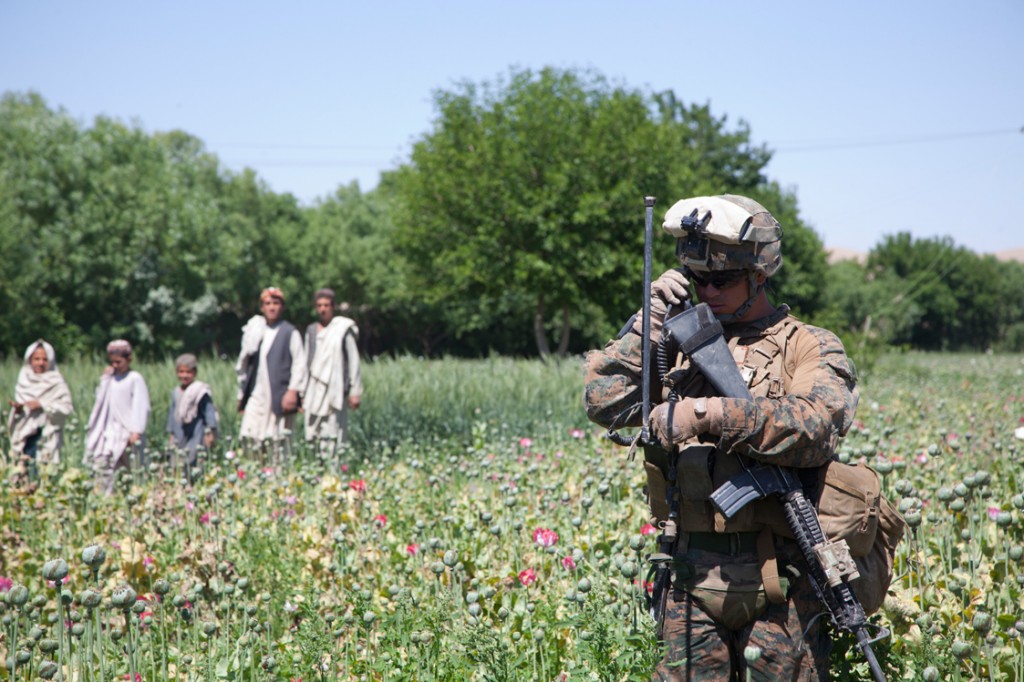
That’s right: The War in Afghanistan saw the country’s practically dead opium industry expanded dramatically. By 2014, Afghanistan was producing twice as much opium as it did in 2000. By 2015, Afghanistan was the source of 90 percent of the world’s opium poppy.
Since 2001, the U.S. has poured billions into counternarcotics programs in Afghanistan. How could this industry flourish right under the nose of the U.S. and our allies? Well, quite simply, because we let it: Aikins alleges that the DEA, FBI, the Justice Department and the Treasury ALL knew about their corrupt allies in the country, but did nothing to pursue them because it would have derailed the troop surge.
“The drug is entwined with the highest levels of the Afghan government and the economy in a way that makes the cocaine business in Escobar-era Colombia look like a sideshow,” Aikins writes, later noting: “On the ground, American commanders’ short-term imperatives of combat operations and logistics trumped other advisers’ long-term concerns over corruption, narcotics and human rights abuses, every time.”
But where did it all go? Well, as Aikins reported, Afghanistan’s “borders leak opium like sieves into five neighboring countries.”
The increased supply flooded European, Asian and Middle Eastern markets. And with Europe no longer reaching out to opium producers in South America and Mexico, that excess flooded the American market. Prices fell everywhere, making heroin dangerously cheap and dangerously accessible.
And this is where we find ourselves today: Heroin, one of the most addictive and deadly substances on Earth, can be found for as little a $4 a bag in some American cities.
Between 2002 and 2013, heroin-related overdose deaths quadrupled. In 2014, more than 10,000 people died of heroin overdoses in America. Should we add these casualties to the 3,504 U.S. and coalition soldiers who died in the war, or the 26,000 dead Afghan civilians?
And heroin use is up across the entire population. Age, sex, race, income, location — it doesn’t matter. And, as the CDC notes, “Some of the greatest increases occurred in demographic groups with historically low rates of heroin use: women, the privately insured, and people with higher incomes.”
Unfortunately, it’s not just the U.S. suffering under the weight of a heroin addiction that’s hit epidemic proportions: Afghanistan, which has a long cultural tradition of smoking opium, is dealing not just with its status as a “narco state,” as Aikins described it, but also with the health and social ills stemming from increased heroin use.
In the process of waging a “War on Terror,” we lost the “War on Drugs.” Both wars deal in corruption and violence, and they put real human lives on the line — not just on the battlefield, but in the fields where farmers cultivate crops and in the neighborhoods where people live.
The “War on Drugs” and the “War on Terror” are more intertwined than that media and our elected officials would like us to think.
And this became full front and center when the U.S.-led global crusades overlapped in Afghanistan, leaving in their wake a legacy of death, addiction and government corruption tainting Afghan and American soil.
In the U.S., the War in Afghanistan is among the major contributing factors to the country’s devastating heroin epidemic.
Over 10,000 people in America died of heroin-related overdoses in 2014 alone– an epidemic fuelled partly by the low cost and availability of one of the world’s most addictive, and most deadly, drugs.
Since the DEA got the boot from the Bolivian government in 2008, cocaine production in that country has steadily fallen year after year.
And in 2012, a Mexican government official claimed that rather than fighting drug traffickers, the CIA and other international security forces are actually trying to “manage the drug trade.”
“It’s like pest control companies, they only control,” Guillermo Terrazas Villanueva, the Chihuahua spokesman, told Al Jazeera. “If you finish off the pests, you are out of a job. If they finish the drug business, they finish their jobs.”
While there is no conclusive proof that the CIA is physically running opium out of Afghanistan, Martin notes:
“[I]t’s hard to believe that a region
under full US military occupation – with guard posts and surveillance
drones monitoring the mountains of Tora Bora – aren’t able to track
supply routes of opium exported from the country’s various poppy farms
(you know, the ones the US military are guarding).”
Ironically, it was the U.S. mission to obliterate the Taliban in the
“War on Terror” that turned Afghanistan into a “narco state.”Prior to the War in Afghanistan, the Taliban actually offered subsidies to farmers to grow food crops not drugs.
In the summer of 2000, Taliban leader Mullah Mohammad Omar announced a total ban on the cultivation of opium poppy, the plant from which heroin is made. Those caught planting poppies in Taliban-controlled parts of the country were beaten and marched through villages with motor oil on their faces.
But then 9/11 hit and the Bush administration pushed into Afghanistan once again, carrying the banner of the “War on Terror.”
“When the Taliban fled or went into hiding, the farmers lost their financial support to grow food, and returned to growing heroin, a crop that thrives in regions of Afghanistan,” as Dr. Steven Kassels noted in a 2015 piece for Social Justice Solutions.
Seeking a “light footprint” in Afghanistan, the U.S. and our allies teamed up with what Aikins describes as “anti-Taliban warlords.” Aikins reported: “Within six months of the U.S. invasion, the warlords we backed were running the opium trade, and the spring of 2002 saw a bumper harvest of 3,400 tons.”
That’s right: The War in Afghanistan saw the country’s practically dead opium industry expanded dramatically. By 2014, Afghanistan was producing twice as much opium as it did in 2000. By 2015, Afghanistan was the source of 90 percent of the world’s opium poppy.
Since 2001, the U.S. has poured billions into counternarcotics programs in Afghanistan. How could this industry flourish right under the nose of the U.S. and our allies? Well, quite simply, because we let it: Aikins alleges that the DEA, FBI, the Justice Department and the Treasury ALL knew about their corrupt allies in the country, but did nothing to pursue them because it would have derailed the troop surge.
“The drug is entwined with the highest levels of the Afghan government and the economy in a way that makes the cocaine business in Escobar-era Colombia look like a sideshow,” Aikins writes, later noting: “On the ground, American commanders’ short-term imperatives of combat operations and logistics trumped other advisers’ long-term concerns over corruption, narcotics and human rights abuses, every time.”
But where did it all go? Well, as Aikins reported, Afghanistan’s “borders leak opium like sieves into five neighboring countries.”
The increased supply flooded European, Asian and Middle Eastern markets. And with Europe no longer reaching out to opium producers in South America and Mexico, that excess flooded the American market. Prices fell everywhere, making heroin dangerously cheap and dangerously accessible.
And this is where we find ourselves today: Heroin, one of the most addictive and deadly substances on Earth, can be found for as little a $4 a bag in some American cities.
Between 2002 and 2013, heroin-related overdose deaths quadrupled. In 2014, more than 10,000 people died of heroin overdoses in America. Should we add these casualties to the 3,504 U.S. and coalition soldiers who died in the war, or the 26,000 dead Afghan civilians?
And heroin use is up across the entire population. Age, sex, race, income, location — it doesn’t matter. And, as the CDC notes, “Some of the greatest increases occurred in demographic groups with historically low rates of heroin use: women, the privately insured, and people with higher incomes.”
Unfortunately, it’s not just the U.S. suffering under the weight of a heroin addiction that’s hit epidemic proportions: Afghanistan, which has a long cultural tradition of smoking opium, is dealing not just with its status as a “narco state,” as Aikins described it, but also with the health and social ills stemming from increased heroin use.
In the process of waging a “War on Terror,” we lost the “War on Drugs.” Both wars deal in corruption and violence, and they put real human lives on the line — not just on the battlefield, but in the fields where farmers cultivate crops and in the neighborhoods where people live.