Showing posts with label human rights. Show all posts

Thursday, April 21, 2016

Why Obama's Campaign to Shield Saudi Arabia From Scrutiny Erodes Human Rights Around the World

The president is aggressively lobbying against 9/11 families seeking to sue the Saudi government.
http://www.alternet.org/grayzone-project/why-obamas-campaign-shield-saudi-arabia-scrutiny-erodes-human-rights-around-world
King Salman bin Abdulaziz of Saudi Arabia bids farewell to President Barack Obama at Erga Palace in Riyadh, Saudi Arabia, Jan. 27, 2015.
Photo Credit: Pete Souza/Public Domain
When President Barack Obama was preparing for his third presidential visit to Saudi Arabia last year, he made it clear that the close U.S. ally’s human rights abuses would not be up for discussion. “Sometimes we have to balance our need to speak to them about human rights issues with immediate concerns that we have in terms of countering terrorism or dealing with regional stability," he told CNN in January 2015 in anticipation of his first face-to-face with then-newly minted King Salman.
During the year that has lapsed between his third and now fourth presidential visit to Riyadh (currently taking place), Obama has done more than simply withhold criticism from the kingdom. He has politically and militarily backed Saudi Arabia’s murderous war on Yemen, which has been waged for over a year with U.S.-manufactured arms. He has stood by as the government carried out a rash of politically motivated executions, including the killing of prominent dissident and protest leader Sheikh Nimr Al-Nimr.
Throughout Obama’s presidency, Saudi Arabia has remained a top importer of U.S.-manufactured weapons, including the tanks the government used to invade Bahrain in 2011 and help violently repress its pro-democracy movements. On its own soil, the kingdom has maintained an oppressive system of male legal guardianship, under which women can’t obtain higher education or even a passport without approval from a father, husband or son. It’s an understatement to point out that the president has strayed far from his 2002 call to “make sure our so-called allies in the Middle East, the Saudis and the Egyptians, stop oppressing their own people.”
“The Obama administration has supported and created the worst human rights conditions in Gulf countries ever,” Ali Al-Ahmed,the director of the Institute for Gulf Affairs, told AlterNet.
But now, the special relationship between the U.S. and Saudi Arabia is giving rise to bizarre developments in domestic politics, as the president aggressively lobbies to shield the kingdom from legal charges over its potential role in the 9/11 attacks, including by campaigning against bereaved U.S. families.
Suspicions stem from George W. Bush’s decision to seal a 28-page section of the 2002 congressional 9/11 inquiry that dealt with the potential role of Saudi officials. While members of Congress are prohibited from revealing the contents of the section, some have spoken on and off the record about its potential implication of Saudi government officials and associates. Former Senator Bob Graham declared as recently as February, "The 28 pages primarily relate to who financed 9/11, and they point a very strong finger at Saudi Arabia as being the principal financier.”
Families who lost loved ones to the attacks have waged a years-long legal battle to sue Saudi Arabia, as well as banks and charities, for their alleged support. But they have been obstructed by laws that limit that ability of U.S. courts to sue some foreign sovereigns.
A proposed Senate bill known as the Justice Against Sponsors of Terrorism Act would overrule these limitations if passed by Congress and the president, clearing the way for families to seek accountability. The legislation “is intended to make clear that the immunity given to foreign nations under the law should not apply in cases where nations are found culpable for terrorist attacks that kill Americans on United States soil,” wrote Mark Mazzetti in a New York Times cover story published Saturday.
In response to the proposed bill, Saudi Foreign Minister Adel al-Jubeir traveled to Washington last month, "telling lawmakers that Saudi Arabia would be forced to sell up to $750 billion in treasury securities and other assets in the United States before they could be in danger of being frozen by American courts,” Mazzetti reports.
While it is not clear if Saudi Arabia will follow through on the threat, the Obama administration is aggressively lobbying against the legislation and is even threatening to veto the bill if it lands on the president’s desk. “Given the long list of concerns I have expressed ... it’s difficult to imagine a scenario in which the president would sign the bill as it's currently drafted,” White House press secretary Josh Earnest told reporters on Monday. “It could put the United States and our taxpayers and our service members and our diplomats at significant risk if other countries were to adopt a similar law,” he argued, adding: “The whole notion of sovereign immunity is at stake.”
Phyllis Bennis, senior fellow at the Institute for Policy Studies, told AlterNet that the reason Obama is lobbying against the bill “probably has less to do with protecting Saudi Arabia than fearing there could be reciprocity and worrying that other countries will bring charges, given that the U.S. has violated the Geneva Conventions and laws of war around the world.”
In fact, people impacted by U.S. war and occupation around the world have protested and spoken out against American immunity for war crimes, including in Afghanistan where such protections are included in a long-term, interventionist "security" deal. Whether or not the Obama administration is opposing the bill to protect itself or placate its ally, the campaign aims to restrict the powers of ordinary people to seek redress for state violence.
Meanwhile, the Obama administration continues to resist efforts to force the release of the 28 pages. When Press Secretary John Kirby was asked Tuesday by an unnamed reporter about the missing 28 pages, he snapped back that “for us to sit here, this many years later, and try to debate it I think is just a fool’s errand.”
These comments come despite the fact that the Saudi government has reportedly come out in support of the release.
Talat Hamdani, a member of the advocacy organization 9/11 Families for Peaceful Tomorrows, told AlterNet, “Those pages need to be revealed. As a mother who lost my son to the September 11th attacks, I want the perpetrators to be accountable. In order to have justice, we need to have hard facts.”
Noting that she is not speaking on behalf of her organization, Hamdani added that she does support Obama's decision to oppose the Just Against Sponsors of Terrorism Act. Her position diverges sharply from that of Mindy Kleinberg, whose husband died in the 9/11 attacks. “It’s stunning to think that our government would back the Saudis over its own citizens,” Kleinberg told Mazzetti.
In fact, U.S. opposition to full scrutiny of the Saudi role in financing terror is relevant not only to U.S. citizens but also to people across the Middle East impacted by violence and displacement. This reality was privately acknowledged by Hillary Clinton in a 2009 cable exposed by WikiLeaks, in which she stated: "Donors in Saudi Arabia constitute the most significant source of funding to Sunni terrorist groups worldwide. Continued senior-level USG engagement is needed to build on initial efforts and encourage the Saudi government to take more steps to stem the flow of funds from Saudi Arabia-based sources to terrorists and extremists worldwide.”
According to Bennis, “There is a lot of uncertainty about whether it’s been the king or crowned prince or other royal family members or government-backed institutions, but it is clear that someone is giving money to ISIS."
The Obama administration will not even release information about the kingdom’s potential role in an attack on U.S. soil, let alone bloodshed in Iraq and Syria, even amid signs that blind support for Saudi Arabia is growing increasingly politically unviable. Earlier this year, grassroots activists, dissidents and human rights campaigners gathered in Washington D.C. to raise concern about the special relationship between the United States and Saudi Arabia. And a bipartisan team of senators announced last week they are introducing legislation to "set new conditions for U.S. military support to Saudi Arabia."
“I believe the whole world today is starting to recognize the problem of human rights violations in Saudi Arabia,” Mohammed Nimr al-Nimr, the son of the executed Saudi dissident, told AlterNet. But, he added that Obama’s visit shows “agreement and support to all human rights violations in Saudi Arabia.”
Sarah Lazare is a staff writer for AlterNet.

Monday, April 4, 2016

The UN’s Ridiculously Biased Human Rights Report

Can you guess which country was named the world’s top human rights violator?


Via Anne Bayefsky at Fox News:
According to the United Nations, the most evil country in the world today is Israel.
On March 24, 2016, the U.N. Commission on the Status of Women (CSW) wrapped up its annual meeting in New York by condemning only one country for violating women’s rights anywhere on the planet – Israel, for violating the rights of Palestinian women.
On the same day, the U.N. Human Rights Council concluded its month-long session in Geneva by condemning Israel five times more than any other of the 192 UN member states.
It’s almost too ludicrous to believe that a nation as progressive as Israel could win this label, especially when one considers the competition. (View the reports here.)
On the continent of Africa, for example, 27 countries condone the routine practice of genital mutilation on young women, according to UNICEF statistics. More than half of the estimated 200 million women and girls who undergone the procedure live in three countries: Indonesia, Egypt, and Ethiopia. You might think that one of these nations would qualify. They do not.
Then there is Yemen, where half the women are illiterate (compared to 17 percent for men) and one out of seven females are married off by the age of 14, according to a recent USA Today report. They are not mentioned either.
Syria, perhaps? In Mr. Assad’s country there is a documented culture of systemic rape, abuse, and abduction. And we’re not just talking about rebels and vigilantes, but abductions at government security checkpoints. How about Iran, where the new rage is throwing acid in the faces of women whose veils are deemed promiscuous? Neither of the nations are mentioned either.
Instead, Israel was the only nation condemned. The resolution was sponsored by the Palestinians and South Africa, according to the Times of Israel, and passed 27-2, with U.S. and Israel voting against the measure.
Israel’s UN Ambassador Ron Prosor said the following:
“If anyone has ever doubted that the UN is biased against Israel, today we got further proof. Of the 193 member states in this institution, dozens slaughter innocent civilians and impose discriminatory laws that marginalize women and yet they all get a free pass. The Commission on the Status of Women itself includes some of the worst violators of human rights, as Iran and Sudan.”
It’s difficult to disagree with Mr. Prosor.
The intellectual dishonesty of reports such as these serve only to (further) diminish the UN and bring into question whether or not the body still serves a legitimate purpose.
Indeed, the fact that the report has generated nary a whimper in the media (outside of Fox) suggests that the culture at the U.N. has reached a point where the absurd is no longer absurd because it’s normal.
--
Jon Miltimore is the Senior Editor of Intellectual Takeout.  He is the former Senior Editor of The History Channel Magazine and a former Managing Editor at Scout Media.

Monday, January 4, 2016

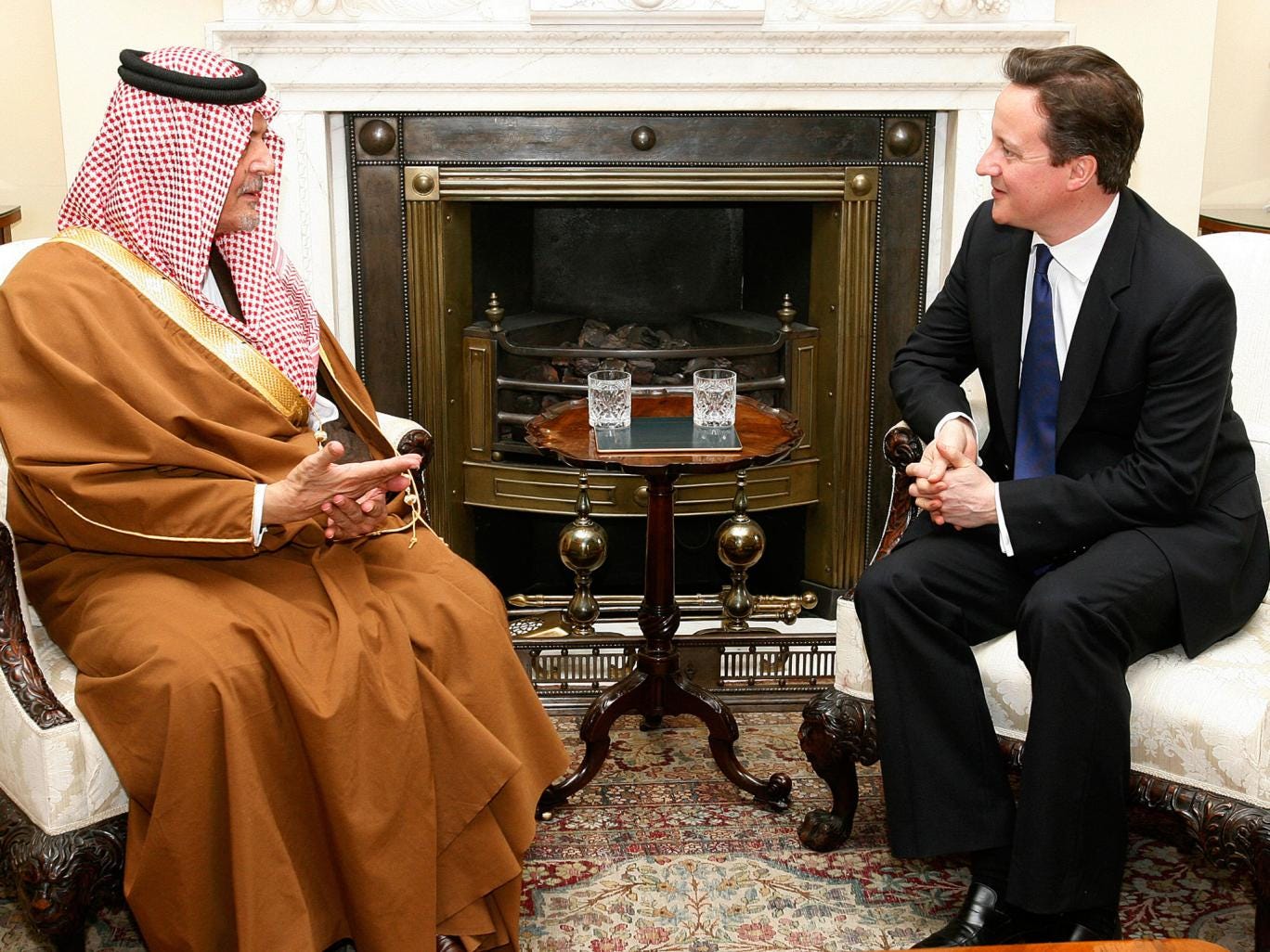
Exclusive: UK Government urged to reveal its role in getting Saudi Arabia onto UN Human Rights Council

Liberal Democrat and Green Party leaders call on David Cameron to reveal whether British government supported Saudi bid 
 
 David Cameron has been urged to "come clean" over the role the UK Government played in voting Saudi Arabia on to the UN Human Rights Council after the kingdom's execution of 47 people in a single day sparked outrage across the Middle East.
The leaders of the Liberal Democrat and Green parties have demanded a public inquiry into whether the UK was involved in a secret vote-trading deal in 2013 to secure both countries a place on an influential UN panel.
Diplomatic cables released by Wikileaks last year purported to show that UK initiated the secret negotiations by asking Saudi Arabia for its support.
The exchanges have never been commented on by UK officials. Both Britain and Saudi Arabia were later named among the 47 member states of the UNHRC following the secret ballot.
Following the execution of dozens of people including the prominent Shia cleric Sheikh Nimr al-Nimr, Mr Cameron has been accused by human rights campaigners of “turning a blind eye” to Saudi abuses.
And speaking to The Independent, Natalie Bennett and Tim Farron have led calls for the Government to issue a full response to last year's alleged leak.
Ms Bennett, the Green Party leader, said the Saudi kingdom’s role on the UN council was “one of many issued raised by the mass executions”. She called for a public inquiry into the leaked diplomatic cables and the UK’s alleged decision to support Saudi Arabia in spite of its human rights record.
“In light of the weekend's events, the government should be launching an inquiry to establish who made the decision to so abuse the UN process and the principle of universal human rights," she said. "The results of this inquiry must be published. 
“And the government must immediately suspend exports of arms to Saudi Arabia, and strengthen its currently extremely weak diplomatic response.”
Tim Farron, the leader of the Liberal Democrats, said: "It is time the Prime Minister came clean about whether the Government supported Saudi Arabia's election to the UN Human Rights Council.
"It would make a utter mockery of the values we hold dear if they did support them. We must be stronger with our supposed allies and say that systematic abuses of human rights will not be tolerated.
"If the Government did support the Saudi bid - it would show once and for all that the Government puts profit above fundermental human rights."
Amid widespread condemnation from the international community, the British government’s response to the Saudi executions has been limited.
Issued through the Foreign Office, it read: “The UK opposes the death penalty in all circumstances and in every country. The death penalty undermines human dignity and there is no evidence that it works as a deterrent.
“The foreign secretary regularly raises human rights issues with his counterparts in countries of concern, including Saudi Arabia. We seek to build strong and mature relationships so that we can be candid with each other about those areas on which we do not agree, including on human rights.”
An FCO spokesman said: "Saudi Arabia took part in an uncontested election for a seat as one of the Asian Group members in the UN's Human Rights Council.
"So while the UK never publicizes how it votes, this was not a contested election within the Asian Group and the UK's vote was immaterial."
At the time of the leak, Hillel Neuer, executive director of UN Watch, told The Australian: "Based on the evidence, we remain deeply concerned that the UK may have contracted to elect the world’s most misogynistic regime as a world judge of human rights."


Monday, October 19, 2015

UK Ignores Barbaric Death & Torture To Become Saudi Arabia's Largest Arms Supplier

Tyler Durden's picture

http://www.zerohedge.com/news/2015-10-19/uk-ignores-barbaric-death-torture-become-saudi-arabias-largest-arms-supplier
Submitted by Claire Bernish via TheAntiMedia.org,
While increasing cries from the West demand an end to all association with Saudi Arabia, the U.K. government described lucrative public contracts with the notorious human rights abuser as a “priority market.”
Government departments have been actively — even aggressively — steering U.K. businesses into bidding for contracts with the Saudis in the health, justice, defense, and security sectors, according to documents seen by the Observer.
“It’s becoming increasingly clear that ministers are bent on ever-closer ties with the world’s most notorious human rights abusers,” said Maya Foa, who directs the death penalty team at Reprieve. “Ministers must urgently come clean about the true extent of our agreements with Saudi Arabia and other repressive regimes.”
As three young Saudis, Ali Mohammad al-Nimr, Abdullah al-Zaher, and Dawoud al-Marhoon face beheading and crucifixion — and another blogger, Raif Badawi, essentially receives a drawn-out death sentence of 1,000 lashes — the U.S. and U.K. governments have been barraged with criticism for continuing political relations. Perhaps inflaming the issue more, according to the Guardian, several of the “most important Saudi contracts” fell under the Overseas Security and Justice Assistance Policy (OSJA) — meant to establish U.K.’s security and justice dealings as “consistent with a foreign policy based on British values, including human rights.”
Labour Party leader Jeremy Corbyn penned an openly critical letter to Prime Minister David Cameron in which he pled for an independent review of the OSJA process:
“By operating under a veil of secrecy, we risk making the OSJA process appear to be little more than a rubber-stamping exercise, enabling the U.K. to be complicit in gross human rights abuses,”  he wrote.
But the U.K. has increased dealings with the kingdom, ignoring the pleas.
In fact, the U.K. is now Saudi Arabia’s largest arms dealer — supplying 36% of its imports. According to the Guardian,
“U.K. business[es] want to capitalize on the fragile situation in the Middle East. A 2013 document, written by an official at U.K. Trade and Investment, the body charged with promoting business interests, outlines how the region’s ‘global policing and security market has ballooned.’ Freedom of Information requests show that the U.K. Trade and Investment Defense and Security Organization (UKTI) is courting the Saudis and that civil servants met Saudi military delegations at the U.K.’s Security and Policing arms fair this year and last summer at the Farnborough airshow. Civil servants were also due to meet Saudi representatives at the major arms expo in London’s Docklands last month, just as the regime upheld a ruling that al-Nimr was to be executed and his body crucified and left in public view for three days.”
Many are struggling to understand why the U.K. would seek to supply arms to the same country from which it withdrew a £5.7 million (nearly $8.8 million) prison contract less than a week ago — reportedly due to yet another impending lashing: this time of 74-year-old Karl Andree for transporting homemade wine in his vehicle.
“The Saudi regime has an appalling human rights record,” said Andrew Smith of the Campaign Against Arms Trade, “yet it remains the world’s largest buyer of U.K. weapons. How many more people will be tortured and killed before the U.K. government finally says enough is enough?”
Saudi Arabia executed at least 134 people so far in 2015, according to a report from Amnesty International. As Smith noted:
“It seems ironic for the U.K. to be working on healthcare with the Saudi regime at the same time as selling them the means to suppress and kill their own people.”

Tuesday, June 30, 2015

Report: Egypt increasingly cracking down on its youth

Egypt's youth and activists are being subjected to a number of repressive measures, according to Amnesty International.

Zoe Hu |
Activists estimate that 41,000 people have been arrested, charged or indicted, often through unfair trials [EPA]
Two years since the removal of ousted President Mohamed Morsi from power, Egypt has swung from "mass protest to mass incarceration", according to a new Amnesty International report.
The report, "Generation Jail: Egypt's Youth Go from Protests to Prison", details the country's increasingly repressive state. Its release on Tuesday marks the second anniversary of Egypt's June 30 protests, whose participants are now facing arbitrary arrests and prison.
"Mass protests have been replaced by mass arrests," said Hassiba Hadj Sahraoui, Deputy Director of the Middle East and North Africa Programme at Amnesty International. "By relentlessly targeting Egypt's youth activists, the authorities are crushing an entire generation's hopes for a brighter future," Sahraoui added.
According to the report, activists estimate that 41,000 people have been arrested, charged or indicted, often through unfair trials where evidence consists solely of statements by security forces.
The report's researchers emphasise that the Egyptian society has seen its avenues for free speech and protest clang shut as the government under President Abdel Fattah el-Sisi seeks to stifle scores of activists, politicians and youth in the name of state security.


The report focuses on 14 young people who were among the thousands that have been subjected to arbitrary arrests and practices "which do not comply with international law".
The authorities' repression of dissent and opposition originally began with the jailing of Muslim Brotherhood leaders and their supporters. Now, however, its scope has reached university campuses and public streets, family homes, and the offices of human rights groups.
"Egypt today is a police state," said Nicholas Piachaud, a researcher on the Egypt team for Amnesty International. "People are deeply afraid of the knock on the door in the night," Piachaud told Al Jazeera.
For the youth in the country, who once enjoyed global praise for being the pulsing centre of Egypt's protest movements, the crackdown has been an overwhelming source of fear and despair.
Egypt's international partners have been silent on the matter, choosing to welcome Sisi back into the political fold [EPA]
One young man, Mohamed Ahmed Hussein, was just 18 years old when he was arrested for wearing a T-shirt with a political slogan on it. He has now spent 500 days in prison without charge or trial, and his family says that his body carries the marks of torture.
"The authorities have made it clear that now, what they wish to do is tear the heart out of the protest movement," Piachaud said. "It's their way or prison."
Recent reports of disappearances have only added to the atmosphere of fear.
On June 9, the National Council for Human Rights, a government-run entity, received 50 complaints lodged by families who suspect their loved ones are being detained with no way of communicating with the outside.
"One family of a detained individual that we spoke with said that what they're going through is awful, but what's happening with the recent disappearances is terrifying," said Piachaud.


In line with the country's Code of Criminal Procedures, accused persons in Egypt may be held without trial for up to 45 days, a period that courts can extend after review.
According to the report, the law has led to some suspects going without trial for over a year.
The authorities have made it clear that now, what they wish to do is tear the heart out of the protest movement.
Nicholas Piachaud, researcher, Amnesty International Egypt
When the trial does come, it can involve unfair practices that warp due process and subject the defence party to incomplete evidence, sudden changes in the hearing's location and even threats against lawyers.
One particularly "farcical" hearing, said the report, sentenced the defender to jail in absentia and featured home videos as evidence.
Yara Sallam, a prominent human rights defender, is another person charged with taking part "in an unauthorised demonstration that endangered public order".
Her lawyers say that Sallam did not participate in any such demonstration, and had been arrested while buying water at a kiosk.
On the day of Sallam's trial, officials changed the address of the hearing location without notifying the defence lawyers.
Sallam and her lawyer had to travel 25km to the new location, where a tinted sheet of glass prevented her from communicating with her defence counsel throughout the trial.
Though Sallam is one of the more well-known individuals prosecuted by authorities, repression in Egypt is not limited to only the prominent voices.
According to the report, innocuous acts by people - such as wearing the wrong shirt, or walking down a street where a demonstration is happening - can lead to detentions and jail time.
"Anyone who criticises the authorities and is seen to criticise the authorities is at risk," said Piachaud.
The report focuses on 14 young people who were among the thousands that have been subjected to arbitrary arrests [EPA]
The already shrinking political space in Egypt is subject to regulations that severely limit when and where demonstrations may happen.
Passed in November 2013, the Protest Law requires any public demonstration to have prior approval from the interior ministry, and permits security forces to use excessive force in dispersing protesters.
The government justified these restrictions by saying that it was restoring stability to the country, invoking recent attacks on security and police forces.
Yet, the report noted that often, if demonstrations do see violence at the hands of one or a few protesters, forces will indiscriminately arrest anyone in the area.
According to Piachaud, this has sucked the air out of all public dissent in society.
Meanwhile, the report highlights that Egypt's international partners have been passive about the matter, choosing to welcome Sisi back into the political fold instead of denouncing the intensifying repression.
The international community, says Piachaud, was silent when Egyptian security forces killed hundreds of protesters in August of 2014, and that silence stretches on today.
"Egypt's partners are saying they do care about human rights, but on the other hand they're selling and transferring hundreds of millions of dollars worth of military and security equipment to Egypt's government," he said. "This is sending a very dangerous signal to the authorities."

Tuesday, April 14, 2015

US, UK thank Russia for evacuation of their citizens from Yemen

The British Foreign Office, as well as the US Secretary of State, have thanked Moscow for the evacuation of their citizens from war-torn Yemen, as Russian planes and ships take hundreds of Russian and foreign nationals from the conflict zone.
In a phone conversation with Russia’s Foreign Minister Sergey Lavrov, US Secretary of State John Kerry “expressed gratitude for assistance in evacuation of American citizens” from Yemen, the Russian Ministry of Foreign Affairs said in a statement on Monday.
A spokesperson for the UK Foreign Office told RT on Monday that, “we can confirm that six British nationals left Yemen at the weekend on a Russian Navy vessel. We thank the Russian authorities for their assistance.”
Over 300 people were evacuated from the Yemeni capital of Sanaa in two Russian flights on Sunday, and another 300 people were earlier taken from the port of Aden to Djibouti by a Russian vessel. According to the Russian Embassy in Djibouti, 18 US citizens and six UK citizens, including children and toddlers, were aboard the ship.
“We feel like we’re left behind. No support. I called every Embassy – all the embassies in Riyadh, in Cairo, in Djibouti – to help me and my family, but they always apologize. They said “help is coming” – but it never came,” an American citizen evacuated on a Russian plane told RT’s Paula Slier. “People now think that Yemeni Americans are like second-class Americans.”

An American citizen currently stranded in Yemen, Summer Nasser, told RT on Monday that “I really want to appreciate the Russian government, because yesterday I got a call from the Russian Ambassador in the capital of Yemen. He was attempting to rescue American citizens. Unfortunately, I couldn’t take the flight at the short notice.”

The US has stated that there are “no government-sponsored plans” to evacuate US citizens from Yemen. “For more than 15 years the State Department has been advising US citizens to defer travel to Yemen, and we’ve been advising those US citizens who are in Yemen to depart,” answered spokesman Jeff Rathke on the question of “the US Government’s inaction in evacuating US citizens from Yemen”.
“[There are] bombings every other day, a few bombings a day. So, it’s very, very scary right now,” Arwa Al-Iraini , another American, currently stranded in Yemen, described the situation in the country to RT. “Basically, we’re just sitting here and waiting. Nobody will help us evacuate. ”
Shamsan Mansoob from Michigan, who is stuck in central Yemen, told RT on Sunday that there was no access to the internet, and no transportation that could help people flee the country, adding that “there is no news that we can follow”.
According to a recent Red Cross report, over 1,000 people have died in the fighting between the Houthi rebels and supporters of Yemeni President Abd-Rabbu Mansour Hadi, who fled the country. The Saudi-led airstrikes, backed by the US, commenced at the end of March, in order to counteract anti-government Shia rebels.

Tuesday, March 24, 2015

Regime Change: America's Failing Weapon Of International Deception


Tyler Durden's picture

http://www.zerohedge.com/news/2015-03-23/regime-change-americas-failing-weapon-international-deception

Authored by Ben Tanosborn,
For years, Winston Churchill’s famous quote, “It has been said that democracy is the worst form of government except all the others that have been tried,” has served as Americans’ last word in any political discussion which requires validation of the US government, no matter how corrupt or flawed in its behavior, as the best in the planet, comparatively or by default.  Never mind the meaning that Mr. Churchill had intended back in 1947, or how the international political panorama has changed during the past seven decades.
These remarks were made by Britain’s prime minister before the House of Commons a few months before there was a changing of the guards in the “Anglo-Saxon Empire” as the Brits gave away their colonial hegemony in favor of the super-influential economic and military power represented by the United States.  And that was symbolically marked by Britain’s relinquishing its mandate in Palestine, and the creation of Israel.
Such reference to democracy in the quote, explicitly defining it as a “government by the people,” basically applied to Britain and the United States at the close of World War II; but such condition has deteriorated in the US to the point where the “common people” no longer have a say as to how the nation is run, either directly or through politicians elected with financial support provided by special interests, undoubtedly expecting their loyalty-vote.  Yet, while this un-democratization period in our system of government was happening, there were many nations that were adopting a true code of democracy, their citizens having a greater say as to how their countries are governed.  Recognizing such occurrence, however, is a seditious sin for an American mind still poisoned by the culture of exceptionalism and false pride in which it has been brainwashed.
And that’s where our empire, or sphere of influence, stands these days… fighting the windmills of the world, giants that we see menacing “American interests,” and doing it under the banner of “for democracy and human rights.”  Such lofty empire aims appear to rationalize an obscene military budget almost twice as large as those of Russia, China, India and United Kingdom combined!  Americans, representing less than 5 percent of the world’s population, are footing a military bill almost twice as large as that expended by half of the world’s population.  If that isn’t imperialistic and obscene, it’s difficult to image what other societal behavior could be more detrimental to peace and harmony in this global village where we all try to co-exist.
Empires and global powers of the past most often resorted to deposing of antagonistic foreign rulers by invading their countries and installing amicable/subservient puppet rulers.  The United States and the United Kingdom, perhaps trying to find refuge, or an excuse, in their democratic tradition, have resorted to regime change “manipulations” to deal with adversary governments-nations. [Bush43’s Iraq invasion stands as a critical exception by a mongrel government: half-criminal (Dick Cheney-as mentor), and half-moronic (George W. Bush-as mentee).]
Regime change has served the United States well throughout much of the Americas from time immemorial; an endless litany of dictators attesting to shameless in-your-face puppetry… manipulations taking the form of sheer military force, or the fear of such force; bribery of those in power, or about to attain power – usually via military coup; or the promise of help from the Giant of the North (US) in improving economic growth, education and health.  Kennedy’s 1961 Alliance for Progress proved to be more political-PR than an honest, effective effort to help the people in Latin America… such program becoming stale and passé in Washington by decade’s end; the focus shifting in a feverish attempt to counter the efforts by Castro’s Cuba to awaken the revolutionary spirit of sister republics in Central and South America (Bolivia, Ecuador, Nicaragua…).
After almost two centuries of political and economic meddling in Latin America under the Monroe Doctrine (1823) banner, much of it involving regime change, the US is finally coming to terms with the reality that its influence has not just waned but disappeared.  Not just in nations which may have adopted socialist politics, but other nations as well.  US’ recent attempt to get other regional republics to label Venezuela (Maduro’s leftist government) as a security threat not only met with opposition from the twelve-country Union of South American Nations (UNASUR) but has brought in the end of an era.  It’s now highly unlikely that secretive efforts by the CIA to effect regime change in Latin America will find support; certainly not the support it had in the past.
To Washington’s despair, similar results, if for other reasons, are happening throughout North Africa and the extended Middle East; certainly not the results the US had hoped for or anticipated from the revolutionary wave in the Arab Spring, now entering its fifth year.  It is no longer the flow of oil that keeps Washington committed to a very strong presence in the Middle East.  It is America’s Siamese relationship with Israel.
But if regime change is no longer an effective weapon for the US in Latin America or the Middle East, the hope is still high that it might work in Eastern Europe, as America keeps corralling Russian defenses to within a holler of American missilery.  Ukraine’s year-old regime change is possibly the last hurrah in US-instigated regime changes… and it is still too early to determine its success; the US counting on its front-line European NATO partners to absorb the recoil in terms of both the economy and a confrontational status now replacing prior smooth relations.
Somehow it is difficult to envision an outcome taking place in Ukraine which would allow the United States a foothold at the very doorsteps of Russia; something totally as inconceivable as if China or Russia were contemplating establishing military bases in Mexico or any part of Central America or the Caribbean.
The era of using regime change as a weapon of mass deception may have already ended for the United States of America… and hopefully for the entire world.

Thursday, February 5, 2015

Pregnant activist crashes glitzy arms industry dinner, urges guests ‘consider career change’

Screenshot from youtube.com/user/wwwcaatorguk
Published time: February 05, 2015 18:32
Edited time: February 05, 2015 21:50

A pregnant political activist entered a glitzy arms industry dinner in Westminster, commandeered a microphone and warned assembled arms dealers and MPs that making profit “causing death and destruction around the world” is unacceptable.
After making her way to a microphone undetected, Anne Marie O'Reilly expressed concern her unborn child would face a world where arms dealers profit from human suffering and bloodshed.
The anti-arms activist’s unexpected intervention left the crowd somewhat stunned.
While O'Reilly's unassuming manner initially drew a warm reception, her criticism of the UK establishment’s links to the arms trade was followed by a long and awkward silence.
Before being escorted off stage, O'Reilly suggested arms dealers in the audience should reconsider their careers.

The UK arms industry, which profits from brokering arms deals with questionable regimes and conflict-ridden states worldwide, is backed and subsidized by the British government.
Tuesday’s annual dinner, which cost attendees £246 per head, was hosted by ADS – a trade body for British Aerospace, and other defense, security and space companies. The group represents a collective of the world’s 50 largest arms firms.
The opulent soiree was attended by Britain’s Business Secretary Vince Cable, the representatives of 100 arms firms across the globe, over 40 British MPs, 30 civil servants, and 30 Ministry of Defence (MoD) personnel.
Andrew Smith, of UK think tank Campaign Against The Arms Trade (CAAT), said the event was a hotbed of lobbying.
“The arms companies don't invite politicians because they want to be nice, it is because it's good for business,” he told RT.
“These arms companies couldn't sell their wares without the active support and promotion that comes from the UK government.”

Image from baesystems.com
CAAT was provided with a list of all MPs who attended the lavish dinner. The document also detailed their seating arrangements.
Tobius Elwood MP, a Foreign and Commonwealth Office minister, was seated at Cobham PLC’s table. The firm is one of the biggest arms companies in the world, and is headquartered in Dorset. Cobham has applied for arms export licenses to Saudi Arabia, Israel, the UAE and Turkey, according to CAAT.
Margaret Curran MP, shadow secretary of state for Scotland, was seated at the table of US-headquartered arms manufacturer Raytheon.
Raytheon makes the targeting system for the Reaper drone deployed by the CIA and other states to conduct strikes across the globe.The firm has also been linked to manufacturing components for bombs deployed in the 2014 Gaza conflict.
Business Secretary Vince Cable, who spoke at the event, sat at the top table beside Shadow Secretary for Defence Vernon Coaker and a group of ADS executives.
CAAT’s Andrew Smith said Cable’s decision to speak at the dinner was telling.
“The fact that a group like ADS is being addressed by Vince Cable MP, the Secretary of State for Business, is a sign of how powerful they are,” he argued.
Also present at the extravagant event were controversial arms firms Thales, BAE Systems and MBDA.
Thales is the eleventh largest arms firm in the world, and has sold military wares to some of the most oppressive regimes across the globe, according to CAAT.
BAE Systems, which had three MPs at its table, is Europe’s largest arms firm, and has also supplied multiple repressive governments. Among the regimes BAE Systems sells to are Saudi Arabia, Bahrain and Mubarak's Egypt.
MBDA is a missile company partially owned by BAE. It sold military wares to Muammar Gadaffi’s government in 2007, and its military hardware was deployed by Britain and France in the 2011 bombing of Libya. The company’s missiles are also thought to have been supplied to rebel groups in Libya, CAAT says.
Probed on the impact of Britain’s government-backed arms trade, Smith said the UK facilitates rampant human rights abuses abroad.
“When the UK sells weapons to regimes like Saudi Arabia, Qatar and Bahrain, it doesn't just provide military support, it also provides political support and a UK endorsement for the human rights abuses that are taking place,” he said.
Smith said it is “outrageous the government actively supports and promotes this deadly trade.”
“The fact that arms dealers were swilling champagne with over 40 MPs is a disgrace and shows the extent of the arms trade's connections and political lobbying,” he added.
READ MORE: ‘I won’t be used to peddle UK arms in Middle East’ – Prince Charles
On Tuesday, it emerged the Prince of Wales allegedly wants to end his role as a promoter of British arms in Gulf States.
The revelation was unveiled by an unauthorized biography documenting Prince Charles’ life, which was published on Thursday.

Tuesday, March 18, 2014

Revealed: Inside the Senate report on CIA interrogations

by   March 18, 2014 8:45AM ET

Exclusive: Intelligence Committee probe concluded some techniques used in CIA interrogations were not legally authorized

CIA

A dispute between the CIA and Sen. Dianne Feinstein flared into public view when, in an extraordinary floor speech, she accused the CIA of improperly searching a computer network the agency had set up for lawmakers to investigate the George W. Bush–era interrogation program for suspected terrorists.
A still-classified report on the CIA's interrogation program established in the wake of 9/11 sparked a furious row last week between the agency and Senate Intelligence Committee chairwoman Dianne Feinstein. Al Jazeera has learned from sources familiar with its contents that the committee's report alleges that at least one high-value detainee was subjected to torture techniques that went beyond those authorized by George W. Bush's Justice Department.
Two Senate staffers and a U.S. official, who spoke on the condition of anonymity because the information they disclosed remains classified, told Al Jazeera that the committee's analysis of 6 million pages of classified records also found that some of the harsh measures authorized by the Department of Justice had been applied to at least one detainee before such legal authorization was received. They said the report suggests that the CIA knowingly misled the White House, Congress and the Justice Department about the intelligence value of detainee Zain Abidin Mohammed Husain Abu Zubaydah when using his case to argue in favor of harsher interrogation techniques.
The committee's report, completed in 2012, must go through a declassification review before any part of it may be released, but conflicts between the CIA — the original classification authority for the documents on which the report is based — and the Senate Intelligence Committee have complicated the process. Even if the report was declassified, releasing it would require Senate approval, and it's not clear that Feinstein, a California Democrat, could muster enough votes to do so. President Barack Obama last week expressed support for releasing the report "so that the American people can understand what happened in the past … That can help guide us as we move forward." 
CIA Director John Brennan delivered a rebuttal to the report last June, more than four months after a deadline imposed by the Intelligence Committee. The 120-page CIA response, which addresses what the agency says are flaws in the Senate report, also remains classified. 
The Intelligence Committee probe began in 2009 after allegations that detainees had been tortured in CIA captivity after the 9/11 attacks. Feinstein has said that a CIA internal review contradicts statements previously made by the agency, but Brennan insists that the committee never should have seen documents assembled by former CIA Director Leon Panetta — which Panetta claims was not a review — because they contain sensitive material protected by executive privilege.
The CIA alleges that Senate staffers walked out of a secure facility in Northern Virginia in possession of documents they were not authorized to access. Feinstein and Sen. Mark Udall, D-Colo., have accused the CIA of monitoring the computers the agency had set up for Senate investigators to review the classified documents related to the agency’s rendition, detention and interrogation program. The Justice Department and FBI are now reviewing the matter.

Agent’s notes missing

Even before accessing the documents, committee staffers received crucial information in a briefing from former FBI agent Ali Soufan in early 2008, according to Al Jazeera’s sources. Soufan — who now runs a private security and intelligence consultancy — told the staffers that he had kept meticulous notes about the methods used by a psychologist under CIA contract to interrogate Abu Zubaydah at a CIA black site in Thailand after his capture in Pakistan in March of 2002. Soufan's account, the staffers say, shows that torture techniques were used on Abu Zubaydah even before some had been sanctioned as permissible by the Bush administration.
Soufan described his briefing of Intelligence Committee researchers in his memoir, “The Black Banners.”
“In early 2008, in a conference room that is referred to as a sensitive compartmented information facility (SCIF), I gave a classified briefing on Abu Zubaydah to staffers of the Senate Select Committee on Intelligence,” Soufan wrote. “The staffers present were shocked. What I told them contradicted everything they had been told by Bush administration and CIA officials. When the discussion turned to whether I could prove everything I was saying, I told them, ‘Remember, an FBI agent always keep his notes.’ ” 
The committee tried to gain access to Soufan’s notes — then in possession of the CIA and FBI — after it launched a review of the agency’s detention and interrogation program in 2009. But Senate investigators were told, according to Al Jazeera’s sources, that Soufan’s notes were missing and could not be found in either the FBI’s or CIA’s computer system, where other classified records about the interrogation program were stored.
More than a year later, the notes ended up with the Senate Intelligence Committee, although it's not clear whether they were turned over to committee investigators by the CIA or FBI or if they were in the cache of documents taken by investigators from the secure facility in Northern Virginia in 2010, which Senate staffers refer to as the Panetta review.
Two Senate staffers told Al Jazeera that the Panetta documents question the Bush administration claims about the efficacy of Abu Zubaydah’s torture, and the staffers noted that some of the techniques to which he was subjected early in his captivity had not yet been authorized.
Christopher White, a CIA spokesman, declined to answer questions about the Senate report’s conclusions on Abu Zubaydah, Soufan’s notes or Panetta’s documents. 

Abu Zubaydah torture sketches

A large section of the Intelligence Committee report is devoted to the interrogation of Abu Zubaydah, according to Al Jazeera’s sources. Abu Zubaydah was the first high-value detainee captured after 9/11 and the first subjected to the agency’s enhanced interrogation program, and claims about his case were later used by the Bush administration to justify new guidelines for those interrogation techniques.
A few weeks before the 2009 announcement of the Senate Intelligence Committee’s investigation, Abu Zubaydah’s attorney Brent Mickum was invited to meet with committee staffers in a secure conference room in the Senate Hart Office Building in Washington.
Mickum recalled in an interview with Al Jazeera that committee staffers were interested in Abu Zubaydah’s recollections. “The committee was talking about torture and whether it was effective,” Mickum said. “I was able to relate to them what Abu Zubaydah told me. We talked about where he was tortured. I told them where we thought he was. I told them that the government confirmed he was never a member of Al-Qaeda. The drawings were then passed around the room.”
Mickum and his co-counsel, Amy Jacobsen, presented to the committee staffers a set of ink drawings on yellow legal paper marked top secret by the CIA. Abu Zubaydah, they said, made the sketches to depict his torture and the torture of two other high-value detainees.
One of the highly detailed drawings, according to knowledgeable intelligence officials, depict Abu Zubaydah being waterboarded. 
Mickum, who holds a top-secret security clearance, said he could not discuss the contents of the drawings because they are classified. But he said the details were “very impressive … right down to the eyeholes on the leg and hand restraints.”
Senate staffers told Al Jazeera that Abu Zubaydah’s drawings were used in the report’s narrative but that the CIA objected to including copies of the images as exhibits. After the Senate Intelligence Committee voted 9 to 6 in December 2012 to approve the report, copies of the 6,300-page document were sent to the White House, the State Department, the Office of the Director of National Intelligence, the Justice Department and the CIA.
The Congressional Record says the report is divided into three volumes: a comprehensive history of the interrogation program, the value of the intelligence it revealed and the claims about its nature and effectiveness made by the CIA to Congress, the Justice Department and the media.
When Panetta briefed CIA employees on March 16, 2009, about the Senate Intelligence Committee’s review, he said Feinstein and her Republican counterpart, Kit Bond of Missouri, had “assured” him “that their goal is to draw lessons for future policy decisions, not to punish those who followed guidance from the Department of Justice.”
But now that some of the report’s conclusions suggest that some of the techniques used on Abu Zubaydah and other captives either went beyond what was authorized by the Justice Department or were applied before they had been authorized, the congressional staffers and U.S. officials who spoke to Al Jazeera said CIA officials are seeking further assurances against any criminal investigation.
Thus far, no such assurances have been given, according to Al Jazeera’s sources, nor is there any indication that the Senate Intelligence Committee’s report would prompt a criminal investigation.
Chris Anders, senior legislative counsel for the American Civil Liberties Union, told Al Jazeera he's not surprised by the CIA's response, because many of those involved in the creation of the interrogation program still work at the agency and may fear being placed in legal jeopardy. 
“Whatever is in the report is big enough and significant enough that the CIA has fought tooth and nail to keep it buried,” Anders said. “If what comes out in this report is as bad as some senators have said, it’s going to require a broader and deeper discussion about what took place, and it will be up to the president and Congress to lead the country through it, figure out what it means and how we need to respond to clean it up.”
Panetta, who also did not return calls or emails seeking comment, announced in 2009 that he, too, planned to review the agency’s detention and interrogation program. He announced the formation of a Director’s Review Group for Rendition, Detention, and Interrogation, whose investigation would run parallel to the one being conducted by the Senate Intelligence Committee.
“Peter Clement, a senior leader from our Directorate of Intelligence, will head this new unit, which will have a small number of officers from across the agency, including the National Clandestine Service,” Panetta’s memo said.
That review group was disbanded and never completed its work, according to the U.S. official and the Senate staffers who spoke on condition of anonymity.
Sen. Martin Heinrich, D-N.M., attempted to get Brennan to go on the record during a congressional hearing in January to explain why the Panetta review group did not finish its work. 
“I’ll be happy to address that question at the time when the committee leadership requests that information from me,” Brennan said.
http://america.aljazeera.com/articles/2014/3/18/revealed-inside-thesenatereportonciainterrogations.html