Showing posts with label hyperinflation. Show all posts

Thursday, April 28, 2016

This Is The End: Venezuela Runs Out Of Money To Print New Money

Tyler Durden's picture

http://www.zerohedge.com/news/2016-04-27/end-venezuela-runs-out-money-print-new-money
Back in February, when we commented on the unprecedented hyperinflation about the be unleashed in the Latin American country whose president just announced that he would expand the "weekend" for public workers to 5 days...

... we joked that it is unclear just where the country will find all the paper banknotes it needs for all its new physical currency. After all, central-bank data shows Venezuela more than doubled the supply of 100-, 50- and 2-bolivar notes in 2015 as it doubled monetary liquidity including bank deposits. Supply has grown even as Venezuela has fewer U.S. dollars to support new bolivars, a result of falling oil prices. 
This question, as morbidly amusing as it may have been to us if not the local population, became particularly poignant recently when for the first time, one US Dollar could purchase more than 1000 Venezuela Bolivars on the black market (to be exact, it buys 1,127 as of today).
And then, as if on cue the WSJ responded: "millions of pounds of provisions, stuffed into three-dozen 747 cargo planes, arrived here from countries around the world in recent months to service Venezuela’s crippled economy. But instead of food and medicine, the planes carried another resource that often runs scarce here: bills of Venezuela’s currency, the bolivar.
The shipments were part of the import of at least five billion bank notes that President Nicolás Maduro’s administration authorized over the latter half of 2015 as the government boosts the supply of the country’s increasingly worthless currency, according to seven people familiar with the deals.
More planes were coming: in December, the central bank began secret negotiations to order 10 billion more bills which would effectively double the amount of cash in circulation. That order alone is well above the eight billion notes the U.S. Federal Reserve and the European Central Bank each print annually—dollars and euros that unlike bolivars are used world-wide.
Where things got even more ridiculous for the government where the largest bill in denomination is 100 Bolivars, is how much physical currency it needed, and the cost to print it:
The high cost of the printing binge is an especially heavy burden as Venezuela reels from the oil-price collapse and 17 years of free-spending socialist rule that have left state finances in shambles.

Most countries around the world have outsourced bank-note printing to private companies that can provide sophisticated anticounterfeiting technologies like watermarks and security strips. What drives Venezuela’s orders is the sheer volume and urgency of its currency needs.

The central bank’s own printing presses in the industrial city of Maracay don’t have enough security paper and metal to print more than a small portion of the country’s bills, the people familiar with the matter said. Their difficulties stem from the same dollar shortages that have plagued Venezuela’s centralized economy, as the Maduro administration struggles to pay for imports of everything, including cancer medication, toilet paper and insect repellent to battle the mosquito-borne Zika virus.
Wait a minute, why not just print a single 100,000,000 Bolivar note instead of one million 100 bolivar bills? After all the savings on the printing, let along the air freight, to the already insolvent country will be tremendous and allow it to pretend it is not a failed nation for at least a few more days? It is here that the sheer brilliance of the rulers of this socialist paradise shines through:
Currency experts say the logistical challenges of importing and storing massive quantities of bank notes underscore an undeniable truth: Venezuela is spending a lot more than it needs because the government hasn’t printed a higher-denomination bank note—revealing a misplaced fear, analysts say, that doing so would implicitly acknowledge high inflation the government publicly denies.

“Big bills do not cause inflation. Big bills are the result of inflation,” said Owen W. Linzmayer, a San Francisco-based bank-note expert and author who catalogs world currencies. “Larger bills can actually save money for the central bank because instead of having to replace 10 deteriorated notes, you only need five or one,” he said.

The Venezuelan central bank’s latest orders have been exclusively only for 100- and 50-bolivar notes, according to the seven people familiar with the deals, because 20s, 10s, 5s and 2s are worth less than the production cost.

Mr. Maduro and his allies say galloping consumer prices reflect a capitalist conspiracy to destabilize the government.
Well, no, but at this point one may as well sit back and laugh at the idiocy of it all.  But at least we will give Maduro one thing: he has done away with the pretense that when push comes to shove, the state and the central bank (and thus commercial banks) are two different things: "the president in late December changed a law to give himself full control over the central bank, stripping congressional oversight just as his political opponents took control of the National Assembly for the first time in 17 years."
Sadly, that did nothing for the imploding economy and country, whose morgues are now overflowing due to rampant social violence.
Of course, the punchline of all the above means that Venezuela has to buy bolivars from abroad at any cost. "It’s easy money for a lot of these companies," one of the people with details on the negotiations said.
The problem is that it is "very difficult money" for Venezuela which needs to pay in hard dollars to print its rapidly devaluing domestic currency. In fact, among the sources of funds to purchase its own money was the liquidation of its gold reserves, which as we reported recently, Venezuela has been quietly selling to willing offshore buyers.
* * *
All of this brings us to today's latest update in the sad story of Venezuela's terminal collapse: today Bloomberg wrote a story that basically covers everything said above, noting that "Venezuela’s epic shortages are nothing new at this point. No diapers or car parts or aspirin -- it’s all been well documented. But now the country is at risk of running out of money itself."
Indeed, as we hinted three months ago, "Venezuela, in other words, is now so broke that it may not have enough money to pay for its money."
Among the new information revealed by Bloomberg is that last month, De La Rue, the world’s largest currency maker, sent a letter to the central bank complaining that it was owed $71 million and would inform its shareholders if the money were not forthcoming. The letter was leaked to a Venezuelan news website and confirmed by Bloomberg News.
"It’s an unprecedented case in history that a country with such high inflation cannot get new bills,” said Jose Guerra, an opposition law maker and former director of economic research at the central bank. Late last year, the central bank ordered more than 10 billion bank notes, surpassing the 7.6 billion the U.S. Federal Reserve requested this year for an economy many times the size of Venezuela’s.
Venezuela had prudently diversified its money printing relationships, and ahead of the 2015 congressional elections, the central bank tapped the U.K.’s De La Rue, France’s Oberthur Fiduciaire and Germany’s Giesecke & Devrient to bring in some 2.6 billion notes, Bloomberg adds. Before the delivery was completed, the bank approached the companies directly for more. De La Rue took the lion’s share of the 3-billion-note order and enlisted the Ottawa-based Canadian Bank Note Company to ensure it could meet a tight end-of-year deadline.
As we reported four months ago, the cash arrived in dozens of 747 jets and chartered planes. Under cover of security forces and snipers, it was transferred to armored caravans where it was spirited to the central bank in dead of night.
But while Venezuela was already planning its future cash orders, the cash vendors were starting to get worried. According to company documents, De La Rue began experiencing delays in payment as early as June. Similarly, the bank was slow to pay Giesecke & Devrient and Oberthur Fiduciaire. So when the tender was offered, the government only received about 3.3 billion in bids, bank documents show.
Which led to an interesting phenomenon: when it comes to counterparty risk, one usually has in mind digital funds or electronic securities. In this case, however, the counterparty risk involved cold, hard cash: "Initially, your eyes grow as big as dish plates," said one person familiar with matter. “An order big enough to fill your factory for a year, but do you want to completely expose yourself to a country as risky as Venezuela?"
As Venezuela's full implosion emerges, the answer has now become obvious, and companies are backing away. With its traditional partners now unenthusiastic about taking on new business, the central bank is in negotiations with others, including Russia’s Goznack, and has a contract with Boston-based Crane Currency, according to documents and industry sources.
We expect these last ditch efforts to obtain much needed paper currency for the hyperinflating nation will break down shortly, forcing Venezuela into one of two choices: do away with cash entirely and resort to barter, or begin printing high-denomination bills which in turn will only facilitate even faster hyperinflation as there will be no actual physical limit on how much something can cost; as of right now the very physical limit is how many 100 bolivar bills one can put on a wheelbarrow.
Steve Hanke, a professor of applied economics at Johns Hopkins University, who has studied hyperinflation for decades, says that to maintain faith in the currency when prices spiral, governments often add zeros to bank notes rather than flood the market.
“It’s a very bad sign to see people running around with wheelbarrows full of money to buy a hot dog,” he said. “Even the cash economy starts breaking down."
In Venezuela's case it is sadly too late.

Monday, April 11, 2016

"It's Pure Chaos Now; There Is No Way Back" - Venezuela Morgues Are Overflowing

Tyler Durden's picture

http://www.zerohedge.com/news/2016-04-10/its-pure-chaos-now-there-no-way-back-venezuela-hits-rock-bottom-its-morgues-overflow
When we previewed Venezuela's upcoming hyperinflation, which in January was predicted to be 720% and as of this moment is likely far higher...


... we said "This Is What The Death Of A Nation Looks Like" and said "there is no good news in any of the above for the long-suffering citizens of this "socialist paradise" which any minute now will be downgraded to its fair value of "socialist hell."

Subsequent news that Venezuela was now openly liquidating its gold reserves while its president, in an amusing twist, announced last week, that henceforth every Friday will be a holiday, (the term there was a slightly different meaning) to cut down on electricity usage (while blaming El Nino for its electricity rationing) merely confirmed that the end if nigh for this once flourishing Latin American nation.
Sadly, while we have been warning for years about Venezuela's inevitable, economic devastation, we said it was only a matter of time before the chaos spreads to broader society and leads to total collapse.
That may have arrived because as even the FT now admits, after visiting the main Caracas morgue, Venezuela risks a descent into chaos.
But back to the morgue of central Caracas, where FT correspondent Andres Schipani writes that the stench forces everyone to cover their nostrils. "Now things are worse than ever," says Yuli Sánchez. "They kill people and no one is punished while families have to keep their pain to themselves."
Ms Sánchez’s 14-year-old nephew, Oliver, was shot five times by malandros, or thugs, while riding on the back of a friend’s motorcycle. His uncle, Luis Mejía, remarked that in a fortnight three members of their family had been shot, including two youths who were shot by police.
Sounds a little like Chicago on a Friday... only in Venezuela things are even worse: "an economic, social and political crisis facing Nicolás Maduro, Venezuela’s unpopular president, is being aggravated by a rise in violence which is prompting fears that this oil-rich country risks becoming a failed state."
Even the morgue employees are asking if they should give up.
"What can we do?" Mr Mejía asks. “Give up.” The morgue employee in charge of handling the corpses notes that a decade ago he received seven or eight bodies every weekend. These days, he says, that number has risen to between 40 and 50: "This is now wilder than the wild west."
Critics say that the Venezuelan government is increasingly unable to provide citizens with water, electricity, health or a functioning economy which can supply basic food staples or indispensable medicines, let alone personal safety.
In other words, total socioeconomic collapse. This is what it looks like:
Last month alone, Venezuelans learned of the summary execution of at least 17 gold miners supposedly by a mining Mafia, the killing of two police officers allegedly by a group of students who drove a bus into a barricade, and a hostage drama inside a prison at the hands of a grenade-wielding criminal gang. On Wednesday, three policemen were killed when an armed gang busted a member out of a lock-up in the capital.

At least 10 were killed in a Caracas shanty town after a confrontation between local thugs armed with assault rifles, while a local mayor was gunned down outside his home in Trujillo state last month. There are widespread reports of lynchings.

All this is creating a broad unease that Mr Maduro is unable to maintain order... There is a lack of basic goods. Analysts warn that the economic crisis risks turning in to a humanitarian one.
Some refuse to acknowledge that a state erected on so much oil wealth can be a failed state:
“Failed state is a nebulous concept often used too lightly. That’s not the case with today’s Venezuela,” says Moisés Naím a Venezuelan distinguished fellow at the Carnegie Endowment for International Peace. “The evidence of state failure is very concrete in the country that sits on top of the world’s largest oil reserves.”
Alas, a failed state is precisely what Venezuela has become: Venezuela is already one of the world’s deadliest countries. The Venezuelan Observatory of Violence, a local think-tank, says the murder rate rose last year to 92 killings per 100,000 residents. The attorney-general cites a lower figure of 58 homicides per 100,000. This is up from 19 per 100,000 in 1998, before Maduro's predecessor Hugo Chavez took power.
It gets worse, because in addition to a soaring murder rate, the government itself is implicated.
"Venezuelans are facing one of the highest murder rates in the hemisphere and urgently need effective protection from violent crime,” said José Miguel Vivanco HRW’s Americas director. “But in multiple raids throughout the country, the security forces themselves have allegedly committed serious abuses.”
Their findings show that police and military raids in low-income and immigrant communities in Venezuela have led to widespread allegations of abuse, including extrajudicial killings, mass arbitrary detentions, maltreatment of detainees, forced evictions, the destruction of homes, and arbitrary deportations.
And like all other failed governments, Maduro's administration is quick to deflect blame, instead accusing violence within its borders on Colombian rightwing paramilitaries "engaged in a war against its revolution." But as David Smilde and Hugo Pérez Hernáiz of the Washington Office on Latin America, a think-tank, recently wrote: “Attributing violence in Venezuela to paramilitary activity has been a common rhetorical move used by the government over the past year, effectively making a citizen security problem into a national security problem.”
For many Venezuelans it no longer matters who is to blame. "It is a state policy of letting anarchy sink in," says a former policeman outside the gates of a compound in Caracas.
The FT adds that the former police station now houses the Frente 5 de Marzo, one of the political groups that consider themselves the keepers of socialism’s sacred flame. The gates bear the colours of the Venezuelan flag and are marked with bullet holes. The man believes there is something akin to a civil war going on.
Venezuela is pure chaos now. It seems to me there is no way back,” the former policeman says.  He is right.
* * *
And since words can not fully do a failed state justice, here is a video clip from Jeff Berwick showing the reality on the ground in the country where "socialism's sacred flame" is about to go out for good.

Friday, January 15, 2016

Financial Collapse Leads To War

Tyler Durden's picture

http://www.zerohedge.com/news/2016-01-14/financial-collapse-leads-war
Submitted by Dmitry Orlov via Club Orlov blog,
[With the new year, a sea change seems to have occurred in the financial markets: instead of “melting up,” the way they used to, they have started “melting down.” My original prediction is that this will lead to more armed conflict. Let's see if I was right.]
Scanning the headlines in the western mainstream press, and then peering behind the one-way mirror to compare that to the actual goings-on, one can't but get the impression that America's propagandists, and all those who follow in their wake, are struggling with all their might to concoct rationales for military action of one sort or another, be it supplying weapons to the largely defunct Ukrainian military, or staging parades of US military hardware and troops in the almost completely Russian town of Narva, in Estonia, a few hundred meters away from the Russian border, or putting US “advisers” in harm's way in parts of Iraq mostly controlled by Islamic militants.
The strenuous efforts to whip up Cold War-like hysteria in the face of an otherwise preoccupied and essentially passive Russia seems out of all proportion to the actual military threat Russia poses. (Yes, volunteers and ammo do filter into Ukraine across the Russian border, but that's about it.) Further south, the efforts to topple the government of Syria by aiding and arming Islamist radicals seem to be backfiring nicely. But that's the pattern, isn't it? What US military involvement in recent memory hasn't resulted in a fiasco? Maybe failure is not just an option, but more of a requirement?
Let's review. Afghanistan, after the longest military campaign in US history, is being handed back to the Taliban. Iraq no longer exists as a sovereign nation, but has fractured into three pieces, one of them controlled by radical Islamists. Egypt has been democratically reformed into a military dictatorship. Libya is a defunct state in the middle of a civil war. The Ukraine will soon be in a similar state; it has been reduced to pauper status in record time—less than a year. A recent government overthrow has caused Yemen to stop being US-friendly. Closer to home, things are going so well in the US-dominated Central American countries of Guatemala, Honduras and El Salvador that they have produced a flood of refugees, all trying to get into the US in the hopes of finding any sort of sanctuary.
Looking at this broad landscape of failure, there are two ways to interpret it. One is that the US officialdom is the most incompetent one imaginable, and can't ever get anything right. But another is that they do not succeed for a distinctly different reason: they don't succeed because results don't matter. You see, if failure were a problem, then there would be some sort of pressure coming from somewhere or other within the establishment, and that pressure to succeed might sporadically give rise to improved performance, leading to at least a few instances of success. But if in fact failure is no problem at all, and if instead there was some sort of pressure to fail, then we would see exactly what we do see.
In fact, a point can be made that it is the limited scope of failure that is the problem. This would explain the recent saber-rattling in the direction of Russia, accusing it of imperial ambitions (Russia is not interested in territorial gains), demonizing Vladimir Putin (who is effective and popular) and behaving provocatively along Russia's various borders (leaving Russia vaguely insulted but generally unconcerned). It can be argued that all the previous victims of US foreign policy—Afghanistan, Iraq, Libya, Syria, even the Ukraine—are too small to produce failure writ large enough to satisfy America's appetite for failure. Russia, on the other hand, especially when incentivized by thinking that it is standing up to some sort of new, American-style fascism, has the ability to deliver to the US a foreign policy failure that will dwarf all the previous ones.
Analysts have proposed a variety of explanations for America's hyperactive, oversized militarism. Here are the top three:
1. The US government has been captured by the military-industrial complex, which demands to be financed lavishly. Rationales are created artificially to achieve that result. But there does seem to be some sort of pressure to actually make weapons and field armies, because wouldn't it be far more cost-effective to achieve full-spectrum failure simply by stealing all the money and skip building the weapons systems altogether? So something else must be going on.

2. The US military posture is designed to assure Americans of their imagined “full-spectrum dominance” over the entire planet. But “full-spectrum dominance” sounds a little bit like “success,” whereas what we see is full-spectrum failure. Again, this story doesn't fit the facts.

3. The US acts militarily to defend the status of the US dollar as the global reserve currency. But the US dollar is slowly but surely losing its attractiveness as a reserve currency, as witnessed by China and Russia acting as swiftly as they can to unload their US dollar reserves, and to stockpile gold instead. Numerous other nations have entered into arrangements with each other to stop using the US dollar in international trade. The fact of the matter is, it doesn't take a huge military to flush one's national currency down the toilet, so, once again, something else must be going on.
There are many other explanations on offer as well, but none of them explain the fact that the goal of all this militarism seems to be to achieve failure.
Perhaps a simpler explanation would suffice? How about this one:
The US has surrendered its sovereignty to a clique of financial oligarchs. Having nobody at all to answer to, this American (and to some extent international) oligarchy has been ruining the financial condition of the country, running up staggering levels of debt, destroying savings and retirements, debasing the currency and so on. The inevitable end-game is that the Federal Reserve (along with the central banks of other “developed economies”) will end up buying up all the sovereign debt issuance with money they print for that purpose, and in the end this inevitably leads to hyperinflation and national bankruptcy. A very special set of conditions has prevented these two events from taking place thus far, but that doesn't mean that they won't, because that's what always happens, sooner or later.

Now, let's suppose a financial oligarchy has seized control of the country, and, since it can't control its own appetites, is running it into the ground. Then it would make sense for it to have some sort of back-up plan for when the whole financial house of cards falls apart. Ideally, this plan would effectively put down any chance of revolt of the downtrodden masses, and allow the oligarchy to maintain security and hold onto its wealth. Peacetime is fine for as long as it can placate the populace with bread and circuses, but when a financial calamity causes the economy to crater and bread and circuses turn scarce, a handy fallback is war.

Any rationale for war will do, be it terrorists foreign and domestic, Big Bad Russia, or hallucinated space aliens. Military success is unimportant, because failure is even better than success for maintaining order because it makes it possible to force through various emergency security measures. Various training runs, such as the military occupation of Boston following the staged bombings at the Boston Marathon, have already taken place. The surveillance infrastructure and the partially privatized prison-industrial complex are already in place for locking up the undesirables. A really huge failure would provide the best rationale for putting the economy on a war footing, imposing martial law, suppressing dissent, outlawing “extremist” political activity and so on.
And so perhaps that is what we should expect. Financial collapse is already baked in, and it's only a matter of time before it happens, and precipitates commercial collapse when global supply chains stop functioning. Political collapse will be resisted, and the way it will be resisted is by starting as many wars as possible, to produce a vast backdrop of failure to serve as a rationale for all sorts of “emergency measures,” all of which will have just one aim: to suppress rebellion and to keep the oligarchy in power. Outside the US, it will look like Americans blowing things up: countries, things, innocent bystanders, even themselves (because, you know, apparently that works too). From the outside looking into America's hall of one-way mirrors, it will look like a country gone mad; but then it already looks that way. And inside the hall of one-way mirrors it will look like valiant defenders of liberty battling implacable foes around the world. Most people will remain docile and just wave their little flags.
But I would venture to guess that at some point failure will translate into meta-failure: America will fail even at failing. I hope that there is something we can do to help this meta-failure of failure happen sooner rather than later.

Wednesday, January 13, 2016

Canadians Panic As Food Prices Soar On Collapsing Currency

Tyler Durden's picture

http://www.zerohedge.com/news/2016-01-13/canadians-panic-food-prices-soar-collapsing-currency 
It was just yesterday when we documented the continuing slide in the loonie, which is suffering mightily in the face of oil’s inexorable decline.
As regular readers are no doubt acutely aware, Canada is struggling through a dramatic economic adjustment, especially in Alberta, the heart of the country’s oil patch. Amid the ongoing crude carnage the province has seen soaring property crime, rising food bank usage and, sadly, elevated suicide rates, as Albertans struggle to comprehend how things up north could have gone south (so to speak) so quickly.
The plunging loonie “can only serve to worsen the death of the 'Canadian Dream'" we said on Tuesday.
As it turns out, we were exactly right.
The currency's decline is having a pronounced effect on Canadians' grocery bills. As Bloomberg reminds us, Canada imports around 80% of its fresh fruits and vegetables. When the loonie slides, prices for those good soar. "With lower-income households tending to spend a larger portion of income on food, this side effect of a soft currency brings them the most acute stress," Bloomberg continues.
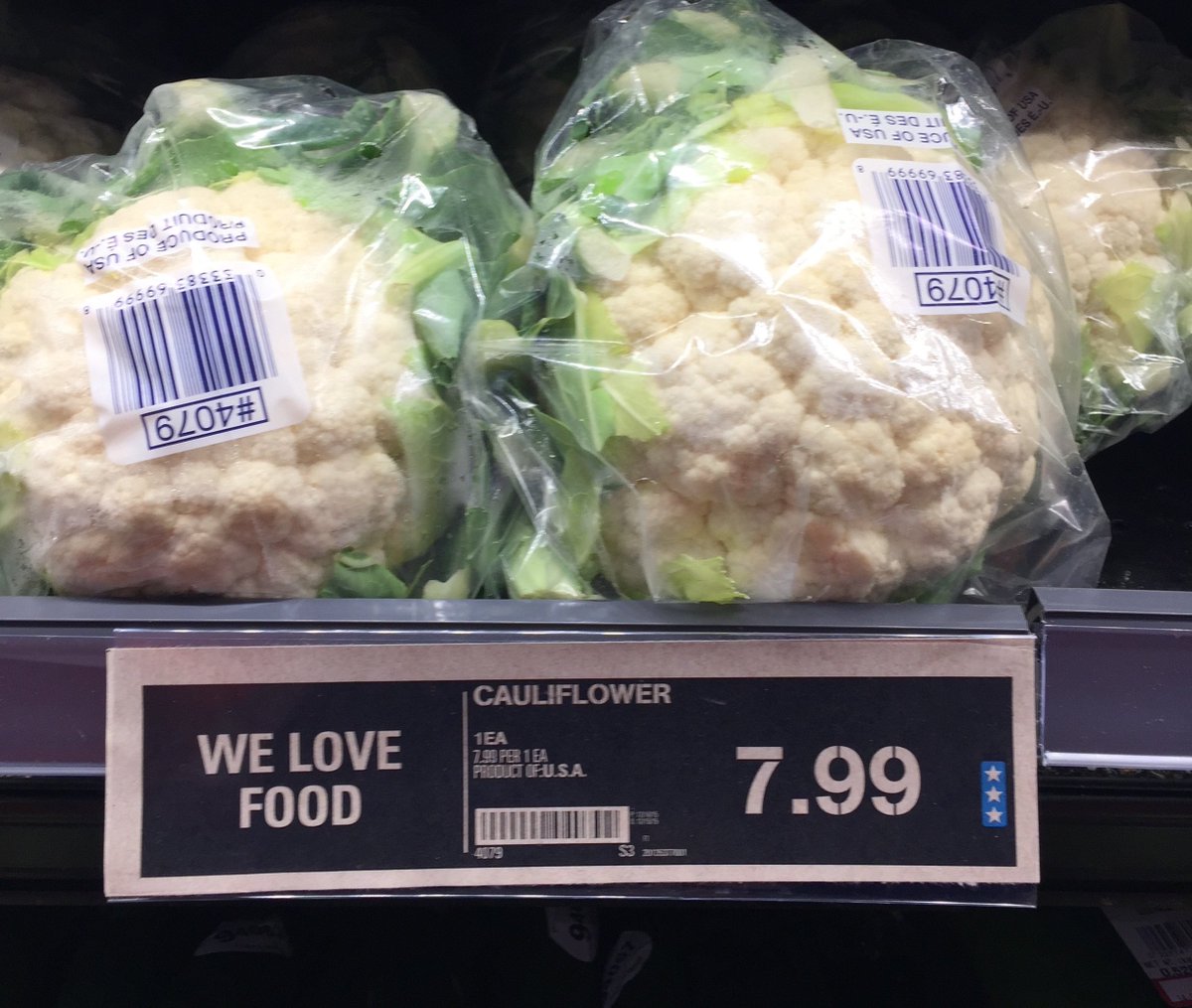
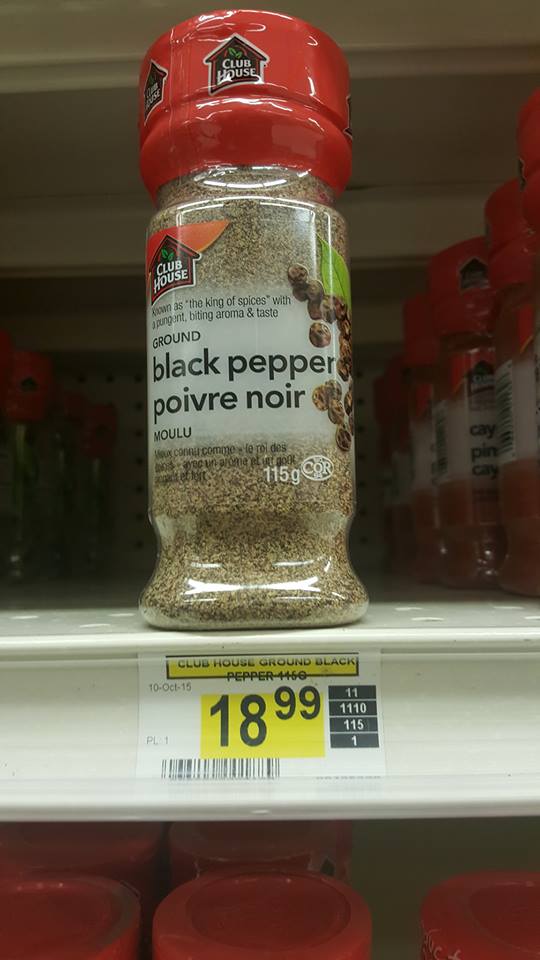
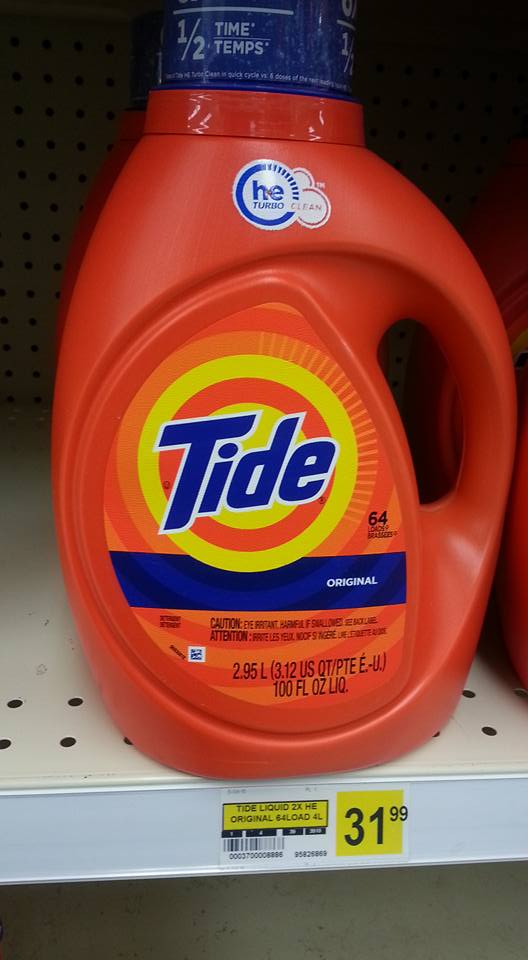
Of course with the layoffs piling up, you can expect more households to fall into the "lower-income" category where they will have to struggle to afford things like $3 cucumbers, $8 cauliflower, and $15 Frosted Flakes. Have a look at the following tweets which underscore just how bad it is in Canada's grocery aisles.
If the CAD $ gets any weaker we might be able to buy groceries with shiny rocks
Three bucks. For a cucumber.
@sladurantaye Heh. Had a similar reaction when I saw the price of cauliflower. Welcome to the future… pic.twitter.com/fxloxyePY3
View image on Twitter
So, the @liberal_party just clawed back $34 M in equalization payments to Nunavut. This is what people pay 4 pepper.
The cost of Tide detergent in Nunavut:


No "Jack Nasty" it's not The Great Depression, but as we highlighted three weeks ago, it is Canada's depression and it's likely to get worse before it gets better. "Last year, fruits and veggies jumped in price between 9.1 and 10.1 per cent, according to an annual report by the Food Institute at the University of Guelph," CBC said on Tuesday. "The study predicts these foods will continue to increase above inflation this year, by up to 4.5 per cent for some items."
If you thought we were being hyperbolic when we suggested that if oil prices don't rise soon, Canadians may well eat themselves to death, consider the following from Diana Bronson, the executive director of Food Secure Canada: 
"Lower- and middle-class people — many who can't find a job that will pay them enough to ensure that they can afford a healthy diet for their families" — also feel the pinch of rising food prices"

"The wrong kind of food is cheap, and the right kind of food is still expensive."
In other words, some now fear that the hardest hit parts of the country may experience a spike in obesity rates as Canadians resort to cheap, unhealthy foods. As we put it, "in Alberta it's 'feast or famine' in the most literal sense of the phrase as those who can still afford to buy food will drown their sorrows in cheap lunch meat and off-brand ice cream while the most hard hit members of society are forced to tap increasingly overwhelmed food banks." 
And the rub is that there's really nothing anyone can do about it.
Were the Bank of Canada to adopt pro-cyclical measures to shore up the loonie, they would risk choking off economic growth just as the crude downturn takes a giant bite out of the economy - no food pun intended.

Thursday, December 31, 2015

"American Capitalism" No Longer Serves Society

Tyler Durden's picture

http://www.zerohedge.com/news/2015-12-30/guest-post-american-capitalism-no-longer-serves-society
Authored by Paul Craig Roberts,
One hundred years ago European civilization, as it had been known, was ending its life in the Great War, later renamed World War I. Millions of soldiers ordered by mindless generals into the hostile arms of barbed wire and machine gun fire had left the armies stalemated in trenches. A reasonable peace could have been reached, but US President Woodrow Wilson kept the carnage going by sending fresh American soldiers to try to turn the tide against Germany in favor of the English and French.
The fresh Amerian machine gun and barbed wire fodder weakened the German position, and an armistance was agreed. The Germans were promised no territorial losses and no reparations if they laid down their arms, which they did only to be betrayed at Versailles. The injustice and stupidity of the Versailles Treaty produced the German hyperinflation, the collapse of the Weimar Republic, and the rise of Hitler.
Hitler’s demands that Germany be put back together from the pieces handed out to France, Belgium, Denmark, Lithuania, Czechoslovakia, and Poland, comprising 13 percent of Germany’s European territory and one-tenth of her population, and a repeat of French and British stupidity that had sired the Great War finished off the remnants of European civilization in World War II.
The United States benefitted greatly from this death. The economy of the United States was left untouched by both world wars, but economies elsewhere were destroyed. This left Washington and the New York banks the arbiters of the world economy. The US dollar replaced British sterling as the world reserve currency and became the foundation of US domination in the second half of the 20th century, a domination limited in its reach only by the Soviet Union.
The Soviet collapse in 1991 removed this constraint from Washington. The result was a burst of American arrogance and hubris that wiped away in over-reach the leadership power that had been handed to the United States. Since the Clinton regime, Washington’s wars have eroded American leadership and replaced stability in the Middle East and North Africa with chaos.
Washington moved in the wrong direction both in the economic and political arenas. In place of diplomacy, Washington used threats and coercion. “Do as you are told or we will bomb you into the stone age,” as Deputy Secretary of State Richard Armitage told President Musharraf of Pakistan. Not content to bully weak countries, Washington threatens poweful countries such as Russia, China, and Iran with economic sanctions and military actions. Consequently, much of the non-Western world is abandoning the US dollar as world currency, and a number of countries are organizing a payments system, World Bank, and IMF of their own. Some NATO members are rethinking their membership in an organization that Washington is herding into conflict with Russia.
China’s unexpectedly rapid rise to power owes much to the greed of American capitalism. Pushed by Wall Street and the lure of “performance bonuses,” US corporate executives brought a halt to rising US living standards by sending high productivity, high value-added jobs abroad where comparable work is paid less. With the jobs went the technology and business knowhow. American capability was given to China. Apple Computer, for example, has not only offshored the jobs but also outsourced its production. Apple does not own the Chinese factories that produce its products.
The savings in US labor costs became corporate profits, executive renumeration, and shareholder capital gains. One consequence was the worsening of the US income distribution and the concentration of income and wealth in few hands. A middle class democracy was transformed into an oligarchy. As former President Jimmy Carter recently said, the US is no longer a democracy; it is an oligarchy.
In exchange for short-term profits and in order to avoid Wall Street threats of takeovers, capitalists gave away the American economy. As manufacturing and tradeable professional skill jobs flowed out of America, real family incomes ceased to grow and declined. The US labor force participation rate fell even as economic recovery was proclaimed. Job gains were limited to lowly paid domestic services, such as retail clerks, waitresses, and bartenders, and part-time jobs replaced full-time jobs. Young people entering the work force find it increasingly difficult to establish an independent existance, with 50 percent of 25-year old Americans living at home with parents.
In an economy driven by consumer and investment spending, the absence of growth in real consumer income means an economy without economic growth. Led by Alan Greenspan, the Federal Reserve in the first years of the 21st century substituted a growth in consumer debt for the missing growth in consumer income in order to keep the economy moving. This could only be a short-term palliative, because the growth of consumer debt is limited by the growth of consumer income.
Another serious mistake was the repeal of financial regulation that had made capitalism functional. The New York Banks were behind this egregious error, and they used their bought-and-paid-for Texas US Senator, whom they rewarded with a 7-figure salary and bank vice chairmanship to open the floodgates to amazing debt leverage and financial fraud with the repeal of Glass-Steagall.
The repeal of Glass-Steagall destroyed the separation of commercial from investment banking. One result was the concentration of banking. Five mega-banks now dominate the American financial scene. Another result was the power that the mega-banks gained over the government of the United States. Today the US Treasury and the Federal Reserve serve only the interests of the mega-banks.
In the United States savers have had no interest on their savings in eight years. Those who saved for their retirement in order to make paltry Social Security benefits liveable have had to draw down their capital, leaving less inheritance for hard-pressed sons, grandsons, daughters and granddaughters.
Washington’s financial policy is forcing families to gradually extinguish themselves. This is “freedom and democracy “ America today.
Among the capitalist themselves and their shills among the libertarian ideologues, who are correct about the abuse of government power but less concerned with the abuse of private power, the capitalist greed that is destroying families and the economy is regarded as the road to progress. By distrusting government regulators of private misbehavior, libertarians provided the cover for the repeal of the financial regulation that made American capitalism functional. Today dysfunctional capitalism rules, thanks to greed and libertarian ideology.
With the demise of the American middle class, which becomes more obvious each day as another ladder of upward mobility is dismantled, the United States becomes a bipolar country consisting of the rich and the poor. The most obvious conclusion is that the failure of American political ledership means instability, leading to a conflict between the haves—the one percent—and the dispossessed—the 99 percent.
The failure of leadership in the United States is not limited to the political arena but is across the board. The time horizon operating in American institutions is very short term. Just as US manufacturers have harmed US demand for their products by moving abroad American jobs and the consumer income associated with the jobs, university administrations are destroying universities. As much as 75 percent of university budgets is devoted to administration. There is a proliferation of provosts, assistant provosts, deans, assistant deans, and czars for every designated infraction of political correctness.
Tenure-track jobs, the bedrock of academic freedom, are disappearing as university administrators turn to adjuncts to teach courses for a few thousand dollars. The decline in tenure-track jobs heralds a decline in enrollments in Ph.D. programs. University enrollments overall are likely to decline. The university experience is eroding at the same time that the financial return to a university education is eroding. Increasingly students graduate into an employment environment that does not produce sufficient income to service their student loans or to form independent households.
Increasingly university research is funded by the Defense Department and by commercial interests and serves those interests. Universities are losing their role as sources of societal critics and reformers. Truth itself is becoming commercialized.
The banking system, which formerly financed business, is increasingly focused on converting as much of the economy as possible into leveraged debt instruments. Even consumer spending is reduced with high credit card interest rate charges. Indebtedness is rising faster than the real production in the economy.
Historically, capitalism was justified on the grounds that it guaranteed the efficient use of society’s resources. Profits were a sign that resources were being used to maximize social welfare, and losses were a sign of inefficient resource use, which was corrected by the firm going out of business. This is no longer the case when the economic policy of a counry serves to protect financial institutions that are “too big to fail” and when profits reflect the relocation abroad of US GDP as a result of jobs offshoring. Clearly, American capitalism no longer serves society, and the worsening distribution of income and wealth prove it.
None of these serious problems will be addressed by the presidential candidates, and no party’s platform will consist of a rescue plan for America. Unbridled greed, short-term in nature, will continue to drive America into the ground.

Monday, October 5, 2015

Deflation Warning: The Next Wave

lighthouse-wave-125301275
The signs of deflation are now flashing all over the globe. In our estimation, the possibility of an associated financial crisis is now dangerously high over the next few months.
As we’ve been saying for a while, our preferred model for how things are going to unfold follows the Ka-Poom! Theory as put out by Erik Janszen of iTulip.com.
That theory states that this epic debt bubble will ultimately burst first by deflation (the “Ka!”) before then exploding (the “Poom!”) in hyperinflation due to additional massive money printing efforts by frightened global central bankers acting in unison.
First an inwards collapse, then an outwards explosion. Ka-Poom!
We’ve been tracking the deflationary impulse for a while, and declared deflation the winner back in July of this year.

A Failed Strategy

What exactly do we mean by deflation?  Back in 2008 the central banks of the developed world, as well as China, had a choice:
  1. admit that prior policies geared towards encouraging borrowing at a faster rate than income growth were a horrible idea, or
  2. double down and push those failed policies even harder
As we all know, they chose option #2. And so here we are, just 8 years later, with nearly $60 trillion in new debt piled on top of the prior mountain — while GDP grew by only $12 trillion over the same time period:
[Note:  Global nominal GDP is projected to be $68.6 trillion in 2015, virtually unchanged from 2013]
In other words, instead of saying to ourselves: Hmmm…. it was probably a terrible idea to pile up debt at 2x the rate of income growth, what the world did instead was to double down on that terrible idea and pile on more debt at 5x the rate(!) of nominal GDP growth.
Talk about not learning from your past mistakes….
At any rate, what all of that money printing, lower interest rates and new debt creation did was force capital over the globe to look for some place to go. Absent any really good and creative ideas, that money primarily chased yield. It piled into risk assets like stocks and junk bonds, often in bubble-like fashion (meaning, in haste), and without proper due diligence.
The only way the central bank “strategy” (and we use that word very loosely) could have worked was if very rapid economic growth emerged to justify the accumulated levels of debt, comprised of both old and new borrowing. Central banks were indeed hoping such growth would materialize and lesson the burden of servicing the interest on all that debt.
But that growth, quite predictably (as forecasted by us among many others), did not emerge.
Perhaps Japan’s experience should have tipped the central bankers off as to why not.  For several decades now, Japan has served as a warning: too much debt is the malady, not the cure.
So here we are.  What are we to make of it all?  It’s our view that the financial markets are important to monitor because they will signal to us when sentiment has shifted, and let us know in advance that events will unfold at a faster pace.
Judging from the market action over the past month, we think that shift has happened. And we’re increasingly concerned that this next ‘correction’ could be pretty rough for a lot of folks.

Bright Red Warning Lights

The global economy is downshifting fast, and there are lots of flashing red warning lights indicating as much.
Doug Noland has captured the emerging market pain caused by the hot money that is now flooding out of those territories, as well as provided a great explanation of the bubble dynamics in play:
The Federal Reserve is flailing and global currency markets are in disarray. Notably, the Brazilian real dropped more than 10% in five sessions, before Thursday’s sharp recovery reversed much of the week’s loss. This week the Colombian peso dropped 3.0%, and the Chilean peso fell 3.1%. The Mexican peso dropped 1.9%.
The Malaysian ringgit sank 4.5% for the week, with the South Korean won down 2.7% and the Indonesia rupiah losing 2.2%. The Singapore dollar fell 1.8%. The South African rand sank 4.4% and the Turkish lira fell 1.4%.
Notably, market dislocation was not limited to EM. The Norwegian krone was hit for 4.4%, and the Swedish krona lost 2.0%. The British pound declined 2.3%. The Australian dollar also lost 2.3%.
The global Bubble is bursting – hence financial conditions are tightening. Bubbles never provide a convenient time to tighten monetary policy. Best practices would require central bankers to tighten early before Bubble Dynamics take firm hold. Central bankers instead nurture and accommodate Bubble excess. It ensures a policy dead end.
As the unfolding EM crisis gathered further momentum this week, the transmission mechanism to the U.S. has begun to clearly show itself. While “full retreat” may be a little too strong at this point, the global leveraged speculating community is backpedaling. Biotech stocks suffered double-digit losses this week, as a significant Bubble deflates in earnest. It’s also worth noting that the broader market underperformed.
(Source)
What does it mean when we see currencies in retreat across the globe?  It means that the hot, speculator money is rushing out of weaker economies and back towards the stronger center.  This is consistent with a liquidity crisis, one where all the borrowed money used to spark all those heady asset gains and falling yields on the way out do the exact opposite on the way back.
And Doug is exactly right – there’s never a good time to pop a bubble.  So the central bankers just sit, paralyzed, afraid to even raise rates by a token amount for fear that the daisy-chain of global bubbles will burst as a result. They needn’t fear: the bubbles will burst no matter what the Fed, et al., does.
A credit default swap (CDS) is a bit of insurance you can buy if you own a bond and are worried that the issuer may default on it.  In a stable climate, the cost of that insurance (measured in percentage points above the stated yield on that debt) is pretty flat. It’s usually close to the yield of the bond in question.
So you might have to pay 1% to 2% (i.e. 100 to 200 basis points) above the yield on, say a Brazilian ten year bond, to insure it against a default.  As things begin to break down and become less certain, that cost will rise.
Now take a look at this chart of recent emerging market CDS ‘spreads':
See those CDS ‘spreads’ blowing out to the upside? That’s the sort of thing I was tracking in 2008 that gave me a clear, early warning that things were about to fall apart.  While these levels are not (yet) flashing the same level of danger that we are seeing in the CDS paper for Glencore (which is almost certain to go bankrupt now), or for US shale drillers (tons of bankruptcies coming there, too), these are pretty serious warning signs to see in sovereign debt.
Why would the sovereign debt of Russia, Turkey, Brazil, and Malaysia be spiking right now?  Because the hot money is flooding out of those countries. There’s now an elevated risk that they may default on their bonds in the future.
These emerging market countries are being squeezed from every direction. But the worst pain is being experience by those that borrowed heavily in dollars (or other stable currencies).  From the WSJ (Sept 29), we see the magnitude of the predicament for companies located in EM nations:
Developing-country firms quadrupled their borrowing from around $4 trillion in 2004 to well over $18 trillion last year, with China accounting for a major share.
Now, prospects in industrializing economies are weakening fast even as the U.S. Federal Reserve is getting set to raise interest rates for the first time in nearly a decade, a move that will raise borrowing costs around the world.
The burden of 26% larger average corporate debt ratios and higher interest rates come as commodity prices plummet, a staple export for many emerging-market economies.
Compounding problems, many firms borrowed heavily in dollars. As the greenback surges against the value of local currency revenues, it makes repaying those loans increasingly difficult.
(Source)
So the afflicted countries are going to see vastly weaker exports, plunging currencies, and their local corporations unable to pay off dollar-denominated loans — on borrowing that ballooned from $4 trillion in 2004 to over $18 trillion just 11 years later.  It’s an amazing statistic, one of many fostered by a cluster of central banks that know everything about blowing bubbles but nothing about ending them.
The punch line from the above article is this: That massive debt build-up means it is “vital” for authorities to be increasingly vigilant, especially to threats to systemically important companies and the firms they have links to, including banks and other financial firms, the IMF said.”
Decoded, that means that $18 trillion is a big number. If even a small portion of that goes into default, it could easily drag down whole swaths of the developed world’s financial corporate structure.  A systemic crisis that would begin on the edge but rapidly spread to the center.
Well, based on the DDBAX ETF which holds bonds priced in local currencies, we can get a sense of the pain those EM companies are feeling which have dollar denominated loans, but conduct business in their local currency:
Ouch!  Based on the above chart, the past year has been painful indeed for those emerging market corporations and governments. No sign of a bottom yet either.

Not So Fast There….

One so-called ‘bright spot’ in the world economy is the US, which supposedly is doing better than everyone else.  As you know, I consider US GDP statistics to be nearly useless because of all the statistical tricks and gimmicks that are now deployed (such as now counting ‘intangibles’ to go along with Owner Occupied Rent which records the price value of people not paying themselves rent, etc.,) to make things look better than they are.
So I’m having trouble believing that the US economy is doing well when our major trading partner to the south is struggling so much due to a huge drop drop in exports:
Mexico factory exports slump by most in over 6-1/2 years in Aug
Sept 25, 2015
(Reuters) – Mexico’s factory-made exports slumped in August by the most in more than 6-1/2 years after uneven growth in the first half of 2015, data showed on Friday, while consumer imports rose.
Manufactured exports sank 7.2 percent in August compared with July, falling back after two months of gains, the national statistics agency said in a statement. It was the biggest month-on-month drop since December 2008, data showed.
Mexico exports mostly manufactured goods like cars and televisions and about three-quarters are sent to the United States.
(Source)
It’s hard to imagine that the US economy is doing fine when a major trading partner who exports 75% of its finished product to the US is experiencing a deep export slump.
But it’s not just Mexico that’s seeing a big decline in export activity:
For the first seven months of 2015, U.S. exports dropped 5.6% to $895.7 billion. The value of South Korean exports shrank a revised 14.9% in August from a year earlier, the sharpest fall in six years, as shipments to China dropped. Chinese imports in August fell 13.8% in dollar terms from a year earlier, after an 8.1% decrease in July.
(Source – WSJ)
If this keeps up, 2015 will see the worst global trade performance since…wait for it…2008.  For the US, 2015 will be the first year that exports have declined since the financial crisis.  Ditto for a number of other countries.
Beyond exports, the surveys of US manufacturing and service sector activity are also flashing recession warning signs.  In fact, the manufacturing survey has only been this low in the past during prior recessions. Maybe this time is different?
On the plus side for the US: reasonably robust housing activity, low initial claims for unemployment, and growing income and expenditures. But the data for some of these is suspect (nearly 100 million working-age adults are not counted in the workforce), and in other areas, not robust enough to hang too many hopes on.
Add it all up, and there are a number of signs that not only is the US economy is far from robust, it may even be teetering on the verge of a recession. But the global economic landscape is decidedly tilted towards contraction, not expansion.
Why is all this important?  Because seeing these signs early enough gives us a better chance to mentally, financially, and physically prepare for the next shock.  The press does a very good job of constantly painting everything in a rosy light, and that’s fine, but it’s not very helpful if it also misleads.
Lots of people are woefully unprepared for what’s coming next. For many it will be a shock.  Not because they couldn’t see it coming years in advance and made their own mental and financial adjustments on their own terms, but because they wouldn’t.  Preferring to avoid an unpleasant truth they put it out of sight and out of mind, hoping that somehow things would work out in their favor.
In Part 2: From Deflation To Hyperinflation, we detail out the likeliest progression of the unfolding deflationary rout and the inevitable tsunami of money printing that the central banks will respond with, unleashing the final hyperinflationary chapter.

Wednesday, September 2, 2015

Oxygen & Markets - Why The Collapse Is Coming

Tyler Durden's picture

http://www.zerohedge.com/news/2015-09-02/oxygen-markets-why-collapse-coming
Via EconomicNoise.com,
Analogies or metaphors are often effective in explaining complex issues. In this instance, oxygen and markets are used to do so. Markets are anthropomorphized, requiring them to have oxygen to survive.
Oxygen for financial markets comes from two sources — the economy and the Federal Reserve:

Economic Oxygen and Markets

The strength of an economy creates wealth. Without a strong economy no nation grows wealthy or stays wealthy. Asset valuations are ultimately grounded in the economy, at least in the long run. Rising employment, standards of living and financial asset prices accompany strong economies. Without these pre-requisites, long-term wealth cannot be created.
Today the relationship between economic oxygen and markets is unsustainable. The economy is not and has not been providing enought oxygen to sustain current levels.
Enter the paramedics we refer to as the Federal Reserve. They show up with their oxygen tanks to resuscitate the patient. The Fed injected enormous amounts of liquidity into the system with two initial purposes — bail out the banking system and stimulate the economy. Large amounts of funds offset banking system insolvency (at least for the time being). But liquidity is at best a temporary stay for a sick economy, despite Keynesian protests to the contrary. However these injections of emergency oxygen revived financial asset markets.

Federal Reserve Oxygen and Markets

Regardless of what one may think about the Fed, it can have positive and negative effects. The Fed failed in re-starting the economy. Economic growth and well-being is a function of individual economic actors and the incentives and disincentives they confront. When times are judged propitious, economic actors take advantage. When they are not expansion activity declines, sometimes reversing.
There is little the Federal Reserve can do to change outlooks other than to mislead economic actors by altering price signals. To the extent that the Fed is successful, the success is based on deceit. Market participants acting on false data are acting against their long-term interests. Eventually they realize that the decisions made were based on unsustainable and false signals. This misguidance only adds to the original problems and necessitates an even bigger correction once it commences. Ludwig von Mises observed these conditions as follows:
There is no means of avoiding the final collapse of a boom brought about by credit (debt) expansion. The alternative is only whether the crisis should come sooner as the result of a voluntary abandonment of further credit (debt) expansion, or later as a final and total catastrophe of the currency system involved.
For markets, the Federal Reserve is akin to an emergency visit from a paramedic. The oxygen provided can revive the patient but it cannot heal the patient. Markets have had their long and steep rise because of the Fed oxygen and the inflation effect which was directed into financial rather than real assets. However, the paramedic has been unable to make the patient breath unattended. The patient is still unable to survive on his own.

Our Current Oxidized Condition

The Fed failed in its attempts to juice the economy. Offsetting their efforts was the avalanche of bad regulations, uncertainty about new ones, fear of inevitable tax increases and the massive overhang of debt. Businesses cut back on investing and hiring. Many bought back outstanding stock to make performance look better. ObamaCare turned many full-time workers into part-time workers. An expansion in welfare benefits prevented depression-era food lines but also, for the lessers skilled workers, made welfare a career option.
In short, nothing the Federal Reserve did or could do could offset the awful fiscal and regulatory environment.
That was not the case in financial markets. The money that poured into the banking system added to their reserves. Little of it went toward new loans. The rest had to go someplace. Instead of going into real assets and jobs, it went into financial assets, especially equity markets. Financial repression was a deliberate Fed policy to further drive money into stocks. By reducing interest rates to zero, people had less incentive to pay down their debts. Lower interest rates serve to drive equities even higher based on traditional valuation models. Even retirees were forced into equities in search for income.

What Comes Next?

Economies around the world are in shambles. All central banks and banking systems are overextended. So too are political entities. The geo-political situation is worse than any time since World War II.
Any of the aforementioned conditions is enough to cause a major correction in financial asset pricing, particularly when these assets have been driven artificially beyond what most consider normal valuations. Central banks are out of bullets that can be effective. Arguably they ran out five years ago. The US economy cannot recover until taxes and regulations are addressed and incentives for growth and investing return. In the meantime more companies have either given up on the US or are hedging their bets by moving all or parts of their operations out of the country.
The only thing that government can offer at this point is doctored economic statistics and claims that the economy is just fine. The Federal Reserve can still print money, but that cannot help the economy or offset bad fiscal policy. Even the printing of money has limits in terms of its effectiveness. Eventually devaluation of currency and inflation of prices is the result.
There is nothing that government or the Federal Reserve can do to remedy overvalued financial assets. Printing more money may support financial asset prices for a while longer but this behavior has long-term bad consequences. The ultimate determinant of wealth — the economy — is not being addressed. Political ideology has turned on free markets and they are key to wealth creation and getting out of this mess.
Markets are coming down and probably dramatically. Ultimately that conclusion holds regardless of what the Fed does. If the Fed continues to inflate, nominal asset prices may continue up for a while but they will not keep pace with inflation. Alternative stores of remaining wealth will be sought, places which will protect against the hyperinflation warned about by Mises.
There is no way to escape the hangover created by the Fed binge. That doesn’t mean the government will not try. Such efforts will succeed in making matters worse, at least in the long-term.
The nature of politics is to kick the can down the road. We are nearly out of road. The scam is likely at its end regardless of what is tried. The piper is coming for what he is owed.