Showing posts with label Crude oil. Show all posts

Wednesday, August 3, 2016

5 Things To Focus On

Via Fasanara Capital's Francesco Filia,
Oil failed to conquer and retain 50$ and is now falling off visibly again: both Brent and WTI lost ~20% since mid-June highs. This is in stark contrast to the price action in Base Metals, as they push through new ytd highs despite weakness in the global economy. We also keep a close look to the USD, which has historically been well correlated to Oil prices. We continue to expect Oil to move erratically, alongside a downward trend, which will eventually take it into new lows. We also expect Base Metals to eventually give in too and remain at levels in line with a depressed economy entangled in structural deflationary trends.
BRENT is currently playing with 200days moving average
During the last 5 years, at times Brent prices cut through 50d, 100d and 200d MAs, a sudden drop followed.


OIL and BASE METALS decoupling, again, while moving in opposite directions
Base metals have closed their underperformance gap vs Oil, which opened up in May, as they moved higher in absolute terms while Oil fell. All this happened despite red-flashing signs of slowdown in the global economy.


Brent (inverted) vs USD Index
Historically, the USD has been nicely correlated to Oil prices. Lower levels for Oil normally coincided with higher level of USD (alongside various fundamental drivers). This is not the case at present, as markets assess the case for Oil to drop more violently from here. The dollar may experience a leg up if Brent prices keep falling.


US Earnings and US Sales confirm their downward trend: behind the smoke and mirrors of headlines beats on skilfully lowered guidance - a trend we got accustomed to in recent past, US earnings’ and Sales keep deteriorating, having been in a downward trend for the last 5 quarters. Valuations are over-stretched as a consequence of (i) lower bond yields distorting equity vs bonds valuations, and (ii) generous 2017 earnings’ upgrade expectations. Equity markets' consensus for 2017 seems then to entail that (i) bonds are wrong in factoring in a depressed economy (although that is the reason for the permanent Central Bank monetary expansion itself), and(ii) escape velocity of GDP is just around the corner. We expect such expectations to be misplaced (see May 2016 Investment Outlook), complacency to gradually fade (see Article: S&P the last castle to fall). We expect extreme valuations to give in, and cheaper US equities. To us, it is more a question of 'when', rather than 'if'.
US Earnings and avg. Sales are trending lower
Earnings/Sales moving lower but the market simply postpones the robust recovery to come, by expanding multiples to historically-silly levels. Just minor delays on the loose schedule of a strong US economy, or markets in denial?


S&P implied volatility moved to new historical lows in recent pastlower implied volatility can only exacerbate the virulence of any downside movements, as and when they occur, for it seduces weak-hands bond-type investors into equity markets, whose mandate is not drafted for stomaching equity-type volatility bouts, resulting in hot money flows at such inflection points when the market heads lower. Low historical volatility also entices Risk Parity strategies, algorithms / CTAs, and more leverage, ready to evaporate quickly once that low volatility gives in. Low volatility is a value trap: it is not so much a reason for an equity sell-off, but rather it may affect its shape and tempo, should a sell-off occur, as we expect.
US Banks have decoupled from US rates: while EU and Japanese banks have closely followed the path of interest rates / the slope of the yield curve, US Banks have decoupled markedly from them. We expect this divergence to correct in the following weeks, as US Banks move lower more than rates, or move higher less than rates. Our case for the EU Banking sector to hit new lows in the near future (see Article) - on grounds of profitability more than solvency - can be extended to US banks too. We look at this as a top value opportunity for the months to come.
US Banks have decoupled from US yields
The three following charts shows US, EU and Japanese Banks against their respective government bond yields. Comparing bank equities to the slope of the yield curve leads into similar conclusions.
While EU and JPN banks have closely followed the rates, US banks diverged from the level of interest rates. We may expect this to correct in the following weeks


Japanese yields experienced their largest 4-days sell-off since 2003the 10yr JBG yield rose ~23 bps since the BoJ meeting’s disappointment of last Thursday, where Kuroda ruled out the possibility of additional rate cuts. We follow closely the moves on JGBs, to see if they may lead to a 2015-type Bunds riot or 2013 l-type Taper Tantrum moment, while only temporarily so.
10yr JGB’s yield experience its largest 4 days rise since 2003
This is a trend to be closely followed, since it may lead to a larger sell-offs in US Treasuries and EU Bonds, although temporarily, as it was the case in April/May 2015.


*  *  *

Wednesday, June 1, 2016

Stunning Satellite Images Of The Global Tanker Oil Glut

One week ago, we showed the latest MarineTraffic update of the unprecedented congestion of crude oil tankers located off the coast of Singapore, together with an extended analysis of what is causing this and what are the implications.


Today, we'll spare readers the ongoing analysis - which hasn't changed - and instead present the following dramatic satellite images just released from Reuters, showing "huge traffic jams of tankers which have formed around the world with some 200 million barrels of oil either waiting to be loaded or delivered as ports struggle to cope with record volumes in perhaps the most visible sign of the global oil glut."

Almost all of the over 660 Very Large Crude Carriers (VLCCs), the largest tankers in use to transport seaborne oil, are used to ship crude between the Middle East and Asia’s consumption hubs around India and the Far East. The map above shows all of these super tankers in operation on April 11.

Waiting in line: Each orange symbol below represents a parked large crude tanker. Ships in transit are not shown.
The exporters


Importers


SINGAPORE AND SOUTHERN MALAYSIA
Almost all tankers going to the Far East pass through Singapore, the world’s petrol station for tankers (bunker fuels) and also a global refinery and ship maintenance hub. In a reminder that the oil glut is still far from over, there are now dozens of large tankers full of unsold crude anchored offshore. New vessels are even hired as floating storage as excess supply needs storage and facilities operate at or near capacity.

A broader view of congestion.
Here's another look at Singapore. This time showing moving and stationary vessels of all types. Tankers here have to jostle for space in congested waters around the port


How busy can it get?
To see just how congested some shipping lanes can become, look no further than the world's busiest port, Shanghai. Hundreds of bulk carriers form highways up and down the Yangtze River to dock at various locations.

Tuesday, May 31, 2016

The Fascinating Story Of How The Petrodollar Was Born And Lived In Secrecy For Over 40 Years

Tyler Durden's picture

http://www.zerohedge.com/news/2016-05-31/secret-story-how-saudi-petrodollar-deal-was-born
For decades, the story of Saudi Arabia recycling petrodollars, i.e., funding the US deficit by buying US Treasuries with proceeds of its crude oil sales (mostly to the US), while the US sweetened the deal by providing the Saudis with military equipment and supplies, remained entirely in the conspiracy realm, with no confirmation or official statement from the US Treasury department.
Now, that particular "theory" becomes the latest fact, thanks to a fascinating story by Bloomberg which gives the background and details of secret meeting between then-US Treasury secretary William Simon and his deputy, Gerry Parsky, and members of the Saudi ruling elite, and lays out the history of how the petrodollar was born.
Here is the background:
It was July 1974. A steady predawn drizzle had given way to overcast skies when William Simon, newly appointed U.S. Treasury secretary, and his deputy, Gerry Parsky, stepped onto an 8 a.m. flight from Andrews Air Force Base. On board, the mood was tense. That year, the oil crisis had hit home. An embargo by OPEC’s Arab nations—payback for U.S. military aid to the Israelis during the Yom Kippur War—quadrupled oil prices. Inflation soared, the stock market crashed, and the U.S. economy was in a tailspin.

Officially, Simon’s two-week trip was billed as a tour of economic diplomacy across Europe and the Middle East, full of the customary meet-and-greets and evening banquets. But the real mission, kept in strict confidence within President Richard Nixon’s inner circle, would take place during a four-day layover in the coastal city of Jeddah, Saudi Arabia.

The goal: neutralize crude oil as an economic weapon and find a way to persuade a hostile kingdom to finance America’s widening deficit with its newfound petrodollar wealth. And according to Parsky, Nixon made clear there was simply no coming back empty-handed. Failure would not only jeopardize America’s financial health but could also give the Soviet Union an opening to make further inroads into the Arab world.

It “wasn’t a question of whether it could be done or it couldn’t be done,” said Parsky, 73, one of the few officials with Simon during the Saudi talks
As noted above, the framework of the required deal was simple: the U.S. would buy oil from Saudi Arabia and provide the kingdom military aid and equipment. In return, the Saudis would plow billions of their petrodollar revenue back into Treasuries and finance America’s spending.
The man leading the US negotiation, US Treasury Secretary William Simon, had just done a stint as Nixon’s energy czar, and "seemed ill-suited for such delicate diplomacy. Before being tapped by Nixon, the chain-smoking New Jersey native ran the vaunted Treasuries desk at Salomon Brothers. To career bureaucrats, the brash Wall Street bond trader—who once compared himself to Genghis Khan—had a temper and an outsize ego that was painfully out of step in Washington. Just a week before setting foot in Saudi Arabia, Simon publicly lambasted the Shah of Iran, a close regional ally at the time, calling him a “nut.”
But Simon, better than anyone else, understood the appeal of U.S. government debt and how to sell the Saudis on the idea that America was the safest place to park their petrodollars. With that knowledge, the administration hatched an unprecedented do-or-die plan that would come to influence just about every aspect of U.S.-Saudi relations over the next four decades (Simon died in 2000 at the age of 72).
In the beginning it wasn't easy: "it took several discreet follow-up meetings to iron out all the details, Parsky said."
But at the end of months of negotiations, Bloomberg writes, there remained one small, yet crucial, catch: King Faisal bin Abdulaziz Al Saud demanded the country’s Treasury purchases stay “strictly secret,” according to a diplomatic cable obtained by Bloomberg from the National Archives database."
The secret remains... until May 16 when the US Treasury for the first time ever revealed the full extent of Saudi TSY holdings.


Bloomberg adds that with a handful of Treasury and Federal Reserve officials, the secret was kept for more than four decades—until now. "In response to a Freedom-of-Information-Act request submitted by Bloomberg News, the Treasury broke out Saudi Arabia’s holdings for the first time this month after “concluding that it was consistent with transparency and the law to disclose the data,” according to spokeswoman Whitney Smith. The $117 billion trove makes the kingdom one of America’s largest foreign creditors."
The TIC data released later that day confirmed the FOIA response.
To be sure, as we commented in mid-May, it is very likely that the Treasury report is incomplete, and that the Saudis also own hundreds of billions in Treasurys held in custody with offshore trading centers such as Euroclear. After all, the current tally represents just 20 percent of its $587 billion of foreign reserves, well below the two-thirds that central banks typically keep in dollar assets
What’s more, the commitment to the decades-old policy of “interdependence” between the U.S. and Saudi Arabia, which arose from Simon’s debt deal and ultimately bound together two nations that share few common values, is showing signs of fraying. America has taken tentative steps toward a rapprochement with Iran, highlighted by President Barack Obama’s landmark nuclear deal last year. The U.S. shale boom has also made America far less reliant on Saudi oil.
Needless to say, the real total notional amount of Saudi holdings will eventually become known, especially if the middle-eastern nation follows through with its threat of liquidating some or all of them.  What is more notable, however, is that with the first disclosure of this data since the birth of the petrodollar, something appears to have changed:
What’s more, the commitment to the decades-old policy of “interdependence” between the U.S. and Saudi Arabia, which arose from Simon’s debt deal and ultimately bound together two nations that share few common values, is showing signs of fraying. America has taken tentative steps toward a rapprochement with Iran, highlighted by President Barack Obama’s landmark nuclear deal last year. The U.S. shale boom has also made America far less reliant on Saudi oil.

“Buying bonds and all that was a strategy to recycle petrodollars back into the U.S.,” said David Ottaway, a Middle East fellow at the Woodrow Wilson International Center in Washington. But politically, “it’s always been an ambiguous, constrained relationship.”
One thing that certainly changed is that in a world where central banks are ravenously buying up each others' (and their own) debt, the need for Petrodollar recyclers such as Saudi Arabia is no longer there. But that was not always the case:
[B]ack in 1974, forging that relationship (and the secrecy that it required) was a no-brainer, according to Parsky, who is now chairman of Aurora Capital Group, a private equity firm in Los Angeles. Many of America’s allies, including the U.K. and Japan, were also deeply dependent on Saudi oil and quietly vying to get the kingdom to reinvest money back into their own economies.

"Everyone—in the U.S., France, Britain, Japan—was trying to get their fingers in the Saudis’ pockets,” said Gordon S. Brown, an economic officer with the State Department at the U.S. embassy in Riyadh from 1976 to 1978. For the Saudis, politics played a big role in their insistence that all Treasury investments remain anonymous.
America's reliance on Saudi Arabia to fund its deficit - and obtain a cheap price for oil - meant that the kingdom would be granted Platinum status in every form of interaction with the US.
Tensions still flared 10 months after the Yom Kippur War, and throughout the Arab world, there was plenty of animosity toward the U.S. for its support of Israel. According to diplomatic cables, King Faisal’s biggest fear was the perception Saudi oil money would, “directly or indirectly,” end up in the hands of its biggest enemy in the form of additional U.S. assistance.

Treasury officials solved the dilemma by letting the Saudis in through the back door. In the first of many special arrangements, the U.S. allowed Saudi Arabia to bypass the normal competitive bidding process for buying Treasuries by creating “add-ons.” Those sales, which were excluded from the official auction totals, hid all traces of Saudi Arabia’s presence in the U.S. government debt market.

“When I arrived at the embassy, I was told by people there that this is Treasury’s business,” Brown said. “It was all handled very privately.”

* * *
Another exception was carved out for Saudi Arabia when the Treasury started releasing monthly country-by-country breakdowns of U.S. debt ownership. Instead of disclosing Saudi Arabia’s holdings, the Treasury grouped them with 14 other nations, such as Kuwait, the United Arab Emirates and Nigeria, under the generic heading “oil exporters”—a practice that continued for 41 years.
Meanwhile, Saudi Arabia continued buying: by 1977, Saudi Arabia had accumulated about 20 percent of all Treasuries held abroad, according to The Hidden Hand of American Hegemony: Petrodollar Recycling and International Markets by Columbia University’s David Spiro.

The deal led to assorted headaches: "an internal memo, dated October 1976, detailed how the U.S. inadvertently raised far more than the $800 million it intended to borrow at auction. At the time, two unidentified central banks used add-ons to buy an additional $400 million of Treasuries each. In the end, one bank was awarded its portion a day late to keep the U.S. from exceeding the limit.
Most of these maneuvers and hiccups were swept under the rug, and top Treasury officials went to great lengths to preserve the status quo and protect their Middle East allies as scrutiny of America’s biggest creditors increased.

Over the years, the Treasury repeatedly turned to the International Investment and Trade in Services Survey Act of 1976—which shields individuals in countries where Treasuries are narrowly held—as its first line of defense.

The strategy continued even after the Government Accountability Office, in a 1979 investigation, found “no statistical or legal basis” for the blackout. The GAO didn’t have power to force the Treasury to turn over the data, but it concluded the U.S. “made special commitments of financial confidentiality to Saudi Arabia” and possibly other OPEC nations.

Simon, who had by then returned to Wall Street, acknowledged in congressional testimony that “regional reporting was the only way in which Saudi Arabia would agree” to invest using the add-on system.
Ultimately, Saudi dominance in the US Treasury market meant they were untouchable. "It was clear the Treasury people weren’t going to cooperate at all,” said Stephen McSpadden, a former counsel to the congressional subcommittee that pressed for the GAO inquiries. “I’d been at the subcommittee for 17 years, and I’d never seen anything like that."
Today, Parsky says the secret arrangement with the Saudis should have been dismantled years ago and was surprised the Treasury kept it in place for so long. But even so, he has no regrets. Doing the deal “was a positive for America”, he says cited by Bloomberg.
And with that the story of how the Petrodollar was born is now public information, something which Saudi Arabia may not be too happy with. For the sake of the US, it better have its ducks in order because the release of this story simply means that the US Treasury is confident it will no longer have a strategic need for its long-time Saudi partner. The Fed, which has implicitly stepped into the Saudi role, better not disappoint.

In Its First Ever Bond Sale, A Cash-Starved Saudi Arabia Is Looking To Issue $15 Billion

Tyler Durden's picture


http://www.zerohedge.com/news/2016-05-31/its-first-ever-bond-sale-cash-starved-saudi-arabia-looking-issue-15-billion
Last week the bond market was stunned by the unprecedented demand for sovereign paper issued by the middle-eastern nation of Qatar, which announced it would issue $9 billion in Eurobonds (in three maturities), more than double what had been originally expected by the market, and well below the total demand for Qatar sovereign paper: according to Reuters, the issue was massively oversubscribed, with over $23 billion in soft orders.
Some were concerned that this massive bond issuance would "reprice" the local bond market and put on hold any new incremental issuance by Qatar's neighbors, most notably Saudi Arabia, which has been very vocal about its own intentions to sell debt in the coming weeks and which, in light of its surging budget deficit ballooning as a result of persistently low oil prices, desperately needs an outside cash infusion.
We said that these concerns were materially overblown as Qatar was merely the latest example of the scramble for yield in the current "risk on" environment, and if anything Qatar's sale demonstrated that any attempt by Saudi Arabia to fund its budget needs would be ridiculously easy.
Sure enough, this was confirmed just days later when earlier today Bloomberg reported that Saudi Arabia is considering the sale of as much as $15 billion of bonds this year, "encouraged by investor demand for Qatar’s recent issue" citing people with knowledge of the matter said.
The details: Saudi Arabia is weighing a sale of $10 billion to $15 billion after the end of Ramadan in July, adding no final decision has been made and the discussions are still at a preliminary stage. It would be Saudi Arabia’s first bond sale in international capital markets. We think that absent another global market swoon, the final notional amount issued will be well greater than "only" $15 billion.
While Saudi Arabia is still sitting on nearly $600 billion in foreign-exchange reserves, the country has burned through $140 billion in reserves since the end of 2014. And the IMF warned the Saudis could eventually run out of cash.
This is not Saudi Arabia's first recent approach to capital markets: in April the kingdom raised a $10 billion loan from a group of banks, its first loan in 25 years. Last year, the Saudis tapped the local bond market for the first time in eight years, raising at least $4 billion.
But this would be the first time Saudi Arabia has issued international bonds. And it will be a whopper.
CNN also quotes John Sfakianakis, a former official in Saudi Arabia's Ministry of Finance who said the sale would likely take place over the next several months. "There is a need to cover the fiscal gap," said Sfakianakis, who is currently director of economic research at the Gulf Research Center in Riyadh, Saudi Arabia. "It's better for this money to come from other sources than reserve assets because as they get depleted that places a bigger risk over the medium to long-term."
Bloomberg adds that Saudi Arabia has invited banks to arrange the bond sale. The country expects to issue a “significant” amount, the people said at the time, without giving more details.
Saudi Arabia's move is hardly a surprise: the country is merely taking advantage of an unprecedented bond bubble inflated by global central banks, where $9.9 trillion in sovereign paper is now trading with negative yields.
As a result, governments in the six-nation Gulf Cooperation Council, which includes the two-biggest Arab economies of Saudi Arabia and the United Arab Emirates, are turning to public markets to raise funds after a plunge in oil prices led to higher budget deficits. Qatar last week attracted $23 billion in orders for its $9 billion sale, the biggest-ever bond issue from the Middle East. Abu Dhabi raised $5 billion from the sale of five and 10 year securities in April.
Some more:
The debut bond will follow the country’s first loan in at least 15 years as it seeks to fill a budget hole estimated at about $100 billion this year. Saudi Arabia sealed a $10 billion facility in April, three people with knowledge of the matter said at the time.

The country also hired HSBC Holdings Plc banker Fahad Al Saif to start a debt management office that will be responsible for the international bond sale, two separate people with knowledge of the matter said this week. Al Saif joined the Ministry of Finance on an open-ended secondment from HSBC’s Saudi British Bank, the people said.

The country is undergoing its biggest-ever economic shakeup, led by Deputy Crown Prince Mohammed bin Salman, as it prepares for the post-oil era following the plunge in crude prices that started in 2014. One of the government’s biggest challenges will be navigating the worst economic slowdown since the global financial crisis as authorities cut spending to plug a budget deficit that reached about 15 percent of gross domestic product in 2015.
The biggest irony here is that while Saudi Arabia has been implicitly fighting the Fed (and other central banks), who have generously funded the US shale industry with hundreds of billions in junk bonds over the past decade, the same industry of "high cost producers" that Saudi Arabia is eager to put out of business indefinitely, it is the same Fed that is coming to Saudi's rescue now by stoking demand for any deficit-funding paper Saudi Arabia may and will issue.
The good news for Saudi Arabia is that the new debt funds will be promptly used to address gaping fiscal holes in the Saudi economy: Moody's recently warned of the social impact of policy reforms in Saudi Arabia and other Gulf countries where "governments are under pressure to continue redistributing oil revenues to their populations to avoid economic-related civil unrest."
But what the inevitable record bond issuance out of Saudi Arabia means, is that the deflationary pressure on oil will persist, as the largest crude oil exporter will not need to rationalize oil supply for the foreseeable future by cutting supply to boost prices. Instead, Saudi can simply fund its budget shortfall by appealing to the same bond investors who are keeping shale afloat, while maintaining its strategy of keeping the oil market continuously oversupplied.

Thursday, May 26, 2016

The Anger Of The Unprivileged Is Rising Globally

Tyler Durden's picture

http://www.zerohedge.com/news/2016-05-26/anger-unprivileged-rising-globally
Submitted by Charles Hugh-Smith of OfTwoMinds blog,
Privilege serves the same purpose--benefiting the few at the expense of the many--regardless of the system's ideological labels.
The righteous disgust with the status quo that spawned the broad-based campaigns of Bernie Sanders and Donald Trump is not unique to the U.S. Globally, those disenfranchised by the status quo--the unprivileged, or in Peggy Noonan's phrase, the unprotected-- are starting to express their discontent in the streets, in social media and in elections.
Why are people around the world angry? It's obvious to everyone in the unprivileged classes and a mystery to the "we're doing just fine here, what's your problem?" privileged classes: The system is rigged to benefit the protected few and marginalize the unprotected many.
The problems are not just political; they are structural. As I outline in my new book, Why Our Status Quo Failed and Is Beyond Reform, there are two structural engines of disorder at the heart of the system:
1. Automation, software and the forces of globalization are disrupting jobs and wages everywhere.
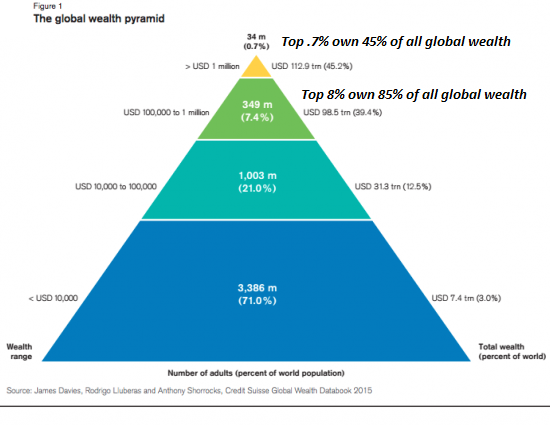
2. Centralized hierarchies and the forces of financialization have extended the power of privilege globally so the few are benefiting at the expense of the many, as revealed in this chart of global wealth:

The growing concentration of wealth and power in the privileged elites is evidenced by the fact that 8% of the world's populace owns 85% of its wealth. What is driving this increasing concentration of wealth and power? In a word: Privilege.
To understand rising wealth/income disparity and the increasing concentration of wealth, we must first understand the dual nature of privilege. Just as power comes in two flavors--hard power (military power) and soft power (exporting cultural wares and values)--so does privilege.
Hard-wired privileges are those that grant the holder of an office or position in the hierarchy specific rights to accumulate income, wealth and political power that are not available to the unprivileged. Officials in corrupt countries gain the right to collect fees from citizens as a direct result of their official position. Financiers in the U.S. have access to unlimited credit at low rates (free money for financiers) as a direct result of their position atop the financial pyramid.
Field-effect ("soft") privileges are defined by class and access rather than by the hard-wired authority of office or position in a formal hierarchy. Field-effect privileges include: enhanced access to Ivy League higher education granted to children of alumni and major donors; membership in exclusive clubs; access to "old boy" networks of alumni and partners, and so on.
Field-effect ("soft") privileges are one primary reason why the income of the top 20% has risen from 40% of total U.S. income to 51% in the past two decades. In a rapidly financializing, globalized economy, those with access to higher education, class connections and abundant credit have built-in advantages over those without all three advantages, which are self-reinforcing.
(I use the term field-effect to suggest that these privileges act like electrical fields, affecting all within their range, often without the privileged even being aware of their privileges. Hence the upper-middle penchant for overlooking all their class advantages and attributing their success to hard work. Well, yes, but that's not the entire story: we must also measure the often-subtle benefits of field-effect privileges.)
Over time, these privileges accrue substantial income and wealth: the 10% difference between 40% and 50% of total household income is $1.4 trillion per year. In the past decade, that means the top 20% has gained about $12 trillion more in income than it would have if its share of total household income had remained at 40%.
(Income data source: Income and Poverty in the United States: 2014)
Having an Ivy League (or equivalent top-tier public university) diploma is a plus, but it doesn't provide a wealth of self-reinforcing privileges unless it is combined with upper-class connections and networks and easy access to credit (to scoop up productive assets on the cheap). Together, these field-effect privileges create synergies that concentrate wealth and power.
Interestingly, privilege serves the same purpose--benefiting the few at the expense of the many--regardless of the system's ideological labels. Socialist, Communist and free-market elites loot their populaces and national wealth with equal gusto. Those who came to do good and stayed to do well first accumulate privileges, which they then leverage into wealth and power.
The grievances of Chinese workers robbed of their wages, Greek small-business owners burdened by ever-rising taxes, downsized corporate warriors in the U.S., etc. may appear to be different, but beneath the surface these grievances all arise from one source: unearned privileges that benefit the few at the expense of the many.
The only way to eliminate social and economic injustice is to eliminate privilege, which is the heart of my book A Radically Beneficial World.

Oil Market Snapshots — Will oil supply glut continue, what will happen with oil prices?

By David Haggith, the Great Recession Blog.
By fernost (Self-photographed) [Public domain], via Wikimedia Commons
Here are several quick looks at the oil supply glut and whether it is likely to worsen, hold the same, or improve during the summer of 2016.

First, a picture of the cost of the oil supply glut

This snapshot of a major oil company epitomizes what is happening in most oil companies, big and small:
Shell’s job losses are about to match Facebook’s total payroll. Royal Dutch Shell just announced it will eliminate another 2,200 jobs, mostly due to the oil glut price crisis. This will bring Shell’s total job losses by the end of 2016 to 12,500 people who have been terminated.
“These are tough times for our industry,” Paul Goodfellow, Shell’s VP in the UK and Ireland, said in a statement. “We have to take further difficult decisions to ensure Shell remains competitive through the current prolonged downturn.” (Oilprice.com)
Shell has also said it will dispose of $30 billion in assets to raise cash in order to make it through the crisis. (To the extent Shell is feeling the bite, so are all the rest.)

Persian Gulf bank oil oversupply engulfs banks in region

Now a quick pic of how the oil supply glut is hitting banks in far parts of the world: More than 65% of banks in the Persian Gulf reported an increase in defaults in the first quarter of the year.

“The days of double-digit profits and expansion plans are gone,” said one United Arab Emirates-based banker. “Now, it’s all about single-digit growth and controlling costs as bad loans are going to keep getting higher. It’s the new normal.” (NewsMax)
Banks, in other words, are rolling back their profit hopes and settling into the idea that oil prices in the current low range are the new norm.

The oversupply of oil means ports are swamped with oil tankers

This picture of one port tells a major story: Tankers are running circles around the Chinese port of Qingdao. One ship has been carving circles in the water for twenty days, waiting for a chance to offload at any one of several “teapot” (small) refineries in the region.
China is the world’s second largest consumer of oil. Lack of available storage capacity on land is slowing down the rate at which refiners can take in crude, as is a reduction in the profitability of refineries, which is causing them to back off on refining.
“Weakening margins are likely to have a stronger impact on independent refineries in China and this will lead to lower crude imports,” said Hong Sung Ki, a senior analyst at Samsung Futures Inc. in Seoul. “That will result in a downward revision for China demand and this will inevitably have a negative impact on oil prices.” (Bloomberg)
Again, a picture that looks likely to worsen over the summer.
Another reason China is awash in oil along its shores is that many OPEC nations took out loans from China that were repayable in oil, not dollars. These nations are now repaying their loans in oil to get more loans in money because they have a lot more oil than money. That’s causing more oil to flow to China than it can use. Yet another reason for oil oversupply in China is that Saudi Arabia, Russia and Iran are all caught up in a oil price war over market share in Asia. That, too, is not going away.

Oil supply looks constipated off the coast of Singapore, too.

“I’ve been coming to Singapore once a year for the last 15 years, and flying in I have never seen the waters so full of idle tankers,” said a senior European oil trader a day after arriving in the city-state…. “The volumes of oil stored at sea in South East Asia – predominantly Singapore and Malaysia – appear to have increased significantly,” said Erik Broekhuizen, Global Manager of tanker research and consultancy at New York-based shipping brokerage Poten & Partners…. “Prices are unlikely to rise too much as the specter of glut is still there….” (Reuters)
Tanker traffic, alone, in Singapore looks like this right now:
Oil supply glut visualized in oil tanker traffic off Singapore.
… like rush hour on the freeway or like swimmers in the ocean at Waikiki. Add in all the other kinds of vessels, and it looks like you could walk across the straits, leaping from vessel to vessel between any two points of land. The number of tankers that are serving as offshore oil storage in the area is increasing at a rate of 10% per week.

Who is creating this tanker backup and does it have anything to do with jacking up oil prices?

Glencore, has built up a massive inventory stake in the Brent market … which it is holding for offshore storage in its tankers in hopes of pushing the price.… As Reuters details … Glencore has built up one of the largest positions in part of the Brent crude market which acts as a benchmark for global oil prices since the start of the year…. According to Reuters Glencore is quietly cornering the Brent market, by holding more than a third of the 37 BFOE cargoes loading in June and is expected to acquire more. (Zero Hedge)
So, yes, this is, at least in part, according to Reuters, a “rigged” market, pardon the oil industry pun. Oil prices are being manipulated upward by some serious attempts to corner the market.

Is the backup of oil tankers a sign of oil oversupply in other parts of the world?

Yes, the backup of oil tankers is getting bad in other ports of the world. Here’s a snapshot from Norway. One new Great Recession Blog reader today writes,
Outside my window I can see 6 supply/stand-by ships from the oil industry without assigment! And they are everywere along the Norwegian coast! So Norway is in no way doing as great they like to show off to the world. Its going downhill…..

But is this backup of oil tankers financially insane?

The need to store oil is so strong that traders are calling up banks to finance storage charters despite there being no profit in keeping fuel in tankers at current rates. “We are receiving unusually high amounts of queries to finance storage charters,” said a senior oil trade financier with a major bank in Asia. “These queries come from traders fully aware that they will not make a profit from storing the oil. This isn’t a trade play, it’s the oil market looking for places to store unsold fuel,” he added…. A trade financier at a European bank said there had been a “spike in interest from oil traders to finance their storage needs” since the start of the year as onshore facilities were almost full…. “There is clearly still far too much physical crude going around for the glut to be over,” said the European oil trader after flying in to Singapore. “And the paper market seems blissfully unaware of it.” (Reuters)
Ah well (sighs). I’ve been trying to make them aware of it! But people don’t see what they don’t want to see, even when an oil slick is floating right past them.

Where is oversupply likely to do to oil prices this summer?

A quick view from one major oil trading company. SCS Commodities Corp says that the “latest rally has come to an end” and reports:
Record inventory gluts at storage hubs from Cushing to Rotterdam exacerbated by supply gains from core OPEC members … [even as ] Canada’s wildfires disrupted output by more than expected this week…. The median estimate for lost Canadian barrels … is still about 1m bpd…. Cushing stocks and overall U.S. inventories both built to new record-highs with help from a flood of imports into the U.S. Gulf Coast. Overseas, Libya’s Hariga port loaded a 650k bbl tanker for the first time since April following the completion of a deal between Tripoli and eastern Libyans. (Oilprice.com)
Canada’s temporary interruption could go away as quickly as Libya’s did, causing the supply glut in the US to build at a quicker pace. US refiners also still have 10,000,000 barrels of crude in floating storage in the Houston area. And US oil rig count finally ended eight consecutive weeks of free fall, holding flat last week. Nigeria’s production, which helped pick up oil prices when it fell due to attacks on Nigeria’s pipelines, is already returning toward normal.
Saudi output is expected to increase this summer, just as Iran has fully entered an Asian price war with Saudi Arabia in Asia:
Iran has regained almost half of its pre-sanctions European market, and exported 1.7 million bpd to Asia in April. Last week, Iran introduced a discount on the June contract for its heavy crude going to Asia, just a few days after Saudi Arabia announced a price increase for its own June contract for the continent. With the discount, Iranian oil will be noticeably cheaper for Asian clients than both Saudi and Iraqi crude. (Oilprice.com)
Nevertheless, the inventory build in the US dropped more than expected in the latest report today, bringing oil prices to a seven-month high. In spite of that, however, oil failed again to push through $50, which has been looking more and more like a firm ceiling.
Of course, if the Fed does what it cannot do but says that it will and raises interest rates, that will raise the value of the dollar, making petrodollar-priced oil more expensive for most of the world, which would likely suppress global demand a little, countering the normal summer rise in gasoline demand around much of the world.
So, all is fragile and continues to hang in the balance daily, but the factors that have reduced the glut appear to be abating, while some of those that could increase it are growing.
For more reading on the topic, see my previous article “The OPEC Epoch is Over” if you haven’t read it yet.

Monday, May 23, 2016

De-Petrodollar-ization Esclates - China Imports Record Amount Of Russian Oil In April

Tyler Durden's picture

http://www.zerohedge.com/news/2016-05-23/de-petrodollar-ization-esclates-china-imports-record-amount-russian-oil-april
We have reported for years that Russia and China have been doing everything they can to displace the use (and influence) of the US dollar.
The US of course, either oblivious or too arrogant to care, has continued to bring Russia and China together by annoying both equally with its incessant meddling. Recall that recently both China and Russia have had to warn the US about its insistence on flying reconnaissance planes too close to their borders.
Of course, as the US has been playing geopolitical games, China and Russia have been working on strengthening their relationship with one another. At the end of 2015, China had become Russia's biggest oil customer, and as of April, Russian oil shipments to China hit a record high. Russia has also surpassed Saudi Arabia as the biggest crude exporter to China.

Russia Today has more
Beijing has ramped up imports of Russian oil by 52.4 percent last month compared to a year earlier. China's General Administration of Customs calculated a record 4.81 million tons.

In March, China bought 4.65 million tons of oil from Russia.

Russia, Saudi Arabia and Angola were China’s three major oil suppliers last month.

April imports from Saudi Arabia fell by 22 percent year-on-year to 4.12 million tons. In March, China imported 3.98 million tons of oil from the country.

China increased year-on-year oil imports from Angola last month by 39 percent to 3.98 million tons. Imports from Iran in April fell by 5.1 percent yoy to 2.76 million tons.

An International Energy Agency report showed that at the end of 2015 Russia overtook Saudi Arabia as the biggest crude exporter to China.
Russian exports to China have doubled over the past five years, and supply is expected to continue to be strong. Transneft's Vice-President Sergey Andropov said that China is expected to import 27 million tons of Russian crude this year via the Eastern Siberia-Pacific Ocean (ESPO) pipeline. The volume underscores the significance of contracts signed  in 2009 by Rosneft, Transneft, and China National Petroleum Corporation to have Russia supply oil to China through the ESPO.
Russian exports to China have more than doubled over the past five years, up by 550,000 barrels a day. Moscow and Beijing have significantly increased energy cooperation, with a wide range of multibillion dollar projects.

Russian oil transport monopoly Transneft’s Vice-President Sergey Andropov said in March that China is ready to import 27 million tons of Russian crude this year via the Eastern Siberia-Pacific Ocean (ESPO) pipeline. Supplies to China through the ESPO pipeline started in 2011 after Rosneft, Transneft and China National Petroleum Corporation (CNPC) signed contracts two years earlier. Currently five million tons of crude are supplied through the pipeline annually, and this is expected to rise to 15 million tons a year.

Experts say Chinese imports of Russian oil are likely to stay high over the coming years due to long-term crude supply contracts and rising demand from the world's second biggest oil consumer.
* * *
There is an underlying theme here that cannot be ignored.
Whatever the US has been focusing on, whether it's commissioning $4.4 billion warships, wargaming in the name of "regional stability", or arguing over LGBT rights and confederate flags, it is neither productive, nor helping its global economic standing. One day when the USD is no longer the reserve currency, and all of the games the Federal Reserve plays to allow fiscal policy to go unchecked are no longer an option, we suspect that it will wish it had done things quite differently.

Friday, May 20, 2016

Something Stunning Is Taking Place Off The Coast Of Singapore

http://www.zerohedge.com/news/2016-05-20/something-stunning-taking-place-coast-singapore

Tyler Durden's picture


   "I've been coming to Singapore once a year for the last 15 years, and flying in I have never seen the waters so full of idle tankers,"
   - Senior European oil trader a day after arriving in the city-state.

Back in November, when the world-record crude inventory glut was still in its early innings, we showed what we then thought was a disturbing image of dozens of oil tankers on anchor near the US oil hub of Galveston, TX, unwilling to unload their cargo at what the owners of the oil thought was too low prices.

* * *
Little did we know that just a few months later this seemingly unprecedented sight of clustered VLCCs would be a daily occurrence as oil producers, concerned by Cushing hitting its operating capacity, would take advantage of oil curve contango to store their oil offshore indefinitely.
However, while the "parking lot" off Galveston has since normalized, something shocking has emerged and continued to grow half way around the world, just off the coat of Singapore. This.


The red dots show ships either at anchor or barely moving, either oil tankers or cargo, which have made the Straits of Malacca, one of the world's most important shipping lanes which carries about a quarter of all seaborne oil primarily from the Persian Gulf headed to China, into a "bumper to bumper" parking lots of ships with tens of millions of barrels in combustible cargo.
it is also the topic of the latest Reuters expose on the historic physical crude oil glut which continues to build behind the scenes, and which so far has proven totally immune to dissipation as a result of the sharp increase in oil prices over the past three months.
Indeed, as Reuters notes, prices for oil futures have jumped by almost a quarter since April, lifted by severe supply disruptions caused by triggers such as Canadian wildfires, acts of sabotage in Nigeria, and civil war in Libya. And yet flying into Singapore, the oil trading hub for the world's biggest consumer region, Asia, reveals another picture: that a global glut that pulled down prices by over 70 percent between 2014 and early 2016 is nowhere near over, and that financial traders betting on higher crude oil futures may be in for a surprise from the physical market.
"I've been coming to Singapore once a year for the last 15 years, and flying in I have never seen the waters so full of idle tankers," said a senior European oil trader a day after arriving in the city-state.
As Asia's main physical oil trading hub, the number of parked tankers sitting off Singapore's coast or in nearby Malaysian waters is seen by many as a gauge of the industry's health.  Judging by this, oil markets are still sickly: a fleet of 40 supertankers is currently anchored in the region's coastal waters for use as floating storage facilities.
The glut is not only constant but is rising with every passing week: the tankers are filled with 47.7 million barrels of oil, mostly crude, up 10 percent from the previous week, according to newly collected freight data in Thomson Reuters Eikon.
What is curious is that the glut is persisting despite seemingly relentless demand by China. Earlier today Bloomberg calculated that 74 VLCCs are bound for China, the highest in 3 weeks, and up from 69 a week earlier. Still the inert glut off Singapore is enough oil to satisfy five working days of Chinese demand, suggesting recent supply disruptions - which have mostly occurred in the Americas, Africa and Europe - have done little to tighten supply in Asia as Middle East producers keep output near record volumes in a bid to win market share.
"The volumes of oil stored at sea in South East Asia - predominantly Singapore and Malaysia - appear to have increased significantly," said Erik Broekhuizen, Global Manager of tanker research and consultancy at New York-based shipping brokerage Poten & Partners. "The current volumes are the highest for at least the last five years."
What is taking place in the oil market appears to be merely the latest disconnect between the paper and physical markets, something quite familiar to precious metals traders in recent years. As Reuters notes, many participants in the physical market dispute recent notes from financial players like Goldman Sachs that forecast a further rise in crude futures. "There has been quite a bit of bullishness from hedge funds in recent months, betting on higher oil prices, and even the analysts at Goldman Sachs have recently turned more bullish on oil prices," said Ralph Leszczynski, head of research at ship broker Banchero Costa.
"Prices are unlikely to rise too much as the specter of glut is still there," he said. However, Leszczynski may be discounting just how powerful algo-driven momentum can be if, or especially when, it is completely disconnected from fundamentals.
* * *
While the sight of tankers at anchor is nothing new, this time something has changed.
Unlike before, when the contango of the oil curve made storing oil offshore profitable, this is no longer the case as contago-funded offshore profits have all but disappeared.
As a reminder, storing oil on ships can be profitable when prices for future delivery of crude are higher than in spot market, a term structure known as contango, as long as future prices are high enough to offset tanker charter costs. However, with the one-year contango for Brent futures collapsing from $7.60 per barrel in January to just $4, far below the $10 that traders say is currently required to make floating storage financially attractive, suddenly parking oil offshore leads to storage losses. The same goes for WTI. 
At a charter cost of more than $40,000 a day for a Very Large Crude Carrier (VLCC) that can store 2 million barrels, the contango is nowhere near steep enough to make it profitable to store oil on tankers for sale at a later date.


This has led to a dramatic development in the oil market: debt-funded storage. Reuters writes that the need to store oil is so strong that traders are calling up banks to finance storage charters despite there being no profit in keeping fuel in tankers at current rates.
"We are receiving unusually high amounts of queries to finance storage charters," said a senior oil trade financier with a major bank in Asia. "These queries come from traders fully aware that they will not make a profit from storing the oil. This isn't a trade play, it's the oil market looking for places to store unsold fuel," he added.
So why are the traders doing this?
Simple: they hope that oil prices will rise fast and soon enough where the capital appreciation in crude will more than make up for the incurrence of new debt which will be repaid with proceeds from "selling higher." The risk, of course, is that oil does not rise and should prices tumble, traders will not only have a capital loss on their hands, but be forced to deal with the excess leverage they had hoped would promptly disappear.
To be sure, while we have warned in the past about the danger of offshore storage becoming unprofitable and being brought back onto the land market, in the process launching a liquidation dumping scramble, it has never been this bad. A trade financier at a European bank said there had been a "spike in interest from oil traders to finance their storage needs" since the start of the year as onshore facilities were almost full.
Still, with record amounts of oil stored offshore and with the profit on such storage now shifting into a loss, many are scratching their heads how much longer this imbalanced, and bank funded, situation can persist.
"Floating storage is unattractive economically, given the current term structure in crude futures," BMI Research said this week. Despite this, BMI said that "the volume of crude in floating storage has risen sharply in recent months," adding that the phenomenon was global, with floating storage up 19.5 percent between the first quarters of 2015 and 2016.
"There is clearly still far too much physical crude going around for the glut to be over," said the European oil trader after flying in to Singapore.
The trader's conclusion: "And the paper market seems blissfully unaware of it."
He is right... for now. Because all that will take for even the algos to give up their relentless upward momentum, is for some of these tens of millions of barrels to finally come onshore, which now that contango is no longer profitable, is just a matter of time.
In the meantime, just keep track of the unprecedented parking lot of ships off the coast of Singapore: the larger it gets, the more violent the price drop will be once banks say "no more" to funding money losing charters.

Thursday, May 19, 2016

Malvinas War 2.0? - Independent Audit Confirms The Falkland Islands Are A Billion-Barrel Basin

Tyler Durden's picture

http://www.zerohedge.com/news/2016-05-19/malvinas-war-20-independent-audit-confirms-falkland-islands-are-billion-barrel-basin
Submitted by Charles Kennedy via OilPrice.com,
Falklands oil and gas producer Rockhopper Exploration Plc has announced that its net contingent oil reserves have doubled to more than 300 million barrels, and independent experts are now eyeing this as nearly billion-barrel basin.
Rockhopper owns more than 50 percent of two oilfields, Sea Lion and Isobel Elaine, which are now estimated to hold 747 million barrels of oil and gas reserves, according to the independent audit that was prepared by ERCE.
Rockhopper has a 24 percent interest in the wells, but this will rise to 64 percent once it completes its merger with Falkland Oil & Gas.

Falkland Oil Basins. Image courtesy: Rockhopper Exploration
Last November, Rockhopper agreed to buy Falkland Oil & Gas in an all-share deal that values the explorer at $87 million.
Argentinian politicians have long promised to throw a spanner in the works. Under British control since 1841, the Falklands Islands, which Argentina calls the Malvinas, have long been in dispute between the two sides.
But there are some indications that Argentina may take a softer stance on this territorial dispute now that a new president is at the helm.
Rockhopper’s takeover of Falkland Oil & Gas was announced within a day of pro-oil Mauricio Macri’s presidential election victory in Argentina, and he has indicated he would adopt a milder attitude with the UK over the Falklands.
His predecessor, former president Cristina Fernandez de Kirchner, had used the Falklands as a campaign tool and had threatened to seize US$156 million in property and bank holdings of oil companies drilling on the islands. Among the targets were Rockhopper and Falkland Oil & Gas.
Foreign Ministry officials in Buenos Aires have said the British energy companies would face prosecution for what they called illegal operations in Argentine territory.
A March ruling by the UN Commission on the Limits of the Continental Shelf could worsen the dispute. The commission expanded Argentinian maritime territory in the South Atlantic Ocean by 35 percent to include the disputed Falkland Islands and beyond.

Thursday, May 5, 2016

Why Saudi Arabia Is Suddenly in Serious Trouble

A major report is forcing Saudi Arabia to consider a future without its lifeblood: oil.
(Love and Blessings to the Common People of Saudi)
Photo Credit: Fedor Selivanov / Shutterstock.com
Saudi Arabia is in serious trouble. The Binladin Group, the kingdom’s largest construction company, has terminated the employment of fifty thousand foreign workers. They have been issued exit visas, which they have refused to honor. These workers will not leave without being paid back wages. Angry with their employer, some of the workers set fire to seven of the company’s buses.
Unrest is on the cards in the Kingdom. In April, King Salman fired the water and electricity minister Abdullah al-Hasin, who had come under criticism for high water rates, new rules over the digging of wells and cuts in energy subsidies. The restructured ministry was to save the Kingdom $30 billion—precious money for an exchequer that is spluttering from low oil prices. Eighty-six percent of Saudis say that they want the water and electricity subsidies to continue. They are not prepared to let these disappear. They see this as their right. Why, they say, should an energy rich country not provide almost free energy for its subjects?
When King Salman took over last year, he inherited a kingdom in dire straits.  Saudi Arabia’s Treasury relies upon oil sales for over ninety percent of its revenue. The population does not pay tax, so the only way to raise funds is from oil sales. As oil prices fell from $100/ barrel to $30/barrel, oil revenues for the Kingdom collapsed. Saudi Arabia lost $390 billion in anticipated oil profits last year. Its budget deficit came to $100 billion—much higher than it has been in memory. For the first time since 1991, Saudi Arabia turned to the world of private finance to raise $10 billion for a five-year loan. That this country, with a vast sovereign wealth fund, needs to borrow money to cover its bills is an indication of its fragile fundamentals.
What does a country do when it enters a period of crisis? It calls the consulting firm McKinsey. That is precisely what Saudi Arabia did. McKinsey sent its crack analysts to the Kingdom. They returned—in December 2015—with Saudi Arabia Without Oil: The Investment and Productivity Transformation. This report could have been written without a site visit. It carries all the clichés of neo-liberalism: transform the economy from a government-led to a market-led one, cut subsidies and transfer payments, and sell government assets to finance the transition. There is not one hint of the peculiar political economy and cultural context of Saudi Arabia. The report calls for a cut in Saudi Arabia’s public-sector employment and a cut in its three million low-wage foreign workers. But the entire political economy of Saudi Arabia and the culture of its Saudi subjects are reliant upon state employment for the subjects and low-wage subservience from the guest workers. To change these two pillars calls into question the survival of the monarchy. A Saudi Arabia without oil, McKinsey should have honestly said, is a Saudi Arabia without a monarchy.
What would the McKinsey transformation produce? “A productivity-led transformation,” wrote the eager analysts, “could enable Saudi Arabia to again double its [Gross Domestic Product] and create as many as six million new Saudi jobs by 2030.”
The King’s son, Mohammed Bin Salman (MbS), took McKinsey at its word. He then copied and pasted the report in his own Saudi Vision 2030. Little of Prince MbS’s statement differs from the McKinsey proposal. The eagerness of the Prince shows his lack of experience. It is unlikely that he has read Naomi Klein’s The Shock Doctrine, a full-scale assault on the idea of economic transformation. Even more unlikely that he has read Duff McDonald’s The Firm, an evisceration of McKinsey’s smoke and mirrors model. To base an entire country’s future on a McKinsey report seems reckless. But then Prince MbS has a streak of recklessness in him. He led the Saudi war on Yemen – and that has not turned out well at all. The peace talks over that war being held in Kuwait remain stalled. Saudi Arabia made almost no gains in Yemen. Should the man who led Saudi Arabia into humiliating failure in Yemen now be in charge of its economic transformation?
Saudi Arabia is a monarchy. Prince MbS has the King’s favor. His talents are measured by the King and not by the people. They will have to tolerate his shenanigans with the economy just as they have had to tolerate his failed war on Yemen.
What is Prince MbS’s Saudi Vision 2030? Despite the attempts to create some stability in the oil market, there is no indication that oil prices would be raised to safe levels anytime soon. If oil remains below $50/barrel, Saudi Arabia has to revise its own economic project. That means that Saudi Arabia will have to find new ways to create revenues. To shift from an oil-dependent economy to an industrial-tourism-finance economy will require a massive dose of investment. To secure that investment, Saudi Arabia plans to sell a small stake of its state-owned oil firm—ARAMCO. The plan is to raise at least $2 trillion from that sale and from the sale of other state assets. This money will bolster the depleted Sovereign Wealth Fund, which might otherwise run dry by 2017-2020.
The enhanced Sovereign Wealth Fund will be used to develop new industrial sectors such as petrochemicals, manufacturing at the medium scale and finance as well as tourism. Foreigners will be allowed to own property in the Kingdom and entrepreneurial activity will be encouraged by the state. How does all this happen by 2020 – the date proposed by Prince MbS—or even by 2030—the name of the Prince’s plan? Will Saudi Arabia be able to rapidly transform its population from being satisfied with receipts of oil revenues to being workers in an insecure market environment? History suggests a long period of dissatisfaction amongst the public during this kind of enormous transition. Can the Saudi royal family manage the level of anger and humiliation that this change will evoke?
The IMF’s director of Middle East and Central Asia—Masood Ahmed—is sure that the transition will work just fine. In fact, Ahmed believes that the McKinsey plan is perhaps a little too modest. What the Saudis need to do, said Ahmed, is to attract more private investment to help the diversification plan. Where will this private investment come from? Perhaps from China, which has already signed a large ($2.48 billion) nuclear deal with Saudi Arabia. The kingdom is China’s largest oil supplier. China’s Sinopec, PetroChina and Yunnan Yuntianhua work closely with ARAMCO to build oil refineries in the kingdom and on the Chinese coastline. Chinese construction companies are building the Haramain railroad that will eventually link Mecca and Madina. China is the largest trading partner of Saudi Arabia. The Binladin group will mothball some of its cranes, but that does not mean that cranes will hang over the skyline of the kingdom. Chinese construction firms are prepared to build the new infrastructural base in Saudi Arabia. Washington, if it is paying attention, must see the drift of its old ally—either into social chaos or into the Chinese orbit. No other alternative exists.

Vijay Prashad is professor of international studies at Trinity College in Hartford, Connecticut. He is the author of 18 books, including Arab Spring, Libyan Winter (AK Press, 2012), The Poorer Nations: A Possible History of the Global South (Verso, 2013) and the forthcoming The Death of a Nation and the Future of the Arab Revolution (University of California Press, 2016). His columns appear at AlterNet every Wednesday.

Monday, April 25, 2016

The Real Reason Saudi Arabia Killed Doha

Tyler Durden's picture

http://www.zerohedge.com/news/2016-04-25/real-reason-saudi-arabia-killed-doha
Submitted by Rakesh Upadhyay via OilPrice.com,
Saudi Arabia single-handedly scuttled the Doha meeting, knowing all along that Iran would not participate, with a valid reason. The Russians and others agreed to proceed without Iran, planning to include them at a later date. So if everything was known beforehand, why did the Saudi’s pour cold water on the aspirations of the remaining members, risking its alienation from Russia and the OPEC community?
Was it simply Saudi enmity toward Iran? Not exactly. Upon closer scrutiny, we can find the Saudi masterstroke behind Doha.
It is well known that Saudi Arabia is heavily dependent on oil revenues, and that those revenues are on the brink of collapse. They have sought financial aid from various international agencies to support their dwindling economy. But the trick here is to determine exactly how desperate the Saudis are. Certainly not as desperate as other countries.
Angola has recently sought support from the International Monetary Fund (IMF). Venezuela’s struggles started well before crude prices dropped to 12-year lows and is fighting to avoid a disaster. Azerbaijan has also approached the IMF and the World Bank for help.
Nigeria is also seeking the World Bank’s support. Without external support, Iraq will find it difficult to continue its war against the Islamic State (ISIS). Lower oil prices continue to make matters worse, and Iraqi Kurdistan has taken advantage of the situation and works towards independence and beefing up its unilateral export plans. Ecuador is the worst hit, and now the devastating earthquake has crippled the nation. It will need help from the IMF, the World Bank and a few other lenders to reconstruct.
After a 3.5 percent contraction in 2015, Russia’s gross domestic product will take a further 1.5 percent hit in 2016, as projected by the Central Bank. Kazakhstan is faring no better. Its growth shrunk to 1.2 percent in 2015 from an impressive 6 percent in 2013 and is expected to slow down further to 0.1 percent in 2016.
Most of the participating nations are financially ruined. They have to undertake drastic measures to reduce their dependence on oil. Disaster is imminent.
The Saudis are definitely not immune, even if on the surface disaster isn’t obvious. Saudi Arabia is burning through its reserves at a record pace, but at the same time, it can sustain low prices for the next three to four years. Not only that, it can increase its production by another 2 million barrels per day, according to the International Energy Agency (IEA), if more funds are required.
But why the drastic action on the eve of the meeting disregarding the plight of the participating member nations?
Though the real reason for the about face is known only in the secretive halls of the royal palace, consider this:
Saudi Arabia has held the mantle as the world leader in oil for decades, and has largely enjoyed veto power on all things concerning oil. However, since 2014, it has waged a losing battle against the U.S. shale oil drillers, who are phenomenally more resilient than anyone expected.
The first signs of the shale producer vulnerability are now, however, becoming visible, with oil production in the U.S. dropping below 9 million barrels a day—the lowest in 18 months. If oil prices continue to remain below $40 per barrel, a few more shale oil producers will fall by the wayside.
But if crude prices rise above $50 per barrel, the shale producers have made their intentions clear, that they will be back in business.
If Saudi Arabia had accepted the deal, oil prices would have jumped to $50/b, giving the shale oil industry a new lease on life. Shale producers would have started pumping at a frantic pace, increasing the glut and pushing oil prices back down.
This whole exercise would permanently dent Saudi Arabia’s reputation as the leading oil player. The baton would have passed to the shale oil drillers—an event that the Saudis simply cannot allow.
With Iran’s return post-sanctions, Saudi Arabia’s leadership in OPEC is under threat. By scuttling the meeting, Saudi Arabia has asserted its supremacy and reminded the OPEC nations just how much power the Saudis still wield.
The Saudis have ascertained their importance in the new cartel as well. They have not let Russia assume sole leadership, they have ensured that they remain at the centre of any decision making in the new cartel.
By voicing their objection to the meeting, Saudi Arabia has attempted to win back the leadership baton from American shale producers. It has shown the OPEC members that it still is the leader, thereby blocking Iran from challenging it, and finally, it has maintained its importance in the new bigger cartel, demanding an equal say in the scheme of things alongside Russia.
The Doha washout was the Saudi masterstroke to regain its importance. However, with many OPEC nations on the edge of collapse, the next OPEC meeting will confirm if the Saudi move was indeed a masterstroke, or if it was just a short-lived power grab.

Wednesday, April 20, 2016

What Everyone Is Missing In The Oil Supply/Demand Conundrum

Tyler Durden's picture

http://www.zerohedge.com/news/2016-04-19/what-everyone-missing-oil-supplydemand-conundrum
Submitted by Gail Tverberg via Our Finite World blog,
Oil production can be confusing because there are various “pieces” that may or may not be included. In this analysis, I look at oil production of the United States broadly (including crude oil, natural gas plant liquids, and biofuels), because this is the way oil consumption is defined. I also provide some thoughts regarding the direction of future world oil prices.
Figure 1. US Liquid Fuels production by month based on EIA March 2016 Monthly Energy Review Reports.
US oil production clearly flattened out in 2015. If we look at changes relative to the same month, one-year prior, we see that as of December 2014, growth was very high, increasing by 18.0% relative to the prior year.
Figure 2. US Liquids Growth Over 12 Months Prior based on EIA's March 2016 Monthly Energy Review.
Figure 2. US Liquids Growth Over 12 Months Prior based on EIA’s March 2016 Monthly Energy Review.
By December 2015, growth over the prior year finally turned slightly negative, with production for the month down 0.2% relative to one year prior. It should be noted that in the above charts, amounts are on an “energy produced” or “British Thermal Units” (Btu) basis. Using this approach, ethanol and natural gas liquids get less credit than they would using a barrels-per-day approach. This reflects the fact that these products are less energy-dense.
Figure 3 shows the trend in month-by-month production.
Figure 3. US total liquids production since January 2013, based on EIA's March 2016 Monthly Energy Review.
Figure 3. US total liquids production since January 2013, based on EIA’s March 2016 Monthly Energy Review.
The high month for production was April 2015, and production has been down since then. The production of natural gas liquids and biofuels has tended to continue to rise, partially offsetting the fall in crude oil production. Production amounts for recent months include estimates, and actual amounts may differ from these estimates. As a result, updated EIA data may eventually show a somewhat different pattern.
Taking a longer view of US liquids production, this is what we see for the three categories separately:
Figure 4. US Liquid Fuel Production since 1949, based on EIA's March 2016 Monthly Energy Review.
Figure 4. US Liquid Fuel Production since 1949, based on EIA’s March 2016 Monthly Energy Review.
Growth in US liquid fuel production slowed in 2015. The increase in liquid fuels production in 2015 amounted to 1.96 quadrillion Btus (“quads”), or about 59% as much as the increase in production in 2014 of 3.34 quads. On a barrels-per-day (bpd) basis, this would equate to roughly a 1.0 million bpd increase in 2015, compared to a 1.68 million bpd increase in 2014.
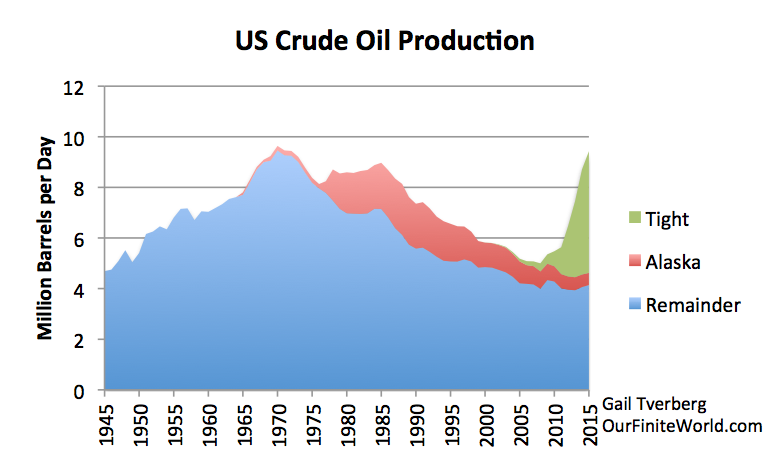
The data in Figure 4 indicates that with all categories included, 2015 liquids exceeded the 1970 peak by 16%. Considering crude oil alone, 2015 production amounted to 98% of the 1970 peak.
Figure 5 shows an approximate breakdown of crude oil production since 1945 on a bpd basis. The big spike in production is from tight oil, which is another name for oil from shale.
Figure 5. Oil crude oil production separated into tight oil (from shale), oil from Alaska, and all other, based on EIA oil production data by state.
Here again, US crude oil production in 2015 appears to amount to 98% of the 1970 crude oil peak. Thus, on a crude oil basis alone, we have not yet hit the 1970 peak.

Prospects for an Oil Price Rise

Most recent analyses of oil prices have focused on the amount of mismatch between supply and demand, and the need to craft a temporary agreement to reduce oil production. The thing that is missing in this discussion is an analysis of buying power of consumers. Is the problem a temporary problem, or a permanent one?
In order for oil product demand to keep rising, the buying power of consumers needs to keep rising. In other words, some combination of consumer wages and debt levels of consumers needs to keep rising. (Rising debt is helpful because, with more debt, it is often possible to buy goods that would not otherwise be affordable.)
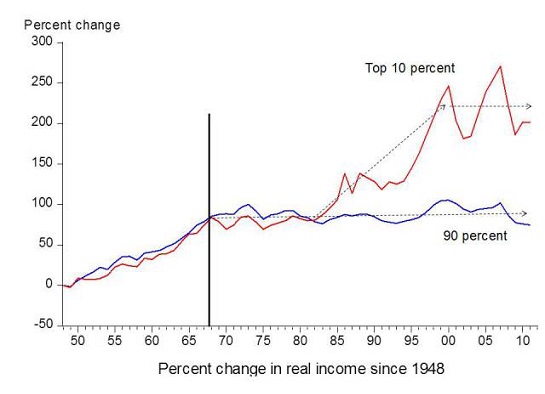
We know that in many countries, wages for lower-level workers have stagnated for a number of reasons, including competition with wages in lower-wage countries, computerization, and the use of automation (Figure 6). Thus, we know that low wages for a large share of consumers may be a problem.
Figure 6. Chart comparing income gains by the top 10% to income gains by the bottom 90% by economist Emmanuel Saez. Based on an analysis IRS data, published in Forbes.
Figure 6. Chart comparing US income gains by the top 10% to income gains by the bottom 90% by economist Emmanuel Saez. Based on an analysis IRS data, published in Forbes.
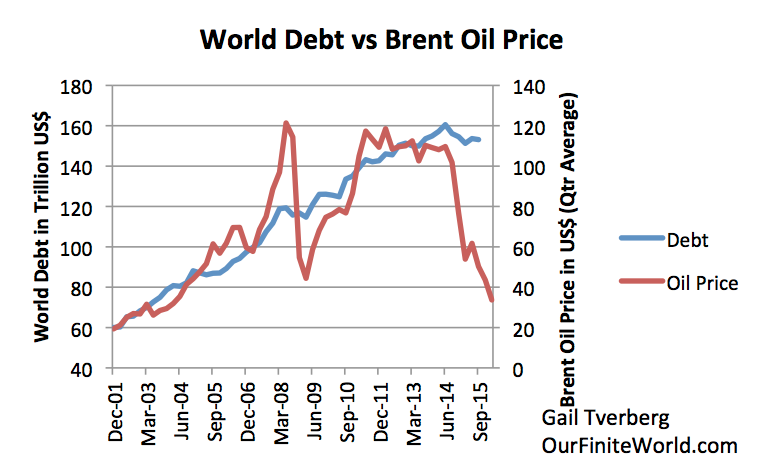
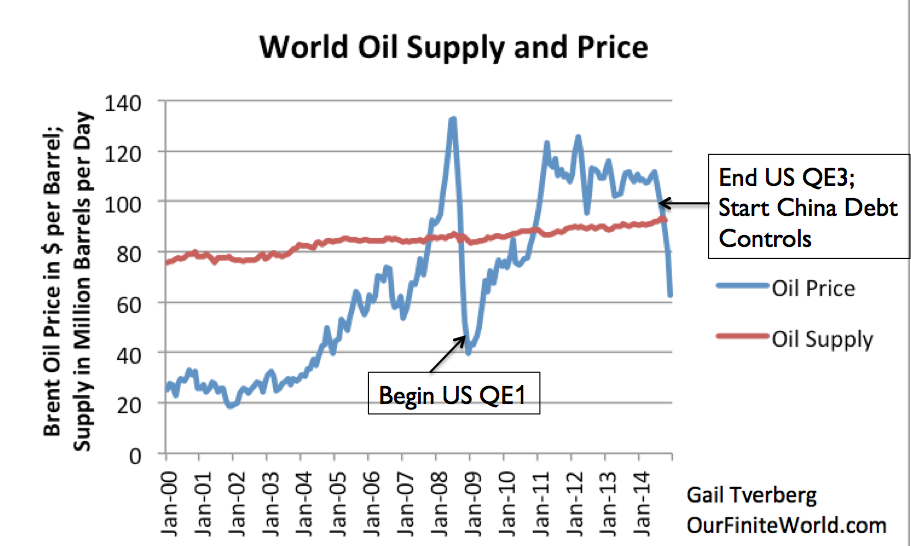
Figure 7 shows that world debt has been falling since June 30, 2014. This is precisely the time when world oil prices started falling.
Figure 6. Total non-financial world debt based on Bank for International Settlements data and average Brent oil price for the quarter, based on EIA data.
Figure 7. Total non-financial world debt based on Bank for International Settlements data and average Brent oil price for the quarter, based on EIA data.
One reason for the fall in world debt, measured in US dollars, is the fact that the US dollar started rising relative to other currencies about this time. Oil is priced in dollars; if the US dollar rises relative to other currencies, it makes oil less affordable to those whose currencies have lower values. The big rise in the level of the dollar came when the US discontinued quantitative easing in 2014. World debt, as measured in US dollars, began to fall as the US dollar rose.
Figure 7. World Oil Supply (production including biofuels, natural gas liquids) and Brent monthly average spot prices, based on EIA data.
Figure 8. World Oil Supply (production including biofuels, natural gas liquids) and Brent monthly average spot prices, based on EIA data.
As long as the US dollar is high relative to other currencies, oil products remain less affordable, and demand tends to stay low.
Another issue that struck me in looking at world debt data is the way the growth in debt is distributed (Figure 9). Debt growth for households has been much lower than for businesses and governments.
Figure 8. World non-financial debt divided among debt of households, businesses, and governments, based on Bank for International Settlements data.
Figure 9. World non-financial debt divided among debt of households, businesses, and governments, based on Bank for International Settlements data.
Since March 31, 2008, non-financial debt of households has been close to flat. In fact, between June 30, 2014 and September 30, 2015,  it shrank by 6.3%. In contrast, non-financial debt of both businesses and governments has risen since March 31, 2008. Government debt has shrunk by 5.6% since June 30, 2014–almost as large a percentage drop as for household debt.
The issue that we need to be aware of is that consumers are the foundation of the economy. If their wages are not rising rapidly, and if their buying power (considering both debt and wages) is not rising by very much, they are not going to be buying very many new houses and cars–the big products that require oil consumption. Businesses may think that they can continue to grow without taking the consumer along, but very soon this growth proves to be a myth. Governments cannot grow without rising wages either, because the majority of their tax revenue comes from individuals, rather than corporations.
Today, there is a great deal of faith that oil prices will rise, if someone, somewhere, will reduce oil production. In fact, in order to bring oil demand back up to a level that commands a price over $100 per barrel, we need consumers who can afford to buy a growing quantity of goods made with oil products. To do this, we need to fix three related problems:
  • Low wages of many consumers
  • World debt that is no longer rising (especially for consumers)
  • A high dollar relative to other currencies
These problems are likely to be difficult to fix, so we should expect low oil prices, more or less indefinitely. Lack of oil supply may bring a temporary spike in oil prices, but it cannot fix a permanent problem with consumer spending around the world.