Showing posts with label gold. Show all posts

Monday, October 26, 2015

Indians Urged To Give Up Their "Idle Gold" For The Good Of The Nation

Tyler Durden's picture

http://www.zerohedge.com/news/2015-10-26/indias-prime-minister-urges-citizens-part-idle-gold-good-nation
One month ago, when reviewing India's ploy to monetize the thousands of tons of gold held by the broader population through the issuance of "gold-backed bonds" (which would need to offer a rate of interest greater than inflation to be attractive but they won't), we asked if this is "the start of India's gold confiscation."
As a reminder, as part of the plan, Indians would be allowed to "deposit their jewelry or bars with banks and earn interest, while the banks will be free to sell the gold to jewelers, thereby boosting supply. The deposits can be for a period of one year to 15 years with the interest on short-term commitments to be decided by the banks and those on long-term deposits by the government in consultation with the central bank."
The sovereign gold bonds are aimed at people buying the precious metal as an investment. The securities may help shift a part of the estimated 300 metric tons a year investment demand, the government said in a separate statement. The bonds will be issued in denominations of 5 grams, 10 grams, 50 grams and 100 grams for a term of five years to seven years with a rate of interest to be calculated on the value of the metal at the time of investment, it said.
When stripped of its pompous rhetoric, what India is offering is simple: a gold-for-paper exchange, which however in a culture where gold has been the definition of money for centuries, would likely be a non-starter from the beginning. One look at the chart below showing Indian gold demands is sufficient to show just how ingrained in the Indian psyche gold hasbecome.

However, as we said a month ago, just because it is doomed from the beginning, at least in its current iteration, does not mean it won't be tried (see: Abenomics)... or adjusted. Because this proposal was nothing short of the initial shot across the gold confiscation bow. Here is what else we said:
The one thing to watch for is a shift in the posture of the Indian government: for now participation in the gold monetization scheme is voluntary, and largely geared to the general public with the 500 gram/year limit. But if and when the Modi cabinet starts "urging" the population, and certainly when threats of fines and/or prison time emerge, that is when we will finally have confirmation that the second coming of Executive Order 6102 has arrived.
Fast forward to this weekend when while we still await the Indian government to unveil the "threats and fines" part, it started the "urging" when during an address on his monthly radio programme of "Mann Ki Baat", Indian prime minister Modi "exhorted people to help convert gold to the nation's economic strength by joining in various schemes to be launched soon" adding that "gold can be converted from dead money to an economic force. To leave gold lying as dead money is behaviour not in sync with the modern times," he said.
We are grateful for this stark admission by India's prime minister that in "modern times", possession of a barbarous relic gold is a activity best relegated to barbarians - you see, "modern people" are all about lending, and rehypothecating their paper gold.
Still, Modi was at least truthful in noting that accumulating gold as a form of economic security is deeply rooted in India's social tradition; as a result we expect the threats of fines and incarceration to follow shortly.
For those who are unfamiliar, the Khaleej Times reminds us of the details of India gold monetization plot: 
Earlier in the week, the Reserve Bank of India issued norms for implementation of the gold monetisation scheme, under which customers can deposit their gold in banks and earn interest on it.

The minimum deposit required will be 30 grams of gold with fineness measuring 995. It could include raw gold in the forms of bars, coins and jewellery, excluding stones and other metals.

On maturity, the principal and interest will be linked to the prevailing price of gold at the time. The depositor will have the option to take gold or equivalent rupees.

The union cabinet approved the scheme last month.
As for the motives, we have covered them before, but here they are again: "the objective of the scheme is to mobilise gold, give a fillip to the gems and jewellery sector by making the metal available from banks on loan and reduce the reliance on imported gold."
In other words, to take it away from the population.
And when this peaceful attempt at "remunerated" gold sequestration fails, the less "amicable" version of gold confiscation - usually involving threats of bodily harm and prison time - will emerge, as it always does when desperate economies scramble to force their population to stop saving (by buying gold), and start spending.

Monday, September 28, 2015

UBS Is About To Blow The Cover On A Massive Gold-Rigging Scandal

Tyler Durden's picture

http://www.zerohedge.com/news/2015-09-28/ubs-about-blow-cover-massive-gold-price-rigging-scandal
With countless settlements documenting the rigging of every single asset class, it was only a matter of time before the regulators - some 10 years behind the curve as usual - finally cracked down on gold manipulation as well, even though as we have shown in the past, central banks in general and the Fed in particular are among the biggest gold manipulators.
That said, we are confident by now nobody will be surprised that there was manipulation going on in the gold casino. In fact, ever since Germany's Bafin launched a probe into Deutsche Bank for gold and silver manipulation, it has been very clear that the only question is how many banks will end up paying billions to settle the rigging of the gold market (with nobody going to prison as usual, of course).
Earlier today, we learned that the Swiss competition watchdog just became the latest to enjoin the ongoing gold manipulation probe when as Reuters reported, it launched an investigation into possible collusion in the precious metals market by several major banks, it said on Monday, the latest in a string of probes into gold, silver, platinum and palladium pricing.
Here are the details that should come as a surprise to nobody:
Global precious metals trading has been under regulatory scrutiny since December 2013, when German banking regulator Bafin demanded documents from Deutsche Bank under an inquiry into suspected manipulation of gold and silver benchmarks by banks. Even though the market has moved to reform the process of deciding on its price benchmarks, accusations of manipulation have refused to go away.

Switzerland's WEKO said its investigation, the result of a preliminary probe, was looking at whether UBS, Julius Baer, Deutsche Bank, HSBC, Barclays, Morgan Stanley and Mitsui conspired to set bid/ask spreads.

"It (WEKO) has indications that possible prohibited competitive agreements in the trading of precious metals were agreed among the banks mentioned," WEKO said in a statement.
Don't hold your breath though: "A WEKO spokesman said the investigation would likely conclude in either 2016 or 2017, adding that the banks were suspected of violating Swiss corporate rules." Those, and virtually all other market rules.
The good news is that unlike Bart Chilton's charade "inquiry" into silver manipulation when after years of "probing" the CFTC found "nothing", at least the Swiss will find proof of rigging for the simple reason that it is there.
he banks face financial penalties if WEKO finds them guilty of wrongdoing, the spokesman said, though he declined to comment on the size of any possible fine.
No please, anything but "financial penalties" for rigging the gold market.
Aside from regulatory probes, a number of lawsuits have also been filed in U.S. courts alleging a conspiracy to manipulate precious metals prices.

Commenting on the WEKO probe, a Julius Baer spokesman said the bank was cooperating with authorities.

In a statement, Deutsche Bank said it was cooperating with requests for information from "certain regulatory authorities" over precious metal benchmarks but declined to comment further.

Representatives for UBS, Barclays, Morgan Stanley and HSBC declined to comment. Mitsui was not immediately available for comment.
Some so-called experts promptly scrambled to talk down the upcoming proof that so-called "paranoid" gold bugs have been right all along:
The impact of the probes on wider precious metals trading was likely to be muted, according to Brian Lucey, professor of finance at the School of Business, Trinity College Dublin.

"The question is not if individuals, or groups of individuals are collaborating to rig the game for themselves, the question is if this has any material effect," he said. "I'm not convinced collusive behaviour will have a meaningful effect micro-economically to the structure of gold trading around the world."
Oh so the question is not if traders and banks made billions in illegal profits by rigging yet another market, but "if this has any material effect." Give this man another distinguished financial professorship title: with observations like that what can one say but... "Keynesian genius."
* * *
However, as we said above, none of the above, and certainly not the idiotic "finance professor" statements, will come as any surprise to anyone.
What will, however, is that unlike previous gold probe cases, this one will actually have consequences.
How do we know?
Because just like in LIBOR-gate, just like in FX-gate, it is the biggest rat of all, Swiss megabank UBS, that is about to turn on its former criminal peers.
As Bloomberg reported earlier "UBS was granted conditional leniency in Swiss antitrust probe of possible manipulation of precious metal prices, a person with knowledge of the matter said."
Bloomberg adds that the "bank may face lower fine than six other banks and financial firms suspected in probe or may avoid penalty altogether, person says."
Why would UBS do this? The same reason UBS did so on at least on two prior occasions: the regulators have definitive proof it is involved, and gave it the option to turn evidence and to rat out its cartel peers, or face even more massive financial penalties.
UBS promptly chose the former, and took the opportunity to minimize yet another key civil (and criminal) market manipulation charge against it, especially after it was already branded a "criminal recidivist" between Libor, FX and, of course, the tax evasion scandal: one more manipulation scandal and the bank could well lose its license to operate in NYC.
Which simply means that now the official countdown on the announcement of what will be revealed as the biggest gold-manipulation and rigging scandal in history, has begun.

Tuesday, September 8, 2015

China Buys 16 Tons Gold In August – Dumps $94 Billion

GoldCore's picture

http://www.zerohedge.com/news/2015-09-08/china-buys-16-tons-gold-august-%E2%80%93-dumps-94-billion
Given the strong demand fundamentals, particularly out of China, gold should go higher but as ever there is a risk of selling in the futures market leading to weakness in the short term as traders follow momentum and ignore fundamentals.

This demand continues and is being bolstered by official Chinese demand. The People’s Bank of China (PBOC) added another 15.98 tonnes of gold in August – at the same time its foreign exchange reserves fell a whopping $94 billion. The Chinese continue to diversify out of the dollar and into gold.

Thursday, August 6, 2015

JPMorgan Helps Comex Avoid Gold Depletion, Boosts Registered Gold By 78% Overnight (smells fishy)

Tyler Durden's picture

http://www.zerohedge.com/news/2015-08-06/jpmorgan-helps-comex-avoid-gold-depletion-concerns-boosts-registered-gold-78-overnig
Earlier this week, when observing the most recent drop in Comex registered gold as a result of a reclassification by the gold vaults of JPM and Brink's of 25,386 ounces of registered gold into eligible (alongside the withrawal of 200,752 ounces of eligible gold from JPM), we wondered if Comex "may be on the edge" since after the adjustment, Comex registered gold had dropped to a never before seen low of just over 10 tons, resulting in record high gold coverage ratio of 124 ounces in outstanding gold open interest for every ounce of physical.


To be sure, we had no explanation for the drop, but we did muse that "the mainstream press will once again start paying close attention to the total, and especially registered, gold held at the Comex: at a pace of 25K a day, the gold vaults that make up the CME's vaulting system would be depleted in just under two weeks of daily withdrawals."
And while the mainstream press has certainly not opined on the peculiar events at the Comex, we have been paying particularly close attention to the daily Comex gold updates, and is probably why we were less than surprised to see that just 2 days after our report, the Comex once again succeeded in sweeping default fears under the rug by boosting its eligible gold by a whopping 78% overnight, from 362K ounces to 643K, thereby pushing deliverable gold from its all time lows.


However, this was not achieved with an infusion of actual new gold into the Comex, but thanks to JPM reclassifying 276K ounces of gold from the Eligible into the Registered category, even as actual eligible gold continues quietly hemmorhaging out of the Comex.

So the gold can was kicked again, but for how long? And will JPM be as eager to continue "adjusting" eligible gold into registered if the recent trend in gold redemptions not just in its vault, but across all Comex gold warehouses continues?
For the answer, keep checking this website around 3pm every day for all the latest gold moves in and out of the Comex.

Monday, August 3, 2015

Big Chunk Of JP Morgan’s Gold Holdings Withdrawn In One Day

Filed in Precious Metals by on August 1, 2015 
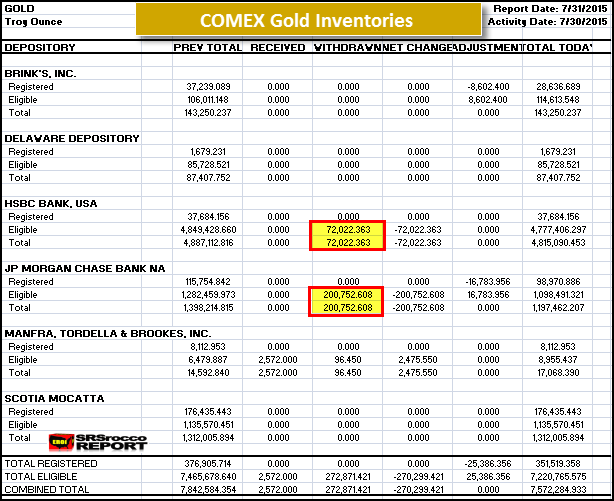
In just one day, a big chunk of JP Morgan’s gold was withdrawn from the COMEX.  It’s been a while since we have seen such a large single withdrawal.  According to the CME Group’s Friday Warehouse Depository gold stocks, a whopping 200,752 ounces of gold were removed from JP Morgan’s Eligible category.
If we look at the table below, we can see JP Morgan’s total gold inventories fell from 1,398,214 oz on Thursday (7/30/2015) to 1,197,462 oz:
COMEX Gold Inventories 73115
Basically, JP Morgan lost nearly 15% of its total gold inventories in one day.  You will notice that JP Morgan only has 115,754 oz of gold in its Registered category.  This is gold that is ready to be delivered.  This 200,752 oz gold withdrawal would have totally wiped out JP Morgan’s Registered gold inventories.
Furthermore, there was another large 72,022 oz gold withdrawal from HSBC for a total of 272,871 oz from the two banks.  Not only are investors starting to be concerned about the Greek situation in Europe spinning out of control, there is growing fear of a possible meltdown of the broader stock markets this fall.
This has sparked a huge increase in physical gold and silver buying shown by the record 170,000 oz of Gold Eagles sold in the month of July, including 5.5 million oz of Silver Eagles (even with the U.S. Mint suspending Silver Eagle sales for two weeks).
If you look at the COMEX Gold Inventory table closely, you will notice that the total Registered Gold inventories are a lousy 351,519 oz.  This is less than peanuts.  Two withdrawals like JP Morgan experienced on Thursday, would totally wipe out the Bankers Registered gold inventories.
I believe things will become quite interesting this fall.  Investors need to WAKE UP to the fact that there are very few excellent stores of wealth going forward.  Gold and silver are probably two right at the top of the list.

Thursday, June 25, 2015

In Gold We Trust 2015


 http://www.acting-man.com/?p=38127#more-38127

The Gold Standard of Gold Reports is Back

As every year around this time, our good friends Ronald Stoeferle and Mark Valek, the managers of the Incrementum Fund, have published their annual “In Gold We Trust” report, the extended version of which can be downloaded below.

Untitled-1


This year’s report is slightly longer than the 2014 report and discusses practically the entire breadth of gold-related topics, including highly instructive excursions into economic theory, monetary history and an extensive discussion of current political and economic trends.
For the past few years, gold investors certainly had little to write home about. In dollar terms, gold has essentially been going nowhere, with a slight downward bias. Actually, the past three years in the USD gold price look a bit like the past 18 years of “global warming”.
And yet, a lot depends on one’s home currency. Gold’s sideways trend in dollar terms actually represents a small victory, given the strong rally in the dollar in 2014. As a result, gold price charts actually look quite encouraging in terms of most non-dollar currencies. In fact, its performance in euro and yen terms over the past 18 months has been none too shabby.
Moreover, as Ronnie and Mark point out, gold has held up extremely well in a disinflationary environment in which many commodities such as crude oil have been obliterated. As our readers know, we believe that the underlying bid that is supporting gold is from people who are looking at the third huge asset bubble blown by loose monetary policy within the past two decades and are feeling increasingly queasy. It can’t hurt to hold some insurance – and sooner or later it will be essential.
Naturally, while the party in “risk” still rages, it is widely held that this time is somehow different. Actually, every slice of economic history is unique, but as Mark Twain noted, history often does tend to rhyme. There is one thing that unites all credit expansions: they eventually all blow up – as in, no exceptions. In this sense, it is never different.

Gold in currenciesGold priced in US dollars, euro and yen over the past 18 months. Gold may look weakish in dollar terms, but it certainly looks just fine in terms of every other major currency, via StockCharts, click to enlarge.

Since the last financial crisis, even more debt has been piled up all over the world. Much of this debt is collateralized by hopelessly overvalued assets, ranging from real estate to securities (it seems unlikely that many art works are bought on credit, but the vast money supply growth of recent years has certainly spilled over into this particular sector as well). More and more debt has come to depend solely on faith: the faith that governments will continue to be able to roll over their debt indefinitely without endangering the value of the currencies they issue.
Ronnie and Mark inter alia discuss Japan, the public debt of which by now amounts to 19 times its tax revenues. It seems obvious that buyers of the government’s debt can no longer merely rely on being made whole by its coercive powers of taxation. That leaves only the central bank’s proverbial printing press as a backstop to this debtberg. Well, we have seen it all before – countless times in fact. Somehow we have yet to see it end happily.

goudenmunt2 A solidus issued by Roman Emperor Heliogabalus, who ruled from AD218-222

Stater, Croesus
One of the earliest known gold coins, the gold stater minted by King Croesus (who ruled Lydia from 561 – 546 BC). Incidentally, the coin depicted above sold for €63,000 at an auction (approx $70,500)

Conclusion

If you wonder why one should buy and hold gold while “missing out” on the seemingly unstoppable expansion in stock, bond and assorted real estate prices, the 2015 “In Gold We Trust” report should make the matter abundantly clear.
Enjoy!

Download Link: In Gold We Trust, 2015

Thursday, June 18, 2015

Texas establishes own gold depository independent of Federal Reserve

Published time: June 17, 2015 20:28
Edited time: June 17, 2015 21:14
Reuters / Michael Dalder
Texas is planning to build its own state-controlled depository and wants its gold back from New York State. The Lone Star state will repatriate its $1 billion in gold bullion.
Texas Governor Greg Abbott signed House Bill 483 into law last Friday.


“With the passage of this bill, the Texas Bullion Depository will become the first state-level facility of its kind in the nation, increasing the security and stability of our gold reserves and keeping taxpayer funds from leaving Texas to pay for fees to store gold in facilities outside our state,” Greg Abbott said on Friday. The location of the future depository is still unknown.
According to the new legislation, neither the federal government nor any other entity would be able to demand the gold back once it arrives in Texas.
“The depository in the case of receiving notice of a purported confiscation, requisition, seizure, or other attempt to control the ownership, disposition, or proceeds of a withdrawal, transfer, liquidation, or settlement of a depository account … may not recognize the governmental or quasi-governmental authority, financial institution, or other person acting as the lawful successor of the registered holder of a depository account in question,” the law states.
The bill was suggested by two Republican members of Texas House of Representatives: Giovanni Capriglione and Lois W. Kolkhorst.
Texas thus prevents an executive order in the style of Executive Order 6102 of April 5, 1933, which obliged people to give their gold bullions and coins to the Federal Reserve System.
Capriglione told the Texas Newspaper Star-Telegram that “…when I first announced this, I got so many emails and phone calls from people literally all over the world who said they want to store their gold … in a Texas depository.”
“People have this image of Texas as big and powerful … so for a lot of people, this is exactly where they would want to go with their gold,” he added. Capriglione also hopes that these measures will allow Texas to generate revenue of the state and reminds that the state pays New York $1 million a year to store its gold. The main holders of Texan gold are University of Texas and Teacher Retirement System.

That is the second attempt of Giovanni Capriglione to establish the depositary in Texas. The first one was made in 2013 but it was not successful.
“The lack of faith in central bank trustworthiness is spreading,” the financial blog ZeroHedge wrote Sunday on the reasoning behind the move.
“There are precisely two important reasons. One involves distrust in the current storage system. The second threatens the paper money system as a whole.”
The gold represents 5% of the university and pension fund which is managed by the University of Texas Investment Management Company in 2011. The decision to turn the fund’s investment into gold bars stored in New York was influenced by Kyle Bass, a Dallas hedge fund manager and member of the organization’s board. Bass is a critic of the Federal Reserve who has stated that he was preparing for an economic collapse by accumulating “guns and gold.”
"When people in multiple states actually start using gold and silver instead of Federal Reserve Notes, it would effectively nullify the Federal Reserve and end the federal government’s monopoly on money," the free market think tank Mises Institute wrote on Monday.

Liberal-leaning users, as might be expected, have a different take on the matter.
Texas is not the first depositor of the Federal Reserve System that wants its gold back. For instance, in 2013 Germany wanted to take away its gold from the Federal Reserve System but the answer was negative. The Federal Reserve System explained that it will take seven years – until 2020 – to fulfil the transaction.
It is unclear at the moment how the actual transportation of the gold will be executed. There hasn’t yet been reaction from the Wall Street.

Monday, June 15, 2015

Writing's On The Wall: Texas Pulls $1 Billion In Gold From NY Fed, Makes It "Non-Confiscatable"

Tyler Durden's picture

The lack of faith in central bank trustworthiness is spreading. First Germany, then Holland, and Austria, and now - as we noted was possible previously - Texas has enacted a Bill to repatriate $1 billion of gold from The NY Fed's vaults to a newly established state gold bullion depository..."People have this image of Texas as big and powerful … so for a lot of people, this is exactly where they would want to go with their gold," and the Bill includes a section to prevent forced seizure from the Federal Government.
From 2011:
"The University of Texas Investment Management Co., the second-largest U.S. academic endowment, took delivery of almost $1 billion in gold bullion and is storing the bars in a New York vault, according to the fund’s board."

The decision to turn the fund’s investment into gold bars was influenced by Kyle Bass, a Dallas hedge fund manager and member of the endowment’s board, Zimmerman said at its annual meeting on April 14. Bass made $500 million on the U.S. subprime-mortgage collapse.

“Central banks are printing more money than they ever have, so what’s the value of money in terms of purchases of goods and services,” Bass said yesterday in a telephone interview. “I look at gold as just another currency that they can’t print any more of.”
And now, after we noted the possibility previously, as The Epoch Times reports, Texas Governor Greg Abbott signed a bill into law on Friday, June 12, that will allow Texas to build a gold and silver bullion depository. In addition, Texas will repatriate $1 billion worth of bullion from the Federal Reserve in New York to the new facility once completed.
On the surface the bill looks rather innocent, but its implications are far reaching. HB 483, “relating to the establishment and administration of a state bullion depository” to store gold and silver coins, was introduced by state Rep. Giovanni Capriglione.

Capriglione told the Star-Telegram:

“We are not talking Fort Knox. But when I first announced this, I got so many emails and phone calls from people literally all over the world who said they want to store their gold … in a Texas depository. People have this image of Texas as big and powerful … so for a lot of people, this is exactly where they would want to go with their gold.”

But isn’t New York, where most of the world’s gold is stored, also big and powerful? Why does the state of Texas want to go through the trouble of building its own storage facility?
There are precisely two important reasons. One involves distrust in the current storage system. The second threatens the paper money system as a whole.
“In a lot of cases with gold you may not have clear title to the metal. You may have a counterparty relationship that makes you a creditor. If the counterparty has a problem unrelated to gold, they can default and then you become an unsecured creditor in bankruptcy,” said Keith Weiner, president of the Gold Standard Institute.

This means you get whatever is left after liquidation, often just a fraction of the initial value of your holdings.

“This exact scenario happened with futures broker MF Global. I knew people who had warehouse receipts to gold bars with a specific serial number. But that gold had an encumbered title and they became unsecured creditors in bankruptcy,” said Weiner.

In Texas, two big public pension funds from the University of Texas (UoT) and the Teacher Retirement System (TRS) own gold worth more than $1 billion.

Being uncomfortable with holding purely financial gold in the form of futures and Exchange-traded Funds, University of Texas actually took delivery of the gold bars in 2011 and warehoused it with HSBC Bank in New York.

At the time pension fund board member and hedge fund manager Kyle Bass explained: “As a fiduciary, which I am in that position to the extent you own gold and you are going for a long time, and it’s not a trade. … We looked at the COMEX at the time and they had about $80 billion of open interest between futures and futures options. And in the warehouse they had $2.7 billion of deliverables. We are going to own it a long time. You are on the board, you are a fiduciary, so that’s an easy one, you go get it.”

Bass is implying that there is much more financial gold out there than physical, and that it is prudent to actually hold the physical.

Taking the gold to Texas would then also solve the counterparty risk. “In this case it’s going to be a depository, the gold is going to be there, they are not going to be able to lend it out and it won’t serve as collateral for other transactions of the bank.” said Victor Sperandeo of trading firm EAM Partners. “Because if the bank closes, you are screwed.”

“I think that somebody was looking at that, we better have this under our complete control,” said constitutional lawyer and gold expert Edwin Vieira, of the Texas bill. “They don’t want to have the gold in some bank somewhere and in two to five years it turns out not to be there.”
So far most of the attention has focused on the part of the depository and the big institutions. However, the bill also includes a provision to prevent seizure, which is important for private parties who want to avoid another 1933 style confiscation of their bullion by Federal authorities.
Section A2116.023 of the bill states: “A purported confiscation, requisition, seizure, or other attempt to control the ownership … is void ab initio and of no force or effect.” Effectively, the state of Texas will protect any gold stored in the depository from the federal government.

And free from the threat of confiscation, private citizens can use gold and silver as money, completely bypassing the paper money system.

“People can legally do that with gold contracts. The difficulty is the implementation. Now Texas has set up a mechanism with the depository. We have accounts in that institution and can easily transfer back and forth certain amounts. So we can run our money system a gold or silver basis if we were so inclined,” said Vieira.

This would not be possible if the gold is stored in a bank because of the risks of bank holidays and bankruptcies. It would also not be possible if the federal government could confiscate gold.

According to Vieira, this anti-seizure provision rests on Article 1, section 10 of the Constitution of the United States, which obliges the States to not make anything tender in payment of debts apart from gold and silver coin.

“If someone from the Department of Justice comes along you are going to see legal and political fireworks. The state is going to say ‘we need to have a mechanism to make gold and silver money. This is pursuant to the constitutional provision we have. You can’t touch this. Our state power on the constitutional level is more powerful than any statute you may pass,'” said Vieira.

Because one of the litigant parties is a state, the case would go directly to the Supreme Court.

“We are talking about something completely new in terms of the legal playing field. This is no longer a fringe concept,” he adds, but cautions about a possible fight with the federal government: “We will have to see how committed the governor and the attorney general are.”

Official Statement from Governor Abbott:
Governor Greg Abbott today signed House Bill 483 (Capriglione, R-Southlake; Kolkhorst, R-Brenham) to establish a state gold bullion depository administered by the Office of the Comptroller. The law will repatriate $1 billion of gold bullion from the Federal Reserve in New York to Texas. The bullion depository will serve as the custodian, guardian and administrator of bullion that may be transferred to or otherwise acquired by the State of Texas. Governor Abbott issued the following statement:

“Today I signed HB 483 to provide a secure facility for the State of Texas, state agencies and Texas citizens to store gold bullion and other precious metals. With the passage of this bill, the Texas Bullion Depository will become the first state-level facility of its kind in the nation, increasing the security and stability of our gold reserves and keeping taxpayer funds from leaving Texas to pay for fees to store gold in facilities outside our state."
*  *  *
Is this the first step down a road to secession? Notably, they'll need that gold to establish their own country once they win the potentially imminent war with the US military which starts on Monday (Jade Helm).
*  *  *
This implicit subordination of The Fed's gold sends a more ominous signal of rising fears of confiscation and leaves us wondering just how long before every state (and or country) decides to follow Texas' lead?

Thursday, December 18, 2014

What Is the Gold-Oil Ratio Telling Us?

Based on historical gold-oil ratios, oil appears extraordinarily cheap right now.

One way to establish if a commodity or asset is relatively expensive or inexpensive is to price it in something other than a fiat currency–for example, gold. Gold goes up and down in value relative to other commodities and fiat currencies, so it is itself a volatile yardstick. Nonetheless, it provides a useful measure of the relative value of gold and whatever is being measured in gold–in this case, oil.
The prices listed are approximate, i.e. rounded to averages in the time frame listed. Of the various measures of oil, I am using WTIC.
According to SRSrocco REPORT, the average gold-oil ratio in the period 2000-2014 is 12. That is, on average, one ounce of gold bought about 12 barrels of oil.
For historical context, in 1976, following the first oil-shock in 1973, oil was $12.80/barrel and gold was around $124, for a ratio of 9.7.
In 1986, the average price of gold was around $368 while oil fell to $14/barrel, for a ratio of 26.3.
At gold’s peak above $1,800/ounce in 2011, oil was around $90/brl, for a ratio of 20.
At oil’s peak above $140/barrel in 2008, gold was around $950/ounce, for a ratio of 6.8.
As a rule of thumb, oil is relatively expensive (and gold is relatively inexpensive) when the ratio is below 9, and oil is relatively inexpensive (and gold is relatively expensive) when the ratio is above 20.
When oil fell below $55/barrel a few days ago, the ratio reached 22. By historical standards, oil is cheap.
Here is a listing of various highs and lows in gold and oil:
Oil priced in gold: how many barrels of oil can be purchased with one ounce of gold?
2000: Oil $30/brl, gold $275
Ratio: 9.2
2006: Oil $70/brl, gold $600
Ratio: 8.6
2008: Oil $140/brl (at the peak), gold $950
Ratio: 6.8
2011: Oil $90/brl, gold $1,800 (at the peak)
(note that oil traded above $100/brl earlier in 2011, but at gold’s peak was around $90/brl)
Ratio: 20.0
2014 (1st quarter): Oil $105/brl, gold $1,300
Ratio: 12.3
2014 (current): Oil $55/brl, gold $1,200
Ratio: 21.8
Here is a chart of gold from 2012 to the present:

Here is a chart of oil (WTIC) from 2012 to the present:

And here is a chart of the gold-oil ratio from 2012 to the present:

While the gold-oil ratio exceeded 25 three decades ago, in the era of rising demand from the emerging markets of China, India and other nations, the ratio has only touched 20 when gold was trading above $1,800/ounce.
Based on historical gold-oil ratios, oil appears extraordinarily cheap right now. Could oil fall further? Of course. Could gold go up or down? Of course. There are a great many factors that influence the ratio, which is simply a short-hand method of measuring the relative value of two important commodities.

How to forge a career in a dysfunctional economy:
Get a Job, Build a Real Career and Defy a Bewildering Economy
,
a mere $9.95 for the Kindle ebook edition and $15.47 for the print edition.

Tuesday, March 4, 2014

$10M Gold Coin Hoard Found in Yard May Have Been Stolen From Mint (and now must be returned to US GOV)

A California couple who found a stash of buried gold coins valued at $10 million may not be so lucky after all. The coins may have been stolen from the US Mint in 1900 and thus be the property of the government, according to a published report.
The San Francisco Chronicle's website reported that a search of the Haithi Trust Digital Library provided by Northern California fishing guide Jack Trout, who is also a historian and collector of rare coins, turned up the news of the theft.
The California couple, who have not been identified, spotted the edge of an old can on a path they had hiked many times before several months ago. Poking at the can was the first step in uncovering a buried treasure of rare coins estimated to be worth $10 million.
"It was like finding a hot potato," the couple told coin expert Don Kagin from Kagin's, Inc. The couple hired the president of Kagin's, Inc. and Holabird-Kagin Americana, a western Americana dealer and auctioneer, to represent them.
The coins are mostly uncirculated and in mint condition, and they add up in face value to $27,000. "Those two facts are a match of the gold heist in 1900 from the San Francisco Mint," the newspaper reported.
Credit: Saddle Ridge Hoard discoverers via Kagin's, Inc./AP Photo
Jack Trout told the paper that an 1866 Liberty $20 gold piece without the words “In God We Trust” was part of the buried stash, and the coin may fetch over $1 million at auction because it's so rare.
“This was someone’s private coin, created by the mint manager or someone with access to the inner workings of the Old Granite Lady (San Francisco Mint),” Trout told the newspaper. “It was likely created in revenge for the assassination of Lincoln the previous year (April 14, 1865). I don’t believe that coin ever left The Mint until the robbery. For it to show up as part of the treasure find links it directly to that inside job at the turn of the century at the San Francisco Mint.”
If the coins were stolen from the government, the couple may be entitled to a finder's fee but they may not be able to keep the stash. The Mint has not yet commented on the situation.
Last week, when news of the stash first broke, coin dealer Kagin spoke about the rarity of such a find.
"Since 1981, people have been coming to us with one or two coins they find worth a few thousand dollars, but this is the first time we get someone with a whole cache of buried coins... It is a million to one chance, even harder than winning the lottery," Kagin told ABCNews.com.
The couple is trying to remain anonymous after finding the five cans of coins last spring on their Tiburon property in northern California and conducted an interview with Kagin.
"I never would have thought we would have found something like this. However, in a weird way I feel like I have been preparing my whole life for it," the couple said.
"I saw an old can sticking out of the ground on a trail that we had walked almost every day for many, many years. I was looking down in the right spot and saw the side of the can. I bent over to scrape some moss off and noticed that it had both ends on it," they said.
It was the first of five cans to be unearthed, each packed with gold coins.
"Nearly all of the 1,427 coins, dating from 1847 to 1894, are in uncirculated, mint condition," said Kagin told ABCNews.com.
He said that the couple plan to sell most of the coins, but before they do, they are "loaning some to the American Numismatic Association for its National Money Show, which opens Thursday in Atlanta."
"Some of the rarest coins could fetch as much as $1 million apiece," said Kagin. He also said that they wish to sell 90 percent of the collection through Amazon.com and on the company's website.
"We'd like to help other people with some of this money. There are people in our community who are hungry and don't have enough to eat. We'll also donate to the arts and other overlooked causes. In a way it has been good to have time between finding the coins and being able to sell them in order to prepare and adjust. It's given us an opportunity to think about how to give back," said the couple.
Kagin and his colleague David McCarthy, senior numismatist and researcher at Kagin's, met with the couple last April, two months after the hoard was found.
When McCarthy and Kagin told the couple that their bonanza will be in the annals of numismatic stories for quite some time, the couple said, "It would have been quite a pity not to share the magnitude of our find. We want to keep the story of these coins intact for posterity."
Credit: Saddle Ridge Hoard discoverers via Kagin's, Inc./AP Photo

Monday, January 27, 2014

Is a Major Gold Scandal Going Mainstream?

Allegation that Central Banks Have Rehypothecated, Leased or Outright Sold the Gold They Claim to Have Is Gaining Momentum

We noted in 2012 that there are serious questions as to whether the Fed and other central banks really have the gold holdings which they claim.
This story is starting to go mainstream.
The Financial Times writes today (h/t Zero Hedge):
A year ago the Bundesbank announced that it intended to repatriate 700 tons of Germany’s gold from Paris and New York. Although a couple of jumbo jets could have managed the transatlantic removal, it made security sense to ship the load in smaller consignments. Just how small, and over how long, has only just become apparent.
Last month Jens Weidmann, Bundesbank president, admitted that just 37 tons had arrived in Frankfurt. The original timescale, to complete the transfer by 2020, was leisurely enough, but at this rate it would take 20 years for a simple operation. Well, perhaps not so simple. While he awaits delivery, Herr Weidmann is welcome to come and look through the bars in the Federal Reserve’s vaults, but the question is: whose bars are they?
In the “armchair farmer” fraud you are told: “Look, this is your pig, in the sty.” It works until everyone wants physical delivery of their pig, which is why Buba’s move last year caused such a stir. After all nobody knows whether there are really 260m ounces of gold in Fort Knox, because the US government won’t let auditors inside.
The delivery problem for the Fed is a different breed of pig. The gold market is far more than exchanging paper money for precious metal. Indeed the metal seems something of a sideshow. In June last year the average volume of gold cleared in London hit 29m ounces per day. The world’s mines are producing 90m ounces per year. The traded volume was many times the cleared volume.
The paper gold in the London Bullion Market takes the familiar forms that bankers have turned into profit machines: futures, options, leveraged trades, collateralised obligations, ETFs . . . a storm of exotic instruments, each of which is carefully logged, cross-checked and audited.
Or perhaps not. High-flying traders find such backroom work tedious, and prefer to let some drone do it, just as they did with those money-market instruments that fuelled the banking crisis. The drones will have full control of the paper trail, won’t they? There’s surely no chance that the Fed’s little delivery difficulty has anything to do with the cat’s-cradle of pledges based on the gold in its vaults?
John Hathaway suspects there is. He worries about all the paper (and pixels) linked to gold. He runs the Tocqueville gold fund (the clue is in the name) and doesn’t share the near-universal gloom of London’s gold analysts, who a year ago forecast an average $1700 for 2013. It is currently $1,260.
As has been remarked here before, forecasting the price is for mugs and bugs. But one day the ties that bind this pixelated gold may break, with potentially catastrophic results. So if you fancy gold at today’s depressed price, learn from Buba and demand delivery.
And last week, Glenn Beck – hate him or love him, he’s got the 594th most popular website in the world and many viewers on Dish network and various cable providers – did an entire 20-minute episode on the issue:

This story hasn’t yet made it to the New York Times, the Washington Post or network television … but it is gaining momentum.

Sunday, December 1, 2013

Bitcoin Plunges Into Bear Market

Tyler Durden's picture

Wednesday, November 27, 2013

Silver & Gold: When Money Is Corrupted - Hidden Secrets

(thanks Dagny!!)

http://www.youtube.com/watch?v=OQWMd_NPSBA

More: http://www.hiddensecretsofmoney.com Welcome to the 5th episode of Michael Maloney's Hidden Secrets Of Money. In this instalment, we travel to Berlin and Frankfurt, where we were able to film the money museum inside the Bundesbank...one of the world's largest Central Banks.

This episode serves as an ideal primer for those waking up to the monetary matrix around them, as it clearly shows the history of true money and why it so important to our freedom. The quality of a society is directly proportional to the quality of its money. Debase a currency for long enough, and you end up with dangerous deficits, debt driven disasters, and eventually...delusional dictators. History proves this to be true.

For further insight on what it was like to film inside a central bank, check out the Exclusive Presentation that goes along with this episode at our website. In it, Mike tells what it was like to look at the displays and explanations from an Austrian Economics perspective. He also shows where he believes we are in the following cycles:

Inflation/Deflation
Quality Money/Quantity Currency
Capitalism/Collectivism

It's a fantastic 30+ minute presentation which also reports on personal freedom, gold and silver, the US dollar, and economic freedom.

Now I'd like to ask you , the reader, to dwell for a minute on Mike's last question in the video:

What use is money if you don't have freedom?

Enjoy this episode, and please share it far and wide. Drop us a line in the comments section below and let us know how we are doing .

See you next week,

Dan


For more information about Gold & Silver or Mike Maloney, visit the Why Gold & Silver channel and subscribe: http://goo.gl/emXEB

Join GoldSilver.com & Mike Maloney on other social networks:

Blog: http://goldsilver.com/