Showing posts with label default. Show all posts

Monday, May 9, 2016

Trump On Debt Renegotiation: "You Never Have To Default Because You Print The Money"

Tyler Durden's picture

http://www.zerohedge.com/news/2016-05-09/trump-debt-renegotiation-you-never-have-default-because-you-print-money

Following Donald Trump's Thursday comments that rising interest rates would be disastrous for the economy, saying that "we're paying a very low interest rate. What happens if that interest rate goes up 2, 3, 4 points?" hinting that the U.S. should "renegotiate longer-term debt" with creditors and that if the economy crashes he "can make a deal", various media outlets went to town on Trump, most notably the NYT, which took Trump to task:
Asked on Thursday whether the United States needed to pay its debts in full, or whether he could negotiate a partial repayment, Mr. Trump told the cable network CNBC, “I would borrow, knowing that if the economy crashed, you could make a deal.”

Such remarks by a major presidential candidate have no modern precedent. The United States government is able to borrow money at very low interest rates because Treasury securities are regarded as a safe investment, and any cracks in investor confidence have a long history of costing American taxpayers a lot of money.

Experts also described Mr. Trump’s proposal as fanciful, saying there was no reason to think America’s creditors would accept anything less than 100 cents on the dollar, regardless of Mr. Trump’s deal-making prowess.

“No one on the other side would pick up the phone if the secretary of the U.S. Treasury tried to make that call,” said Lou Crandall, chief economist at Wrightson ICAP. “Why should they? They have a contract” requiring payment in full.
As the NYT admits, when "pressed to elaborate on his remarks, Mr. Trump did appear to step back. He said that he was not suggesting a default, but instead that the government could seek to repurchase debt for less than the face value of the securities. The government, in other words, would seek to repay less money than it borrowed."
In any case, the confusion about Trump's intentions continued and ultimately led to his latest CNN appearance in which he explained what he meant earlier this morning.
"If interest rates go up, we can buyback debt at a discount if we are liquid enough as a country. People say I want to default on debt - these people are crazy. First of all you never have to default because you print the money I hate to tell you, so there is never a default. It was reported in the NYT that I want to default on debt - you know I am the king of debt, I love debt, but debt is tricky and its dangerous. But let me just tell you: if interest rates go up and bonds go down, you can buy debt - that's what I'm talking about. So here is the story, if we have an opportunity where interest rates go up and you can buy back debt at a discount. I always like to be able to do that if you can do that. That's all I was talking about, they have it like I'm going to go back to creditors and I am going to renegotiate or restructure debt. It's ridiculous."
Here is the clip:
http://www.cnn.com/video/api/embed.html#
Aside from the comment that "one never has to default if one is printing the money", which has not exactly led to favorable outcomes for countries which have done just that and the only difference in the case of the US is possession of the reserve currency for now, what Trump is really talking about is inflating away the debt, something the Fed and all other central banks have been desperately trying to do for the past 7 years, so far without much success. 
In effect, Trump's point is really just a continuation of Fed policies: boosting inflation, and leading to a spike in long end yields; all Trump does is explain mechanistically how the US can take advantage of this "debt inflation", which as he correctly points out, can simply be repurchased at a price well below par if rates are surging in effect reducing the nominal debt burden.
Which incidentally brings us back to Trump's point about wanting lower interest rates: if the "king of debt" is so eager to buyback debt at a discount, what he should be urging is not lower but far higher interest rates. Now that is a proposal the Fed, Goldman and all global banks would love to get behind, even if it means leaving the economy in a state of even bigger collapse...

Friday, April 15, 2016

The Fed Sends A Frightening Letter To JPMorgan, Corporate Media Yawns

Tyler Durden's picture

http://www.zerohedge.com/news/2016-04-15/fed-sends-frightening-letter-jpmorgan-corporate-media-yawns
Submitted by Pam Martens and Russ Martens via WallStreetOnParade.com,
Yesterday the Federal Reserve released a 19-page letter that it and the FDIC had issued to Jamie Dimon, the Chairman and CEO of JPMorgan Chase, on April 12 as a result of its failure to present a credible plan for winding itself down if the bank failed. The letter carried frightening passages and large blocks of redacted material in critical areas, instilling in any careful reader a sense of panic about the U.S. financial system.
A rational observer of Wall Street’s serial hubris might have expected some key segments of this letter to make it into the business press. A mere eight years ago the United States experienced a complete meltdown of its financial system, leading to the worst economic collapse since the Great Depression. President Obama and regulators have been assuring us over these intervening eight years that things are under control as a result of the Dodd-Frank financial reform legislation. But according to the letter the Fed and FDIC issued on April 12 to JPMorgan Chase, the country’s largest bank with over $2 trillion in assets and $51 trillion in notional amounts of derivatives, things are decidedly not under control.
At the top of page 11, the Federal regulators reveal that they have “identified a deficiency” in JPMorgan’s wind-down plan which if not properly addressed could “pose serious adverse effects to the financial stability of the United States.” Why didn’t JPMorgan’s Board of Directors or its legions of lawyers catch this?
It’s important to parse the phrasing of that sentence. The Federal regulators didn’t say JPMorgan could pose a threat to its shareholders or Wall Street or the markets. It said the potential threat was to “the financial stability of the United States.”
That statement should strike fear into even the likes of presidential candidate Hillary Clinton who has been tilting at the shadows in shadow banks while buying into the Paul Krugman nonsense that “Dodd-Frank Financial Reform Is Working” when it comes to the behemoth banks on Wall Street.
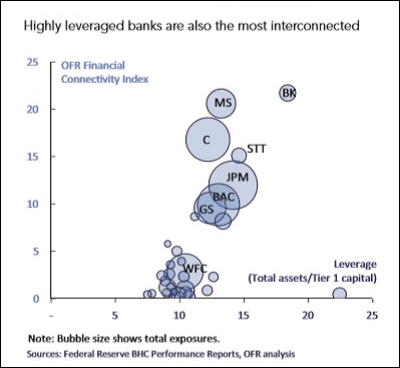
How could one bank, even one as big and global as JPMorgan Chase, bring down the whole financial stability of the United States? Because, as the U.S. Treasury’s Office of Financial Research (OFR) has explained in detail and plotted in pictures (see below), five big banks in the U.S. have high contagion risk to each other. Which bank poses the highest contagion risk? JPMorgan Chase.
The OFR study was authored by Meraj Allahrakha, Paul Glasserman, and H. Peyton Young, who found the following:
“…the default of a bank with a higher connectivity index would have a greater impact on the rest of the banking system because its shortfall would spill over onto other financial institutions, creating a cascade that could lead to further defaults. High leverage, measured as the ratio of total assets to Tier 1 capital, tends to be associated with high financial connectivity and many of the largest institutions are high on both dimensions…The larger the bank, the greater the potential spillover if it defaults; the higher its leverage, the more prone it is to default under stress; and the greater its connectivity index, the greater is the share of the default that cascades onto the banking system. The product of these three factors provides an overall measure of the contagion risk that the bank poses for the financial system.”
The Federal Reserve and FDIC are clearly fingering their worry beads over the issue of “liquidity” in the next Wall Street crisis. That obviously has something to do with the fact that the Fed has received scathing rebuke from the public for secretly funneling over $13 trillion in cumulative, below-market-rate loans, often at one-half percent or less, to the big U.S. and foreign banks during the 2007-2010 crisis. The two regulators released background documents yesterday as part of flunking the wind-down plans (living wills) of five major Wall Street banks. (In addition to JPMorgan Chase, plans were rejected at Wells Fargo, Bank of America, State Street and Bank of New York Mellon.) One paragraph in the Resolution Plan Assessment Framework and Firm Determinations (2016) used the word “liquidity” 11 times:
“Firms must be able to reliably estimate and meet their liquidity needs prior to, and in, resolution. In this regard, firms must be able to track and measure their liquidity sources and uses at all material entities under normal and stressed conditions. They must also conduct liquidity stress tests that appropriately capture the effect of stresses and impediments to the movement of funds. Holding liquidity in a manner that allows the firm to quickly respond to demands from stakeholders and counterparties, including regulatory authorities in other jurisdictions and financial market utilities, is critical to the execution of the plan. Maintaining sufficient and appropriately positioned liquidity also allows the subsidiaries to continue to operate while the firm is being resolved. In assessing the firms’ plans with regard to liquidity, the agencies evaluated whether the companies were able to appropriately forecast the size and location of liquidity needed to execute their resolution plans and whether those forecasts were incorporated into the firms’ day-to-day liquidity decision making processes. The agencies also reviewed the current size and positioning of the firms’ liquidity resources to assess their adequacy relative to the estimated liquidity needed in resolution under the firm’s scenario and strategy. Further, the agencies evaluated whether the firms had linked their process for determining when to file for bankruptcy to the estimate of liquidity needed to execute their preferred resolution strategy.”
Apparently, the Federal regulators believe JPMorgan Chase has a problem with the “location,” “size and positioning” of its liquidity under its current plan. The April 12 letter to JPMorgan Chase addressed that issue as follows:
“JPMC does not have an appropriate model and process for estimating and maintaining sufficient liquidity at, or readily available to, material entities in resolution…JPMC’s liquidity profile is vulnerable to adverse actions by third parties.”
The regulators expressed the further view that JPMorgan was placing too much “reliance on funds in foreign entities that may be subject to defensive ring-fencing during a time of financial stress.” The use of the term “ring-fencing” suggests that the regulators fear that foreign jurisdictions might lay claim to the liquidity to protect their own financial counterparty interests or investors.
JPMorgan’s sprawling derivatives portfolio that encompasses $51 trillion notional amount as of December 31, 2015 is also causing angst at the Fed and FDIC. The regulators wanted more granular detail on what would happen if JPMorgan’s counterparties refused to continue doing business with it if rating agencies cut its credit ratings. The regulators asked for a “narrative describing at least one pathway” for winding down the derivatives portfolio, taking into account a number of factors, including “the costs and challenges of obtaining timely consents from counterparties and potential acquirers (step-in banks).” The regulators wanted to see the “losses and liquidity required to support the active wind-down” of the derivatives portfolio “incorporated into estimates of the firm’s resolution capital and liquidity execution needs.” 
According to the Office of the Comptroller of the Currency’s (OCC) derivatives report as of December 31, 2015, JPMorgan Chase is only centrally clearing 37 percent of its derivatives while a whopping 63 percent of its derivatives remain in over-the-counter contracts between itself and unnamed counterparties. The Dodd-Frank reform legislation had promised the public that derivatives would all become exchange traded or centrally cleared. Indeed, on March 7 President Obama falsely stated at a press conference that when it comes to derivatives “you have clearinghouses that account for the vast majority of trades taking place.”
But the OCC has now released four separate reports for each quarter of 2015 showing just the opposite of what the President told the press and the public on March 7. In its most recent report the OCC, the regulator of national banks, states that “In the fourth quarter of 2015, 36.9 percent of the derivatives market was centrally cleared.”
Equally disturbing, the most dangerous area of derivatives, the credit derivatives that blew up AIG and necessitated a $185 billion taxpayer bailout, remain predominately over the counter. According to the latest OCC report, only 16.8 percent of credit derivatives are being centrally cleared. At JPMorgan Chase, more than 80 percent of its credit derivatives are still over-the-counter.

Wall Street Mega Banks Are Highly Interconnected: Stock Symbols Are as Follows: C=Citigroup; MS=Morgan Stanley; JPM=JPMorgan Chase; GS=Goldman Sachs; BAC=Bank of America; WFC=Wells Fargo.

Three of the five largest U.S. banks (JPMorgan Chase, Bank of America and Wells Fargo) have now had their wind-down plans rejected by the Federal agency insuring bank deposits (FDIC) and the Federal agency (Federal Reserve) that secretly sluiced $13 trillion in rollover loans to the insolvent or teetering banks in the last epic crisis that continues to cripple the country’s economic growth prospects. Maybe it’s time for the major newspapers of this country to start accurately reporting on the scale of today’s banking problem.

Wednesday, April 13, 2016

It Begins: Obama Forgives Student Debt Of 400,000 Americans

Tyler Durden's picture

http://www.zerohedge.com/news/2016-04-12/it-begins-obama-forgives-student-debt-400000-americans
Joining the ranks of "broke lawyers" who can cancel their student debt, "Americans with disabilities have a right to student loan relief,” now according to Ted Mitchell, the undersecretary of education, said in a statement. Almost 400,000 student loan borrowers will now have an easier path to a debt bailout as Obama primes the populist voting pump just in time for the elections.
On top of "the student loan bubble’s dirty little secret," here is another round of student debt relief...as MarketWatch reports,
The Department of Education will send letters to 387,000 people they’ve identified as being eligible for a total and permanent disability discharge, a designation that allows federal student loan borrowers who can’t work because of a disability to have their loans forgiven. The borrowers identified by the Department won’t have to go through the typical application process for receiving a disability discharge, which requires sending in documented proof of their disability. Instead, the borrower will simply have to sign and return the completed application enclosed in the letter.

If every borrower identified by the Department decides to have his or her debt forgiven, the government will end up discharging more than $7.7 billion in debt, according to the Department.

“Americans with disabilities have a right to student loan relief,” Ted Mitchell, the undersecretary of education, said in a statement. “And we need to make it easier, not harder, for them to receive the benefits they are due.”

About 179,000 of the borrowers identified by the Department are in default on their student loans, and of that group more than 100,000 are at risk of having their tax refunds or Social Security checks garnished to pay off the debt. Often borrowers losing out on these benefits aren’t even aware that they’re eligible for a disability discharge, said Persis Yu, the director of the Student Loan Borrower Assistance Project at the National Consumer Law Center.

“Borrowers just frankly don’t know about this program,” she said. “In the past it’s been incredibly complicated to apply and that process has been getting better over time, but some people just assume that it’s not going to work.” The letters will help make more borrowers aware of their rights, Yu said.
*  *  *
So it's a start - "broke lawyers" , "the poor" and "disabled Americans" get student debt relief. What about models that suddenly become too ugly to work? Or Petroleum Engineers no longer able to work because of The Fed's over-indulgent easy money creating a glut in oil prices? Don't they have a right to relief from their student debt? Seems like not granting students debt relief would violate all of their "safe spaces" - so cancel it all! Student Debt Jubilee here we come.
As we detailed previously, however, this is a drop in the bucket...
Borrowers hold $1.2 trillion in federal student loans, the second-biggest category of consumer debt, after mortgages. Of that, more than $200 billion is in plans with an income-based repayment option, according to the Department of Education and Moody’s Investors Service. For taxpayers the loans are "a slow-ticking time bomb," says Stephen Stanley, a former Federal Reserve economist who’s now chief economist at Amherst Pierpont Securities in Stamford, Conn.

The Congressional Budget Office estimates that, for loans originated in 2015 or after, the programs will cost the government an additional $39 billion over the next decade.
So that's a $39 billion taxpayer loss just on loans originated this year or later, and that could very well rise as schools begin to figure out that they can effectively charge whatever they want for tuition now that the government is set to pick up the tab for any balances borrowers can't pay (which incidentally is precisely what we said in March).
Consider that, then consider how much of the existing $200 billion pile of IBR debt will have to be written off and add in another $10 billion or so to account for for-profit closures and it's not at all unreasonable to suspect that taxpayers will ultimately get stuck with a bill on the order of $100 billion by the time it's all said and done and that's if they're lucky - if the "cancel all student debt" crowd gets its way, the bill will run into the trillions.
*  *  *
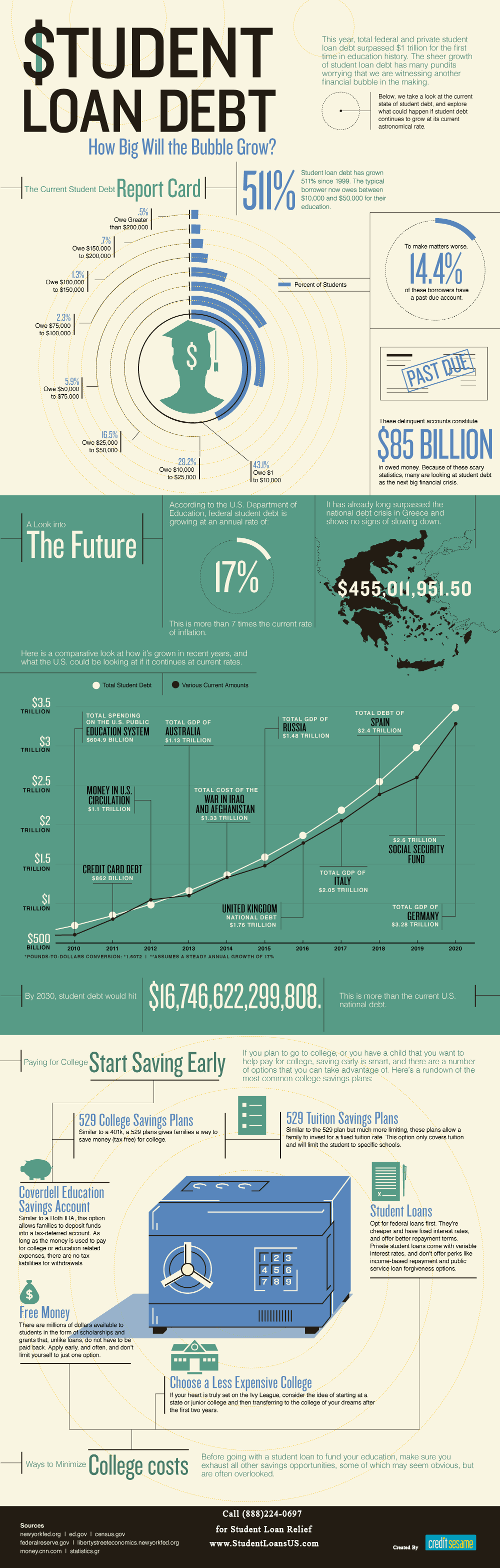
 And finally, as a reminder, if things don't change, Student Debt could be $17 trillion by 2030...
Student Loan Debt is a cancer for our society. This misconception that getting a college education equals a steady career has been dashed by the recession. For-profit colleges pray on undereducated and low-income individuals. Text book prices have risen exponentially while the cost of a quality education has as well.


Source: DailyInfographic.com
This industry of education is going backwards, and will one day burst.

Monday, April 11, 2016

Deutsche Bank Says World "Past The Point Of No Return" In The Default Cycle

Tyler Durden's picture

http://www.zerohedge.com/news/2016-04-11/deutsche-bank-says-world-past-point-no-return-default-cycle
Over the past year, the credit cycle finally turned, and has unleashed the latest default cycle. In fact, as BofA's Michael Contopoulos warned last week, it may be the worst default cycle in history with "cumulative losses over the length of the entire cycle could be worse than we’ve ever seen before."
Over the weekend, the FT got the memo with a report that "global company bond defaults at highest level since 2009" in which it said that "the global bond default rate by companies is running at its highest since 2009 with the US accounting for the vast majority, according to rating agency Standard & Poor’s. A further four defaults this week, with three coming from the troubled oil and gas sector, pushed the overall tally to 40 with a little over a quarter of 2016 done."
To be sure, the US default cycle is bad and getting worse. But how much worse?
The latest to attempt that answer is DB's Jim Reid who in his just released 18th annual default study explains why his "late cycle fears continue to build." These are some of the highlights:
There are clear signs the cycle is turning, especially in the US. Our US strategists have previously suggested that we need the combination of three conditions for us to be confident the next default cycle is imminent. We need the accumulation of excessive debt and preferably of deteriorating quality, some kind of external shock/trigger and tighter monetary policy/a flattening of the yield curve. The pieces of the jigsaw are building. US corporate debt accumulation now compares with that seen prior to previous default cycles. Equity volatility has seen two spikes in the last 12 months (August and early 2016), bank equity is falling (a lead indicator of lending?) and global yield curves continue to flatten.
* * *
The buildup of excess is often a pre-requisite for bubbles to burst or for economic cycles to be vulnerable to shocks. One argument for why this US economic cycle might still be able to run for a few years is that many economists feel that excess hasn’t been as prevalent as in prior cycles. However one can argue there has been a sizeable increase in US corporate debt since the GFC comparable to increases prior to previous default cycles. As Figure 15 shows, in the modern era of leveraged finance the debt cycle waves have been well correlated to defaults. We’ve used single-Bs to keep credit quality constant throughout and used Fed data to determine non-financial corporate debt/GDP.


Our US credit strategists measure the total growth of debt stock as well as its aggressiveness to determine whether there has been sufficient “material” created to feed the next wave of defaults. Figure 16 looks at the growth of the stock of US HY debt as well as the aggressiveness of new issuance. The former is measured by the combined size of the HY bond market (USD developed markets) and loans on U.S. bank balance sheets. The graph shows distinct periods of debt growth in the past, going back to the late 1980s, with each of the past three complete credit cycles preceded by waves of new debt creation, lasting from four to five and a half years, and resulting in cumulative debt stock growth of 53-68% (shaded areas). The current episode, measured since early 2011, has lasted 5.2 years and resulted in 64% growth in the combined value of the high yield bond market and loans on bank balance sheets, putting it comfortably inside the range of previous cycles. It shows a similar result to our own US corporate debt/GDP chart.


For a measure of aggressiveness in recent issuance trends, our US strategists look at CCC-rated issuance in HY and leveraged loans, as a percentage of total  market size, as shown in the right-hand graph of Figure 16. Volume is presented as a percentage of total market size (HY + loans), on a trailing-12- month basis. Shaded areas again highlight previous debt growth cycles, as well as the most recent one, with figures printed inside representing cumulative CCC issuance volume for the full duration of each episode, divided by the market size at its start. The previous two credit cycles, in the late 1990s and mid- to late 2000s, saw this indicator expand by 20% and 18%, respectively, compared to its present value of 17%. Unfortunately, there is a lack of detailed issuance data to extend this to the first cycle in the late 1980s.

The analysis is somewhat conservative in estimating the starting point of the current credit cycle to be January 2011. Arguably, the market was healing and perhaps even expanding in 2010, which would make these measurements of pre-requisite debt growth and aggressiveness look even more stretched here. We will nonetheless use the numbers shown above, as we aim to build our case for the timing of the next default cycle based on the more conservative assumptions.

We can therefore conclude that pre-requisites for the next default cycle are now in place.
From the conclusion:
The artificial ingredients keeping defaults below their 1983-2003 levels are still broadly in place so although we expect the next default cycle to be round the corner it could still be mild relative to the early 90s and early 00s cycle and even the already subdued 2009 cycle which was very short, especially given the economic wreckage seen.

As we’ve suggested in previous editions of this report, this is likely due to the increasing artificial demand for fixed income seen over the last 15-20 years which effectively allows more financing opportunities for levered companies at lower yields than they might be asked to pay if global fixed income markets were a perfectly free market where the only consideration was relative value. Over the last two decades, SWFs, pension funds, insurance companies, banks and more recently central banks in great size have distorted the demand for and yield of global fixed income. This is unlikely to change and although the Oil and Gas sector demonstrates that bad fundamentals can still win out, for more marginal companies, the artificial conditions in fixed income could still help prevent a more savage cycle.

Obviously the Oil and Gas sector will play a big part in determining the overall level of defaults and in a separate section our US strategists detail their expectations for defaults in this sector and how that will filter through into the wider US HY market.

It’s also true that credit spreads are relatively elevated and price in a default rate markedly higher than current levels. Indeed as we’ll see throughout the body of this report, at an aggregate level a buy-and-hold investor would need to see defaults worse than virtually all observed periods through history for them not to get a positive excess return relative to Government bonds from this starting point. However if we do see a recession even if defaults are relatively subdued the illiquidity of financial markets could easily see big mark-to- market losses. Recession tend to bring big overshoots in credit spreads relative to default risk anyway. So lower structural defaults may not provide comfort in the heat of the next recession but current spreads should give longer-term investors some comfort across the vast majority of sectors.
All of which perhaps explains why the ECB is well on its path to monetizing junk bonds once it is done with investment grade corporates.

Saturday, April 9, 2016

BofA Notices Something Troubling: China's Debt Bubble Has Burst

Tyler Durden's picture


http://www.zerohedge.com/news/2016-04-08/bofa-notices-something-troubling-chinas-debt-bubble-has-burst
It was just a few days ago when we covered most recently that China has created a subprime debt bubble of monstrous proportions. We explained that the exposure isn’t just within the conventional, state-backed banking system, but also within their "wild west" shadow banking system, which has introduced "investors" to a significant amount of risk. 
We know that it’s not a question of if, but when will the bubble finally pop (and as we show below, it already has) and introduce a new subprime (and debt in general) financial crisis for the world to deal with.
While it is sometimes difficult to get the data around just how significant a problem NPL defaults have become for China, and more specifically how the shadow banking lenders are faring, Bank of America has done some work to help give clarity around just that.
As BofAML shows below, defaults in the shadow banking sector have accelerated sharply, growing in both size and volume since late 2011.
And just like that, the relaxed credit policies in China, in their desperate desire to reinflate housing prices and stimulate the economy, have created a significant issue for the central planners to contend with , one which seems to be a recurring theme... Needless to say, the government is now scrambling to both suppress the number of defaults, and companies are even taking drastic measures to not have to report that they’re insolvent, but it may be too late.
Because as the chart above clearly shows, China's debt bubble has officially burst. It's all downhill from here.
BofA's David Cui explains:
We have noticed a sharp jump since mid-2015 in the total value of reported defaults of shadow banking products, defined here as non-bank-loan debt instruments that include bonds, trusts, and credit products offered by peer-to-peer (P2P) and various offline wealth management companies (WMCs). While the government and some involved parties are busily trying to suppress defaults, risk exists that at certain point the scale and scope of the task may overwhelm their efforts; which may trigger a credit crunch, in our view. Although the exact timing is difficult to forecast, as defaults pile up, the risk of the debt market reaching a psychological turning point should keep on rising by our assessment.

Chart 1 (above) shows the trend of defaulted value in the shadow banking sector, based on data we gathered on noticeable default cases since late 2011 as reported by the media. As of June 2015, the accumulated amount was Rmb53bn; by now, it’s reached Rmb214bn.

* * *

The government is clearly concerned about the risks in shadow banking. Just today, it’s reported that 1) NDRC had called upon issuers and underwriters of enterprise bonds to assess default risks; 2) the Shanghai municipal government had stopped registration of new WMCs, and will review certain existing ones; 3) the Asset Management Association of China (AMAC) will announce rules by the end of Apr to help investors identify illegal fund raising activities by privately raised funds; and 4) CSRC may require brokers to include their off-balance sheet businesses, including derivatives, in their risk assessment, including leverage. The question is whether the government is closing the stable door after the horse has bolted. We suspect that the answer is yes.
One couldn't make it any more convoluted, opaque and sadly, entertaining (for when it all unravels) if one tried.
It sounds like an enormous storm is brewing, and once again it’s a direct result of central planners convinced they know best not only how to run an economy, but that they will be able to fix everything once what is China's most historic debt bubble ever, burst. 
Or maybe, what we are told by overeager 17 year old hedge funds is true, and this time it’s different.

Tuesday, March 22, 2016

A Glimpse Of Things To Come: Canadian Oil Company Liquidates Hours After Bank Demands Repayment

Tyler Durden's picture

http://www.zerohedge.com/news/2016-03-22/glimpse-things-come-canadian-oil-company-liquidates-hours-after-bank-demands-repayme
Until recently, the bulk of the attention on the insolvent North American oil and gas sector fell squarely on the US. That is starting to change for two reasons: first, Canada's regulator just ended the cute game (first profiled here) Canadian banks had been playing for years by reserving zero of their potential loan losses to the collapsing energy sector; second, slowly but surely Canadian oil and gas failures are starting to become a daily reality; failures such as that of Canadian junior oil and gas producer Terra Energy Corp which yesterday said it shut down production, ceased operations and announced the resignation of directors and officers on Monday, after its lender, Canadian Western Bank, demanded full repayment of its debt.


And that's all it takes: one simple debt acceleration, which has led to the shuttering of Terra, and which would send thousands of insolvent energy companies into bankruptcy overnight. For now, most such insolvent companies continue to exist as zombies, many of which can't even afford an interest payment, but which after the direct intervention of the Dallas Fed and the OCC (which as we exclusively reported bought the insolvent sector a brief reprieve when it demanded that banks not force debtors to repay) continue to exist as the Fed is terrified of the default tsunami that would be unleashed once the bankruptcies finally arrive, as they will.
As for the now defunct Canadian junior, according to Reuters, Terra, which was producing around 3,600 barrels of oil equivalent per day from its operations in western Alberta and north-eastern British Columbia, said that at current low oil prices the cost of operating was more than its revenue.
Oops.
Reuters adds that since September 2015, Terra has sold off around C$12 million in oil and gas assets to help pay down debt, but clearly the amount was not enough to cover all its liabilities.
Terra also said the asset sales in Alberta were hampered by the company having a liability management rating of below one - the ratio that regulators use to assess whether a company's revenues cover the cost of fully reclaiming all its oil wells.
Liability management ratings and oil well liabilities are becoming an increasingly hot topic in Alberta, where lawyers have warned buyer concerns over reclamation costs tied to inactive wells are disrupting energy asset sales.
The company is the latest Canadian producer to fall victim to the prolonged slump in global crude prices.
This happened after one bank decided that throwing good money after bad is no longer feasible, no matter how much pressure US or Canadian regulators put on it, namely Canadian Western Bank, which served notice on Friday demanding repayment in full of the C$15.9 million ($12.18 million) owed by the company by March 28.
"The company's lender has declined to provide further financial support to Terra and there is no other means of financing available to the company at this time," Terra said in a statement on its website.
The ironic thing is that the lender knew the recovery on its loan will be negligible - if any - and yet it still pulled the plug, refusing to comply with the charade that "all is well" any more. According to Reuters, Canadian Western Bank has not announced a receiver to sell Terra's assets. A source with direct knowledge of the matter said no receiver had been appointed because Canadian Western Bank is concerned the receivership process would not be worth the cost to the bank.
That's right: the bank believes it would spend more on the process of liquidating Terra than it would collect in the end of the day.
"They are worried they will not find any (asset) purchasers because of economic and regulatory problems," said the source, who declined to be named because of client confidentiality.
Canadian Western Bank declined to comment on the matter; after all what can it say - "we should have defaulted Terra much earlier when we still had a chance of recovering something?"
Prepare to hear this lament far more often in the future as banks ask themselves why they allowed zombie shale companies - like Terra - to pretend they are alive for as long as they have.

Monday, January 18, 2016

Wells Fargo's Problem Emerges: $17 Billion In Junk Energy Exposure

Tyler Durden's picture

http://www.zerohedge.com/news/2016-01-17/wells-fargos-problem-emerges-17-billion-junk-energy-exposure
When Wells Fargo reported its Q4 earnings last week, the one topic analysts and investors wanted much more clarity on, was the bank's exposure to oil and gas loans, and much more color on its energy book over concerns that Wells, like most of its peers, was underestimating the severity of the upcoming shale default wave.
And while the company's earnings call indeed reveals that things are deteriorating rapidly in Wells energy book, perhaps an even bigger concern for Wells investors, which just happens to be the largest US mortgage lender, should be what is going on with its mortgage book. The answer: nothing. In fact, at $64 billion in mortgage applications in the quarter, this was not only a major drop from Q3, but also the lowest since the first quarter of 2014.


Needless to say, without significant growth in Wells' mortgage pipeline and originations, there can be no upside to Wells Fargo stock, meanwhile one can kiss the so-called housing recovery goodbye for the final time, because now that the US Treasury is cracking down on criminal and money laundering "all cash" buyers, we fully expect the housing industry to grind to a near halt in the coming 2-3 quarters.
That covers the lack of upside. As for the substantial downside, here are the key parts from Wells Fargo's conference call discussing the bank's energy exposure.
First: how big is Wells' loan loss allowance for energy:
We've considered the challenges within the energy sector and our allowance process throughout 2015 and approximately $1.2 billion of the allowance was allocated to our oil and gas portfolio. It's important to note that the entire allowance is available to absorb credit losses inherent in the total loan portfolio.
Then, from the Q&A, how much is Wells' total loan exposure, its fixed income and equity exposure toward energy:
I would use $17 billion as outstandings  for energy loans. And for securities, I would use, call it, $2.5 billion which is the sum of AFS securities and non-marketable securities.
In other words, a 7% loan loss reserve toward energy, perhaps the highest on all of Wall Street.
Then, here is the breakdown by services:
We're focused on the whole thing. Half of  those customers - half of those balances represent E&P companies, upstream companies. A quarter of them represent oilfield services companies, and a  quarter of them represent pipelines and storage and other midstream activity. And it excludes what I would describe as investment grade sort of diversified larger cap companies where we don't view the credit exposure as quite the same.
But the "downside risk" punchline was the following exchange with Mike Mayo:
<Q - Mike L. Mayo>: What percent of the $17 billion is not investment grade?

<A - John R. Shrewsberry>: I would say most of it. Most of it.

<Q - Mike L. Mayo>: So most of the $17 billion is non-investment grade.

<A - John R. Shrewsberry>: Correct.
To summarize: $17 billion in oil and energy exposure, which has a modest $1.2 billion, or 7%, loss reserve assigned to it (the highest on the street mind you), and which is made up "mostly" of junk bonds.
Why could the be concerning? Well, one reason is that junk yields just surpassed the all time highs set just after the Lehman bankruptcy.

In retrospect we can see why the Dallas Fed told banks to stop marking assets to market.
As for Wells, Warren Buffett may want to take another bath in the coming days.
Source: Wells Fargo Q4, 2015 Conference Call

Tuesday, October 27, 2015

Why A Russian Default Is A Very Real Scenario In 2016

Tyler Durden's picture

http://www.zerohedge.com/news/2015-10-27/why-russian-default-very-real-scenario-2016
Submitted by Marin Katusa via KatusaResearch.com,
Debt.
Everyone understands it pretty well when it comes to their personal finances. You borrow money, you have to pay it back. If you can’t, your creditor hounds you until you either come up with the cash or restructure your repayment schedule. Or, worst case, you eventually file for bankruptcy, thereby defaulting on your debt. Simple.
Yet people, especially in the West, seem blithely unaware that the same basic principles apply to countries, as well. Most of us tend to think that nations can’t or won’t default on their debt. Well … maybe Greece will. But surely not a big country.
Why we believe this is partly due to an ignorance of history, which features literally countless defaults, among nations great and small. Even the US has done it. More than once. It happened right at the beginning, in 1779, when the fledgling US nation defaulted on its first currency, the Continental (which led to widespread use of an early American pejorative phrase: “not worth a Continental.”) And a very recent example was when Nixon severed the tie between gold and the dollar in 1971; that was a default on the precious metal debt the country owed to France and others.
It’s also partly due to the current financial behavior of the American government, which acts as if the cure for a debt problem is more debt (do not try this at home, by the way).  As Congress raises the federal debt ceiling, and the Federal Reserve creates ever more currency units out of thin air, it creates the illusion of stability. All it’s really doing, though, is just kicking the can down the road.  The US has placed itself firmly on this path. But that doesn’t ensure that the rest of the world’s nations can or will follow the same one.
Particularly Russia.
In 2014, I published The Colder War, which became a New York Times Bestseller.  Vladimir Putin, Russia, oil and energy were all dissected in my book, which today is every bit as timely as it was when I wrote it in 2013.  Because of the decade I spent researching the book, I have a very unique Westerner’s perspective on Russia.
Here’s one of the things I learned: Russia is completely unafraid of a default on its debt.
Russia was a basket case in the 1990’s.  The first war in Chechnya was a disaster, both economically and psychologically for the Russians.  Russia not only lost that war, it had a disaster of an economy, ran a huge governmental budget deficit, and was stuck with a very unfavorable fixed exchange rate between the ruble and the currencies of all its trading partners. The country was barely staying afloat.
Then, on top of all that, came the two additional straws that finally broke the Bear’s back: the Asian financial crisis and a crash in oil prices.
But the West totally mis-guessed the eventual outcome. The World Bank and the IMF arrogantly assumed the Russians would continue to play by their rules.  In fact, years later it was leaked that billions in IMF relief funds had headed east, where they were “misplaced.” Or, in laymen’s terms, stolen before they even hit the Russian bank accounts.
On August 17, 1998, the so-called “Russian flu” infected world markets. Moscow announced that a moratorium would be placed on payments to foreign creditors. In addition, the ruble was devalued by 33% (from 7.1RUR/USD to 9.5RUR/USD).  Within a few months, the government allowed the ruble to float freely and the currency devalued by another 120% to 21RUR/USD.  There were bank closures, political fall guys and rabid inflation.
The Russian oligarchs, many of them ruthless criminals, made their moves—and consolidated their wealth at levels that would make the American robber barons blush.
Into this chaos, in 1999, entered Vladimir Putin—one of the most mischaracterized politicians on the planet. An archetypal Russian strong man, he brutally squashed the Chechen revolt and moved decisively to bring the oligarchs under state control, which meant killing or imprisoning them, or driving them into exile. Most importantly, he committed massive resources to reviving an energy sector that had fallen into disrepair, and made it quasi-public with companies headed up by his buddies and inner circle. As prices moved upwards, Russian crude oil output expanded like crazy to become #1 in the world and the economy boomed, as did Putin’s global agenda.
Through a series of deft political maneuverings, Putin still controls Russia 16 years later.  During that time, he has stayed enormously popular among his countrymen despite policies that Westerners (and some dissenting Russians) find reprehensible. His prolonged supremacy is quite a feat, given how the byzantine nature of Russian politics laid low any number of his predecessors.  But he’s done it by persuading the mass of the people that he always acts in what he sees as the best way to push Mother Russia to the head of the table among nations, and that in that pursuit he’s willing to let all manner of chips fall where they may.
Today, Russia is in crisis again, having been hit with the double whammy of plummeting energy prices and heavy sanctions laid on by the West over Putin’s foreign policy. Given the country’s struggling economy, it’s puzzling why the world is ignoring the risk of Russia defaulting on its debt. Again. And why it may be underestimating Putin. Again.
Why a Russian Default is a very real scenario in 2016
The IMF is loaning billions to Ukraine.  In addition, NATO is spending billions in Ukraine on a war that has lasted longer than any US or NATO official expected.  The West, led by the US, has put national sanctions on Russia, and personal ones on many of Putin’s associates—despite a clear historical record that shows sanctions almost never achieve their stated ends.
To understand how misguided this is, you just have to ask one question: Who holds the majority of the debt that would be at risk in a Russian default? Not China.  Not Iran.  Not Syria.  No, it’s the exact same nations, and banks and funds within those nations, that are applying the sanctions against Russia.
So, if Russia does default, what does it mean in terms of its political relationship with the West?
Nothing.
But what does it mean to its creditors?
Everything.
They’re the ones who will take the hit. And by the way, to anyone who thinks they will be able to enforce their nation’s debt laws on the Russian government or any Russian companies, I have this to say: I wish you the best of luck.
Don’t buy my story?
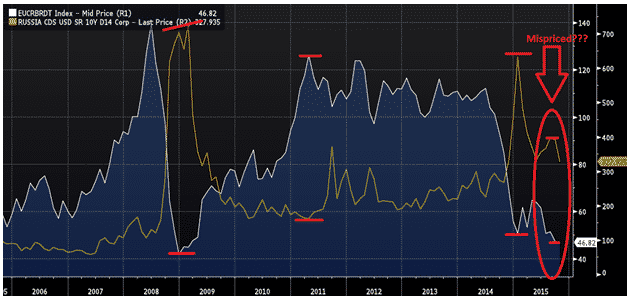
Here is a chart of Brent Oil pricing verses the 10-year Russian credit default swaps (CDS).
The market is completely mispricing the Russian CDS, by totally ignoring the potential for a Russian Default.
For comparison purposes, in the oil crash of late 2008 early 2009, Russian CDS popped 600% to over 7%. (The CDS market can be a bit complicated, but in general terms, the higher the rate, the more perceived risk is being priced into the market.)
Even earlier this year, with the Brent price of oil trading higher than it does now, the CDS were 100% more expensive. But they’ve since fallen to around 3%, which is absurd, as oil is lower now than when the CDS were at 100% higher rate—therefore if the market was paying attention, CDS should have a “higher” rate now than earlier this year.
10yrRuscds
The market is assuming that Putin will play by the western bankers’ rules; therefore there is no fear that the Russians might default on their debt.
Otherwise, there’s no reason Russian CDS would be 50% lower than earlier this year, given the fall in the price of oil, which is critical to their economy.
Has something else changed?
Are we in some better place globally now? I highly doubt it for many reasons, but how about I just mention one horrific fact: the world has never seen more displaced persons—ever— than we currently have at over 60 million.
Or has Putin merely distracted the Western world by diverting its interest to Ukraine and Syria?
Those are relatively small items on Russia’s policy agenda. Putin’s real focus is on strengthening his country’s economy by ramping up business with China and the emerging markets. That is where the future lies. If Putin can’t entirely eliminate all dependence on the West, he’s certainly moving forcefully to greatly diminish its influence.
The $400 billion natural gas deal he signed with China in 2014 is just one powerful indicator.
In a few words, if Putin believes that the benefits of a default outweigh the consequences to his country, he won’t hesitate to do it, no matter the international ruckus it might raise.
So … my advice is that if you are invested in any funds or banks that are exposed to debt in Russia, I would rethink your investment thesis. The rules of the game are apt to change quickly, and not to the foreign debt holders’ benefit.
And, if you like ironic coincidences, I’ll close with this one.
Donald Trump is the current leader for the Republican presidential nomination. During his business career, he’s helmed four companies that filed for Chapter 11. Which just happens to be the same number of Russian bankruptcies that have occurred during ‘The Donald’s’ lifetime.
Who knows, ‘The Donald’ and Putin might end up the best of friends…

Wednesday, October 21, 2015

We Didn't "Financially Engineer" Our Way Out Of The Great Depression, We Won A World War

Tyler Durden's picture


Excerpted from Artemis Capital Management letter to investors,
The arms race of devaluation is not free and has come at the cost of massive global debt expansion. There is no precedent in financial history for a robust economic recovery absent either debt reduction or rampant inflation.  We never deleveraged, in fact we just doubled down. According to a recent McKinsey study the world has reached $200 trillion of debt in 2014 (286% of global GDP), which is a staggering 40% increase from 2007 levels (+$57 trillion). In China, debt has grown four times faster than GDP since 2007, and half of that debt is linked to their property market. The world has simply shifted private debt to the public balance sheet.

The private risk transfer to the public balance sheet can also be seen in the evolution of credit default swap pricing since 2007. Notice the sharp divergence between global sovereign CDS (red) and financial corporate CDS (blue) starting in 2013. The next major global crash will likely be driven by unhealthy sovereign credit rather than corporate credit. The next Lehman moment will be the financial collapse of a major developed country instead of a bank.

There are those who point to aggressive central banking of the late-1930s as the model for de-leveraging post-depression but this argument is highly flawed.
We didn’t financially engineer our way out of the Great Depression - we won a World War.

It’s extremely helpful in the de-leveraging process if you are the only capitalist industrial power left in the world untouched by utter and complete destruction. De-leveraging from the Great Depression had as much to do with the blood, sweat, and tears of American soldiers, the development of nuclear weapons, and the fact we were an ocean removed from the battlefield on both sides, as anything related to fiscal and monetary policy from the era.
I don’t think some investors are being radically honest when they omit this brutal truth in their analysis of late-1930s as model to argue for more quantitative easing. More quantitative easing is a great thing if you run a large risk parity fund but it will not help the American middle class.

Monday, September 7, 2015

The "Great Unwind" Has Arrived

Tyler Durden's picture

 http://www.zerohedge.com/news/2015-09-06/great-unwind-has-arrived
It’s my overarching thesis that the world is in the waning days of a historic multi-decade experiment in unfettered finance. As I have posited over the years, international finance has for too long been effectively operating without constraints on either the quantity or the quality of Credit issued. From the perspective of unsound finance on a globalized basis, this period has been unique. History, however, is replete with isolated episodes of booms fueled by bouts of unsound money and Credit - monetary fiascos inevitably ending in disaster. I see discomforting confirmation that the current historic global monetary fiasco’s disaster phase is now unfolding. It is within this context that readers should view recent market instability.
It’s been 25 years of analyzing U.S. finance and the great U.S. Credit Bubble. When it comes to sustaining the Credit boom, at this point we’ve seen the most extraordinary measures along with about every trick in the book. When the banking system was left severely impaired from late-eighties excess, the Greenspan Fed surreptitiously nurtured non-bank Credit expansion. There was the unprecedented GSE boom, recklessly fomented by explicit and implied Washington backing. We’ve witnessed unprecedented growth in “Wall Street finance” - securitizations and sophisticated financial instruments and vehicles. There was the explosion in hedge funds and leveraged speculation. And, of course, there’s the tangled derivatives world that ballooned to an unfathomable hundreds of Trillions. Our central bank has championed it all.
Importantly, the promotion of “market-based” finance dictated a subtle yet profound change in policymaking. A functioning New Age financial structure required that the Federal Reserve backstop the securities markets. And especially in a derivatives marketplace dominated by “dynamic hedging” (i.e. buying or selling securities to hedge market “insurance” written), the Fed was compelled to guarantee “liquid and continuous” markets. This changed just about everything.
Contemporary finance is viable only so long as players can operate in highly liquid securities markets where price adjustments remain relatively contained. This is not the natural state of how markets function. The bullish premise of readily insurable/hedgeable market risks rests upon those having written protection being able to effectively off-load risk onto markets that trade freely without large price gaps/dislocations. And, sure enough, perceptions of liquid and continuous markets do create their own reality (Soros’ reflexivity). Sudden fear of market illiquidity and dislocation leads to financial crashes.
U.S. policymaking and finance changed profoundly after the “tech” Bubble collapse. Larger market intrusions and bailouts gave way to Federal Reserve talk of “helicopter money” and the “government printing press” necessary to fight the scourge of deflation. Mortgage finance proved a powerful expedient. In hindsight, 2002 was the fateful origin of both the historic mortgage finance Bubble along with “do whatever it takes” central banking. The global policy response to the 2008 Bubble collapse unleashed Contemporary Finance’s Bubble Dynamics throughout the world - China and EM in particular.
There are myriad serious issues associated with New Age finance and policymaking going global. The bullish consensus view holds that China and EM adoption of Western finance has been integral to these economies’ natural and beneficial advancement. Having evolved to the point of active participants in “globalization,” literally several billion individuals have the opportunity to prosper from and promote global free-market Capitalism. Such superficial analysis disregards this Credit and market cycles’ momentous developments.
The analysis is exceptionally complex – and has been so for a while now. The confluence of sophisticated finance, esoteric leverage, the highly speculative nature of market activity and the prominent role of government market manipulation has created an extremely convoluted backdrop. Still, a root cause of current troubles can be boiled down to a more manageable issue: “Contemporary finance” and EM just don’t mix. Seductively, the two appeared almost wonderfully compatible - but that ended with the boom phase. For starters, the notion of “liquid and continuous” markets is pure fantasy when it comes to “developing” economies and financial systems. As always, “money” gushes in and rushes out of EM. Submerged in destabilizing finance, EM financial, economic and political systems become, as always, overwhelmed and dysfunctional. And as always is the case, the greater the boom the more destabilizing the bust.
In general, reckless “money” printing has over years produced a massive pool of destabilizing global speculative finance. Simplistically, egregious monetary inflation (along with zero return on savings) ensured that there was way too much “money” chasing too few risk assets. Every successful trade attracted too much company. Successful strategies spurred a proliferation of copycats and massive inflows. Strong markets were flooded with finance. Perceived robust economies were overrun. Popular regions were completely inundated. To be sure, the post-crisis “Global Reflation Trade” amounted to history’s greatest international flow of speculative finance. Dreadfully, now comes The Unwind.
From individual trades, to themes to strategic asset-class and regional market allocations, speculative “hot money” flows have reversed course. Global deleveraging and de-risking have commenced. The fallacy of “liquid and continuous” markets is being exposed. Faith that global central bankers have things under control has begun to wane. And for the vast majority in the markets it remains business as usual. Another buying opportunity.
Whether on the basis of an individual trade or a popular theme, boom-time success ensured that contemporary (trend-following and performance-chasing) market dynamics spurred speculative excess and associated structural impairment. They also ensured latent Crowded Trade fragilities (notably illiquid and discontinuous “risk off” markets).
Crowded Trade Dynamics ensure that a rush for the exits has folks getting trampled. Previous relationships break down and time-tested strategies flail. “Genius” fails. When the Crowd decides it wants out, the market turns bereft of buyers willing and able to take the other side of the trade. And the longer the previous success of a trade, theme or strategy the larger The Crowd - and the more destabilizing The Unwind. Previous performance and track records will offer little predictive value. Models (i.e. “risk parity” and VAR!) will now work to deceive and confound.
Today, a Crowd of “money” is rushing to exit EM. The Crowd seeks to vacate a faltering Chinese Bubble. “Money” wants out of Crowded global leveraged “carry trades.” In summary,the global government finance Bubble has been pierced with profound consequences. Of course there will be aggressive policy responses. I just fear we’ve reached The Unwind phase where throwing more liquidity at the problem only exacerbates instability. Sure, the ECB and BOJ could increase QE – in the process only further stoking king dollar at the expense of faltering energy, commodities, EM and China. And the Fed could restart it program of buying U.S. securities. Bolstering U.S. markets could also come at the expense of faltering Bubbles around the globe.
It has been amazing to witness the expansion of Credit default swap (CDS) markets to all crevices of international finance. To see China’s “shadow banking” assets balloon to $5 Trillion has been nothing short of astonishing. Then there is the explosion of largely unregulated Credit insurance throughout Chinese debt markets – and EM generally. I find it incredible that Brazil’s central bank would write $100 billion of currency swaps (offering buyers protection against devaluation). Throughout it all, there’s been an overriding certitude that policymakers will retain control. Unwavering faith in concerted QE infinity, as necessary. The fallacy of liquid and continuous markets persisted so much longer than I ever imagined.
I feel I have a decent understanding of how the Fed and global central bankers reflated the system after the 2008 mortgage finance Bubble collapse. The Federal Reserve collapsed interest-rates to zero, while expanding its holdings (Fed Credit) about $1 Trillion. Importantly, the Fed was able to incite a mortgage refinance boom, where hundreds of billions of suspect “private-label” mortgages were transformed into (money-like) GSE-backed securities (becoming suitable for Fed purchase). The Fed backstopped the securities broker/dealer industry, the big banks and money funds. Washington backed Fannie, Freddie and the FHLB, along with major derivative players such as AIG. The Fed injected unprecedented amounts of liquidity into securities markets, more than content to devalue the dollar. Importantly, with the benefit of international reserve currency status and debt denominated almost exclusively in dollars, U.S. currency devaluation appeared relatively painless.
These days I really struggle envisaging how global policymakers reflate after the multi-dimensional collapse of the global government finance Bubble. We’re already witness to China’s deepening struggles. Stimulus over the past year worked primarily to inflate a destabilizing stock market Bubble that has gone bust. They (again) were forced to backtrack from currency devaluation. Acute fragilities associated both with massive financial outflows and enormous amounts of foreign currency-denominated debt were too intense. Markets are skeptical of Chinese official signals that the renminbi will be held stable against the dollar. Market players instead seem to be interpreting China’s efforts to stabilize their currency as actually raising the probability for future abrupt policy measures (significant devaluation and capital controls) or perhaps a highly destabilizing uncontrolled breakdown in the peg to the U.S. dollar.
And as China this week imposed onerous conditions on some currency derivative trading/hedging, it’s now clear that Chinese officials support contemporary market-based finance only when it assists their chosen policy course. How long will Chinese officials tolerate bleeding the nation's international reserves to allow “money” to exit China at top dollar?
...
I wholeheartedly agree with the statement “technical factors can push the market away from fundamentals.” Indeed, that’s been the case now for going on seven years. A confluence of unprecedented monetary inflation, interest-rate manipulation, government deficits and leveraged speculation inflated a historic divergence between securities markets Bubbles and underlying fundamentals. The global Bubble is now faltering. Risk aversion is taking hold. De-leveraging is accelerating.
The yen jumped 2.2% this week. Japanese stocks were hit for 7%. The Brazilian real sank 7.3%. The South African rand dropped 4.2%. The Turkish lira dropped another 2.9% and the Russian ruble sank 5.0%. China sovereign CDS surged, pulling Asian CDS higher throughout. The Hang Seng China H-Financials Index sank another 7.4% this week, having now declined 39% from June highs. From my vantage point, market action points to serious unfolding financial dislocation in China. It also would appear that a large swath of the leveraged speculating community is facing some real difficulty.
After a rough trading session and an ominous week for global markets, I was struck by Friday evening headlines. From the Wall Street Journal: “An Investor’s Field Guild to Bottom Fishing;” “Global CEOs See Emerging Markets As Rich With Opportunity.” From CNBC: “Spike in Volatility Creates ‘Traders Paradise.” And from the Financial Times: “Wall Street Waiting for Those Buy Signals;” “Time to Buy EM Stocks, History Suggests;” “Why I’m Adding Emerging Markets Exposure Despite China Wobble;” “G20 Defies Gloom to Forecast Rise in Growth.”
There still seems little recognition of the seriousness of the unfolding global market dislocation. It’s destined to be a wrenching bear market – at best.

Thursday, August 6, 2015

JPMorgan Helps Comex Avoid Gold Depletion, Boosts Registered Gold By 78% Overnight (smells fishy)

Tyler Durden's picture

http://www.zerohedge.com/news/2015-08-06/jpmorgan-helps-comex-avoid-gold-depletion-concerns-boosts-registered-gold-78-overnig
Earlier this week, when observing the most recent drop in Comex registered gold as a result of a reclassification by the gold vaults of JPM and Brink's of 25,386 ounces of registered gold into eligible (alongside the withrawal of 200,752 ounces of eligible gold from JPM), we wondered if Comex "may be on the edge" since after the adjustment, Comex registered gold had dropped to a never before seen low of just over 10 tons, resulting in record high gold coverage ratio of 124 ounces in outstanding gold open interest for every ounce of physical.


To be sure, we had no explanation for the drop, but we did muse that "the mainstream press will once again start paying close attention to the total, and especially registered, gold held at the Comex: at a pace of 25K a day, the gold vaults that make up the CME's vaulting system would be depleted in just under two weeks of daily withdrawals."
And while the mainstream press has certainly not opined on the peculiar events at the Comex, we have been paying particularly close attention to the daily Comex gold updates, and is probably why we were less than surprised to see that just 2 days after our report, the Comex once again succeeded in sweeping default fears under the rug by boosting its eligible gold by a whopping 78% overnight, from 362K ounces to 643K, thereby pushing deliverable gold from its all time lows.


However, this was not achieved with an infusion of actual new gold into the Comex, but thanks to JPM reclassifying 276K ounces of gold from the Eligible into the Registered category, even as actual eligible gold continues quietly hemmorhaging out of the Comex.

So the gold can was kicked again, but for how long? And will JPM be as eager to continue "adjusting" eligible gold into registered if the recent trend in gold redemptions not just in its vault, but across all Comex gold warehouses continues?
For the answer, keep checking this website around 3pm every day for all the latest gold moves in and out of the Comex.

Tuesday, July 14, 2015

Complete Humiliation: Greek Parliament Pressed To "Approve" German "Coup"

Tyler Durden's picture

http://www.zerohedge.com/news/2015-07-14/complete-humiliation-greek-parliament-pressed-approve-german-coup
Months ago we said the following about the future of Greek politics:
It is becoming increasingly clear that the Syriza show will ultimately have to be canceled in Greece (or at least recast) if the country intends to find a long-term solution that allows for stable relations with European creditors although it may be time for Greeks to ask themselves if binding their fate to Europe is in their best interests given that some EU officials seem to be perfectly fine with inflicting untold economic pain upon everyday Greeks if it means usurping the 'radical leftists.'
At the risk of overstating the case, that assessment has now proven to be almost entirely accurate.
Greeks did indeed ask themselves if they wished to bind their fate to European "partners" who seem bent on punishing the country for its decision at the ballot box in January and nearly two-thirds of Greeks said the terms of continued EMU membership as presented by creditors were unacceptable.
Despite that clear mandate, PM Alexis Tsipras declined what some (The Telegraph’s Abrose Evans-Pritchard for one) have suggested was a better option in German FinMin Wolfgang Schaeuble’s 5-year, Brussels managed, “time-out”, in favor of a deal so bad that it might have only been proposed because no one thought he would accept it.
Now, Tsipras must push that deal through a Greek parliament where Syriza party hardliners - who tabled a proposal to default and exit the euro months ago - are quite simply beside themselves. The likely result: a party reshuffle and a recasting of the Syriza show, exactly as we said. Here’s Bloomberg with more on the political infighting:
Greek Prime Minister Alexis Tsipras faces two days of parliamentary maneuvering in Athens to secure approval for a package of austerity measures that threatens to break his coalition apart.

With all 18 fellow euro-area governments looking on, Tsipras is set to submit a bill to parliament on Tuesday containing sales-tax increases and pension cuts that go against his own Syriza party’s pledges. The legislation, to be voted on Wednesday, is a precondition for creditors to begin talks on a new loan of as much as 86 billion euros ($94 billion).

Dozens of Syriza lawmakers have said they will rebel against the cuts, forcing Tsipras to rely on opposition support to carry the legislation needed to keep Greece in the euro. Panos Kammenos, the defense minister and leader of Tsipras’s Independent Greeks junior coalition partner, said his lawmakers will only back those measures agreed by Greek political leaders and not those imposed by creditors, which he denounced as an attempted "coup d’etat."

"Despite potential defections" among the coalition "we think the deal will be approved with the support of opposition parties," Roubini Global Economics analysts led by Nouriel Roubini said in a note to clients. Yet the legislation means Greece "will have to endure significant austerity measures and other types of reforms, all of which are hard to implement, hard to reinforce and possibly hard for the public to accept."
And more color from FT:
Greek prime minister, on Tuesday will seek to shore up support within his own government after he accepted the most intrusive programme ever mounted by the EU as the price for a new €86bn bailout to keep Greece in the eurozone.

Mr Tsipras looks set to be forced to rely on opposition support to pass a swath of economic reform measures by Wednesday’s EU-imposed deadline or face the country’s bankruptcy, as a growing number of far-left MPs voiced opposition to the deal. The ruling Syriza party’s extremist Left Platform called it a "humiliation of Greece".

The leader of the Independent Greeks, the rightwing coalition partner, also said that his party could not agree to the accord, calling it a "coup by Germany" and its hardline eurozone allies, the Netherlands and Finland.

Marina Chrysoveloni, the Independent Greeks spokeswoman, said on state TV on Tuesday there were “limits” to the party’s support for the government “that are shaped by the mandate of the Greek people, both in January’s elections and in the referendum”.

Greek political leaders said the legislation was not at risk of failing because it had wide support of mainstream opposition lawmakers, who would make up any government defections in the 300-member legislature.

But the insurrection called into question how long Mr Tsipras could survive as prime minister once the legislation was passed. Nikos Filis, Syriza’s parliamentary spokesman, called on any government MPs who did not back the plans to resign.

With 17 government MPs failing to support a far more limited plan offered by Mr Tsipras last week, the prime minister seemed almost certain to lose his parliamentary majority, which currently stands at 12. Some analysts believe that the number of rebels could swell to as many as 30. Already, 15 far-left Syriza MPs who voted for Mr Tsipras’s plan last week have said they would not make similar commitments in the future.

Panagiotis Lafazanis, the Syriza energy minister, on Tuesday branded the agreement "unacceptable". In an emailed statement he said the deal “cancels the popular mandate and the proud ‘NO’ of the Greek people in the referendum”.
As is clear from the above - and from Yanis Varoufakis' "impressionistic" first thoughts on the Greek deal which we posted here earlier - every lawmaker in Athens is now fully aware of the fact that what has happened to Greece is nothing short of a ruthless political coup executed by Germany. The writing has been on the wall for some time and indeed we outlined the entire plan in "Democracy Under Fire: Trokia Looks To Force Greece Political Reshuffle."
In short, we’ve said for months now that come hell, high water, or "Grimbo," Germany was going to extract its pension cuts and VAT hikes from Tsipras, and not because anyone seriously thinks it will make a difference in terms of putting the country on a 'sustainable' path, but because the EU simply cannot afford for Syriza sympathizers in more economically consequential countries like Spain to get any ideas about rolling back austerity (of 'fauxsterity' as it were) and using EMU membership as a bargaining chip.
And even as the IMF (with Washington's blessing) "suggests" that Germany "mark it zero," it may be too late to preserve democracy in the periphery because as you can see from the following, Schaeuble appears to have gotten his point across:
Greece and Spain are 2 different economies that require different strategies, Nacho Alvarez, Podemos’s economic policy chief, said Tuesday in Madrid. Alvarez says change doesn’t necessarily mean restructuring of public debt.

Tuesday, July 7, 2015

The Biggest Winner From The Greek Tragedy

Tyler Durden's picture


http://www.zerohedge.com/news/2015-07-06/who-biggest-winner-greek-tragedy
Long after Greece has left the Eurozone and Germany is using the Deutsche Mark as its currency, the people of the two nations, antagonized to a level unseen since World War II, will be accusing each other of benefiting more from the brief but tumultuous period of the common currency.
In reality, nobody had put a gun to Greece's head and told it to lever up, enriching local oligarchs and corrupt politicians, taking advantage of credit that was artificially cheap only due to the common currency and an implicit monetary, if not fiscal, union.
Germany, whose exports account for nearly 50% of GDP, on the other hand experienced an unprecedented exporting golden age, made possible only due to an artificial currency, the Euro, that was by definition created to be weaker than the Deutsche Mark and benefitted from any bout of weakness in Europe's periphery, such as the past 5 years.
The truth is, when things were good nobody second-guessed any decisions for a second, and since the rising economic tide lifted all boats, nobody cared.
And then the tide rolled out, displaced by trillions in bad loans and gargantuan mountains of sovereign and financial debt, which ultimately would lead to the first, then second, then third and then an all-out cascade of sovereign defaults.
Sadly, the losers - regardless of the propaganda and jingoist rhetoric - are the ordinary, common, taxpaying people of Germany and Greece (and every other European nation), who enjoyed a few brief years of artificial prosperity, which in retrospect was entirely due to debt, masked well by the "currency swaps" and other financial engineering concocted by banks such as Goldman Sachs, in clear violation of the Maastricht treaty which is now a long-forgotten memory of the founding ideals behind the Eurozone.
For every loser there is a winner, and in the case of Greece and its tragedy, just as millions are about to lose everything, a few not only made billions but quietly, under the guise of "sovereign bailouts" transferred their entire risk onto the taxpaying public.
They are shown in the chart below.


It is that transfer of private-to-public risk, which is also the main reason why the public debt of so many European countries, not only Greece, whose debt is record high despite a default to its private creditors in 2012 and where only 10% of bailout proceeds ever made it to the actual economy...


... but the entire periphery has soared in the last few years.


Inevitably, there will be many angry people, because what is about to come to Europe will be hardship unlike anything seen in generations. Our suggestion: before neighbor takes it out on neighbor, study the following map closely because just like Libor was an impossible conspiracy theory until it was a proven fact, what is happening in Europe was propagated and effectuated by one bank more than any other.
This one:


Or, one can ignore this as merely yet another conspiracy theory. And that's fine.
But there is one critical, factual loose end that has to be investigated.
Back in June 2012, the ECB, whose head was the recently crowned Mario Draghi who had less than a decade ago worked at none other than Goldman Sachs, was sued by Bloomberg's legendary Mark Pittman under Freedom of Information rules demanding access to two internal papers drafted for the central bank’s six-member Executive Board. They show how Greece used swaps to hide its borrowings, according to a March 3, 2010, note attached to the papers and obtained by Bloomberg News. The first document is entitled “The impact on government deficit and debt from off-market swaps: the Greek case.” The second reviews Titlos Plc, a securitization that allowed National Bank of Greece SA, the country’s biggest lender, to exchange swaps on Greek government debt for funding from the ECB, the Executive Board said in the cover note. From Bloomberg:
In the largest derivative transaction disclosed so far, Greece borrowed 2.8 billion euros from Goldman Sachs Group Inc. in 2001 through a derivative that swapped dollar- and yen-denominated debt issued by the nation for euros using a historical exchange rate, a move that generated an implied reduction in total borrowings.

“The Greek authorities had never informed Eurostat about this complex issue, and no opinion on the accounting treatment had been requested,” Eurostat, the Luxembourg-based statistics agency, said in a statement. The watchdog had only “general” discussions with financial institutions over its debt and deficit guidelines when the swap was executed in 2001.

“It is possible that Goldman Sachs asked us for general clarifications,” Eurostat said, declining to elaborate further.
The ECB's response: "the European Central Bank said it can’t release files showing how Greece may have used derivatives to hide its borrowings because disclosure could still inflame the crisis threatening the future of the single currency."
Considering the crisis of the (not so) single currency is very much "inflamed" right now as it is about to be proven it was never "irreversible", perhaps it is time for at least one aspiring, true journalist, unafraid of disturbing the status quo of wealthy oligarchs and central planners, to at least bring some closure to the Greek people as they are swept out of the Eurozone which has so greatly benefited the very same Goldman Sachs whose former lackey is currently deciding the immediate fate of over €100 billion in Greek savings.
Because something tells us the reason why Mario Draghi personally blocked Bloomberg's FOIA into the circumstances surrounding Goldman's structuring, and hiding, of Greek debt that allowed not only Goldman to receive a substantial fee on the transaction, but permitted Greece to enter the Eurozone when it should never have been allowed there in the first place, is that the person who oversaw and personally endorsed the perpetuation of the Greek lie is none other than Goldman's Vice Chairman and Managing Director at Goldman Sachs International from 2002 to 2005. The man who is also now in charge of the ECB.
Mario Draghi.