


There’s
a lot of math in soap making. It doesn’t have to be difficult though,
you probably just need a refresher. (This page is for Americans. We
weigh and measure things differently from most of the rest of the
world.)
First, the scale and why you have to have it.
Volume and Weight:
There are two kinds of measurements we are used to in the kitchen. One is volume and the other is weight. You have to understand the difference. To start to get an idea, picture what this would look like: One pound of feathers and one pound of bricks.
 Equal
weights of feathers and bricks would be very different in volume.
Volume is the space they take up. A kitchen measuring cup is 8 ounces.
That is a volume measure. When you measure out a cup of flour, you fill
that 8 ounce cup or you add flour up to the mark that says 8 ounces.
It doesn’t weigh 8 ounces. (It actually weighs about 4 1/4 ounces).
That 8 ounces is the volume measurement. We want to measure out the
amount that takes up that much space when we are baking. When we are
making soap, we need to measure in weights, not volume.
Water is the basis of our kitchen measurements in both weight and volume. 8 ounces (weight) of water takes up 8 ounces (volume) of space. Everything else is different by weight than by volume. An 8 ounce measuring cup of lye is a very different amount than 8 ounces of lye on the scale. Oils, although they are closer, are also different in weight and volume. This is why it is very important to use a scale and even can be dangerous if you don’t.
Stop here. If I didn’t make the above clear, you have to let me know. (Well, you don’t actually have to but I hope you will). Ok, thanks. Proceed.
Percentages vs. Specific Amounts
Soap recipes are usually given in percentages. My long time recipe is 65% olive oil and 35% coconut oil. We’ll use that for the example. The advantage to using percentages is that no matter whether we make a pound of soap or 100 pounds of soap, we can use the same recipe. We will just convert the percentages to actual amounts – and we’ll have a lot of help with that.
How much soap do you want to make?
For any recipe to be put into action you first need to know how much you want to make. This will quite often (especially for beginners) depend on the mold you have to fill.
Figuring how much your mold can hold.

I have used this box for some soap experiments. It’s a fancy cardboard box from Dollar General that had a lid (I cut off). The inside measurements of the box are 2.75 deep by 3.75 wide by 10.25 long. To figure out how much soap it can hold we multiply the depth by the width by the length and then multiply times .4 to get the amount of oils we need in our recipe.
Here’s how we do that. In this case that is 2.75 x 3.75 x 10.25 which equals 106. Then we take 106 x .4 to get 42.4. 42.4 ounces is the amount of oils for the recipe that will fill our box. We are going to round this down to 42 to simplify.
Calculating the easy way: Soap Calc
Now I know that I want to make enough soap to fill this box and that amount of soap will take 42 ounces of oils. I know that my recipe calls for 65% olive oil and 35% coconut oil. The next step is to go for help. There are a couple of ways to look at this. We can think it’s scary and be overwhelmed or we can be incredibly grateful that we live in a time when there is a SoapCalc. Take it from an old soap maker who used to have to figure these things manually – or even use trial and error, Soap Calc is your friend. There are other soap calculators that are more simple but this seems to be the most popular, you’ll hear it talked about in soap groups and it’s the one people will send you to so it’s the one I’m going to use.
Because this is a basic tutorial for Soap Calc I am going to assume you are using someone’s recipe. You will hear “always run the recipe through SoapCalc”. What SoapCalc will do is the most important aspect of soapmaking: it will tell you how much lye you need for your amount of fat (oils, butters). Every other calculation and additive can be based on experience, or preference but the ratio of fat to lye is specific and essential and you must calculate it.
When you get to SoapCalc it will look like this (at the top):

You can click on the numbers to get help for that particular item. There is also a lot of info on their site. I’m just giving you the very basics so you won’t be overwhelmed and can move on.

5, 6, 7 Go to Heaven
Here is how the bottom of the SoapCalc screen looks when you get there:

Scroll down the list of oils until you come to your first one. In this case “Coconut OIl 76 degree” (Coconut oil is always 76 degree unless specified) Clicking (or double clicking ) on it will fill it in the box under #6. When it appears in the box fill in the green space next to it the percentage you want: 35. Do the same with the Olive oil and 65. The oils must always total 100%. It will now look like this:

That’s all there is to it. If your recipe has 7 oils, do the same for all of them. When you have entered all the oils, click on Calculate Recipe which will activate the “View or Print Recipe” button under it. Click on that to get your final print out which will look like this:

There is a whole lot of information on here and most of it will be meaningless to you if you are following someone else’s recipe and that’s OK. The really important part is this part which is your recipe calculated for the amount you want to make.

Use these exact amounts (as closely as your scale can calculate). That is your recipe.
The bottom part will give you SoapCalc’s analysis of your recipe and I only want to comment on two of these because they are the stinkers that always make trouble.

SoapCalc gives you a range that it thinks your recipe value should be in. For example, the hardness should be between 29 and 54. That’s a pretty big range. Ours is 39. According to SoapCalc that is adequate for hardness. Only one of our values is out of range and only by one number. That is the “Cleansing” value. The Cleansing and Conditioning are the two items that are often misleading, the Cleansing especially.
What cleansing really means, to SoapCalc is “oil stripping” and this value will not change if you raise the superfat in the soap, even though we know that changes the soap a lot. What Conditioning means is “not oil stripping”. This is sort of the range of squeaky clean (high cleansing) to silky (or slimy) (high conditioning). Look at the two analyses below, one for 100% coconut oil soap and one for castile soap. Soap does not really condition your skin (and you can’t say it does on your label, legally).
100% Coconut
Note that with coconut oil the Cleansing is off the charts and the Conditioning is low. (I consider this great soap, many of my customers love it and there is not a single value in the SoapCalc range)

100% Olive (Castile)
With castile the Conditioning is off the charts and the Cleansing is 0. We know that castile is a good cleaning soap. There are people in many areas that still use castile as house clean-up soap. Again, the numbers are completely outside of SoapCalc’s acceptable range, except one.

So, take SoapCalc’s analyses with a grain of salt and get to know the properties of the oils you are using. The only way to learn soap is to make soap. SoapCalc (and other calculators can’t be beaten for giving us the easy ratios of fats to lye and they are good for guidelines to new soap makers but let your soap teach you the real story. Make it, use it, adjust it.
And have fun!!
First, the scale and why you have to have it.
Volume and Weight:
There are two kinds of measurements we are used to in the kitchen. One is volume and the other is weight. You have to understand the difference. To start to get an idea, picture what this would look like: One pound of feathers and one pound of bricks.
Equal
weights of feathers and bricks would be very different in volume.
Volume is the space they take up. A kitchen measuring cup is 8 ounces.
That is a volume measure. When you measure out a cup of flour, you fill
that 8 ounce cup or you add flour up to the mark that says 8 ounces.
It doesn’t weigh 8 ounces. (It actually weighs about 4 1/4 ounces).
That 8 ounces is the volume measurement. We want to measure out the
amount that takes up that much space when we are baking. When we are
making soap, we need to measure in weights, not volume.Water is the basis of our kitchen measurements in both weight and volume. 8 ounces (weight) of water takes up 8 ounces (volume) of space. Everything else is different by weight than by volume. An 8 ounce measuring cup of lye is a very different amount than 8 ounces of lye on the scale. Oils, although they are closer, are also different in weight and volume. This is why it is very important to use a scale and even can be dangerous if you don’t.
Stop here. If I didn’t make the above clear, you have to let me know. (Well, you don’t actually have to but I hope you will). Ok, thanks. Proceed.
Percentages vs. Specific Amounts
Soap recipes are usually given in percentages. My long time recipe is 65% olive oil and 35% coconut oil. We’ll use that for the example. The advantage to using percentages is that no matter whether we make a pound of soap or 100 pounds of soap, we can use the same recipe. We will just convert the percentages to actual amounts – and we’ll have a lot of help with that.
How much soap do you want to make?
For any recipe to be put into action you first need to know how much you want to make. This will quite often (especially for beginners) depend on the mold you have to fill.
Figuring how much your mold can hold.
I have used this box for some soap experiments. It’s a fancy cardboard box from Dollar General that had a lid (I cut off). The inside measurements of the box are 2.75 deep by 3.75 wide by 10.25 long. To figure out how much soap it can hold we multiply the depth by the width by the length and then multiply times .4 to get the amount of oils we need in our recipe.
Here’s how we do that. In this case that is 2.75 x 3.75 x 10.25 which equals 106. Then we take 106 x .4 to get 42.4. 42.4 ounces is the amount of oils for the recipe that will fill our box. We are going to round this down to 42 to simplify.
Calculating the easy way: Soap Calc
Now I know that I want to make enough soap to fill this box and that amount of soap will take 42 ounces of oils. I know that my recipe calls for 65% olive oil and 35% coconut oil. The next step is to go for help. There are a couple of ways to look at this. We can think it’s scary and be overwhelmed or we can be incredibly grateful that we live in a time when there is a SoapCalc. Take it from an old soap maker who used to have to figure these things manually – or even use trial and error, Soap Calc is your friend. There are other soap calculators that are more simple but this seems to be the most popular, you’ll hear it talked about in soap groups and it’s the one people will send you to so it’s the one I’m going to use.
Because this is a basic tutorial for Soap Calc I am going to assume you are using someone’s recipe. You will hear “always run the recipe through SoapCalc”. What SoapCalc will do is the most important aspect of soapmaking: it will tell you how much lye you need for your amount of fat (oils, butters). Every other calculation and additive can be based on experience, or preference but the ratio of fat to lye is specific and essential and you must calculate it.
When you get to SoapCalc it will look like this (at the top):

You can click on the numbers to get help for that particular item. There is also a lot of info on their site. I’m just giving you the very basics so you won’t be overwhelmed and can move on.
- Type of Lye: NaOH is sodium hydroxide. It’s the lye you are using. Leave as is.
- Weight of oils: I always change this to ounces. Click on the green box and change the one to your number, in this case, 42.
- Water: You can change this when you become more advanced but until you have a reason to change it, leave it as is.
- Superfat is the extra amount of fat that is insurance against the bar being lye heavy. 5 is the standard so unless your recipe says to change that, leave it as is. Fragrance varies a lot but when you don’t know where to start, always use the default 0.5 for Essential oil and whatever the manufacturer tells you for fragrance oil. (I use 0.7 if I don’t have info from the manufacturer).

5, 6, 7 Go to Heaven
Here is how the bottom of the SoapCalc screen looks when you get there:
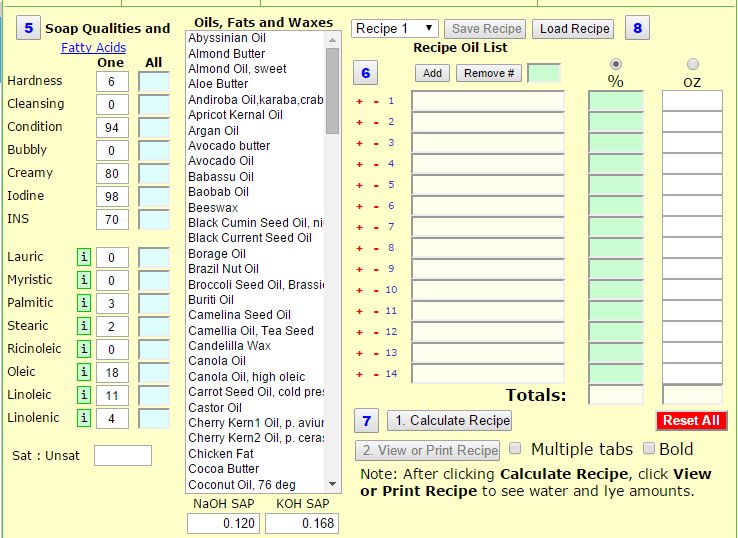
Scroll down the list of oils until you come to your first one. In this case “Coconut OIl 76 degree” (Coconut oil is always 76 degree unless specified) Clicking (or double clicking ) on it will fill it in the box under #6. When it appears in the box fill in the green space next to it the percentage you want: 35. Do the same with the Olive oil and 65. The oils must always total 100%. It will now look like this:
That’s all there is to it. If your recipe has 7 oils, do the same for all of them. When you have entered all the oils, click on Calculate Recipe which will activate the “View or Print Recipe” button under it. Click on that to get your final print out which will look like this:
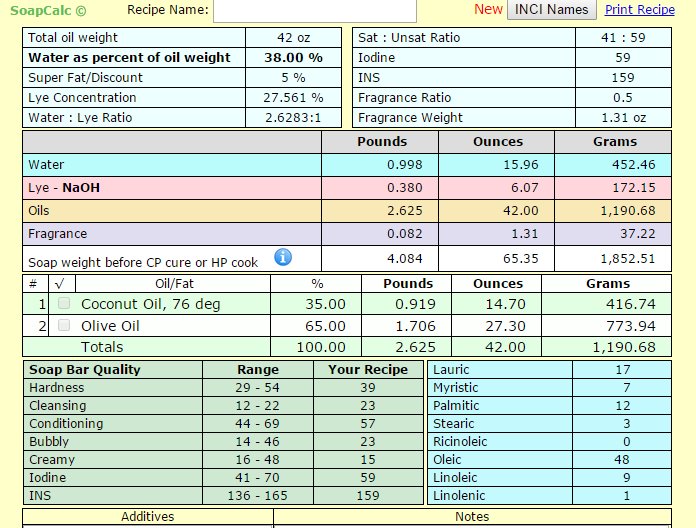
There is a whole lot of information on here and most of it will be meaningless to you if you are following someone else’s recipe and that’s OK. The really important part is this part which is your recipe calculated for the amount you want to make.
Use these exact amounts (as closely as your scale can calculate). That is your recipe.
The bottom part will give you SoapCalc’s analysis of your recipe and I only want to comment on two of these because they are the stinkers that always make trouble.
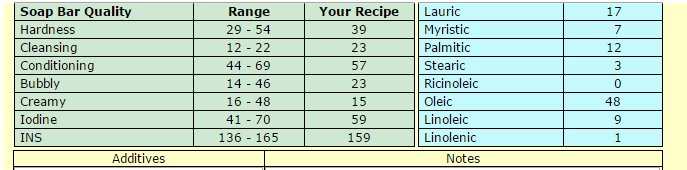
SoapCalc gives you a range that it thinks your recipe value should be in. For example, the hardness should be between 29 and 54. That’s a pretty big range. Ours is 39. According to SoapCalc that is adequate for hardness. Only one of our values is out of range and only by one number. That is the “Cleansing” value. The Cleansing and Conditioning are the two items that are often misleading, the Cleansing especially.
What cleansing really means, to SoapCalc is “oil stripping” and this value will not change if you raise the superfat in the soap, even though we know that changes the soap a lot. What Conditioning means is “not oil stripping”. This is sort of the range of squeaky clean (high cleansing) to silky (or slimy) (high conditioning). Look at the two analyses below, one for 100% coconut oil soap and one for castile soap. Soap does not really condition your skin (and you can’t say it does on your label, legally).
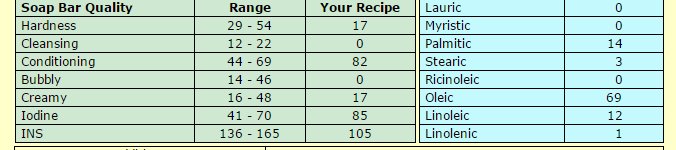
100% Coconut
Note that with coconut oil the Cleansing is off the charts and the Conditioning is low. (I consider this great soap, many of my customers love it and there is not a single value in the SoapCalc range)
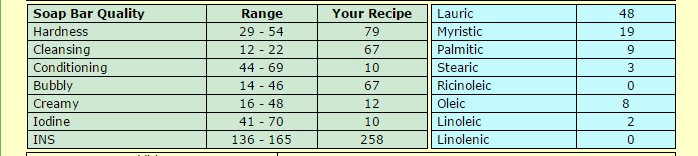
100% Olive (Castile)
With castile the Conditioning is off the charts and the Cleansing is 0. We know that castile is a good cleaning soap. There are people in many areas that still use castile as house clean-up soap. Again, the numbers are completely outside of SoapCalc’s acceptable range, except one.
So, take SoapCalc’s analyses with a grain of salt and get to know the properties of the oils you are using. The only way to learn soap is to make soap. SoapCalc (and other calculators can’t be beaten for giving us the easy ratios of fats to lye and they are good for guidelines to new soap makers but let your soap teach you the real story. Make it, use it, adjust it.
And have fun!!


