Showing posts with label petro-currency. Show all posts

Wednesday, April 20, 2016

What Everyone Is Missing In The Oil Supply/Demand Conundrum

Tyler Durden's picture

http://www.zerohedge.com/news/2016-04-19/what-everyone-missing-oil-supplydemand-conundrum
Submitted by Gail Tverberg via Our Finite World blog,
Oil production can be confusing because there are various “pieces” that may or may not be included. In this analysis, I look at oil production of the United States broadly (including crude oil, natural gas plant liquids, and biofuels), because this is the way oil consumption is defined. I also provide some thoughts regarding the direction of future world oil prices.
Figure 1. US Liquid Fuels production by month based on EIA March 2016 Monthly Energy Review Reports.
US oil production clearly flattened out in 2015. If we look at changes relative to the same month, one-year prior, we see that as of December 2014, growth was very high, increasing by 18.0% relative to the prior year.
Figure 2. US Liquids Growth Over 12 Months Prior based on EIA's March 2016 Monthly Energy Review.
Figure 2. US Liquids Growth Over 12 Months Prior based on EIA’s March 2016 Monthly Energy Review.
By December 2015, growth over the prior year finally turned slightly negative, with production for the month down 0.2% relative to one year prior. It should be noted that in the above charts, amounts are on an “energy produced” or “British Thermal Units” (Btu) basis. Using this approach, ethanol and natural gas liquids get less credit than they would using a barrels-per-day approach. This reflects the fact that these products are less energy-dense.
Figure 3 shows the trend in month-by-month production.
Figure 3. US total liquids production since January 2013, based on EIA's March 2016 Monthly Energy Review.
Figure 3. US total liquids production since January 2013, based on EIA’s March 2016 Monthly Energy Review.
The high month for production was April 2015, and production has been down since then. The production of natural gas liquids and biofuels has tended to continue to rise, partially offsetting the fall in crude oil production. Production amounts for recent months include estimates, and actual amounts may differ from these estimates. As a result, updated EIA data may eventually show a somewhat different pattern.
Taking a longer view of US liquids production, this is what we see for the three categories separately:
Figure 4. US Liquid Fuel Production since 1949, based on EIA's March 2016 Monthly Energy Review.
Figure 4. US Liquid Fuel Production since 1949, based on EIA’s March 2016 Monthly Energy Review.
Growth in US liquid fuel production slowed in 2015. The increase in liquid fuels production in 2015 amounted to 1.96 quadrillion Btus (“quads”), or about 59% as much as the increase in production in 2014 of 3.34 quads. On a barrels-per-day (bpd) basis, this would equate to roughly a 1.0 million bpd increase in 2015, compared to a 1.68 million bpd increase in 2014.
The data in Figure 4 indicates that with all categories included, 2015 liquids exceeded the 1970 peak by 16%. Considering crude oil alone, 2015 production amounted to 98% of the 1970 peak.
Figure 5 shows an approximate breakdown of crude oil production since 1945 on a bpd basis. The big spike in production is from tight oil, which is another name for oil from shale.
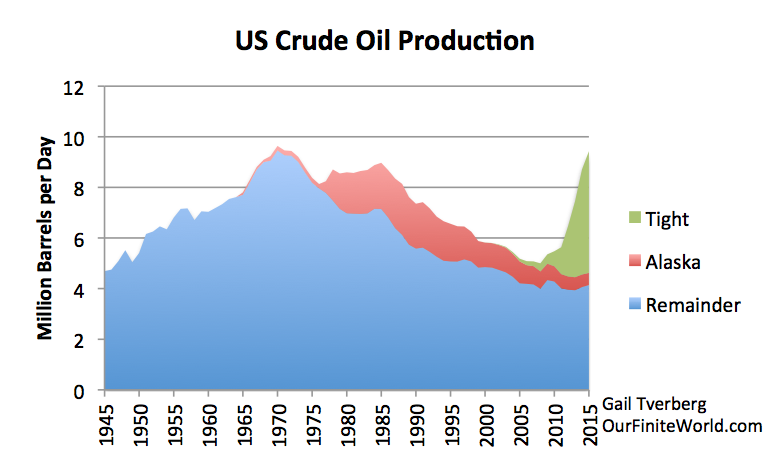
Figure 5. Oil crude oil production separated into tight oil (from shale), oil from Alaska, and all other, based on EIA oil production data by state.
Here again, US crude oil production in 2015 appears to amount to 98% of the 1970 crude oil peak. Thus, on a crude oil basis alone, we have not yet hit the 1970 peak.

Prospects for an Oil Price Rise

Most recent analyses of oil prices have focused on the amount of mismatch between supply and demand, and the need to craft a temporary agreement to reduce oil production. The thing that is missing in this discussion is an analysis of buying power of consumers. Is the problem a temporary problem, or a permanent one?
In order for oil product demand to keep rising, the buying power of consumers needs to keep rising. In other words, some combination of consumer wages and debt levels of consumers needs to keep rising. (Rising debt is helpful because, with more debt, it is often possible to buy goods that would not otherwise be affordable.)
We know that in many countries, wages for lower-level workers have stagnated for a number of reasons, including competition with wages in lower-wage countries, computerization, and the use of automation (Figure 6). Thus, we know that low wages for a large share of consumers may be a problem.
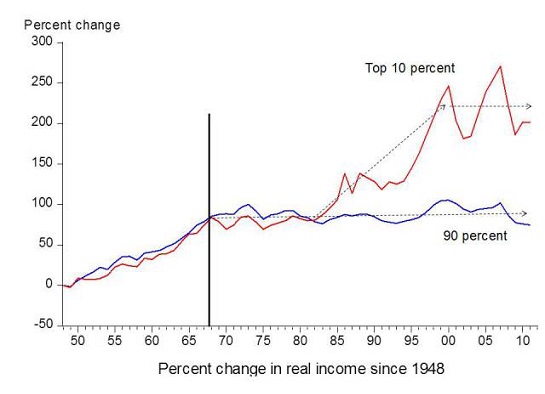
Figure 6. Chart comparing income gains by the top 10% to income gains by the bottom 90% by economist Emmanuel Saez. Based on an analysis IRS data, published in Forbes.
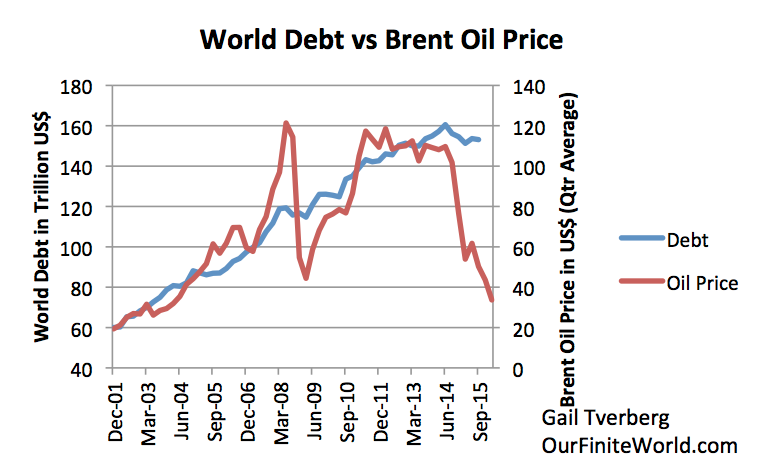
Figure 6. Chart comparing US income gains by the top 10% to income gains by the bottom 90% by economist Emmanuel Saez. Based on an analysis IRS data, published in Forbes.
Figure 7 shows that world debt has been falling since June 30, 2014. This is precisely the time when world oil prices started falling.
Figure 6. Total non-financial world debt based on Bank for International Settlements data and average Brent oil price for the quarter, based on EIA data.
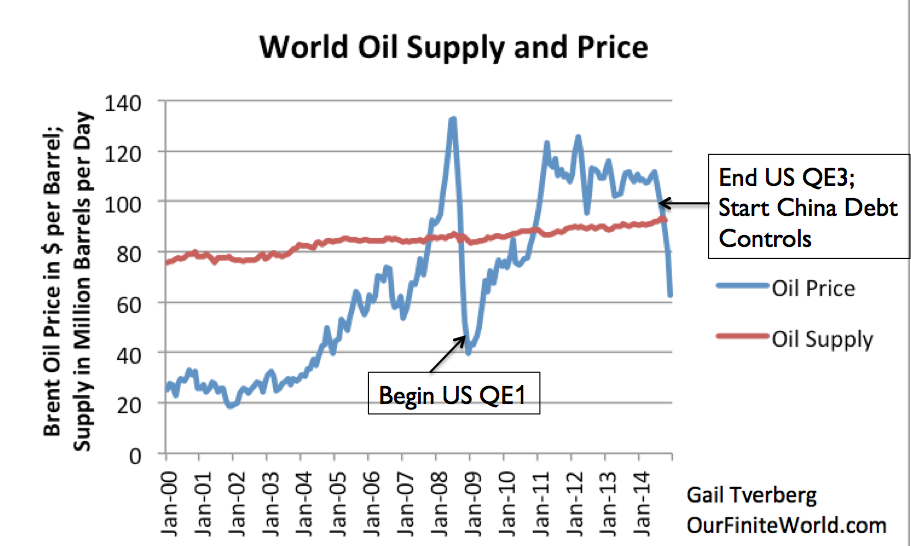
Figure 7. Total non-financial world debt based on Bank for International Settlements data and average Brent oil price for the quarter, based on EIA data.
One reason for the fall in world debt, measured in US dollars, is the fact that the US dollar started rising relative to other currencies about this time. Oil is priced in dollars; if the US dollar rises relative to other currencies, it makes oil less affordable to those whose currencies have lower values. The big rise in the level of the dollar came when the US discontinued quantitative easing in 2014. World debt, as measured in US dollars, began to fall as the US dollar rose.
Figure 7. World Oil Supply (production including biofuels, natural gas liquids) and Brent monthly average spot prices, based on EIA data.
Figure 8. World Oil Supply (production including biofuels, natural gas liquids) and Brent monthly average spot prices, based on EIA data.
As long as the US dollar is high relative to other currencies, oil products remain less affordable, and demand tends to stay low.
Another issue that struck me in looking at world debt data is the way the growth in debt is distributed (Figure 9). Debt growth for households has been much lower than for businesses and governments.
Figure 8. World non-financial debt divided among debt of households, businesses, and governments, based on Bank for International Settlements data.
Figure 9. World non-financial debt divided among debt of households, businesses, and governments, based on Bank for International Settlements data.
Since March 31, 2008, non-financial debt of households has been close to flat. In fact, between June 30, 2014 and September 30, 2015,  it shrank by 6.3%. In contrast, non-financial debt of both businesses and governments has risen since March 31, 2008. Government debt has shrunk by 5.6% since June 30, 2014–almost as large a percentage drop as for household debt.
The issue that we need to be aware of is that consumers are the foundation of the economy. If their wages are not rising rapidly, and if their buying power (considering both debt and wages) is not rising by very much, they are not going to be buying very many new houses and cars–the big products that require oil consumption. Businesses may think that they can continue to grow without taking the consumer along, but very soon this growth proves to be a myth. Governments cannot grow without rising wages either, because the majority of their tax revenue comes from individuals, rather than corporations.
Today, there is a great deal of faith that oil prices will rise, if someone, somewhere, will reduce oil production. In fact, in order to bring oil demand back up to a level that commands a price over $100 per barrel, we need consumers who can afford to buy a growing quantity of goods made with oil products. To do this, we need to fix three related problems:
  • Low wages of many consumers
  • World debt that is no longer rising (especially for consumers)
  • A high dollar relative to other currencies
These problems are likely to be difficult to fix, so we should expect low oil prices, more or less indefinitely. Lack of oil supply may bring a temporary spike in oil prices, but it cannot fix a permanent problem with consumer spending around the world.

Obama Arrives In Saudi Arabia To "Reassure" His Close Ally That Nothing Has Changed

Tyler Durden's picture

http://www.zerohedge.com/news/2016-04-20/obama-arrives-saudi-arabia-reassure-his-close-ally-nothing-has-changed
While Congress is scrambling to sweep the recently introduced Bipartisan bill that would allow US families to sue Saudi Arabia for Sept 11, Barack Obama has just landed in Saudi Arabia to reassure his close ally that all is under control.

President Obama with Saudi Crown Prince Mohammed bin Nayef,
center, and Deputy Crown Prince Mohammed bin Salman, in May 2015
As the WSJ reports, Obama arrived today in the Saudi kingdom for a brief trip "meant to provide reassurances to Gulf allies and to bolster his own foreign-policy legacy."
With just nine months left in office, Mr. Obama is aiming to steady what have become rocky relationships in the region and to tackle issues ranging from the fight against Islamic State to addressing Iranian aggression, along with easing tensions between Tehran and Saudi Arabia. But in Riyadh, the president will find frustrated allies who already have begun to look ahead to the next administration.
Obama plans to spend about 28 hours in the Saudi capital, holding talks with King Salman Wednesday afternoon and attending a Thursday summit hosted by leaders of the six-nation Gulf Cooperation Council. This trip, perhaps the last to Riyadh during Mr. Obama’s presidency, serves as a bookend for an administration that once sought a “new beginning” for the U.S. and the Islamic world, but now is confronting the prospect of a tense conclusion to this chapter.
Of course, the main reason for the simmering Saudi tensions has been the thawing of US relations with Iran, Saudi Arabia's self-proclaimed biggest regional threat.
Meanwhile, from the NYT, here are some pointers on what Obama should not do during his visit: sell even more weapons to the belligerent kingdom in exchange for goodwill that only lasts as long as the status quo is not threatened.
When President Obama visits Saudi Arabia this week for a meeting with representatives from the Gulf Cooperation Council countries, he should avoid doing what he did at Camp David last May, the last time he met with them: promise more arms sales. Since Mr. Obama hosted that meeting, the United States has offered over $33 billion in weaponry to its Persian Gulf allies, with the bulk of it going to Saudi Arabia. The results have been deadly.

The Saudi-American arms deals are a continuation of a booming business that has developed between Washington and Riyadh during the Obama years. In the first six years of the Obama administration, the United States entered into agreements to transfer nearly $50 billion in weaponry to Saudi Arabia, with tens of billions of dollars of additional offers in the pipeline.

The Pentagon claims that these arms transfers to Saudi Arabia “improve the security of an important partner which has been and continues to be an important force for political stability and economic progress in the Middle East.” Recent Saudi actions suggest otherwise.

The Obama administration says that it has urged restraint from the Saudis, but that doesn’t appear to have worked. Human Rights Watch has reported that two Saudi strikes on a market in the Yemeni village of Mastaba in mid-March killed at least 97 civilians, including 25 children. This was just one in a series of Saudi strikes on marketplaces, hospitals and other civilian targets, attacks that Human Rights Watch and Amnesty International have said may constitute war crimes.
Alas, Obama is in a bind: threaten to expose Saudi involvement in Sept 11, or dare to suggest that the US military-industrial supply chain into Saudi Arabia is slowing, and the response is already clear: a threat to dump hundreds of billions in US securities. Which is why Obama has zero leverage and will fold to any Saudi demand presented during his meetings today.

Crude Slides After Russia Warns Of Production Increase: "Was Never Ready To Cut Output"

Tyler Durden's picture

http://www.zerohedge.com/news/2016-04-20/crude-slides-after-russia-warns-production-increase-was-never-ready-cut-output
Perhaps upset at the weekend's development, Russia has decided to rattle the global crude complex cage. Amid hopes of a freeze, Russia's energy minister Alexander Novak has reversed course and stated that Russia could "in theory" increase oil output and "was never ready to cut production." It appears things are rapidly breaking down between Russia and The Kingdom - which perhaps explains Obama's rapidly arranged trip to kiss the ring in Riyadh.


The oil market is not transparent enough, which leads to the demand-supply mismatch, Russia’s Deputy Prime Minister Arkady:
"The policy of certain countries regarding diversification of energy sources aimed at supporting local production is sometimes implemented inefficiently as it creates extra costs for consumers and changes the oil and gas market balance. From our viewpoint, the situation is not transparent enough as not the whole information is provided to consumers," he said.

Tuesday, April 5, 2016

Triffin's Paradox Revisited: Crunch-Time For The U.S. Dollar & The Global Economy

Tyler Durden's picture

http://www.zerohedge.com/news/2016-04-05/triffins-paradox-revisited-crunch-time-us-dollar-global-economy
Submitted by Charles Hugh-Smith of OfTwoMinds blog,
The reality is that we're one panic away from foreign-exchange markets ripping free of central bank manipulation.
While all eyes on fixated on global stock markets as the measure of "prosperity" and "growth" (or is it hubris?), the larger force at work beneath the dovish cooing of central bankers is foreign exchange: the relative value of nations' currencies, which are influenced (like everything else) by supply and demand, which is in turn influenced by interest rates, perceived risk, asset purchases and sales by central banks and capital flows seeking the lowest possible risk and the highest possible return.
Which brings us to Triffin's Paradox, a topic I've covered for many years:
Understanding the "Exorbitant Privilege" of the U.S. Dollar (November 19, 2012)
The Federal Reserve, Interest Rates and Triffin's Paradox (November 19, 2015)
The core of Triffin's Paradox is that the issuer of a reserve currency must serve two entirely different sets of users: the domestic economy, and the international economy.
The U.S. dollar (USD) is the global economy's primary reserve currency. When the Federal Reserve lowered interest rates to zero (Zero Interest Rate Policy, ZIRP), it weakened the dollar relative to other currencies. In this ZIRP environment, it made sense to borrow dollars for next to nothing and use this free money to buy bonds and other assets in other currencies that paid higher yields. Many of these assets were in emerging market economies such as Brazil.
As a result of this enormous carry trade, an estimated $7 trillion was borrowed in USD and invested in other currencies/nations.
Once the Fed started making noises about "normalizing"/raising interest rates in the U.S. (i.e. signaling the markets that a trend change was at hand), the dollar strengthened and the carry trade started reversing: those who had bought assets in other currencies with borrowed USD started selling those assets, which pushed emerging market currencies and markets off a cliff.
Meanwhile, since China pegs its currency the yuan/RMB to the USD, the rising dollar dragged the yuan higher thanks to the peg. A strengthening yuan made China's exports more expensive and less competitive, the last thing China needed as its domestic credit bubble ran out of steam.
So while the Fed needed to "normalize" rates in the U.S. before the next recession required more Fed stimulus, it also needed to weaken the USD to protect China from a destabilizing currency devaluation.
Those holding millions of soon-to-be-devalued yuan in China were naturally anxious to convert their yuan into USD before the devaluation robbed them of 25% of the purchasing power of their money, and this has created an unprecedented capital flow of cash out of China and into USD and other Western assets, such as chateaux in France, homes in Vancouver B.C., etc.
This mad rush of capital out of China is adding another destabilizing factor to China's already wobbly debt bubble economy, and China's weakness has weakened an already wobbly global economy crippled by stagnation and the decline of emerging markets and commodities--two consequences of the rising USD.
This has created a no-win conundrum for the Fed: if it normalizes rates (as it should, after seven years of ZIRP and stimulus) in the domestic U.S. economy, that will strengthen the USD, further pressuring China's yuan and emerging markets, which in turn will further pressure an already-tottering global economy.
There are no winners, regardless of what policy the Fed chooses to pursue. This is why we see such absurd waffling in the Fed: one statement suggests interest rates hikes are on the way, and the next dovish cooing suggests rate hikes are so far away that global markets can safely ignore the possibility.
This push-pull is reflected in the chart of the USD:

As the Fed waffles in response to global markets, the USD has swung up and down in a trading range.
Sorry, Fed: you can't have it both ways. Eventually, the domestic economy will pay the price of essentially zero interest rates, or China and the global economy will pay the price of a strengthening USD.
No nation ever achieved global hegemony by devaluing its currency. Hegemony requires a strong currency, for the ultimate arbitrage is trading fiat currency that has been created out of thin air for real commodities and goods.
Generating currency out of thin air and trading it for tangible goods is the definition of hegemony. Is there is any greater magic power than that?
In essence, the Fed must raise rates to strengthen the U.S. dollar (USD) to keep commodities such as oil cheap for American consumers. The most direct way to keep commodities cheap is to strengthen one's currency, which makes commodities extracted in other nations cheaper by raising the purchasing power of the domestic economy on the global stage.
Another critical element of U.S. hegemony is to be the dumping ground for the exports of our trading partners. By strengthening the dollar, the Fed increases the purchasing power of everyone who holds USD. This lowers the cost of goods imported from nations with weakening currencies, who are more than willing to trade their commodities and goods for USD.
What better way to keep bond yields low and stock valuations high than insuring a flow of capital into U.S.-denominated assets?
There is one more destabilizing possibility: the markets may push the USD higher, regardless of what the Fed says or does. The currency markets trade $5 trillion a day--more than the Fed's entire $4 trillion balance sheet.
Once traders realize China will have to devalue the yuan by a lot more than a few baby-step devaluations, the stampede into USD could overwhelm even coordinated interventions by central bankers.
Of course no central banker will ever admit that markets could wrest free of central bank control, but the reality is that we're one panic away from foreign-exchange markets ripping free of central bank manipulation.

Saturday, October 10, 2015

Another Petro-State Throws In The Towel: The Last Nail In The Petrodollar Coffin

Tyler Durden's picture
Submitted by  Eugen von Böhm-Bawerk  of Bawerk.net
Another Petro-State Throws In The Towel - The Last Nail In The Petrodollar coffin
Source: Norwegian Ministry of Finance, Bawerk.net
According to the proposed budget submitted by the current ‘blue-blue’ government the Norwegian deficit will reach another record high in 2016. Mainland taxes are expected to bring in 1,008 billion NOKs, while expenditures are estimated at 1,215 billion NOKs. In other words, 2016 will be another year of record mainland deficit which need to be covered by the offshore sector and its 6,900 bn NOK sovereign wealth fund (SWF).
While record mainland deficits covered by the petroleum sector is nothing new in Norwegian budget history, on the contrary it is closer to the norm, the 2016 budget did raise some eyebrows. The other side of the ledger, the net inflow to the SWF from activities in the North Sea will, again according to budget, be lower than the required amount to cover the deficit. This has never happened before and is testimony of the sea change occurring in the world of petrodollar recycling. Interestingly enough, the need to liquidate SWF holdings is helping to create further deflation in the Eurodollar system in a self-reinforcing loop.
As Eurodollar liquidity dries up and consequently pushes up the price of actual dollar (note, Eurodollars are international claims to domestic US dollars but for which no such dollars actual exists) the problem for petro-states compounds. One way this manifest itself is through international purchasing power of prior savings. A SWF as the Norwegian was created through a surplus of exports over imports meaning it can only be utilized through future imports over exports. When the Norwegians look at their wealth expressed in Norwegian kroner it all looks fine, but expressed in dollars the SWF has shrunk considerably in size. Thus, the surfeit imports expected by the Norwegian populace cannot be met. Norway rode high on a wave of liquidity which pushed up commodity currencies, leading Norwegians to consume more imported goods today, without realizing they were tapping into the principal of their future. When the tide turns the gross misconception is revealed.
Source: Norwegian Ministry of Finance, Central Bank of Norway, Bawerk.net
The Government claims it is all fine though. The current down-cycle will, according to them, end early 2016 so despite a 2 percentage point reduction in corporate- and personal income tax, mainland tax revenues are expected to increase 1.9 per cent.  That is obviously a pipedream, just as the expected 17.9 per cent increase in interest and dividend income which will make sure the SWF continue to grow at a healthy pace despite the massive mainland deficit.
Assuming oil prices remain low, mainland tax revenue will plummet as they are very much a function of what goes on offshore, while expenditure will rise as they do in all welfare states during a down cycle.
If we are right, a global recession is imminent, meaning the expected increase in dividend income will never materialize.
In other words, the drawdown of the SWF will exceed its inflow even after adding financial income flows. The last remnant of the petro-dollar will thus die in 2016.
For a country 100 per cent dependent on continued leverage in the Eurodollar system the absolutely best case scenario is for the US economy to grow just slowly enough for international monetary policy to again realign; reducing the value of the USD through continued ZIRP in the US.
Robust growth in the US will prompt Yellen to hike, spiking the dollar (as Eurodollar claims scramble for actual dollars) while paradoxically a recession in the US will lead to the exact same outcome. The goldilocks scenario of 1-2 per cent growth is the best that the Norwegian government can hope for. It will minimize the gap between the lies and propaganda spewed out by the Ministry of Finance and reality.

Friday, December 12, 2014

The Financialized-Oil Dominoes Are Toppling

The drop in oil revenues has triggered a self-reinforcing feedback dynamic.

Oil is not just something that is refined into fuel–it is capital, collateral, debt and risk. In other words, it is intrinsically financial. As I noted in The Oil-Drenched Black Swan, Part 2: The Financialization of Oil, oil has been financialized to the point that few outside the industry understand the dominoes that are currently toppling.
Let’s start with the obvious fact that the impact of lower oil is financial, political and geopolitical. Lower oil revenues are negatively impacting:
1. Oil-exporters’ revenues
2. Monetary policy of central banks
3. Trade flows
4. Global financial markets
Lower revenues are pressuring oil-dependent governments such as Russia, Venezuela and Iran, and destabilizing the geopolitical order as weakened oil exporters sink into recession and political turmoil.
Lower revenues are also kicking the financial supports out from under the debt-dependent, enormously capital-intensive oil exploration and development projects in North America.
Simply put, the sharp drop in oil revenues has knocked over a line of financial dominoes whose end is not yet in sight. These issues have been addressed by a number of analysts; here is a small selection of recent stories:
Why US Shale May Fizzle Rather Than Boom (research by Mason Inman)
It’s Different This Time… Rig-Count Edition
Profit Recession On Deck Due To Surging Dollar And Plunging Crude, Deutsche Warns
Bank of America sees $50 oil as Opec dies
Fossil fuels: are we on the edge of the Seneca cliff?
This Time Is The Same: Like The Housing Bubble, The Fed Is Ignoring The Shale Bubble In Plain Sight
Ten Reasons Why a Severe Drop in Oil Prices is a Problem
The drop in oil revenues has triggered a self-reinforcing feedback dynamic. As the financial dominoes fall, there is less capital available to maintain production, so oil output falls, further reducing income. As the collateral,income and impaired debt dominoes topple, risky debt in sectors completely unrelated to oil start falling as institutions trim risk throughout their holdings.
Gordon T. Long and I discuss the highlights of this complex set of issues in this video program, The Oil-Drenched Black Swan (28 minutes):
Go here for direct links and video - http://www.washingtonsblog.com/2014/12/financialized-oil-dominoes-toppling.html

Wednesday, November 27, 2013

Expect Devastating Global Economic Changes In 2014 

Thanks Dagny!

 By any reasonable measure, I think it is safe to say that the last quarter of 2013 has been an insane game of economic Russian Roulette.  Even more unsettling is the fact that most of the American population still has little to no clue that the U.S. was on the verge of a catastrophic catalyst event at least three times in the past three months alone, and that we face an even greater acceleration next year. 

The first near miss was the Federal Reserve's announcement of a possible “taper” of QE stimulus in early fall, which sent shivers through stock markets and proved what we have been saying all along – that the entire recovery is a facade built on an ever thinning balloon of fiat money.  Today, markets function entirely on the expectation that the Fed will continue stimulus forever.  If the Fed does cut QE in any way, the frail psychology of the markets will shatter, and the country will come crashing down with it.

The second near miss was the possible unilateral invasion of Syria demanded by the Obama Administration.  As we have discussed here at Alt-Market for years, any invasion of Syria or Iran will bring detrimental consequences to the U.S. economy and energy markets, not to mention draw heavy opposition from Russia and China.  Though the naïve shrug it off as a minor foreign policy bungle, Syria could have easily become WWIII, and I believe the only reason the establishment has not yet followed through with a strike in the region is because the alternative media has been so effective in warning the masses.  The elites need a certain percentage of support from the general public and the military for any war action to be effective, which they did not receive.  After all, no one wants to fight and die in support of CIA funded Al Qaeda terrorist cells on the other side of the world.  The establishment tried to hide who the rebels were, and failed.  

The third near miss was, of course, the debt ceiling debate, which has been extended to next spring.  America came within a razor's edge of debt default, which many people rightly fear.  What some do not yet grasp, though, is that debt default of the U.S. was NOT avoided last month, it is INEVITABLE.  Debt default will ultimately result in the death of the dollar as the world reserve currency, and the petro-currency.  This final gasp will lead to hyperstagflation within our financial system, and third world status for most of the citizenry.  It is only a matter of time, and timing.

“Timing” is truly what we are all concerned about.  Those of us in the field of alternative media and economics understand well that the U.S. is on a collision course with disaster; it is a mathematical certainty.  We no longer think in terms of “if” it happens - we only question “when” it will happen.  Our fiscal structure now hangs by the thinnest of threads, a thread which for all we know could be cut at a moments notice.  However, economic and political storms appear to be brewing with the year 2014 as a target. 

Globalists have been openly seeking the destabilization of U.S. sovereignty, and they have openly admitted that the destruction of the dollar and our economic foundations will aid them in their goal.  It is important to never forget that international financiers WANT to absorb America into a new global economic structure, and that the U.S. must be debased before this can be accomplished.   Here are a few reasons why I believe 2014 may be the year they make their final move...   
   

Much more here - http://www.alt-market.com/articles/1837-expect-devastating-global-economic-changes-in-2014