Showing posts with label natural gas. Show all posts

Wednesday, April 20, 2016

What Everyone Is Missing In The Oil Supply/Demand Conundrum

Tyler Durden's picture

http://www.zerohedge.com/news/2016-04-19/what-everyone-missing-oil-supplydemand-conundrum
Submitted by Gail Tverberg via Our Finite World blog,
Oil production can be confusing because there are various “pieces” that may or may not be included. In this analysis, I look at oil production of the United States broadly (including crude oil, natural gas plant liquids, and biofuels), because this is the way oil consumption is defined. I also provide some thoughts regarding the direction of future world oil prices.
Figure 1. US Liquid Fuels production by month based on EIA March 2016 Monthly Energy Review Reports.
US oil production clearly flattened out in 2015. If we look at changes relative to the same month, one-year prior, we see that as of December 2014, growth was very high, increasing by 18.0% relative to the prior year.
Figure 2. US Liquids Growth Over 12 Months Prior based on EIA's March 2016 Monthly Energy Review.
Figure 2. US Liquids Growth Over 12 Months Prior based on EIA’s March 2016 Monthly Energy Review.
By December 2015, growth over the prior year finally turned slightly negative, with production for the month down 0.2% relative to one year prior. It should be noted that in the above charts, amounts are on an “energy produced” or “British Thermal Units” (Btu) basis. Using this approach, ethanol and natural gas liquids get less credit than they would using a barrels-per-day approach. This reflects the fact that these products are less energy-dense.
Figure 3 shows the trend in month-by-month production.
Figure 3. US total liquids production since January 2013, based on EIA's March 2016 Monthly Energy Review.
Figure 3. US total liquids production since January 2013, based on EIA’s March 2016 Monthly Energy Review.
The high month for production was April 2015, and production has been down since then. The production of natural gas liquids and biofuels has tended to continue to rise, partially offsetting the fall in crude oil production. Production amounts for recent months include estimates, and actual amounts may differ from these estimates. As a result, updated EIA data may eventually show a somewhat different pattern.
Taking a longer view of US liquids production, this is what we see for the three categories separately:
Figure 4. US Liquid Fuel Production since 1949, based on EIA's March 2016 Monthly Energy Review.
Figure 4. US Liquid Fuel Production since 1949, based on EIA’s March 2016 Monthly Energy Review.
Growth in US liquid fuel production slowed in 2015. The increase in liquid fuels production in 2015 amounted to 1.96 quadrillion Btus (“quads”), or about 59% as much as the increase in production in 2014 of 3.34 quads. On a barrels-per-day (bpd) basis, this would equate to roughly a 1.0 million bpd increase in 2015, compared to a 1.68 million bpd increase in 2014.
The data in Figure 4 indicates that with all categories included, 2015 liquids exceeded the 1970 peak by 16%. Considering crude oil alone, 2015 production amounted to 98% of the 1970 peak.
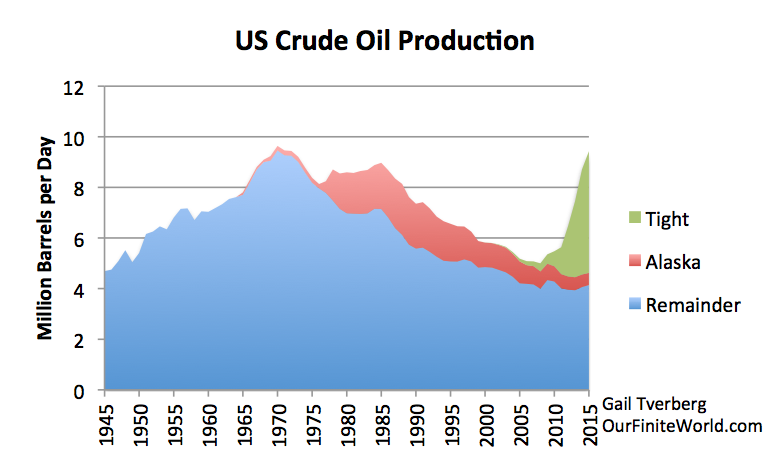
Figure 5 shows an approximate breakdown of crude oil production since 1945 on a bpd basis. The big spike in production is from tight oil, which is another name for oil from shale.
Figure 5. Oil crude oil production separated into tight oil (from shale), oil from Alaska, and all other, based on EIA oil production data by state.
Here again, US crude oil production in 2015 appears to amount to 98% of the 1970 crude oil peak. Thus, on a crude oil basis alone, we have not yet hit the 1970 peak.

Prospects for an Oil Price Rise

Most recent analyses of oil prices have focused on the amount of mismatch between supply and demand, and the need to craft a temporary agreement to reduce oil production. The thing that is missing in this discussion is an analysis of buying power of consumers. Is the problem a temporary problem, or a permanent one?
In order for oil product demand to keep rising, the buying power of consumers needs to keep rising. In other words, some combination of consumer wages and debt levels of consumers needs to keep rising. (Rising debt is helpful because, with more debt, it is often possible to buy goods that would not otherwise be affordable.)
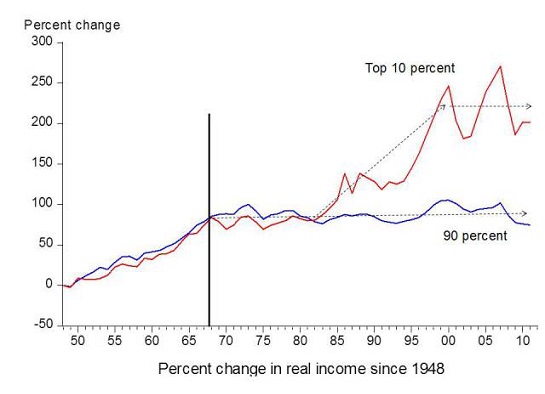
We know that in many countries, wages for lower-level workers have stagnated for a number of reasons, including competition with wages in lower-wage countries, computerization, and the use of automation (Figure 6). Thus, we know that low wages for a large share of consumers may be a problem.
Figure 6. Chart comparing income gains by the top 10% to income gains by the bottom 90% by economist Emmanuel Saez. Based on an analysis IRS data, published in Forbes.
Figure 6. Chart comparing US income gains by the top 10% to income gains by the bottom 90% by economist Emmanuel Saez. Based on an analysis IRS data, published in Forbes.
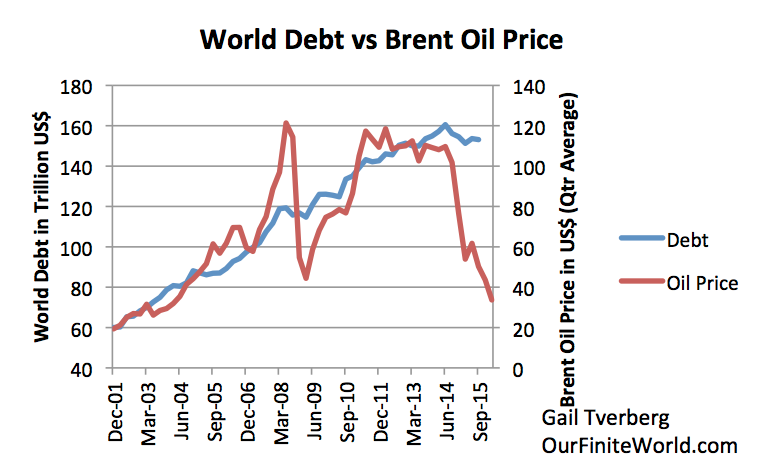
Figure 7 shows that world debt has been falling since June 30, 2014. This is precisely the time when world oil prices started falling.
Figure 6. Total non-financial world debt based on Bank for International Settlements data and average Brent oil price for the quarter, based on EIA data.
Figure 7. Total non-financial world debt based on Bank for International Settlements data and average Brent oil price for the quarter, based on EIA data.
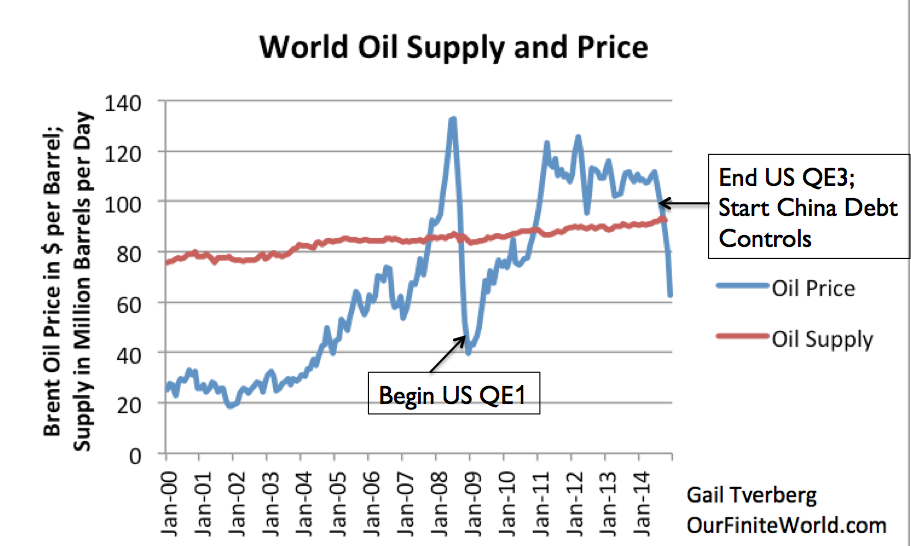
One reason for the fall in world debt, measured in US dollars, is the fact that the US dollar started rising relative to other currencies about this time. Oil is priced in dollars; if the US dollar rises relative to other currencies, it makes oil less affordable to those whose currencies have lower values. The big rise in the level of the dollar came when the US discontinued quantitative easing in 2014. World debt, as measured in US dollars, began to fall as the US dollar rose.
Figure 7. World Oil Supply (production including biofuels, natural gas liquids) and Brent monthly average spot prices, based on EIA data.
Figure 8. World Oil Supply (production including biofuels, natural gas liquids) and Brent monthly average spot prices, based on EIA data.
As long as the US dollar is high relative to other currencies, oil products remain less affordable, and demand tends to stay low.
Another issue that struck me in looking at world debt data is the way the growth in debt is distributed (Figure 9). Debt growth for households has been much lower than for businesses and governments.
Figure 8. World non-financial debt divided among debt of households, businesses, and governments, based on Bank for International Settlements data.
Figure 9. World non-financial debt divided among debt of households, businesses, and governments, based on Bank for International Settlements data.
Since March 31, 2008, non-financial debt of households has been close to flat. In fact, between June 30, 2014 and September 30, 2015,  it shrank by 6.3%. In contrast, non-financial debt of both businesses and governments has risen since March 31, 2008. Government debt has shrunk by 5.6% since June 30, 2014–almost as large a percentage drop as for household debt.
The issue that we need to be aware of is that consumers are the foundation of the economy. If their wages are not rising rapidly, and if their buying power (considering both debt and wages) is not rising by very much, they are not going to be buying very many new houses and cars–the big products that require oil consumption. Businesses may think that they can continue to grow without taking the consumer along, but very soon this growth proves to be a myth. Governments cannot grow without rising wages either, because the majority of their tax revenue comes from individuals, rather than corporations.
Today, there is a great deal of faith that oil prices will rise, if someone, somewhere, will reduce oil production. In fact, in order to bring oil demand back up to a level that commands a price over $100 per barrel, we need consumers who can afford to buy a growing quantity of goods made with oil products. To do this, we need to fix three related problems:
  • Low wages of many consumers
  • World debt that is no longer rising (especially for consumers)
  • A high dollar relative to other currencies
These problems are likely to be difficult to fix, so we should expect low oil prices, more or less indefinitely. Lack of oil supply may bring a temporary spike in oil prices, but it cannot fix a permanent problem with consumer spending around the world.

Friday, January 22, 2016

The Secret Behind The Next Global Crash (??)

Tyler Durden's picture


http://www.zerohedge.com/news/2016-01-22/secret-behind-next-global-crash
The World Economic Forum in Davos is submerged by a tsunami of denials, and even non-denial denials, stating there won’t be a follow-up to the Crash of 2008.
Yet there will be. And the stage is already set for it.
Selected Persian Gulf traders, and that includes Westerners working in the Gulf confirm thatSaudi Arabia is unloading at least $1 trillion in securities and crashing global markets under orders from the Masters of the Universe – those above the lame presidency of Barack Obama.

An official of the Saudi oil company Aramco watches progress at a rig at the al-Howta oil field.
Those were the days when the House of Saud would as much as flirt with such an idea to have all their assets frozen. Yet now they are acting under orders. And more is to come; according to crack Persian Gulf traders Saudi Western security investments may amount to as much as $8 trillion, and Abu Dhabi’s as $4 trillion.
In Abu Dhabi everything was broken into compartments, so no one could figure it out, except brokers and traders who would know each supervisor of a compartment of investments. And for the House of Saud, predictably, denial is an iron rule. 
This massive securities dump has been occasionally corporate media, but the figures are grossly underestimated. The full information simply won’t filter because the Masters of the Universe have vetoed it. 
There has been a huge increase in the Saudi and Abu Dhabi dump since the start of 2016. A Persian Gulf source says the Saudi strategy “will demolish the markets.” Another referred to a case of “maggots eating the carcass in the dark”; one just had to look at the rout in Wall Street, across Europe and in Hong Kong and Tokyo on Wednesday.
So it’s already happening. And a crucial subplot may be, in the short to medium term, no less than the collapse of the eurozone.
The Crash of 2016?
So a case could be made of a panicked House of Saud being instrumentalized to crash a great deal of the global economy. Cui bono? 
Russian former Finance Minister Alexei Kudrin
 
 
Moscow and Tehran are very much on it. The logic behind crashing markets, creating a recession and a depression – from the point of view of the Masters of the Universe above the lame duck President of the United States — is to engineer a major slow down, cripple buying patterns, decrease oil and natural gas consumption, and point Russia on a road to ruin. Besides, the ultra low oil price also translates into a sort of ersatz sanction on Iran.
Still, Iranian oil about to reach the market will be around an extra 500,000 barrels a day by mid-year, plus a surplus stored in tankers in the Persian Gulf. This oil can and will be absorbed, as demand is rising (in the US, for instance, by 1.9 million barrels a day in 2015) while supply is falling.
Surging demand and falling production will reverse the oil crash by July. Moreover, China’s oil imports recently surged 9.3% at 7.85 million barrels a day, discrediting the hegemonic narrative of a collapse of China's economy – or of China being responsible for the current market blues.
So, as I outlined here, oil should turn around soon. Goldman Sachs concurs. That gives the Masters of the Universe a short window of opportunity enabling the Saudis to dump massive amounts of securities in the markets.
The House of Saud may need the money badly, considering their budget on red alert. But dumping their securities is also clearly self-destructive. They simply cannot sell $8 trillion. The House of Saud is actually destroying the balance of their wealth. As much as Western hagiography tries to paint Riyadh as a responsible player, the fact is scores of Saudi princes are horrified at the destruction of the wealth of the kingdom through this slow motion harakiri.
Would there be a Plan B? Yes. Warrior prince Mohammed bin Sultan – who’s actually running the show in Riyadh – should be on the first flight to Moscow to engineer a common strategy. Yet that won’t happen.
Oil pumps in operation at an oilfield near central Los Angeles
 
 
And as far as China – Saudi Arabia’s top oil importer — is concerned, Xi Jinping has just been to Riyadh; Aramco and Sinopec signed a strategic partnership; but the strategic partnership that really matters, considering the future of One Belt, One Road, is actually Beijing-Tehran.
The massive Saudi dumping of securities ties in with the Saudi oil price war. In the current, extremely volatile situation oil is down, stocks are down and oil stocks are down. Still the House of Saud has not understood that the Masters of the Universe are getting them to destroy themselves many times over, including flooding the oil market with their shut-in capacity. And all that to fatally wound Russia, Iran and… Saudi Arabia itself.
Only a Pawn in Their Game
Meanwhile, Riyadh is rife with rumors there will be a coup against King Salman – virtually demented and confined to a room in his palace in Riyadh. There are two possible scenarios in play:
1) King Salman, 80, abdicates in favor of his son, notorious arrogant/ignorant troublemaker Warrior Prince Mohammed bin Salman, 30, currently deputy crown prince and defense minister and the second in the line of succession but de facto running the show in Riyadh. This could happen anytime soon. As an extra bonus, current Oil Minister Ali al-Naimi, not a royal, would be replaced by Abdulaziz bin Salman, another son of the king.

2) A palace coup. Salman – and his troublemaker son – are out of the picture, replaced by Ahmed bin Abdulaziz (who was a previous Minister of the Interior), or Prince Mohammed bin Nayef (the current Minister of the Interior and Crown Prince.)
Whatever scenario prevails, the British MI6 is intimately aware of the whole pantomime. And the German BND might be. Everyone remembers the BND memo at the end of 2015 that depicted Deputy Crown Prince Mohammed bin Salman as a “political gambler” who is destabilizing the Arab world through proxy wars in Yemen and Syria.
Saudi sources — for obvious reasons insisting on anonymity — stress that as much as 80% of the House of Saud favors a coup.
Yet the question is whether a House reshuffle would change their slow motion hara-kiri. The categorical imperative remains; the Masters of the Universe are ready to bring the whole world down in a major recession basically to strangle Russia. The House of Saud is just a pawn in this vicious game.

Friday, January 8, 2016

Doctors Urge California Residents "Leave Now...While You Can" As Gas Leak Fears Grow

Tyler Durden's picture


http://www.zerohedge.com/news/2016-01-08/doctors-urge-california-residents-leave-nowwhile-you-can-gas-leak-fears-grow
California Governor Jerry Brown finally declared a state of emergency on Wednesday, concerning the ongoing, currently unstoppable methane gas leak spewing from Aliso Canyon that has created a nightmare for residents of Porter Ranch.
“I will tell you, this goes well beyond Porter Ranch. We’ve had complaints from as far as Chatsworth, Northridge, and Granada Hills,” emphasized Los Angeles City Councilman Mitchell Englander during a Porter Ranch town hall meeting on December 28. “Apparently this plume of toxic chemicals and whatever it might be, doesn’t know zip codes […] This is the equivalent of the BP oil spill on land, in a populated community.”
Aliso Canyon sits less than two and a half miles from Porter Ranch and less than 30 miles from the city of Los Angeles — the second most populous city in the United States — whose outlying total statistical areaincludes nearly 18 million residents, as of 2013.
Brown has been widely criticized for lack of decisive action on the leak, which is erupting from its underground storage area with all the force “of a volcano.” Under Wednesday’s declaration, “all state agencies will utilize state personnel, equipment, and facilities to ensure a continuous and thorough state response to this incident.”
Porter Ranch residents have been evacuating the area for some time, though SoCalGas’ rather maladroit handling of the relocation procedure has been a nightmare — and the cause for a mounting number oflawsuits, including one from the L.A. city attorney’s office.
Los Angeles City Attorney Mike Feuer filed a civil lawsuit last month concerning the massive methane leak’s impact on area residents’ health and damage to the environment — which alleged failure by SoCalGas to prevent the leak and further exacerbation of “the effects of that failure by allowing acute odor and health problems faced by the community to persist for more than a month, to say nothing about the indefinite time it will persist into the future.”
Pediatrician Dr. Richard Kang gave an ominous warning during the Porter Ranch meeting, saying, “Unfortunately, the only real way to get away from the symptoms is… you have to relocate — you have to get away from the environment.” Health complaints include severe headaches, nosebleeds, respiratory issues including increasing cases of asthma, and a number of other issues.
SoCalGas, in the meantime, stated they were “providing air filters for people’s homes,” but though “the odor added to the leaking gas can cause symptoms for some, the gas is not toxic and county health officials have said the leak does not pose a long-term health risk.”
But, as the Los Angeles Daily News reported on December 25, “Los Angeles County health officials said prolonged exposure to trace chemicals, some of which are known carcinogens, can cause long-term health effects.” Nevertheless, they also “cautioned that levels examined so far here are not believed to be associated with long-term health problems.”
“The gas company says, ‘This is just the smell you’re reacting to, it’s just temporary, it’s not a problem, it’s not serious’ — these people aren’t stupid,” said attorney Rex Paris. “How could somebody possibly say that? We have children whose noses are bleeding every day, we have people who suffer from chronic headaches [and] are nauseous every, single day. How does that not become a serious issue? Why are they saying something nobody here believes? […] They’re trying to convince everybody that it’s all in our heads. It’s a trick.”
In fact, as Erin Brockovich pointed out, “no one really knows the long-term side effects of benzene and radon, the carcinogens that are commonly found in natural gas.”
Additionally, area house pets seem particularly vulnerable — possibly acting the part of unwitting canaries — as veterinarian Dr. David Smith described in the town hall meeting. Noting he has seen dozens of sickened animals, Smith said, “I’ve seen dogs, cats, birds, pocket pets… the primary symptoms I’ve seen are gastrointestinal vomiting […]These are not things you should be inhaling.” He added, “We have seen dermatological issues as well, some very unusual bacterial infections in dogs,” including one case in which a dog had such an infection on its face, and “the client developed almost the exact same kind of symptoms soon after that […] their physician thinks it’s related [to exposure from the gas leak] and so I tend to think these correlations are real.”
Though the declaration of emergency states “the Division of Oil, Gas, and Geothermal Resources shall continue its prohibition against Southern California Gas Company injecting any gas into the Aliso Canyon Storage Facility,” it does not make that moratorium dependent on stoppage of the leak; rather, only “until a comprehensive review, utilizing independent experts […] is completed.”
Physician Dr. Brooks Michaels, addressing the town hall meeting, gave the sternest advice to those still in the area surrounding the unprecedented leak:
“If you have a chance to leave, if you’re able to leave… if you have a chance to relocate, do it now. I’m telling you, it’s really critical.”
Understandably, Brown’s state of emergency seems almost too little, too late for many.

Thursday, September 10, 2015

Competing Gas Pipelines Are Fueling The Syrian War & Migrant Crisis

Tyler Durden's picture

http://www.zerohedge.com/news/2015-09-10/competing-gas-pipelines-are-fueling-syrian-war-migrant-crisis
Submitted by Mnar Muhawesh via MintPressNews.com,
Don’t let anyone fool you: As we have detailed since 2013, sectarian strife in Syria has been engineered to provide cover for a war for access to oil and gas, and the power and money that come along with it.

Editor’s note: This article has been updated to reflect recent Wikileaks revelations of US State Department leaks that show plans to destabilize Syria and overthrow the Syrian government as early as 2006.  The leaks reveal that these plans were given to the US directly from the Israeli government and would be formalized through instigating civil strife and sectarianism through partnership with nations like Saudi Arabia, Turkey, Qatar and even Egypt to break down the power structue in Syria to essentially to weaken Iran and Hezbolla. The leaks also reveal Israeli plans to use this crisis to expand it’s occupation of the Golan Heights for additional oil exploration and military expansion.
* * *
Images of Aylan Kurdi, the three-year-old Syrian boy who washed up dead on Mediterranean shores in his family’s attempt to flee war-torn Syria, have grabbed the attention of people around the world, sparking outrage about the true costs of war.
The heart-wrenching refugee crisis unfolding across the Middle East and at European borders has ignited a much needed conversation on the ongoing strife and instability that’s driving people from their homes in countries like Syria, Libya and Iraq. It’s brought international attention to the inhumane treatment these refugees are receiving if — and it is a major “if” — they arrive at Europe’s door.
In Syria, for example, foreign powers have sunk the nation into a nightmare combination of civil war, foreign invasion and terrorism. Syrians are in the impossible position of having to choose between living in a warzone, being targeted by groups like ISIS and the Syrian government’s brutal crackdown, or faring dangerous waters with minimal safety equipment only to be denied food, water and safety by European governments if they reach shore.
Other Syrians fleeing the chaos at home have turned to neighboring Arab Muslim countries. Jordan alone has absorbed over half a million Syrian refugees; Lebanon has accepted nearly 1.5 million; and Iraq and Egypt have taken in several hundred thousand.
Although it’s not an Arab nation or even part of the Middle East, Iran sent 150 tons of humanitarian goods, including 3,000 tents and 10,000 blankets, to the Red Crescents of Jordan, Iraq and Lebanon via land routes to be distributed among the Syrian refugees residing in the three countries last year.
Turkey has taken in nearly 2 million refugees to date. Turkey’s Prime Minister Recep Erdogan made international headlines for opening his nation’s arms to migrants, positioning himself as a kind of savior in the process.
A paramilitary police officer carries the lifeless body of three-year-old Aylan Kurdi after he drowned when the boat he and his family members were in capsized near the Turkish resort of Bodrum early Wednesday, Sept. 2, 2015. (Photo: Nilüfer Demir/DHA)
A paramilitary police officer carries the lifeless body of three-year-old Aylan Kurdi after he drowned when the
boat he and his family members were in capsized near the Turkish resort of Bodrum early Wednesday, Sept. 2, 2015.
(Photo: Nilüfer Demir/DHA)
Meanwhile, Gulf Arab nations like Saudi Arabia, Qatar, Kuwait and the United Arab Emirates have provided refuge to zero Syrian refugees.
While there’s certainly a conversation taking place about refugees — who they are, where they’re going, who’s helping them, and who isn’t — what’s absent is a discussion on how to prevent these wars from starting in the first place. Media outlets and political talking heads have found many opportunities to point fingers in the blame game, but not one media organization has accurately broken down what’s driving the chaos: control over gas, oil and resources.
Indeed, it’s worth asking: How did demonstrations held by “hundreds” of protesters demanding economic change in Syria four years ago devolve into a deadly sectarian civil war, fanning the flames of extremism haunting the world today and creating the world’s second largest refugee crisis?
While the media points its finger to Syrian President Bashar Assad’s barrel bombs and political analysts call for more airstrikes against ISIS and harsher sanctions against Syria, we’re four years into the crisis and most people have no idea how this war even got started.

This “civil war” is not about religion

Citing a lack of access on the ground, the United Nations stopped regularly updating its numbers of casualties in the Syrian civil war in January 2014. Estimates put the death toll between 140,200 and 330,380, with as many as 6 million Syrians displaced, according to the U.N.
While there is no question that the Syrian government is responsible for many of the casualties resulting from its brutal crackdown, this is not just a Syrian problem.
Foreign meddling in Syria began several years before the Syrian revolt erupted.  Wikieaks released leaked US State Department cables from 2006 revealing US plans to overthrow the Syrian government through instigating civil strife, and receiving these very orders straight from Tel Aviv.  The leaks reveal the United State’s partnership with nations like Saudi Arabia, Turkey, Qatar and even Egypt to use sectarianism to divide Syria through the Sunni and Shiite divide to destabilize the nation to weaken Iran and Hezbolla.  Israel is also revealed to attempt to use this crisis to expand it’s occupation of the Golan Heights for additional oil exploration.
According to major media outlets like the BBC and the Associated Press, the demonstrations that supposedly swept Syria were comprised of only hundreds of people, but additional Wikileaks cables reveal CIA involvement on the ground in Syria to instigate these very demonstrations as early as March 2011.
FILE - In this Monday, Dec. 19, 2011 file photo, Syrians hold a large poster depicting Syria's President Bashar Assad during a rally in Damascus, Syria. Some activists expressed regret that one year later their "revolution" against President Bashar Assad's rule had become mired in violence. (AP Photo/Muzaffar Salman, File)
FILE – In this Monday, Dec. 19, 2011 file photo, Syrians hold a large poster depicting Syria’s President Bashar
Assad during a rally in Damascus, Syria. Some activists expressed regret that one year later their “revolution”
against President Bashar Assad’s rule had become mired in violence. (AP Photo/Muzaffar Salman, File)
Just a few months into the demonstrations which now consisted of hundreds of armed protesters with CIA ties, demonstrations grew larger, armed non-Syrian rebel groups swarmed into Syria, and a severe government crackdown swept through the country to deter this foreign meddling. It became evident that the United States, United Kingdom, France, Qatar, Saudi Arabia and Turkey would be jumping on the opportunity to organize, arm and finance rebels to form the Free Syrian Army as outlined in the State Department plans to destabilize Syria. (Just a few months ago, WikiLeaks confirmed this when it released Saudi intelligence that revealed Turkey, Qatar and Saudi Arabia had been working hand in hand to arm and finance rebels to overthrow the Syrian government since 2012.)
These foreign nations created a pact in 2012 called “The Group of Friends of the Syrian People,” a name that couldn’t be further from the truth. Their agenda was to divide and conquer in order to wreak havoc across Syria in view of overthrowing Syrian President Bashar Assad.
A Free Syrian Army soldier carries his weapon at the northern town of Sarmada, in Idlib province, Syria, Wednesday, Aug. 1, 2012. (AP Photo)
A Free Syrian Army soldier carries his weapon at the northern town of Sarmada, in Idlib province, Syria,
Wednesday, Aug. 1, 2012. (AP Photo)
The true agenda to hijack Syria’s revolt quickly became evident, with talking heads inserting Syria’s alliance with Iran as a threat to the security and interests of the United States and its allies in the region. It’s no secret that Syria’s government is a major arms, oil and gas, and weapons ally of Iran and Lebanon’s resistance political group Hezbollah.
But it’s important to note the timing: This coalition and meddling in Syria came about immediately on the heels of discussions of an Iran-Iraq-Syria gas pipeline that was to be built between 2014 and 2016 from Iran’s giant South Pars field through Iraq and Syria. With a possible extension to Lebanon, it would eventually reach Europe, the target export market.
Perhaps the most accurate description of the current crisis over gas, oil and pipelines that is raging in Syria has been described by Dmitry Minin, writing for the Strategic Cultural Foundation in May 2013:
“A battle is raging over whether pipelines will go toward Europe from east to west, from Iran and Iraq to the Mediterranean coast of Syria, or take a more northbound route from Qatar and Saudi Arabia via Syria and Turkey. Having realized that the stalled Nabucco pipeline, and indeed the entire Southern Corridor, are backed up only by Azerbaijan’s reserves and can never equal Russian supplies to Europe or thwart the construction of the South Stream, the West is in a hurry to replace them with resources from the Persian Gulf. Syria ends up being a key link in this chain, and it leans in favor of Iran and Russia; thus it was decided in the Western capitals that its regime needs to change.


It’s the oil, gas and pipelines, stupid!

Indeed, tensions were building between Russia, the U.S. and the European Union amid concerns that the European gas market would be held hostage to Russian gas giant Gazprom. The proposed Iran-Iraq-Syria gas pipeline would be essential to diversifying Europe’s energy supplies away from Russia.
Turkey is Gazprom’s second-largest customer. The entire Turkish energy security structure relies on gas from Russia and Iran. Plus, Turkey was harboring Ottoman-like ambitions of becoming a strategic crossroads for the export of Russian, Caspian-Central Asian, Iraqi and Iranian oil and even gas to Europe.
The Guardian reported in August 2013:
“Assad refused to sign a proposed agreement with Qatar and Turkey that would run a pipeline from the latter’s North field, contiguous with Iran’s South Pars field, through Saudi Arabia, Jordan, Syria and on to Turkey, with a view to supply European markets – albeit crucially bypassing Russia. Assad’s rationale was ‘to protect the interests of [his] Russian ally, which is Europe’s top supplier of natural gas.’”
Note the purple line which traces the proposed Qatar-Turkey natural gas pipeline and note that all of the countries highlighted in red are part of a new coalition hastily put together after Turkey finally (in exchange for NATO’s acquiescence on Erdogan’s politically-motivated war with the PKK) agreed to allow the US to fly combat missions against ISIS targets from Incirlik. Now note which country along the purple line is not highlighted in red. That’s because Bashar al-Assad didn’t support the pipeline and now we’re seeing what happens when you’re a Mid-East strongman and you decide not to support something the US and Saudi Arabia want to get done.
Note the purple line which traces the proposed Qatar-Turkey natural gas pipeline and note that all of the
countries highlighted in red are part of a new coalition hastily put together after Turkey finally (in exchange for
NATO’s acquiescence on Erdogan’s politically-motivated war with the PKK) agreed to allow the US to fly combat
missions against ISIS targets from Incirlik. Now note which country along the purple line is not highlighted in red.
That’s because Bashar al-Assad didn’t support the pipeline and now we’re seeing what happens when you’re a
Mid-East strongman and you decide not to support something the US and Saudi Arabia want to get done.
(Map: ZeroHedge.com)
Knowing Syria was a critical piece in its energy strategy, Turkey attempted to persuade Syrian President Bashar Assad to reform this Iranian pipeline and to work with the proposed Qatar-Turkey pipeline, which would ultimately satisfy Turkey and the Gulf Arab nations’ quest for dominance over gas supplies. But after Assad refused Turkey’s proposal, Turkey and its allies became the major architects of Syria’s “civil war.”

Much of the strategy currently at play was described back in a 2008 U.S. Army-funded RAND report, “Unfolding the Future of the Long War”:
“The geographic area of proven oil reserves coincides with the power base of much of the Salafi-jihadist network. This creates a linkage between oil supplies and the long war that is not easily broken or simply characterized. … For the foreseeable future, world oil production growth and total output will be dominated by Persian Gulf resources. … The region will therefore remain a strategic priority, and this priority will interact strongly with that of prosecuting the long war.”
In this context, the report identifies the divide and conquer strategy while exploiting the Sunni-Shiite divide to protect Gulf oil and gas supplies while maintaining a Gulf Arab state dominance over oil markets.
“Divide and Rule focuses on exploiting fault lines between the various Salafi-jihadist groups to turn them against each other and dissipate their energy on internal conflicts. This strategy relies heavily on covert action, information operations (IO), unconventional warfare, and support to indigenous security forces. … the United States and its local allies could use the nationalist jihadists to launch proxy IO campaigns to discredit the transnational jihadists in the eyes of the local populace. … U.S. leaders could also choose to capitalize on the ‘Sustained Shia-Sunni Conflict’ trajectory by taking the side of the conservative Sunni regimes against Shiite empowerment movements in the Muslim world…. possibly supporting authoritative Sunni governments against a continuingly hostile Iran.”
The report notes that another option would be “to take sides in the conflict, possibly supporting authoritative Sunni governments against a continuingly hostile Iran.”
This framework crafted an interesting axis: Turkey, Qatar, Saudi Arabia, U.S., Britain and France vs. Syria, Iran and Russia.

Divide and conquer: A path to regime change

With the U.S., France, Britain, Qatar, Saudi Arabia and Turkey — aka, the new “Friends of Syria” coalition — publicly calling for the overthrow of Syrian President Bashar Assad between  2011 and 2012 after Assad’s refusal to sign onto the gas pipeline, the funds and arms flowing into Syria to feed the so-called “moderate” rebels were pushing Syria into a humanitarian crisis. Rebel groups were being organized left and right, many of which featured foreign fighters and many of which had allied with al-Qaida.
Saudi Arabia's permanent representative to the League of Arab States Ahmad al-Qattan, center, attends the Arab League summit in Baghdad, Iraq, Thursday, March, 29, 2012. The annual Arab summit meeting opened in the Iraqi capital Baghdad on Thursday with only 10 of the leaders of the 22-member Arab League in attendance and amid a growing rift between Arab countries over how far they should go to end the one-year conflict in Syria. (AP Photo/Karim Kadim)
Saudi Arabia’s permanent representative to the League of Arab States Ahmad al-Qattan, center, attends the Arab
League summit in Baghdad, Iraq, Thursday, March, 29, 2012. (AP Photo)
The Syrian government responded with a heavy hand, targeting rebel held areas and killing civilians in the process.
Since Syria is religiously diverse, the so-called “Friends of Syria” pushed sectarianism as their official “divide and conquer” strategy to oust Assad. Claiming that Alawites ruled over a majority Sunni nation, the call by the “moderate” U.S.-backed rebels became one about Sunni liberation.
Although the war is being sold to the public as a Sunni-Shiite conflict, so-called Sunni groups like ISIS,  the Syrian al-Qaida affiliate Jabhat al-Nusra (the Nusra Front) and even the “moderate” Free Syrian Army have indiscriminately targeted Syria’s Sunnis, Shiites, Christians and Jews. At the same time, these same foreign nations supported and even armed the Bahraini government, which claims to be Sunni, in its violent crackdown on the majority Shiite pro-democracy demonstrations that swept the nation.
The Syrian government army itself is over 80 percent Sunni, which indicates that the true agenda has been politically — not religiously — motivated.
In addition to this, the Assad family is Alawite, an Islamic sect that the media has clumped in with Shiites, though most Shiites would agree that the two are unrelated. Further, the Assad family is described as secular and running a secular nation. Counting Alawites as Shiites was simply another way to push a sectarian framework for the conflict: It allowed for the premise that the Syria-Iran alliance was based on religion, when, in fact, it was an economic relationship.
This framework carefully crafted the Syrian conflict as a Sunni revolution to liberate itself from Shiite influence that Iran was supposedly spreading to Iraq, Syria and Lebanon.
But the truth is, Syria’s Sunni community is divided, and many defected to join groups like the Free Syrian Army, ISIS and al-Qaida. And as mentioned earlier, over 80 percent of Assad’s military is Sunni.
As early as 2012, additional rebels armed and financed by Arab Gulf nations and Turkey like al-Qaida and the Muslim Brotherhood, declared all-out war against Shiites. They even threatened to attack Lebanon’s Hezbollah and Iraq’s government after they had overthrown the Assad government.
Soon after, the majority of the Muslim Brotherhood rebels became part of al-Qaida-affiliated groups. Together, they announced that they would destroy all shrines — not just those ones which hold particular importance to Shiites.
Hezbollah entered the scene in 2012 and allied itself with the Syrian government to fight al-Nusra and ISIS, which were officially being armed and financed by Qatar, Saudi Arabia and Turkey. And all the arms were actively being sold to these nations by the United States. Thus, US arms were falling into the hands of the same terror group the US claims to be fighting in its broader War on Terror.
Hezbollah fighters carry the coffin of Hezbollah member Mohammad Issa who was killed in an airstrike that killed six members of the Lebanese militant group and an Iranian general in Syria, during his funeral procession, in the southern village of Arab Salim, Lebanon, Tuesday, Jan. 20, 2015. Hezbollah has accused Israel of carrying out Sunday's airstrike, which occurred on the Syrian side of the Golan Heights. Issa was the highest-ranking among the group, and was among the senior cadres who headed the group's operations in Syria against the Sunni-led rebellion. (AP Photo/Mohammed Zaatari)
Hezbollah fighters carry the coffin of Hezbollah member Mohammad Issa who was killed in an airstrike that
killed six members of the Lebanese militant group and an Iranian general in Syria, during his funeral procession,
in the southern village of Arab Salim, Lebanon, Tuesday, Jan. 20, 2015. Hezbollah has accused Israel of carrying
out Sunday’s airstrike, which occurred on the Syrian side of the Golan Heights. Issa was the highest-ranking among
the group, and was among the senior cadres who headed the group’s operations in Syria against the Sunni-led
rebellion. (AP Photo/Mohammed Zaatari)
According to reports, Hezbollah was and has been been active in preventing rebel penetration from Syria to Lebanon, being one of the most active forces in the Syrian civil war spillover in Lebanon. Despite this, the U.S. sanctioned both the Syrian government and Hezbollah in 2012.
Also that year, Russia and Iran sent military advisers to assist the Syrian government in quelling the terror groups, but Iranian troops were not on the ground fighting during this time.
What was once a secular, diverse and peaceful nation, was looking more like it was on its way to becoming the next Afghanistan; its people living under Taliban-style rule as jihadists took over more land and conquered more cities.

Effects of foreign meddling outweigh self-determination

If you think that was hard to follow, you’re certainly not alone.
Most sectarian civil wars are purposely crafted to pit sides against one another to allow for a “divide and conquer” approach that breaks larger concentrations of power into smaller factions that have more difficulty linking up. It’s a colonial doctrine that the British Empire famously used, and what we see taking place in Syria is no different.
So, let’s get one thing straight: This is not about religion. It might be convenient to say that Arabs or Muslims kill each other, and it’s easy to frame these conflicts as sectarian to paint the region and its people as barbaric. But this Orientalist, overly simplistic view of conflict in the Middle East dehumanizes the victims of these wars to justify direct and indirect military action.
If the truth was presented to the public from the perspective that these wars are about economic interests, most people would not support any covert funding and arming of rebels or direct intervention. In fact, the majority of the public would protest against war. But when something is presented to the public as a matter of good versus evil, we are naturally inclined to side with the “good” and justify war to fight off the supposed “evil.”
The political rhetoric has been carefully crafted to make lies sound truthful and murder respectable. Ultimately, no matter the agendas, the alliances or instability brought on by foreign meddling, the calls for freedom, democracy and equality that erupted in 2011 were real then and they’re real today. And let’s not forget that the lack of freedom, democracy and equality have been brought on more by foreign meddling to prop up brutal dictators and arm terror groups than by self-determination.
Migrant men help a fellow migrant man holding a boy as they are stuck between Macedonian riot police officers and migrants during a clash near the border train station of Idomeni, northern Greece, as they wait to be allowed by the Macedonian police to cross the border from Greece to Macedonia, Friday, Aug. 21, 2015. Macedonian special police forces have fired stun grenades to disperse thousands of migrants stuck on a no-man's land with Greece, a day after Macedonia declared a state of emergency on its borders to deal with a massive influx of migrants heading north to Europe. (AP Photo/Darko Vojinovic)
Refugee’s assist a fellow Refugee holding a boy as they are stuck between Macedonian riot police officers and
refugees during a clash near the border train station of Idomeni, northern Greece, as they wait to be allowed by
the Macedonian police to cross the border from Greece to Macedonia, Friday, Aug. 21, 2015. Macedonian special
police forces have fired stun grenades to disperse thousands of refugees stuck on a no-man’s land with Greece, a
day after Macedonia declared a state of emergency on its borders to deal with a massive influx of refugees heading
north to Europe. (AP Photo/Darko Vojinovic)
The people in the Middle East once stood united and strong together against foreign meddling, exploitation and colonialism no matter their religious or cultural background. But today, the Middle East is being torn to shreds by manipulative plans to gain oil and gas access by pitting people against one another based on religion. The ensuing chaos provides ample cover to install a new regime that’s more amenable to opening up oil pipelines and ensuring favorable routes for the highest bidders.
And in this push for energy, it’s the people who suffer most. In Syria, they are fleeing en masse. They’re waking up, putting sneakers on their little boys and girls, and hopping on boats without life jackets, hoping just to make it to another shore. They’re risking their lives, knowing full well that they may never reach that other shore, because the hope of somewhere else is better than the reality at home.

Wednesday, February 4, 2015

Another Conspiracy Theory Becomes Fact: The Entire Oil Collapse Is All About Crushing Russian Control Over Syria

Tyler Durden's picture

While the markets are still debating whether the price of oil is more impacted by the excess pumping of crude here, or the lack of demand there, or if it is all just a mechanical squeeze by momentum-chasing HFT algos who also know to buy in the milliseconds before 2:30pm, we bring readers' attention back to what several months ago was debunked as a deep conspiracy theory.
Back then we wrote about a certain visit by John Kerry to Saudi Arabia, on September 11 of all days, to negotiate a secret deal with the now late King Abdullah so as to get a "green light" in order "to launch its airstrikes against ISIS, or rather, parts of Iraq and Syria. And, not surprising, it is once again Assad whose fate was the bargaining chip to get the Saudis on the US' side, because in order to launch the incursion into Syrian sovereign territory, it "took months of behind-the-scenes work by the U.S. and Arab leaders, who agreed on the need to cooperate against Islamic State, but not how or when. The process gave the Saudis leverage to extract a fresh U.S. commitment to beef up training for rebels fighting Mr. Assad, whose demise the Saudis still see as a top priority."


We concluded:
Said otherwise, the pound of flesh demanded by Saudi Arabia to "bless" US airstrikes and make them appear as an act of some coalition, is the removal of the Assad regime. Why? So that, as we also explained last year, the holdings of the great Qatar natural gas fields can finally make their way onward to Europe, which incidentally is also America's desire - what better way to punish Putin for his recent actions than by crushing the main leverage the Kremlin has over Europe?
Because at the end of the day it is all about energy. We made as much very clear one month later when in mid-October we said "If The Oil Plunge Continues, "Now May Be A Time To Panic" For US Shale Companies." The panic time has long since come, but only after we laid out the problem clearly enough for all to grasp:
... while we understand if Saudi Arabia is employing a dumping strategy to punish the Kremlin as per the "deal" with Obama's White House, very soon there will be a very vocal, very insolvent and very domestic shale community demanding answers from the Obama administration, as once again the "costs" meant to punish Russia end up crippling the only truly viable industry under the current presidency.

As a reminder, the last time Obama threatened Russia with "costs", he sent Europe into a triple-dip recession.

It would truly be the crowning achievement of Obama's career if, amazingly, he manages to bankrupt the US shale "miracle" next.
Of course, all of the above was purely in the realm of the conspiratorial, because the last thing the administration would admit is that the tradeoff to its bargain with Saudi Arabia to implement a (largely failed) foreign policy regarding ISIS (which has grown in size since the coalition campaign) was to put at risk the entire US shale miracle, a miracle which is evaporating in front of everyone's eyes. And all thanks to that "closest" of US allies in the middle east: Saudi Arabia.
It was conspiratorial, that is, until today, when thanks to the far less "tinfoil" NYT one more conspiracy theory becomes conspiracy fact, following a report that "Saudi Arabia has been trying to pressure President Vladimir V. Putin of Russia to abandon his support for President Bashar al-Assad of Syria, using its dominance of the global oil markets at a time when the Russian government is reeling from the effects of plummeting oil prices."
From the NYT:
Saudi Arabia and Russia have had numerous discussions over the past several months that have yet to produce a significant breakthrough, according to American and Saudi officials. It is unclear how explicitly Saudi officials have linked oil to the issue of Syria during the talks, but Saudi officials say — and they have told the United States — that they think they have some leverage over Mr. Putin because of their ability to reduce the supply of oil and possibly drive up prices."
As we predicted, correctly, in September: it was all about Syria:
“If oil can serve to bring peace in Syria, I don’t see how Saudi Arabia would back away from trying to reach a deal,” a Saudi diplomat said. An array of diplomatic, intelligence and political officials from the United States and Middle East spoke on the condition of anonymity to adhere to protocols of diplomacy.
So what would it take for the price of oil to finally jump? Not much: Putin's announcement that Syria's leader Bashar is no longer a strategic ally of Russia.
Any weakening of Russian support for Mr. Assad could be one of the first signs that the recent tumult in the oil market is having an impact on global statecraft. Saudi officials have said publicly that the price of oil reflects only global supply and demand, and they have insisted that Saudi Arabia will not let geopolitics drive its economic agenda. But they believe that there could be ancillary diplomatic benefits to the country’s current strategy of allowing oil prices to stay low — including a chance to negotiate an exit for Mr. Assad.
...
"Russia has been one of the Syrian president’s most steadfast supporters, selling military equipment to the government for years to bolster Mr. Assad’s forces in their battle against rebel groups, including the Islamic State, and supplying everything from spare parts and specialty fuels to sniper training and helicopter maintenance."
Will Putin relent?
"Mr. Putin, however, has frequently demonstrated that he would rather accept economic hardship than buckle to outside pressures to change his policies. Sanctions imposed by the United States and European countries have not prompted Moscow to end its military involvement in Ukraine, and Mr. Putin has remained steadfast in his support for Mr. Assad, whom he sees as a bulwark in a region made increasingly volatile by Islamic extremism."
Actually that's not it: Syria, as we have been explaining for nearly two years is the critical transit zone of a proposed natural gas pipeline, originating in Qatar, and one which would terminate somewhere in central Europe. The same Qatar which was the "mystery sponsor of weapons and money to Syrian mercenary rebels" who eventually became ISIS. The same Qatar which is now directly funding ISIS. Of course, if Putin were to handover Syria to the Saudi princes (and to Qatar), he would effectively shoot himself in the foot by ending any leverage Gazprom has over Europe.
This too is very well known to Putin. For now he has shown that he has no intention of abdicating Syria, and losing critical leverage when it comes to being the provider of last resort of European gas:
The Saudis have offered economic enticements to Russian leaders in return for concessions on regional issues like Syria before, but never with oil prices so low. It is unclear what effect, if any, the discussions are having. While the United States would support initiatives to end Russian backing for Mr. Assad, any success by the Saudis to cut production and raise global oil prices could hurt many parts of the American economy.

After the meeting in Moscow in November between Prince Saud al-Faisal, the Saudi foreign minister, and Sergey V. Lavrov, the Russian foreign minister, Mr. Lavrov rejected the idea that international politics should play a role in setting oil prices.

“We see eye to eye with our Saudi colleagues in that we believe the oil market should be based on the balance of supply and demand,” Mr. Lavrov said, “and that it should be free of any attempts to influence it for political or geopolitical purposes.”
Which, in retrospect puts the Ukraine conflict, and the western isolation of Russia in a very simple spotlight - the whole point is to inflict as much pain as possible, so Putin has no choice but to hand over Syria.
Russia is feeling financial pain and diplomatic isolation because of international sanctions stemming from its incursion into Crimea and eastern Ukraine, American officials said. But Mr. Putin still wants to be viewed as a pivotal player in the Middle East. The Russians hosted a conference last week in Moscow between the Assad government and some of Syria’s opposition groups, though few analysts believe the talks will amount to much, especially since many of the opposition groups boycotted them. Some Russia experts expressed skepticism that Mr. Putin would be amenable to any deal that involved removing support for Mr. Assad.

Saudi Arabia’s leverage depends on how seriously Moscow views its declining oil revenues. “If they are hurting so bad that they need the oil deal right away, the Saudis are in a good position to make them pay a geopolitical price as well,” said F. Gregory Gause III, a Middle East specialist at Texas A&M’s Bush School of Government and Public Service.

As for Assad, the Syrian president "has shown no inclination to step aside. He said in a recent interview with Foreign Affairs magazine that the true threat in Syria comes from the Islamic State and Qaeda-affiliated groups that, in his words, make up the “majority” of rebellion. American and Arab officials said that even if Russia were to abandon Mr. Assad, the Syrian president would still have his most generous benefactor, Iran. Iranian aid to the Syrian government has been one of the principal reasons that Mr. Assad has been able to hold power as other autocrats in the Middle East have been deposed.

And as a major oil producer, Iran would benefit if Saudi Arabia helped push up oil prices as part of a bargain with Russia.

“You are going to strengthen your enemy whether you like it or not, and the Iranians are not showing any flexibility here,” said Mustafa Alani, an analyst at the Gulf Research Center who is close to the Saudi royal family.

But the military aid that Russia provides to Syria is different enough from what Damascus receives from Iran, its other major supplier, that if “Russia withdrew all military support, I don’t think the Syrian Army could function,” a senior Obama administration official said.
The conclusion:
A number of Arab nations have been pushing for the Saudis and Russians — polar extremes in their positions toward Mr. Assad — to find common ground on the matter as a step toward ending the carnage of Syria’s civil war, now almost four years old. But, as one Arab diplomat put it, “This decision is ultimately in Putin’s hands.”
And that, ladies and gentlemen, is what the great oil collapse of 2014/2015 is all about. For those who want to know when to buy oil, the answer is simple: just after (or ideally before) Putin announces he will no longer support the Assad regime. If, that is, he ever does because that act will effectively destroy all leverage Putin may ever have over Europe, and in the process, also end - quite prematurely - his career.
Until then, every single HFT-induced spike in oil is one to be ultimately faded, because as the past few months have shown, it is the Saudis who set the price, and they will not take no for an answer, even if it means crippling the entire US shale, and energy, industry in the process.

Monday, December 16, 2013

US Officials To Meet With Syrian Extremist Rebels, Including Al Qaeda Forces

Tyler Durden's picture

As was reported several days ago, the latest embarrassment for US foreign policy in Syria took place when the US-backed commander of the Free Syrian Army was forced to flee the country to Qatar after "Islamist fighters ran the top Western-backed rebel commander out of his headquarters." In other words, the Islamic Front, which is a more palatable name for the six major groups among Syria's religious extremist rebels, or as some call them, Al Qaeda, is now the only entity "fighting" the regime of Assad (funded with Qatari and Saudi financial generosity), which as recently as September was a very theatrically sworn enemy of John Kerry. So what is an isolated America to do in a country in which ambitions for Qatari nat gas pipelines will almost certainly rear their heads as soon as the spring of 2014? Why engage directly with Al Qaeda, pardon, the Islamic Front of course. Because the enemy of my enemy, who obstinately refuses to throw Putin under the bus or allow a Qatari gas pipeline under their territory, is my friend.
From Reuters:
U.S. officials may meet commanders from Syria's Islamic Front this week, the State Department said, after the grouping took control of weapon depots belonging to the Western-backed opposition.

Over the weekend, Reuters reported that these talks were expected to take place but U.S. representatives based in Turkey were unable to give details about a visit from U.S. Syria envoy Robert Ford.

"State Department officials might be meeting with representatives of the Islamic Front this week," State Department spokeswoman Jen Psaki said on Monday. She said that did not signify a change in U.S. support for the Syrian National Coalition, the moderate political opposition.
One wonders just what weapons will the US promise to various Al Qaeda members of the Islamic Front, and how it will safeguard and prevent the use of said weapons against the US?
As for what is next for the extremist "negotiators"? A trip to Geneva, preferably first class.
The State Department spokeswoman said in her email that Syria's political opposition had started to seek contact with the Islamic Front, a step that "we welcome as the opposition prepares for the Geneva 2 conference".

Monzer Akbik, chief of staff in the Syrian National Coalition, said the Islamic Front would be welcome to take part in Geneva, even though it has so far rejected participation.

"We would love it if the Islamic Front went to Geneva 2," said another coalition leader on condition of anonymity.

"We haven't offered them any seats but if they want to go we can figure out an arrangement with them. Geneva 2 can only be meaningful if it is supported by fighters in Syria which includes the Islamic Front."
Or, as all of the above will be summarized by the US State Department: success.
http://www.zerohedge.com/news/2013-12-16/us-officials-meet-syrian-extremist-rebels-including-al-qaeda-forces