Showing posts with label Bank of America. Show all posts

Friday, April 15, 2016

The Fed Sends A Frightening Letter To JPMorgan, Corporate Media Yawns

Tyler Durden's picture

http://www.zerohedge.com/news/2016-04-15/fed-sends-frightening-letter-jpmorgan-corporate-media-yawns
Submitted by Pam Martens and Russ Martens via WallStreetOnParade.com,
Yesterday the Federal Reserve released a 19-page letter that it and the FDIC had issued to Jamie Dimon, the Chairman and CEO of JPMorgan Chase, on April 12 as a result of its failure to present a credible plan for winding itself down if the bank failed. The letter carried frightening passages and large blocks of redacted material in critical areas, instilling in any careful reader a sense of panic about the U.S. financial system.
A rational observer of Wall Street’s serial hubris might have expected some key segments of this letter to make it into the business press. A mere eight years ago the United States experienced a complete meltdown of its financial system, leading to the worst economic collapse since the Great Depression. President Obama and regulators have been assuring us over these intervening eight years that things are under control as a result of the Dodd-Frank financial reform legislation. But according to the letter the Fed and FDIC issued on April 12 to JPMorgan Chase, the country’s largest bank with over $2 trillion in assets and $51 trillion in notional amounts of derivatives, things are decidedly not under control.
At the top of page 11, the Federal regulators reveal that they have “identified a deficiency” in JPMorgan’s wind-down plan which if not properly addressed could “pose serious adverse effects to the financial stability of the United States.” Why didn’t JPMorgan’s Board of Directors or its legions of lawyers catch this?
It’s important to parse the phrasing of that sentence. The Federal regulators didn’t say JPMorgan could pose a threat to its shareholders or Wall Street or the markets. It said the potential threat was to “the financial stability of the United States.”
That statement should strike fear into even the likes of presidential candidate Hillary Clinton who has been tilting at the shadows in shadow banks while buying into the Paul Krugman nonsense that “Dodd-Frank Financial Reform Is Working” when it comes to the behemoth banks on Wall Street.
How could one bank, even one as big and global as JPMorgan Chase, bring down the whole financial stability of the United States? Because, as the U.S. Treasury’s Office of Financial Research (OFR) has explained in detail and plotted in pictures (see below), five big banks in the U.S. have high contagion risk to each other. Which bank poses the highest contagion risk? JPMorgan Chase.
The OFR study was authored by Meraj Allahrakha, Paul Glasserman, and H. Peyton Young, who found the following:
“…the default of a bank with a higher connectivity index would have a greater impact on the rest of the banking system because its shortfall would spill over onto other financial institutions, creating a cascade that could lead to further defaults. High leverage, measured as the ratio of total assets to Tier 1 capital, tends to be associated with high financial connectivity and many of the largest institutions are high on both dimensions…The larger the bank, the greater the potential spillover if it defaults; the higher its leverage, the more prone it is to default under stress; and the greater its connectivity index, the greater is the share of the default that cascades onto the banking system. The product of these three factors provides an overall measure of the contagion risk that the bank poses for the financial system.”
The Federal Reserve and FDIC are clearly fingering their worry beads over the issue of “liquidity” in the next Wall Street crisis. That obviously has something to do with the fact that the Fed has received scathing rebuke from the public for secretly funneling over $13 trillion in cumulative, below-market-rate loans, often at one-half percent or less, to the big U.S. and foreign banks during the 2007-2010 crisis. The two regulators released background documents yesterday as part of flunking the wind-down plans (living wills) of five major Wall Street banks. (In addition to JPMorgan Chase, plans were rejected at Wells Fargo, Bank of America, State Street and Bank of New York Mellon.) One paragraph in the Resolution Plan Assessment Framework and Firm Determinations (2016) used the word “liquidity” 11 times:
“Firms must be able to reliably estimate and meet their liquidity needs prior to, and in, resolution. In this regard, firms must be able to track and measure their liquidity sources and uses at all material entities under normal and stressed conditions. They must also conduct liquidity stress tests that appropriately capture the effect of stresses and impediments to the movement of funds. Holding liquidity in a manner that allows the firm to quickly respond to demands from stakeholders and counterparties, including regulatory authorities in other jurisdictions and financial market utilities, is critical to the execution of the plan. Maintaining sufficient and appropriately positioned liquidity also allows the subsidiaries to continue to operate while the firm is being resolved. In assessing the firms’ plans with regard to liquidity, the agencies evaluated whether the companies were able to appropriately forecast the size and location of liquidity needed to execute their resolution plans and whether those forecasts were incorporated into the firms’ day-to-day liquidity decision making processes. The agencies also reviewed the current size and positioning of the firms’ liquidity resources to assess their adequacy relative to the estimated liquidity needed in resolution under the firm’s scenario and strategy. Further, the agencies evaluated whether the firms had linked their process for determining when to file for bankruptcy to the estimate of liquidity needed to execute their preferred resolution strategy.”
Apparently, the Federal regulators believe JPMorgan Chase has a problem with the “location,” “size and positioning” of its liquidity under its current plan. The April 12 letter to JPMorgan Chase addressed that issue as follows:
“JPMC does not have an appropriate model and process for estimating and maintaining sufficient liquidity at, or readily available to, material entities in resolution…JPMC’s liquidity profile is vulnerable to adverse actions by third parties.”
The regulators expressed the further view that JPMorgan was placing too much “reliance on funds in foreign entities that may be subject to defensive ring-fencing during a time of financial stress.” The use of the term “ring-fencing” suggests that the regulators fear that foreign jurisdictions might lay claim to the liquidity to protect their own financial counterparty interests or investors.
JPMorgan’s sprawling derivatives portfolio that encompasses $51 trillion notional amount as of December 31, 2015 is also causing angst at the Fed and FDIC. The regulators wanted more granular detail on what would happen if JPMorgan’s counterparties refused to continue doing business with it if rating agencies cut its credit ratings. The regulators asked for a “narrative describing at least one pathway” for winding down the derivatives portfolio, taking into account a number of factors, including “the costs and challenges of obtaining timely consents from counterparties and potential acquirers (step-in banks).” The regulators wanted to see the “losses and liquidity required to support the active wind-down” of the derivatives portfolio “incorporated into estimates of the firm’s resolution capital and liquidity execution needs.” 
According to the Office of the Comptroller of the Currency’s (OCC) derivatives report as of December 31, 2015, JPMorgan Chase is only centrally clearing 37 percent of its derivatives while a whopping 63 percent of its derivatives remain in over-the-counter contracts between itself and unnamed counterparties. The Dodd-Frank reform legislation had promised the public that derivatives would all become exchange traded or centrally cleared. Indeed, on March 7 President Obama falsely stated at a press conference that when it comes to derivatives “you have clearinghouses that account for the vast majority of trades taking place.”
But the OCC has now released four separate reports for each quarter of 2015 showing just the opposite of what the President told the press and the public on March 7. In its most recent report the OCC, the regulator of national banks, states that “In the fourth quarter of 2015, 36.9 percent of the derivatives market was centrally cleared.”
Equally disturbing, the most dangerous area of derivatives, the credit derivatives that blew up AIG and necessitated a $185 billion taxpayer bailout, remain predominately over the counter. According to the latest OCC report, only 16.8 percent of credit derivatives are being centrally cleared. At JPMorgan Chase, more than 80 percent of its credit derivatives are still over-the-counter.
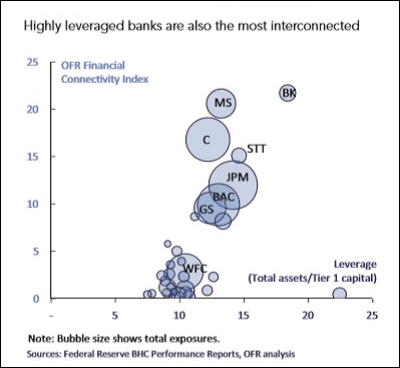
Wall Street Mega Banks Are Highly Interconnected: Stock Symbols Are as Follows: C=Citigroup; MS=Morgan Stanley; JPM=JPMorgan Chase; GS=Goldman Sachs; BAC=Bank of America; WFC=Wells Fargo.

Three of the five largest U.S. banks (JPMorgan Chase, Bank of America and Wells Fargo) have now had their wind-down plans rejected by the Federal agency insuring bank deposits (FDIC) and the Federal agency (Federal Reserve) that secretly sluiced $13 trillion in rollover loans to the insolvent or teetering banks in the last epic crisis that continues to cripple the country’s economic growth prospects. Maybe it’s time for the major newspapers of this country to start accurately reporting on the scale of today’s banking problem.

Monday, January 18, 2016

The Fed's Stunning Admission Of What Happens Next

Tyler Durden's picture

http://www.zerohedge.com/news/2016-01-17/feds-stunning-admission-what-happens-next
Following an epic stock rout to start the year, one which has wiped out trillions in market capitalization, it has rapidly become a consensus view (even by staunch Fed supporters such as the Nikkei Times) that the Fed committed a gross policy mistake by hiking rates on December 16, so much so that this week none other than former Fed president Kocherlakota openly mocked the Fed's credibility when he pointed out the near record plunge in forward breakevens suggesting the market has called the Fed's bluff on rising inflation.
All of this happened before JPM cut its Q4 GDP estimate from 1.0% to 0.1% in the quarter in which Yellen hiked.
To be sure, the dramatic reaction and outcome following the Fed's "error" rate hike was predicted on this website on many occasions, most recently two weeks prior to the rate hike in "This Is What Happened The Last Time The Fed Hiked While The U.S. Was In Recession" when we demonstrated what would happen once the Fed unleashed the "Ghost of 1937."
As we pointed out in early December, conveniently we have a great historical primer of what happened the last time the Fed hiked at a time when it misread the US economy, which was also at or below stall speed, and the Fed incorrectly assumed it was growing.
We are talking of course, about the infamous RRR-hike of 1936-1937, which took place smack in the middle of the Great Recession.

Here is what happened then, as we described previously in June.
[No episode is more comparable to what is about to happen] than what happened in the US in 1937, smack in the middle of the Great Depression. This is the only time in US history which is analogous to what the Fed will attempt to do, and not only because short rates collapsed to zero between 1929-36 but because the Fed’s balance sheet jumped from 5% to 20% of GDP to offset the Great Depression.
Just like now.
Follows a detailed narrative of precisely what happened from a recent Bridgewater note:
The first tightening in August 1936 did not hurt stock prices or the economy, as is typical.

The tightening of monetary policy was intensified by currency devaluations by France and Switzerland, which chose not to move in lock-step with the US tightening. The demand for dollars increased. By late 1936, the President and other policy makers became increasingly concerned by gold inflows (which allowed faster money and credit growth).

The economy remained strong going into early 1937. The stock market was still rising, industrial production remained strong, and inflation had ticked up to around 5%. The second tightening came in March of 1937 and the third one came in May. While neither the Fed nor the Treasury anticipated that the increase in required reserves combined with the sterilization program would push rates higher, the tighter money and reduced liquidity led to a sell-off in bonds, a rise in the short rate, and a sell-off in stocks. Following the second increase in reserves in March 1937, both the short-term rate and the bond yield spiked.

Stocks also fell that month nearly 10%. They bottomed a year later, in March of 1938, declining more than 50%!
Or, as Bank of America summarizes it: "The Fed exit strategy completely failed as the money supply immediately contracted; Fed tightening in H1’37 was followed in H2’37 by a severe recession and a 49% collapse in the Dow Jones."
* * *
As it turns out, however, the Fed did not even have to read this blog, or Bank of America, or even Bridgewater, to know the result of its rate hike. All it had to do was to read... the Fed.
But first, as J Pierpont Morgan reminds us, it was Charles Kindleberger's "The World in Depression" which summarized succinctly just how 2015/2016 is a carbon copy of the 1936/1937 period. In explaining how and why both the markets and the economy imploded so spectacularly after the Fed's decision to tighten in 1936, Kindleberger says:
"For a considerable time there was no understanding of what had happened. Then it became clear. The spurt in activity from October 1936 had been dominated by inventory accumulation. This was especially the case in automobiles, where, because of fears of strikes, supplies of new cars had been built up. It was the same in steel and textiles - two other industries with strong CIO unions."
If all off this sounds oddly familiar, here's the reason why: as we showed just last week, while inventories remain at record levels, wholesale sales are crashing, and the result is that the nominal spread between inventories and sales is all time high.

The inventory liquidation cycle was previewed all the way back in June in "The Coming US Recession Charted" long before it bacame "conventional wisdom."
Kindleberger continues:
When it became evident after the spring of of 1937 that commodity prices were not going to continue upward, the basis for the inventory accumulation was undermined, and first in textiles, then in steel, the reverse procees took place.
Oil anyone?
And then this: "The steepest economic descent in the history of the United States, which lost half the ground gained for many indexes since 1932, proved that the economic recovery in the United States had been built on an illusion."
Which, of course, is what we have been saying since day 1, and which even such finance legends as Bill Gross now openly admit when they say that the zero-percent interest rates and quantitative easing created leverage that fueled a wealth effect and propped up markets in a way that now seems unsustainable, adding that "the wealth effect is created by leverage based on QE’s and 0% rates."
And not just Bill Gross. The Fed itself.
Yes, it was the Fed itself who, in its Federal Reserve Bulletin from June 1938 as transcribed in the 8th Annual General Meeting of the Bank of International Settlements, uttered the following prophetic words:
The events of 1929 taught us that the absence of any rise in prices did not prove that no crisis was pending. 1937 has taught us that an abundant supply of gold and a cheap money policy do not prevent prices from falling.
If only the Fed had listened to, well, the Fed.
What happened next? The chart below shows the stock market reaction in 1937 to the Fed's attempt to tighten smack in the middle pf the Great Depression.

If the Fed was right, the far more prophetic 1937 Fed that is not the current wealth effect-pandering iteration, then the market is about to see half its value wiped out.

h/t @pierpont_morgan

Tuesday, June 16, 2015

In Dramatic Decision Judge Finds Fed Bailout Of AIG Was "Illegal", Government "Violated Federal Reserve Act"

Tyler Durden's picture

http://www.zerohedge.com/news/2015-06-15/dramatic-decision-judge-finds-fed-bailout-aig-was-illegal-government-violated-federa
Earlier today, former AIG head Hank Greenberg's long-running legal battle of the US government came to a dramatic end when in a 75-page ruling,  U.S. Court of Claims Judge Thomas Wheeler found that Greenberg was indeed correct in claiming the government overstepped its legal boundaries in its "unduly harsh treatment of AIG in comparison to other institutions" which was "misguided and had no legitimate purpose."
But because “the question is not whether this treatment was inequitable or unfair, but whether the government’s actions created a legal right of recovery for AIG’s shareholders" Wheeler found that Greenberg was not owed any money as AIG would have gone bankrupt without the government's forced intervention. Greenberg was seeking at least $25 billion in damages for shareholders.
The reason for the case is that years after the initial $85 billion bailout which eventually ballooned to $182 billion, AIG - with the government's explicit backstop and thus zero credit risk - managed to repay the government bailout funds and the government with a $22.7 billion profit. Greenberg argued that the pre-bailout equity holders deserved a piece of the pie, very much the same way that Fannie and Freddie stakeholders are also arguing they too deserve a piece of the post-government bailout pie.
However, “in the end, the Achilles’ heel of Starr’s case is that, if not for the Government’s intervention, AIG would have filed for bankruptcy. In a bankruptcy proceeding, AIG’s shareholders would most likely have lost 100 percent of their stock value" the judge found, and admitted that the pre-government bailout equity value of financial companies - since all of them were facing bankruptcy without a bailout - was zero.  Whether this opens up the door to a class action lawsuit by all those who were short financials into the bailout and were then squeezed by the Fed's bailout which the court has found to be an "illegal exaction" remains to be seen.
Here are the key sections from the court ruling:
The weight of the evidence demonstrates that the Government treated AIG much more harshly than other institutions in need of financial assistance. In September 2008, AIG’s international insurance subsidiaries were thriving and profitable, but  its Financial Products Division experienced a severe liquidity shortage due to the collapse of the housing market. Other major institutions, such as Morgan Stanley, Goldman Sachs, and Bank of America, encountered similar liquidity shortages. Thus, while the Government publicly singled out AIG as the poster child for causing the September 2008 economic crisis (Paulson, Tr. 1254-55), the evidence supports a conclusion that AIG actually was less responsible for the crisis than other major institutions.
Well, there was Lehman too, whose stock most certainly went to zero and which never got a government bailout but that was to be expected: after all Goldman needed to eliminate its biggest fixed income competitor at the time, and what better way than to wipe it out completely.
Wheeler continues:
The notorious credit default swap transactions were very low risk in a thriving housing market, but they quickly became very high risk when the bottom fell out of this market. Many entities engaged in these transactions, not just AIG. The Government’s justification for taking control of AIG’s ownership and running its business operations appears to have been entirely misplaced. The Government did not demand shareholder equity, high interest rates, or voting control of any entity except AIG. Indeed, with the exception of AIG, the Government has never demanded equity ownership from a borrower in the 75-year history of Section 13(3) of the Federal Reserve Act. Paulson, Tr. 1235-36; Bernanke, Tr. 1989-90.
In other words, there has never been a Fed-mediated nationalization of a private corporation prior to 2008. Which is accurate. It is also illegal according to the court, a ruling that may have dramatic repercussions for all future government/Fed bailouts of banks that Goldman deems relevant.
Starr alleges in its own right and on behalf of other AIG shareholders that the Government’s actions in acquiring control of AIG constituted a taking without just compensation and an illegal exaction, both in violation of the Fifth Amendment to the U.S. Constitution.... Having considered the entire record, the Court finds in Starr’s favor on the illegal exaction claim.
It is not quite clear why the Fed is equivalent to the Government in this case but we'll just let that slide.
Here are the details:
With the approval of the Board of Governors, the Federal Reserve Bank of New York had the authority to serve as a lender of last resort under Section 13(3) of the Federal Reserve Act in a time of “unusual and exigent circumstances,” 12 U.S.C. § 343 (2006), and to establish an interest rate “fixed with a view of accommodating commerce and business,” 12 U.S.C. § 357. However, Section 13(3) did not authorize the Federal Reserve Bank to acquire a borrower’s equity as consideration for the loan. Although the Bank may exercise “all powers specifically granted by the provisions of this chapter and such incidental powers as shall be necessary to carry on the business of banking within the limitations prescribed by this chapter,” 12 U.S.C. § 341, this language does not authorize the taking of equity.
So if they Fed is not authorized to "take equity", does that mean that the NY Fed trading desk at Liberty 33 or its backup desk in Chicago, also known as the "Plunge Protection Team" will have to do a firesale of all its stock, E-mini, and ETF holdings obtained as a result of levitating the market ever higher for the past 7 years? Inquiring minds demand to know.
The good news is that while the Fed's bailout of AIG was illegal, at least it was not unconstitutional, as that particular pathway would have likely led to that Constitutional "Expert", the president of the US, to get involved and opine on the "fairness" of a Fed bailout now and in the future.
A ruling in Starr’s favor on the illegal exaction claim, finding that the Government’s takeover of AIG was unauthorized, means that Starr’s Fifth Amendment taking claim necessarily must fail. If the Government’s actions were not authorized, there can be no Fifth Amendment taking claim.... Thus, a claim cannot be both an illegal exaction (based upon unauthorized action), and a taking (based upon authorized action).
Furthermore, the Court found that like in the BofA negotations over the Merrill rescue, the government effectively strongarmed AIG management into accepting the terms of the bailout it proposed:
The Government defends on the basis that AIG voluntarily accepted the terms of the proposed rescue, which it says would defeat Starr’s claim regardless of whether the challenged actions were authorized or unauthorized. While it is true that AIG’s Board of Directors voted to accept the Government’s proposed terms on September 16, 2008 to avoid bankruptcy, the board’s decision resulted from a complete mismatch of negotiating leverage in which the Government could and did force AIG to accept whatever punitive terms were proposed. No matter how rationally AIG’s Board addressed its alternatives that night, and notwithstanding that AIG had a team of outstanding professional advisers, the fact remains that AIG was at the Government’s mercy.
This would be especially accurate if an armed drone was flying outside of AIG HQ's during the "negotiation."
And yet, despite this clearly favorable to Greenberg ruling, the Court did not award him any damages. Why? For the simple reason that AIG was already effectively broke when the government stepped in, and as such there was be no residual equity value going into Lehman weekend and subsequently.
In the end, the Achilles’ heel of Starr’s case is that, if not for the Government’s intervention, AIG would have filed for bankruptcy. In a bankruptcy proceeding, AIG’s shareholders would most likely have lost 100 percent of their stock value. DX 2615 (chart showing that equity claimants typically have recovered zero in large U.S. bankruptcies). Particularly in the case of a corporate conglomerate largely composed of insurance subsidiaries, the assets of such subsidiaries would have been seized by state or national governmental authorities to preserve value for insurance policyholders. Davis Polk’s lawyer, Mr. Huebner, testified that it would have been a “very hard landing” for AIG, like cascading champagne glasses where secured creditors are at the top with their glasses filled first, then spilling over to the glasses of other creditors, and finally to the glasses of equity shareholders where there would be nothing left. Huebner, Tr. 5926, 5930-31; see also Offit, Tr. 7370 (In a bankruptcy filing, the shareholders are “last in line” and in most cases their interests are “wiped out.”).

A popular phrase coined by financial adviser John Studzinski, in counseling AIG’s Board on September 21, 2008 is that “twenty percent of something [is] better than 100 percent of nothing.”
All of this is absolutely correct. It also applies to Goldman, JPM, BofA, Citi, Wells and so on: all of the banks which accepted a government bailout either in equity, loan, discount window access, and so on, primed their stock to the point where the equity was worthless. As such, the entire equity tranches of the US financial system at the moment Lehman failed was worth precisely nothing.  It is also why the Goldman controlled Fed did everything in Hank Paulson's power to provide the Fed with a blank check to bail out Goldman Sachs the US financial system at any taxpayer means necessary.
Which is precisely what happened, to the tune of trillions and trillions of liquidity injections, government backstops and loans into what was at that moment a financial system which was operating but whose equity was for all intents and purposes utterly worthless.
* * *
Which takes us to the Court's closing arguments:
the Court finds that the first plaintiff class prevails on liability because of the Government’s illegal exaction, but recovers zero damages.
As the Court noted during closing arguments, a troubling feature of this outcome is that the Government is able to avoid any damages notwithstanding its plain violations of the Federal Reserve Act. Closing Arg., Tr. 69-70. Any time the Government saves a private enterprise from bankruptcy through an emergency loan, as here, it can essentially impose whatever terms it wishes without fear of reprisal. Simply put, the Government often may ignore the conditions and restrictions of Section 13(3) knowing that it will never be ordered to pay damages. 
And there you have it in a nutshell: 103 years after the Aldrich Plan to create a National Reserve Association in which private, commercial banks could create money out of thin air, failed to pass and instead an "impartial" Federal Reserve was created, the US Central Bank is nothing more than what its founder on Jekyll Island first envisioned: a private enterprise above the law, which caters entirely to commercial bank, bails them out, or nationalizes them illegally as it sees fit, and generally does whatever it wishes without any public oversight.
As to the Fed's take on just how illegal its actions were, or if - gasp - it learned its lesson and will no longer illegally "bail out" this bank or that, here is the answer.
The Federal Reserve strongly believes that its actions in the AIG rescue during the height of the financial crisis in 2008 were legal, proper and effective.  
And judging by the public's response to the events of 2008, where it is clear that not only the Fed but nobody learned anything, the next bailout of US commercial banks will proceed very much like the previo sone. And the next. And the one after that.
Source: Starr International Company v The United States