Showing posts with label meltdown. Show all posts

Friday, April 15, 2016

The Fed Sends A Frightening Letter To JPMorgan, Corporate Media Yawns

Tyler Durden's picture

http://www.zerohedge.com/news/2016-04-15/fed-sends-frightening-letter-jpmorgan-corporate-media-yawns
Submitted by Pam Martens and Russ Martens via WallStreetOnParade.com,
Yesterday the Federal Reserve released a 19-page letter that it and the FDIC had issued to Jamie Dimon, the Chairman and CEO of JPMorgan Chase, on April 12 as a result of its failure to present a credible plan for winding itself down if the bank failed. The letter carried frightening passages and large blocks of redacted material in critical areas, instilling in any careful reader a sense of panic about the U.S. financial system.
A rational observer of Wall Street’s serial hubris might have expected some key segments of this letter to make it into the business press. A mere eight years ago the United States experienced a complete meltdown of its financial system, leading to the worst economic collapse since the Great Depression. President Obama and regulators have been assuring us over these intervening eight years that things are under control as a result of the Dodd-Frank financial reform legislation. But according to the letter the Fed and FDIC issued on April 12 to JPMorgan Chase, the country’s largest bank with over $2 trillion in assets and $51 trillion in notional amounts of derivatives, things are decidedly not under control.
At the top of page 11, the Federal regulators reveal that they have “identified a deficiency” in JPMorgan’s wind-down plan which if not properly addressed could “pose serious adverse effects to the financial stability of the United States.” Why didn’t JPMorgan’s Board of Directors or its legions of lawyers catch this?
It’s important to parse the phrasing of that sentence. The Federal regulators didn’t say JPMorgan could pose a threat to its shareholders or Wall Street or the markets. It said the potential threat was to “the financial stability of the United States.”
That statement should strike fear into even the likes of presidential candidate Hillary Clinton who has been tilting at the shadows in shadow banks while buying into the Paul Krugman nonsense that “Dodd-Frank Financial Reform Is Working” when it comes to the behemoth banks on Wall Street.
How could one bank, even one as big and global as JPMorgan Chase, bring down the whole financial stability of the United States? Because, as the U.S. Treasury’s Office of Financial Research (OFR) has explained in detail and plotted in pictures (see below), five big banks in the U.S. have high contagion risk to each other. Which bank poses the highest contagion risk? JPMorgan Chase.
The OFR study was authored by Meraj Allahrakha, Paul Glasserman, and H. Peyton Young, who found the following:
“…the default of a bank with a higher connectivity index would have a greater impact on the rest of the banking system because its shortfall would spill over onto other financial institutions, creating a cascade that could lead to further defaults. High leverage, measured as the ratio of total assets to Tier 1 capital, tends to be associated with high financial connectivity and many of the largest institutions are high on both dimensions…The larger the bank, the greater the potential spillover if it defaults; the higher its leverage, the more prone it is to default under stress; and the greater its connectivity index, the greater is the share of the default that cascades onto the banking system. The product of these three factors provides an overall measure of the contagion risk that the bank poses for the financial system.”
The Federal Reserve and FDIC are clearly fingering their worry beads over the issue of “liquidity” in the next Wall Street crisis. That obviously has something to do with the fact that the Fed has received scathing rebuke from the public for secretly funneling over $13 trillion in cumulative, below-market-rate loans, often at one-half percent or less, to the big U.S. and foreign banks during the 2007-2010 crisis. The two regulators released background documents yesterday as part of flunking the wind-down plans (living wills) of five major Wall Street banks. (In addition to JPMorgan Chase, plans were rejected at Wells Fargo, Bank of America, State Street and Bank of New York Mellon.) One paragraph in the Resolution Plan Assessment Framework and Firm Determinations (2016) used the word “liquidity” 11 times:
“Firms must be able to reliably estimate and meet their liquidity needs prior to, and in, resolution. In this regard, firms must be able to track and measure their liquidity sources and uses at all material entities under normal and stressed conditions. They must also conduct liquidity stress tests that appropriately capture the effect of stresses and impediments to the movement of funds. Holding liquidity in a manner that allows the firm to quickly respond to demands from stakeholders and counterparties, including regulatory authorities in other jurisdictions and financial market utilities, is critical to the execution of the plan. Maintaining sufficient and appropriately positioned liquidity also allows the subsidiaries to continue to operate while the firm is being resolved. In assessing the firms’ plans with regard to liquidity, the agencies evaluated whether the companies were able to appropriately forecast the size and location of liquidity needed to execute their resolution plans and whether those forecasts were incorporated into the firms’ day-to-day liquidity decision making processes. The agencies also reviewed the current size and positioning of the firms’ liquidity resources to assess their adequacy relative to the estimated liquidity needed in resolution under the firm’s scenario and strategy. Further, the agencies evaluated whether the firms had linked their process for determining when to file for bankruptcy to the estimate of liquidity needed to execute their preferred resolution strategy.”
Apparently, the Federal regulators believe JPMorgan Chase has a problem with the “location,” “size and positioning” of its liquidity under its current plan. The April 12 letter to JPMorgan Chase addressed that issue as follows:
“JPMC does not have an appropriate model and process for estimating and maintaining sufficient liquidity at, or readily available to, material entities in resolution…JPMC’s liquidity profile is vulnerable to adverse actions by third parties.”
The regulators expressed the further view that JPMorgan was placing too much “reliance on funds in foreign entities that may be subject to defensive ring-fencing during a time of financial stress.” The use of the term “ring-fencing” suggests that the regulators fear that foreign jurisdictions might lay claim to the liquidity to protect their own financial counterparty interests or investors.
JPMorgan’s sprawling derivatives portfolio that encompasses $51 trillion notional amount as of December 31, 2015 is also causing angst at the Fed and FDIC. The regulators wanted more granular detail on what would happen if JPMorgan’s counterparties refused to continue doing business with it if rating agencies cut its credit ratings. The regulators asked for a “narrative describing at least one pathway” for winding down the derivatives portfolio, taking into account a number of factors, including “the costs and challenges of obtaining timely consents from counterparties and potential acquirers (step-in banks).” The regulators wanted to see the “losses and liquidity required to support the active wind-down” of the derivatives portfolio “incorporated into estimates of the firm’s resolution capital and liquidity execution needs.” 
According to the Office of the Comptroller of the Currency’s (OCC) derivatives report as of December 31, 2015, JPMorgan Chase is only centrally clearing 37 percent of its derivatives while a whopping 63 percent of its derivatives remain in over-the-counter contracts between itself and unnamed counterparties. The Dodd-Frank reform legislation had promised the public that derivatives would all become exchange traded or centrally cleared. Indeed, on March 7 President Obama falsely stated at a press conference that when it comes to derivatives “you have clearinghouses that account for the vast majority of trades taking place.”
But the OCC has now released four separate reports for each quarter of 2015 showing just the opposite of what the President told the press and the public on March 7. In its most recent report the OCC, the regulator of national banks, states that “In the fourth quarter of 2015, 36.9 percent of the derivatives market was centrally cleared.”
Equally disturbing, the most dangerous area of derivatives, the credit derivatives that blew up AIG and necessitated a $185 billion taxpayer bailout, remain predominately over the counter. According to the latest OCC report, only 16.8 percent of credit derivatives are being centrally cleared. At JPMorgan Chase, more than 80 percent of its credit derivatives are still over-the-counter.
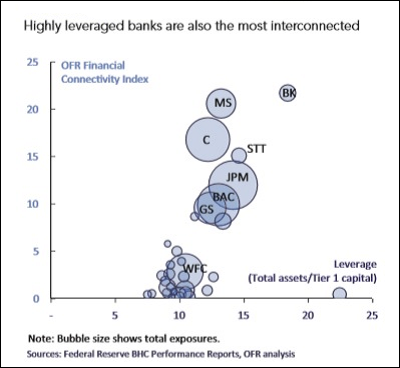
Wall Street Mega Banks Are Highly Interconnected: Stock Symbols Are as Follows: C=Citigroup; MS=Morgan Stanley; JPM=JPMorgan Chase; GS=Goldman Sachs; BAC=Bank of America; WFC=Wells Fargo.

Three of the five largest U.S. banks (JPMorgan Chase, Bank of America and Wells Fargo) have now had their wind-down plans rejected by the Federal agency insuring bank deposits (FDIC) and the Federal agency (Federal Reserve) that secretly sluiced $13 trillion in rollover loans to the insolvent or teetering banks in the last epic crisis that continues to cripple the country’s economic growth prospects. Maybe it’s time for the major newspapers of this country to start accurately reporting on the scale of today’s banking problem.

Friday, November 20, 2015

Is This How The Next Global Financial Meltdown Will Unfold?

Tyler Durden's picture

http://www.zerohedge.com/news/2015-11-20/how-next-global-financial-meltdown-will-unfold
Submitted by Charles Hugh-Smith of OfTwoMinds blog,
In effect, a currency crisis is simply the abrupt revaluation of the currency to reflect new realities.
I have long maintained that the structural imbalances of debt and risk that triggered the Global Financial Meltdown of 2008-2009 have effectively been transferred to the foreign exchange (FX) markets.
This creates a problem for the central banks that have orchestrated the "recovery" by goosing asset bubbles in stocks, real estate and bonds: unlike these markets, the currency-FX market is too big for even the Federal Reserve to manipulate for long.
The FX market trades roughly the entire Fed balance sheet of $4.5 trillion every day or two.
Currencies are in the midst of multi-year revaluations that will destabilize the tottering towers of debt, leverage and risk that have propped up global growth since 2009.
Though the relative value of currencies is discovered in the global FX market, there are four fundamental factors that influence the value of any currency:
1. Capital flows into and out of the currency (and the nation that issues the currency).
2. Perceived risk, specifically, will this currency preserve my global purchasing power (i.e. capital) or erode it?
3. The yield or interest rate paid on bonds denominated in this currency.
4. The scarcity or over-abundance of the currency.
If we dig even deeper, we find that currencies reflect the income streams and assets of the issuing nation. Consider the currency of an oil exporting nation that has seen both its income from selling oil and the underlying value of its oil in the ground fall by more than 50%.
Why shouldn't that nation's currency decline in parallel with the erosion of income and asset valuation? As a nation's income and asset base decline, there is less national income to pay interest on sovereign bonds, less private income to tax, and a reduced asset base for additional borrowing.
This is especially true if the nation issued debt and/or currency profligately in good times. Recall that debt and currency are one in the same: if someone trades euros for a U.S. Treasury bond, they don't just own a bit of sovereign debt--they own the currency of the nation that issued the bond (in this case, the U.S. dollar).
This is equally true of corporate bonds--all the debt is denominated in a specific currency, and owners of the bonds are not just betting that the interest will be paid and the bond redeemed at maturity, but that the underlying currency will not lose much of its global purchasing power.
One proxy for the absolute destruction of commodity-based income streams and assets is the CRB Index. No wonder emerging economies that depend heavily on the export of commodities are cratering, along with the currencies they issue.

Once participants become aware of the rising risk of holding a depreciating currency, the trickle out of a currency quickly becomes a torrent of fleeing capital.
Once the perceived risk switches from risk-on to risk-off, the only way to prop up the currency is to raise the interest rates that bonds denominated in that currency yield.
But raising interest rates has a brutally negative effect on the domestic economy, as higher rates choke off domestic lending, which then pushes the economy into recession.
It's a no-win double bind, though, for doing nothing and letting one's currency implode drains the nation of capital and makes imports unaffordable. That matters when the imports are energy and/or food.
When those become scarce and unaffordable, social disorder soon follows.
The currency that has benefited from this reversal of capital flows is the U.S. dollar (USD):

Debt/currency crises tend to trigger defaults and weakness in other currencies. We have a recent example of such a crisis: the Asian Contagion of 1997-98:

Though that crisis was linked to Thailand's failed bid to support its currency's peg to the U.S. dollar, the current situation is actually far more fragile as the destruction of commodity income and valuation raises the risk of sovereign defaults, corporate bond defaults, and capital flight that deepens already severe emerging-market recessions.
The bone-dry half-dead forest awaiting an igniting lightning strike is the global mountain of debt--debt which is no longer supported by current valuations of commodities and risk.
In effect, a currency crisis is simply the abrupt revaluation of the currency to reflect new realities. That revaluation then raises the risk premium on debt denominated in that currency or owed in other currencies.
As emerging market currencies decline, the income streams needed to service all the debt denominated in U.S. dollars declines, a self-reinforcing dynamic: as income and valuations fall, capital flees, pushing the relative value of the currency down even more, which further raises the risk premium that then triggers even more capital flight.
The sums in play are so staggering (an estimated $11 trillion in emerging market debts denominated in other currencies) that even the Fed won't be able to stop the meltdown.

Thursday, November 5, 2015

When Collapse Is Cheaper And More Effective Than Reform

Tyler Durden's picture

http://www.zerohedge.com/news/2015-11-05/when-collapse-cheaper-and-more-effective-reform
Submitted by Charles Hugh-Smith of OfTwoMinds blog,
Collapse begins when real reform becomes impossible.
We all know why reforms fail: everyone whose share of the power and money is being crimped by reforms fights back with everything they've got.
Reforms that can't be stopped by the outright purchase of politicos are watered down in committee, and loopholes wide enough for jumbo-jets of cash to fly through are inserted.
The reform quickly becomes "reform"--a simulacrum that maintains the facade of fixing what's broken while maintaining the Status Quo. Another layer of costly bureaucracy is added, along with hundreds or thousands of pages of additional regulations, all of which add cost and friction without actually solving what was broken.
The added friction increases the system's operating costs at multiple levels. Practitioners must stop doing actual work to fill out forms that are filed and forgotten; lobbyists milk the system to eradicate any tiny reductions in the flow of swag; attorneys probe the new regulations for weaknesses with lawsuits, and the enforcing agencies add staff to issue fines.
None of this actually fixes what was broken; all these fake-reforms add costs and reduce whatever efficiencies kept the system afloat. Recent examples include the banking regulations passed in the wake of the 2008 meltdown and the ObamaCare Affordable Care Act (ACA).
Back in 2010 I prepared this chart of The Lifecycle of Bureaucracy: as bureaucracies expand, they inevitably become less accountable, less efficient, more bloated with legacy staffing and requirements that no longer make sense, etc.
As costs soar, the bureaucracy's budget is attacked, and the agency circles the wagons and focuses on lobbying politicos and the public to leave the budget untouched.
Since accountability has been dissipated, management becomes increasingly incompetent and larded with people who can't be fired so they were kicked upstairs. Staff morale plummets as the competent quit/transfer out in disgust, leaving the least productive and those clinging on in order to retire with generous government benefits.
In this state of terminal decline, the agency's original function is no longer performed adequately and the system implodes from the dead weight of its high costs, lack of accountability, gross incompetence, inability to adapt and staggering inefficiency.

I've covered this dynamic a number of times:
Our Legacy Systems: Dysfunctional, Unreformable (July 1, 2013)
The Way Forward (April 25, 2013)
When Escape from a Previously Successful Model Is Impossible (November 29, 2012)
Complexity: Bureaucratic (Death Spiral) and Self-Organizing (Sustainable) (February 17, 2011)
This generates a ratchet effect, where costs increase even as the bureaucracy's output declines. The ratchet effect can also be visualized as a rising wedge, in which costs and inefficiencies continue rising until any slight decrease in funding collapses the organization.
Dislocations Ahead: The Ratchet Effect, Stick-Slip and QE3 (February 14, 2011)
The Ratchet Effect: Fiefdom Bloat and Resistance to Declining Incomes (August 23, 2010)

The net result of the Ratchet Effect and the impossibility of reform is this: it's cheaper and more effective to let the system collapse than squander time and treasure attempting reforms that are bound to fail as vested interests will fight to the death to retain every shred of power and swag.
Since the constituent parts refuse to accept any real reforms, the entire system implodes. We can look at healthcare, higher education and the National Security State as trillion-dollar examples of systems that become increasingly costly even as their performance declines or falls off the cliff.
This is the lesson of history, as described in the seminal book The Upside of Down: Catastrophe, Creativity, and the Renewal of Civilization.
Collapse does not need to be complete or sudden. Collapse tends to be a process, not an event.
Collapse begins when you can't find any doctors willing to accept Medicaid payments, when the potholes don't get filled even when voters approve millions of dollars in new taxes, and when kids aren't learning anything remotely useful or practical despite the school board raising tens of millions of dollars in additional property taxes.
Collapse begins when real reform becomes impossible.

Tuesday, September 8, 2015

The Numbers Are In: China Dumps A Record $94 Billion In US Treasurys In One Month

Tyler Durden's picture

http://www.zerohedge.com/news/2015-09-07/numbers-are-china-dumps-record-94-billion-us-treasurys-one-month
Shortly after the PBoC’s move to devalue the yuan, we noted with some alarm that it looked as though China may have drawn down its reserves by more than $100 billion in the space of just two weeks. That, we went on the point out, would represent a stunning increase over the previous pace of the country’s reserve draw down, which we began documenting months ahead of the devaluation (see here, for instance). We went on to estimate, based on the projected size of the RMB carry trade unwind, how large the FX reserve liquidation might need to be to offset capital outflows and finally, late last week, we suggested that China’s official FX reserve data was set to become the new risk-on/off trigger for nervous, erratic markets. In short, the pace at which Beijing is burning through its USD assets in defense of the yuan has serious implications not only for investors’ collective perception of market stability, but for yields on core paper, for global liquidity, and for US monetary policy. 
On Monday we got the official data from China and sure enough, we find out that the PBoC liquidated around $94 billion in reserves during the month of August to $3.557 trillion (the lowest since September 2013)...

... and as Goldman argues (see below), the "real" figure might have been closer to $115 billion. Whatever the case, it’s a staggering burn rate and needless to say, were the PBoC to continue to liquidate its assets at this pace, it would necessitate a raft of RRR cuts and hundreds of billions in short-term liquidity ops to ensure that money markets don’t seize up in the face of the liquidity drain.
Here’s some commentary from across sellside desks on the official numbers:
  • From RBC’s Sue Trinh: 
    • China FX reserves suggest about $140b used to defend yuan in April once valuation is accounted for
    • Believes PBOC has been intervening to maintain the yuan’s stability since the devaluation, but this kind of intervention can’t continue indefinitely
    • It’s unsustainable in the long run; yuan is overvalued by around 15% by RBC’s latest estimate; still targeting USD/CNY at 6.56 by year-end and 6.95 by the end of 2016
  • From Commerzbank’s Zhou Hao:
    • Decline in foreign reserves clearly suggests China’s central bank intervened intensively in the FX market to stabilize CNY exchange rate
    • “One-off devaluation” in mid-Aug. triggered market expectations of further CNY deprecation, which has not only endangered the financial stability, but also posts a downside risk to the economy due to capital outflows
    • It’s costly because frequent intervention will burn foreign reserves rapidly and tighten the onshore market liquidity; that said, further tightening of regulations is expected near term
    • Expects spread between CNY and CNH is likely to persist as PBOC has become an active player in onshore market
  • From Goldman:
    • The People’s Bank of China (PBOC) reported that its foreign exchange reserves dropped by US$94bn in August, to US$3.557tn at the end of the month. However, it is not straightforward to derive the actual scale of FX reserves sales from the headline FX reserves data, given uncertain valuation effects and possible balance sheet management by the PBOC.
    • It is possible to get an approximate sense about valuation effects stemming from currency movement: e.g., assuming the currency composition of the PBOC’s FX reserves broadly follows that of the average country’s (using the IMF COFER weights, which suggest roughly 70% in USD for EM countries), the currency valuation effect would probably be positive to the tune of roughly US$20bn (i.e., if we only look at the change in headline FX reserves as a gauge of sales of FX reserves, sales of FX reserves might have been underestimated by around US$20bn, given the currency valuation effect). However, besides currency movements, there could also be significant valuation effects from changes to the market prices of the PBOC’s investment portfolios, and the direction and size of those effects is hard to measure given the uncertainty of the asset composition. Moreover, there could also be possible short-term transactions and agreements between the PBOC and banks that may complicate the interpretation of the change in FX reserves as an underlying measure of RMB demand.
Of course the huge draw down was widely anticipated and indeed, we've explored and detailed virtually every angle of this story in the lead up to the data. The key takeaway here is that we now have official confirmation that August saw $94 billion in reverse QE (and more likely $115 billion) or, quantitative tightening as Deutsche Bank puts it.
We can, as we explained on Saturday, argue about what the ultimate effect on safe haven assets will be, but what's not up for debate is that conceptually speaking, China's massive UST dumping is the opposite of Western central bank QE and as such should be expected to pressure yields. More specifically, Citi has suggested that for every $500 billion in EM FX reserve liquidation, there's an attendant 108 bps or so of upward pressure on 10Y yields. Similarly, Deutsche Bank, citing the extant literature, flags 50-60bps of upward pressure on 5Y yields for every $100 billion in monthly EM FX reserve liquidations.
The takeaway, as we put it last week, is that if the Fed hikes this month, it will be tightening into a tightening.
But it's not that simple. It's also possible that, if China's FX reserve draw downs do indeed end up serving as a trigger for risk-off behavior (i.e. a selloff in risk assets), the subsequent flight to safety could end up driving yields on long bonds lower, not higher. We discussed this in detail over the weekend.
Still, China isn't the only country liquidating its USD assets. When you consider that global EM FX reserves amount to more than $7 trillion, it seems reasonable to ask whether the flight to safety that would invariably accompany a worldwide selloff in risk assets would be sufficient to replace the lost bid from massive reserve draw downs. Or, as we put it on Saturday, "the real question is what would everyone else do. If the other EMs join China in liquidating the combined $7.5 trillion in FX reserves (i.e., mostly US Trasurys but also those of Europe and Japan) shown below into an illiquid Treasury bond market where central banks already hold 30% or more of all 10 Year equivalents (the BOJ will own 60% by 2018), then it is debatable whether the mere outflow from stocks into bonds will offset the rate carnage."
And that consideration, in turn, puts the Fed in a very, very difficult spot. A rate hike cycle will put further pressure on already beleaguered EM currencies which raises the possibility that the FX reserve liquidation will be larger than the eventual safe haven flows and besides, there's bound to be a lag between the liquidation of USD assets and the flight to safety and given the potential for extraordinary bouts of volatility in UST, JGB, and German Bund markets, it's anyone's guess what happens in between.
Whatever the case, something will have to give here. That is, all of these dynamics (i.e. a Fed hike, China's massive UST dumping, an EM meltdown precipitating FX reserve drawdowns, illiquid markets for the same assets everyone is dumping, hemorrhaging petrostate budgets, etc.) simply cannot coexist for long without something snapping because, as we put it last week, in this very unstable arrangement, the smallest policy error will reverberate exponentially, and those reverberations can lead to only one thing: the Fed's admission of policy failure by adopting a tightening bias, and ultimately launching another phase of monetary easing, be it QE4 or perhaps even the long-overdue and much anticipated Friedmanesque "helicopter money" episode.

Monday, August 24, 2015

Why The Bear Of 2015 Is Different From The Bear Of 2008

Tyler Durden's picture

http://www.zerohedge.com/news/2015-08-24/why-bear-2015-different-bear-2008
Submitted by Charles Hugh-Smith of OfTwoMinds blog,
Are there any conditions now that are actually better than those of 2008?
It's tempting to see similarities in last week's global stock market mini-crash and the monumental meltdown that almost took down the Global Financial System in 2008-2009. The dizzying drop invites comparison to the last Bear Market that took the S&P 500 from 1,565 in October 2007 to 667 on March 9, 2009.
But this Bear is beginning in circumstances quite different from 2007-08. Let's list a few of the differences:
1. Then: Markets and central banks feared inflation, as WTIC oil had hit $133 per barrel in the summer of 2008.
Now: As oil tests the $40/barrel level, markets and central banks fear deflation.
2. Then: China had a relatively modest $7 trillion in total debt, considerably less than 100% of GDP.
now: China's debt has quadrupled from $7 trillion in 2007 to $28 trillion as of mid-2014, an astonishing 282% of gross domestic product (GDP)
3. Then: Central banks had a full toolbox of unprecedented monetary surprises to unleash on the market: TARP, TARF, BARF (OK, that one is made up) rescue packages and credit guarantees, quantitative easing (QE), zero interest rate policy (ZIRP) and direct purchases of mortgages, to name just the top few.
Now: The central bank toolbox is empty: every tool has already been deployed on an unprecedented scale. Every potential new program is simply a retread of QE, yield curve bending, asset purchases, etc.--the same old bag of tricks.
4. Then: Central banks had a relatively clean slate to work with. Interventions in the market and economy were limited to suppressing interest rates in the post-dot-com meltdown era.
Now: Central banks have never stopped intervening since 2008. The market is in effect a reflection of 6+ years of unprecedented central bank interventions. Rather than a clean slate, central banks face a global marketplace that is dominated by incentives to speculate with leveraged/borrowed money established by 6 years of central bank policies.
5. Then: Interest rates had rebounded from the post-dot-com lows in 2003. The Fed Funds rate in 2006-07 was above 5%, and the Prime Lending Rate exceeded 8%.
Now: The Fed Funds Rate has been screwed down to .25% for 6+ years--an unprecedented period of near-zero interest rates.
6. Then: The average 30-year mortgage rate was above 6% from October 2005 to November 2008.
Now: Mortgage rates have been under 4% in 2015.
7. Then: The U.S. dollar only soared in financial crises as capital flowed to safe havens in late 2008-early 2009 and again in 2010.
Now: The U.S. dollar began a 20% increase in mid-2014, in the midst of what was generally perceived as a solid global expansion.

8. Then: The U.S. dollar fell sharply from 2006 to 2008, and again in 2010 to 2011, boosting the overseas profits of U.S. corporations that account for 40% to 50% of total multinational corporate profits.
Now: The rising dollar has crushed the overseas profits of U.S. corporations. The soaring USD has also crushed emerging market currencies and stock markets, and forced China to devalue its currency, the the RMB (yuan)--a devaluation that triggered the current global meltdown in stocks.
9. Then: The global boom 2003-2008 was widely viewed as a tide that raised all ships.
Now: Central bank policies are recognized as engines of inequality that have widened income and wealth inequality for 6+ years.
Are there any conditions now that are actually better than those of 2008? Or are conditions now less resilient, more fragile and more dependent on unprecedented central bank interventions?

Thursday, July 2, 2015

Here is How The Next Crisis Will Play Out

Phoenix Capital Research's picture

http://www.zerohedge.com/news/2015-07-02/here-how-next-crisis-will-play-out
As I noted yesterday, the Fuse on the Global Debt Bomb has been lit. We are now officially in the Crisis to which the 2008 Meltdown was just the warm up.
The process will take time to unfold. The Tech Bubble, arguably the single biggest stock market bubble of all time, was both obvious to investors AND isolated to a single asset class: stocks. In spite of this, it took two years for stocks to finally bottom.


In contrast, the current Crisis that we are facing involves bonds… the bedrock of the financial system.
Every asset class in the world trades based on the pricing of bonds. So the fact that bonds are in a bubble (arguably the biggest bubble in financial history), means that EVERY asset class is in a bubble.
And what a bubble it is.
All told, globally there are $100 trillion in bonds in existence today.
A little over a third of this is in the US. About half comes from developed nations outside of the US. And finally, emerging markets make up the remaining 14%.
Over $100 trillion...the size of the bond bubble alone should be enough to give pause.
However, when you consider that these bonds are pledged as collateral for other securities (usually over-the-counter derivatives) the full impact of the bond bubble explodes higher to $555 TRILLION.
To put this into perspective, the Credit Default Swap  (CDS) market that nearly took down the financial system in 2008 was only a tenth of this ($50-$60 trillion).
What does all of this mean?
The $100 trillion bond bubble will implode. As it does, the financial system will begin to deleverage as debt is defaulted on or restructured (reducing the amount of US Dollars in the system, pushing the US Dollar higher).
By the time it’s all over, I expect:
1)   Numerous emerging market countries to default and most emerging market stocks to lose 50% of their value.
2)   The Euro to break below parity before the Eurozone is broken up (eventually some new version of the Euro to be introduced and remain below parity with the US Dollar).
3)   Japan to have defaulted and very likely enter hyperinflation.
4)   US stocks to lose at least 50% of their value and possibly fall as far as 400 on the S&P 500.
5)   Numerous “bail-ins” in which deposits are frozen and used to prop up insolvent banks.
This process has already begun in Europe. It will be spreading elsewhere in the months to come. Smart investors are preparing now BEFORE it hits so they are in a position to profit from it, instead of getting slaughtered

Saturday, January 25, 2014

20 Early Warning Signs That We Are Approaching A Global Economic Meltdown

Tyler Durden's picture


Submitted by Michael Snyder of The Economic Collapse blog,
Have you been paying attention to what has been happening in Argentina, Venezuela, Brazil, Ukraine, Turkey and China?  If you are like most Americans, you have not been.  Most Americans don't seem to really care too much about what is happening in the rest of the world, but they should.  In major cities all over the globe right now, there is looting, violence, shortages of basic supplies, and runs on the banks.  We are not at a "global crisis" stage yet, but things are getting worse with each passing day.  For a while, I have felt that 2014 would turn out to be a major "turning point" for the global economy, and so far that is exactly what it is turning out to be.  The following are 20 early warning signs that we are rapidly approaching a global economic meltdown...
#1 The looting, violence and economic chaos that is happening in Argentina right now is a perfect example of what can happen when you print too much money...
For Dominga Kanaza, it wasn’t just the soaring inflation or the weeklong blackouts or even the looting that frayed her nerves.

It was all of them combined.

At one point last month, the 37-year-old shop owner refused to open the metal shutters protecting her corner grocery in downtown Buenos Aires more than a few inches -- just enough to sell soda to passersby on a sweltering summer day.
#2 The value of the Argentine Peso is absolutely collapsing.
#3 Widespread shortages, looting and accelerating inflation are also causing huge problems in Venezuela...
Economic mismanagement in Venezuela has reached such a level that it risks inciting a violent popular reaction. Venezuela is experiencing declining export revenues, accelerating inflation and widespread shortages of basic consumer goods. At the same time, the Maduro administration has foreclosed peaceful options for Venezuelans to bring about a change in its current policies.

President Maduro, who came to power in a highly-contested election last April, has reacted to the economic crisis with interventionist and increasingly authoritarian measures. His recent orders to slash prices of goods sold in private businesses resulted in episodes of looting, which suggests a latent potential for violence. He has put the armed forces on the street to enforce his economic decrees, exposing them to popular discontent.
#4 In a stunning decision, the Venezuelan government has just announced that it has devalued the Bolivar by more than 40 percent.
#5 Brazilian stocks declined sharply on Thursday.  There is a tremendous amount of concern that the economic meltdown that is happening in Argentina is going to spill over into Brazil.
#6 Ukraine is rapidly coming apart at the seams...
A tense ceasefire was announced in Kiev on the fifth day of violence, with radical protesters and riot police holding their position. Opposition leaders are negotiating with the government, but doubts remain that they will be able to stop the rioters.
#7 It appears that a bank run has begun in China...
As China's CNR reports, depositors in some of Yancheng City's largest farmers' co-operative mutual fund societies ("banks") have been unable to withdraw "hundreds of millions" in deposits in the last few weeks. "Everyone wants to borrow and no one wants to save," warned one 'salesperson', "and loan repayments are difficult to recover." There is "no money" and the doors are locked.
#8 Art Cashin of UBS is warning that credit markets in China "may be broken".  For much more on this, please see my recent article entitled "The $23 Trillion Credit Bubble In China Is Starting To Collapse – Global Financial Crisis Next?"
#9 News that China's manufacturing sector is contracting shook up financial markets on Thursday...
Wall Street was rattled by a key reading on China's manufacturing which dropped below the key 50 level in January, according to HSBC. A reading below 50 on the HSBC flash manufacturing PMI suggests economic contraction.
#10 Japanese stocks experienced their biggest drop in 7 months on Thursday.
#11 The value of the Turkish Lira is absolutely collapsing.
#12 The unemployment rate in France has risen for 9 quarters in a row and recently soared to a new 16 year high.
#13 In Italy, the unemployment rate has soared to a brand new all-time record high of 12.7 percent.
#14 The unemployment rate in Spain is sitting at an all-time record high of 26.7 percent.
#15 This year, the Baltic Dry Index experienced the largest two week post-holiday decline that we have ever seen.
#16 Chipmaker Intel recently announced that it plans to eliminate 5,000 jobs over the coming year.
#17 CNBC is reporting that U.S. retailers just experienced "the worst holiday season since 2008".
#18 A recent CNBC article stated that U.S. consumers should expect a "tsunami" of store closings in the retail industry...
Get ready for the next era in retail—one that will be characterized by far fewer shops and smaller stores.

On Tuesday, Sears said that it will shutter its flagship store in downtown Chicago in April. It's the latest of about 300 store closures in the U.S. that Sears has made since 2010. The news follows announcements earlier this month of multiple store closings from major department stores J.C. Penney and Macy's.

Further signs of cuts in the industry came Wednesday, when Target said that it will eliminate 475 jobs worldwide, including some at its Minnesota headquarters, and not fill 700 empty positions.
#19 The U.S. Congress is facing another deadline to raise the debt ceiling in February.
#20 The Dow fell by more than 170 points on Thursday.  It is becoming increasingly likely that "the peak of the market" is now in the rear view mirror.
And I have not even mentioned the extreme drought that has caused the U.S. cattle herd to drop to a 61 year low or the nuclear radiation from Fukushima that is washing up on the west coast.
In light of everything above, is there anyone out there that still wants to claim that "everything is going to be okay" for the global economy?
Sadly, most Americans are not even aware of most of these things.
All over the country today, the number one news headline is about Justin Bieber.  The mainstream media is absolutely obsessed with celebrity scandals, and so is a very large percentage of the U.S. population.
A great economic storm is rapidly approaching, and most people don't even seem to notice the storm clouds that are gathering on the horizon.
In the end, perhaps we will get what we deserve as a nation.
http://www.zerohedge.com/news/2014-01-24/20-early-warning-signs-we-are-approaching-global-economic-meltdown

Monday, November 25, 2013

Fukushima reactor cores (1,2, & 3) may have had “Melt Through to China Syndrome” and went into the earth itself — Includes over 1,500 pounds of plutonium


[...] It is becoming apparent that the three molten cores, each weighing 120 to 130 tons have not only melted their way through 6 inches of steel in the reactor vessels, but they now either sit on concrete floors of the severely cracked containment buildings or they have melted their way into the earth itself – this, in nuclear parlance, is called ‘A Melt Through to China Syndrome’.
[...] Each reactor core contains 500lbs of plutonium, but Reactor 3 contains even more, because it also contained plutonium/uranium fuel rods which were placed inside the core as an experiment.
[...] The whole reactor site sits on sodden ground, which has now become unstable, muddy and possibly liquefied. The site itself experiences many minor earthquakes each day, but should a quake greater than 6 or 7 on the Richter scale occur, it is likely that one or several of the buildings could collapse with absolutely disastrous consequences. [...]
http://enenews.com/fukushima-reactor-cores-melt-china-syndrome-gone-earth-1500-pounds-plutonium

Scientist back from Japan: Melt-through of Fukushima containment vessels being discussed — They can’t locate any of the 3 molten reactor cores — “It’s bad, it’s definitely not over”

Cape Cod Times, Nov. 24, 2013: [Woods Hole Oceanographic Institution Senior Scientist Ken] Buesseler, along with a team from WHOI, made the first of his three visits to the Fukushima area in June 2011 [...] the Japanese are not able to locate three molten reactor cores. There is ongoing discussion of whether the cores have undergone a meltdown or a melt-through of the containment vessels, Buesseler said. “You can’t send humans in there. It takes decades to come up with a plan,” he said. “It’s bad. It’s definitely not over yet.”
Asia Times, Nov. 18, 2013: At least some of the reactor cores are believed to have melted through the containment vessels, and possibly into the ground, contaminating groundwater with unprecedented levels of hot particles.
Kyodo, Nov. 20, 2013: The Nos. 5 and 6 reactors [...] will not actually be dismantled and instead will be used as a research facility to develop technologies for achieving the unprecedented task of removing melted fuel from the Nos. 1 to 3 crippled reactors [...]
NPR, Nov. 18, 2013: [...] And then there are the three reactors that melted down, which will pose an even greater challenge. “They have fuel not just in the pools above the reactors, but in the cores themselves. That fuel is melted down and it’s going to take a very, very long time to even figure out how to get that fuel out,” [NPR's Geoff Brumfiel] says.
More from Buesseler: NHK: There was a melt-through so Fukushima fuel is definitely down with the groundwater, and that's flowing into Pacific -- Americans need to watch, it gets international very quickly -- May already be at West Coast -- No 'immediate' risk (VIDEO)

http://enenews.com/scientist-back-from-japan-they-cant-locate-any-of-the-molten-reactor-cores-melt-through-of-containment-vessels-being-discussed-its-bad-its-definitely-not-over-yet-at-fukushima