Showing posts with label derivatives. Show all posts

Monday, May 23, 2016

We're In The Eye Of A Global Financial Hurricane

Tyler Durden's picture

We're In The Eye Of A Global Financial Hurricane
Submitted by Charles Hugh-Smith via OfTwoMinds blog,
The only "growth" we're experiencing are the financial cancers of systemic risk and financialization's soaring wealth/income inequality.
The Keynesian gods have failed, and as a result we're in the eye of a global financial hurricane.

The Keynesian god of growth has failed.
The Keynesian god of borrowing from the future to fund today's consumption has failed.
The Keynesian god of monetary stimulus / financialization has failed.
Every major central bank and state worships these Keynesian idols:
1. Growth. (Never mind the cost or what kind of growth--all growth is good, even the financial equivalent of aggressive cancer).
2. Borrowing from the future to fund today's keg party, worthless college diploma, particle board bookcase, stock buy-back, etc. (oops, I mean "investment")--a.k.a. deficit spending which is a polite way of saying this unsavory truth: stealing from our children and grandchildren to fund our lifestyles today.
3. Monetary stimulus / financialization. If private investment sags (because there are few attractive investments at today's nosebleed valuations and few attractive investments in a global economy burdened with massive over-production and over-capacity), drop interest rates to zero (or below zero) to "stimulate" new borrowing... for whatever: global carry trades, bat guano derivatives, etc.
Here is my definition of Financialization:
Financialization is the mass commodification of debt and debt-based financial instruments collaterized by previously low-risk assets, a pyramiding of risk and speculative gains that is only possible in a massive expansion of low-cost credit and leverage.
That is a mouthful, so let's break it into bite-sized chunks.
Home mortgages are a good example of how financialization increases financial profits by jacking up risk and distributing it to suckers who don't recognize the potential for staggering losses.
In the good old days, home mortgages were safe and dull: banks and savings and loans institutions issued the mortgages and kept the loans on their books, earning a stable return for the 30 years of the mortgage's term.
Then the financialization machine revolutionized the home mortgage business to increase profits. The first step was to generate entire new types of mortgages with higher profit margins than conventional mortgages. These included no-down payment mortgages (liar loans), no-interest-for-the-first-few-years mortgages, adjustable-rate mortgages, home equity lines of credit, and so on.
This broadening of options (and risks) greatly expanded the pool of people who qualified for a mortgage. In the old days, only those with sterling credit qualified for a home mortgage. In the financialized realm, almost anyone with a pulse could qualify for an exotic mortgage.
The interest rate, risk and profit margins were all much higher for the originators. What's not to like? Well, the risk of default is a problem. Defaults trigger losses.
Financialization's solution: package the risk in safe-looking securities and offload the risk onto suckers and marks. Securitizing mortgages enabled loan originators to skim the origination fees and profits up front and then offload the risk of default and loss onto buyers of the mortgage securities.
Securitization was tailor-made for hiding risk deep inside apparently low-risk pools of mortgages and rigging the tranches to maximize profits for the packagers at the expense of the unwary buyers, who bought high-risk securities under the false premise that they were "safe home mortgages."
Financialization-- which can only expand to dominate an economy if it is supported by a central bank bent on expanding credit--has two inevitable and highly toxic consequences:
-- Risk seeps into every nook and cranny of the financial system, greatly increasing the odds of a systemic domino reaction in financial meltdowns. This is precisely what we saw in the 2008-09 Global Financial Meltdown (GFM): supposedly "contained" subprime mortgages toppled dominoes left and right, bringing the entire risk-saturated system to its knees.
-- Extraordinary wealth and income inequality, as those closest to the central bank money/credit spigots can scoop up income-producing assets first at much lower costs than Mom and Pop Main Street investors.
The rising anger of the masses left behind by the central bank / financialization wealth harvesting machine is the direct result of Keynesian monetary stimulus that rewards debt-based speculative gambles by those closest to the cheap-credit spigots.
As I explain in my book Why Our Status Quo Failed and Is Beyond Reform, the only possible output of central bank monetary stimulus is financialization, and the only possible output of financialization is unprecedented wealth and income inequality.
The global financial system is in the eye of an unprecedented hurricane. While central bankers are congratulating themselves on their god-like mastery of Nature, and secretly praying to the idols of the Keynesian Cargo Cult every night, the inevitable consequence of borrowing from the future, the obsession with "growth" at any cost and financialization /monetary stimulus, a.k.a. the rich get richer thanks to central banks is systemic collapse.
Don't fall for the mainstream media and politicos' shuck-and-jive that all is well and "growth" will return any day now. The only "growth" we're experiencing are the financial cancers of systemic risk and financialization's soaring wealth/income inequality.

Tuesday, May 10, 2016

With A Historic -150% Net Short Position, Carl Icahn Is Betting On An Imminent Market Collapse

Tyler Durden's picture

http://www.zerohedge.com/news/2016-05-09/historic-150-net-short-position-carl-icahn-betting-imminent-market-collapse
Over the past year, based on his increasingly more dour media appearances, billionaire Carl Icahn had been getting progressively more bearish. At first, he was mostly pessimistic about junk bonds, saying last May that "what's even more dangerous than the actual stock market is the high yield market." As the year progressed his pessimism become more acute and in December he said that the "meltdown in high yield is just beginning." It culminated in February when he said on CNBC that a "day of reckoning is coming."
Some skeptics thought that Icahn was simply trying to scare investors into selling so he could load up on risk assets at cheaper prices, however that line of thought was quickly squashed two weeks ago when Icahn announced to the shock of ever Apple fanboy that several years after his "no brainer" investment in AAPL, Icahn had officially liquidated his entire stake.
As it turns out, Icahn's AAPL liquidation was just the appetizer of how truly bearish the legendary investor has become.
* * *
As readers will recall, when it comes to what we believe is one of the world's most bearish hedge funds, we traditionally highlight the net exposure of Horseman Global, which not only has been profitable for the past four years, it has done so while running a net short book. To the point, as of March 31, Horseman was net short by a record 98%.


As it turns out this was nothing compare to Icahn's latest net exposure.
In the just disclosed 10-Q of Icahn's investment vehicle, Icahn Enterprises LP in which the 80 year old holds a 90% stake, we find that as of March 31, Carl Icahn - who subsequently divested his entire long AAPL exposure - has been truly putting money, on the short side, where his mouth was in the past quarter. So much so that what on December 31, 2015 was a modest 25% net short, has since exploded into a gargantuan, and unprecedented for Icahn, 149% net short position.

This is the result of a relatively flat long gross exposure of 164% resulting from a 156% equity and 8% credit long (a combined long exposure which is certainly far lower following the AAPL liquidation), and a soaring short book which has exploded from 150% as of March 31, 2015 to a whopping 313% one year later, on the back of 277% in gross short equity exposure and 36% short credit.


Putting this number in context, in the history of IEP, not only has Icahn never been anywhere near this short, but just one year ago when he first started complaining about stocks, he was still 4% net long. Thos days are gone, and starting in Q3 and Q4, Icahn proceeded to wage into net short territory, with roughly -25% exposure, a number that has increased a record six-fold in just the last quarter!
What is just as notable is the dramatic leverage involved on both sides of the flatline, but nothing compares to the near 3x equity leverage on the short side (this is not CDS). As a reminder, Icahn Enterprises used to be run as a hedge fund with outside investors, but Icahn returned outside money in 2011, leaving IEP and Icahn as the two dominant investors.  According to Barron's, the entire fund appears to be about $5.8 billion, with $4 billion coming from Icahn personally. Which means that this is a very substantial bet in dollar terms.
When asked about this unprecedented bearish position, Icahn Enterprises CEO Keith Cozza said during the May 5 earnings call that "Carl has been very vocal in recent weeks in the media about his negative views." He certainly has been, although many though he was merely exagerating. He was not.
"We’re much more concerned about the market going down 20% than we are it going up 20%. And so the significant weighting to the short side reflects that," Cozza added. 
Icahn was not personally present at the conference call, however now that his bet on what is arguably a massive market crash has become public, we are confident he will be on both CNBC and Bloomberg TV in the coming days if not hours, to provide damage control and to avoid a panic as mom and pop investors scramble, and wonder just what does one of the world's most astute investors see that they don't. 
Source

Friday, April 15, 2016

The Fed Sends A Frightening Letter To JPMorgan, Corporate Media Yawns

Tyler Durden's picture

http://www.zerohedge.com/news/2016-04-15/fed-sends-frightening-letter-jpmorgan-corporate-media-yawns
Submitted by Pam Martens and Russ Martens via WallStreetOnParade.com,
Yesterday the Federal Reserve released a 19-page letter that it and the FDIC had issued to Jamie Dimon, the Chairman and CEO of JPMorgan Chase, on April 12 as a result of its failure to present a credible plan for winding itself down if the bank failed. The letter carried frightening passages and large blocks of redacted material in critical areas, instilling in any careful reader a sense of panic about the U.S. financial system.
A rational observer of Wall Street’s serial hubris might have expected some key segments of this letter to make it into the business press. A mere eight years ago the United States experienced a complete meltdown of its financial system, leading to the worst economic collapse since the Great Depression. President Obama and regulators have been assuring us over these intervening eight years that things are under control as a result of the Dodd-Frank financial reform legislation. But according to the letter the Fed and FDIC issued on April 12 to JPMorgan Chase, the country’s largest bank with over $2 trillion in assets and $51 trillion in notional amounts of derivatives, things are decidedly not under control.
At the top of page 11, the Federal regulators reveal that they have “identified a deficiency” in JPMorgan’s wind-down plan which if not properly addressed could “pose serious adverse effects to the financial stability of the United States.” Why didn’t JPMorgan’s Board of Directors or its legions of lawyers catch this?
It’s important to parse the phrasing of that sentence. The Federal regulators didn’t say JPMorgan could pose a threat to its shareholders or Wall Street or the markets. It said the potential threat was to “the financial stability of the United States.”
That statement should strike fear into even the likes of presidential candidate Hillary Clinton who has been tilting at the shadows in shadow banks while buying into the Paul Krugman nonsense that “Dodd-Frank Financial Reform Is Working” when it comes to the behemoth banks on Wall Street.
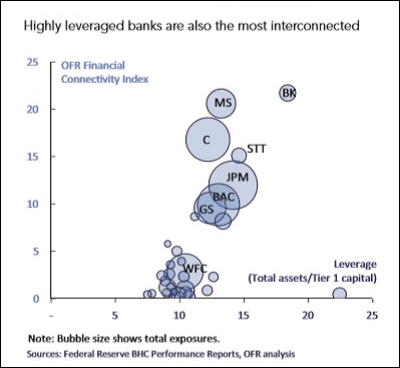
How could one bank, even one as big and global as JPMorgan Chase, bring down the whole financial stability of the United States? Because, as the U.S. Treasury’s Office of Financial Research (OFR) has explained in detail and plotted in pictures (see below), five big banks in the U.S. have high contagion risk to each other. Which bank poses the highest contagion risk? JPMorgan Chase.
The OFR study was authored by Meraj Allahrakha, Paul Glasserman, and H. Peyton Young, who found the following:
“…the default of a bank with a higher connectivity index would have a greater impact on the rest of the banking system because its shortfall would spill over onto other financial institutions, creating a cascade that could lead to further defaults. High leverage, measured as the ratio of total assets to Tier 1 capital, tends to be associated with high financial connectivity and many of the largest institutions are high on both dimensions…The larger the bank, the greater the potential spillover if it defaults; the higher its leverage, the more prone it is to default under stress; and the greater its connectivity index, the greater is the share of the default that cascades onto the banking system. The product of these three factors provides an overall measure of the contagion risk that the bank poses for the financial system.”
The Federal Reserve and FDIC are clearly fingering their worry beads over the issue of “liquidity” in the next Wall Street crisis. That obviously has something to do with the fact that the Fed has received scathing rebuke from the public for secretly funneling over $13 trillion in cumulative, below-market-rate loans, often at one-half percent or less, to the big U.S. and foreign banks during the 2007-2010 crisis. The two regulators released background documents yesterday as part of flunking the wind-down plans (living wills) of five major Wall Street banks. (In addition to JPMorgan Chase, plans were rejected at Wells Fargo, Bank of America, State Street and Bank of New York Mellon.) One paragraph in the Resolution Plan Assessment Framework and Firm Determinations (2016) used the word “liquidity” 11 times:
“Firms must be able to reliably estimate and meet their liquidity needs prior to, and in, resolution. In this regard, firms must be able to track and measure their liquidity sources and uses at all material entities under normal and stressed conditions. They must also conduct liquidity stress tests that appropriately capture the effect of stresses and impediments to the movement of funds. Holding liquidity in a manner that allows the firm to quickly respond to demands from stakeholders and counterparties, including regulatory authorities in other jurisdictions and financial market utilities, is critical to the execution of the plan. Maintaining sufficient and appropriately positioned liquidity also allows the subsidiaries to continue to operate while the firm is being resolved. In assessing the firms’ plans with regard to liquidity, the agencies evaluated whether the companies were able to appropriately forecast the size and location of liquidity needed to execute their resolution plans and whether those forecasts were incorporated into the firms’ day-to-day liquidity decision making processes. The agencies also reviewed the current size and positioning of the firms’ liquidity resources to assess their adequacy relative to the estimated liquidity needed in resolution under the firm’s scenario and strategy. Further, the agencies evaluated whether the firms had linked their process for determining when to file for bankruptcy to the estimate of liquidity needed to execute their preferred resolution strategy.”
Apparently, the Federal regulators believe JPMorgan Chase has a problem with the “location,” “size and positioning” of its liquidity under its current plan. The April 12 letter to JPMorgan Chase addressed that issue as follows:
“JPMC does not have an appropriate model and process for estimating and maintaining sufficient liquidity at, or readily available to, material entities in resolution…JPMC’s liquidity profile is vulnerable to adverse actions by third parties.”
The regulators expressed the further view that JPMorgan was placing too much “reliance on funds in foreign entities that may be subject to defensive ring-fencing during a time of financial stress.” The use of the term “ring-fencing” suggests that the regulators fear that foreign jurisdictions might lay claim to the liquidity to protect their own financial counterparty interests or investors.
JPMorgan’s sprawling derivatives portfolio that encompasses $51 trillion notional amount as of December 31, 2015 is also causing angst at the Fed and FDIC. The regulators wanted more granular detail on what would happen if JPMorgan’s counterparties refused to continue doing business with it if rating agencies cut its credit ratings. The regulators asked for a “narrative describing at least one pathway” for winding down the derivatives portfolio, taking into account a number of factors, including “the costs and challenges of obtaining timely consents from counterparties and potential acquirers (step-in banks).” The regulators wanted to see the “losses and liquidity required to support the active wind-down” of the derivatives portfolio “incorporated into estimates of the firm’s resolution capital and liquidity execution needs.” 
According to the Office of the Comptroller of the Currency’s (OCC) derivatives report as of December 31, 2015, JPMorgan Chase is only centrally clearing 37 percent of its derivatives while a whopping 63 percent of its derivatives remain in over-the-counter contracts between itself and unnamed counterparties. The Dodd-Frank reform legislation had promised the public that derivatives would all become exchange traded or centrally cleared. Indeed, on March 7 President Obama falsely stated at a press conference that when it comes to derivatives “you have clearinghouses that account for the vast majority of trades taking place.”
But the OCC has now released four separate reports for each quarter of 2015 showing just the opposite of what the President told the press and the public on March 7. In its most recent report the OCC, the regulator of national banks, states that “In the fourth quarter of 2015, 36.9 percent of the derivatives market was centrally cleared.”
Equally disturbing, the most dangerous area of derivatives, the credit derivatives that blew up AIG and necessitated a $185 billion taxpayer bailout, remain predominately over the counter. According to the latest OCC report, only 16.8 percent of credit derivatives are being centrally cleared. At JPMorgan Chase, more than 80 percent of its credit derivatives are still over-the-counter.

Wall Street Mega Banks Are Highly Interconnected: Stock Symbols Are as Follows: C=Citigroup; MS=Morgan Stanley; JPM=JPMorgan Chase; GS=Goldman Sachs; BAC=Bank of America; WFC=Wells Fargo.

Three of the five largest U.S. banks (JPMorgan Chase, Bank of America and Wells Fargo) have now had their wind-down plans rejected by the Federal agency insuring bank deposits (FDIC) and the Federal agency (Federal Reserve) that secretly sluiced $13 trillion in rollover loans to the insolvent or teetering banks in the last epic crisis that continues to cripple the country’s economic growth prospects. Maybe it’s time for the major newspapers of this country to start accurately reporting on the scale of today’s banking problem.

Thursday, April 14, 2016

Inside the $5.1B Goldman Sachs subprime mortgage settlement

http://www.cbsnews.com/news/inside-the-5-billion-dollar-goldman-sachs-subprime-mortgage-settlement/?linkId=23337679
News of the $5 billion settlement thrust Goldman Sachs into the glare of the public spotlight, and the cross hairs of the presidential campaign.
Senator Bernie Sanders called it "a fraudulent organization," while Governor John Kasich said "the Wall Street firms engaged in greed, massive greed."
In February, Morgan Stanley settled for $3.2 billion, Wells Fargo agreed to pay $1.2 billion, J.P. Morgan Chase paid $13 billion three years ago, and Bank of America coughed up a whopping $16.6 billion in 2014.
Goldman admitted that in bundling mortgages from subprime loan specialists like Countrywide Financial -- and then selling them to investors as bonds -- it largely failed to address financial problems it knew about.
In one period during August 2006, Goldman found what it called an "unusually high" percentage of loans with credit and compliance defects.
When one transaction manager was asked by Goldman officials "How do we know that we caught everything," he answered: "We don't."
Another responded it "depends on what you mean by everything." And when an outside analyst wrote a positive review of Countrywide, the head of due diligence at Goldman wrote in an e-mail: "if they only knew."
This was a civil case, so no one is going to jail. And that's likely to add to the anger, according to Robert Weissman of advocacy group Public Citizen.
"Millions of people were thrown out of jobs, millions of people lost their homes, communities were destroyed -- all because of their wrong doing. Yet they are escaping any criminal accountability, it seems."
While a $5 billion civil penalty is a lot of money, approximately half of it appears to be tax deductible -- meaning Goldman Sachs will be getting a tax break that could shave about a billion dollars off the total they've agreed to pay.

Wells Fargo Finally Reveals Its Dire Energy Exposure: $32 Billion To Junk-Rated Oil And Gas Companies

Tyler Durden's picture

http://www.zerohedge.com/news/2016-04-14/wells-fargo-has-problem-32-billion-junk-rated-energy-exposure
Following its recent critical profile by Bloomberg which earlier this week penned, "Wells Fargo Misjudged the Risks of Energy Financing", which came about 4 months after we wrote an almost identical report, the biggest US bank by market cap knew it had to reveal more than just the usual placeholder data in its investor presentation today. Sure enough, Warren Buffett's favorite bank finally opened its books more than usual as concerns built about its $17.4 billion in total outstanding oil and energy loans (at the end of 2015). This is what it revealed.
First, the big picture. As the chart below shows, Wells' net income has been consistently declining in the past year, with earnings of $5.5BN down from $5.8BN a year ago even as revenues grow 4% over the same period.

Here is the reason: Net Interest Margin continues to decline, as a result of the continued curve flattening.


This ongoing decline in NIM is forcing Wells to issue ever more loans to maintain its average loan/yield constant. As the chart below shows, it is doing just that, with period end loans outstanding soaring by $86BN from a year ago to $947.3BN.


All of that, however has to do with the structural constraints of the economy, and the ongoing collapse in rates.
What about Wells' overall credit book? Here we find some curious observations here.
Net charge-offs rose to $886 million, up $55 million, or 7%, LQ on $87 million higher oil and gas portfolio losses. And yet, despite the abovementioned $17.8 billion (as of Q1) in loans to oil and energy and despite the deteriorating conditions, Wells only built reserves by a paltry $200 million reserve build in the quarter, resulting in a 0.38% net charge-off rate "as continued improvement in residential real estate was more than offset by higher oil and gas reserves." Will that reserve

Still it wasn't just energy related losses: Wells also revealed that commercial losses were 20 bps, up 4 bps LQ. while consumer losses of 57 bps, up 1 bp LQ
Just as interesting was Wells' disclosure of its Non performing assets, which jumped by $706 million to $13.5 billion, the biggest such increase since the crisis.

This was Wells' explanation:
  • Nonaccrual loans increased $852 million on $1.1 billion higher oil and gas and $343 million from the addition of GE Capital loans, partially offset by lower residential and commercial real estate nonaccruals
  • Acquired loans and leases from GE Capital acquisitions were marked to fair value in purchase accounting with no Allowance recorded with the closings
  • Future allowance levels will be based on a variety of factors, including loan growth, portfolio performance and general economic conditions
Finally, we get to the real meat - Wells' Oil and Gas loan portfolio and total exposure. Here are the details:
Oil and gas loan portfolio of $17.8 billion, or 1.9% of total loan outstandings

The total outstanding amount was up $474 million, or 3%, from the $17.4 billion in 4Q15 on drawn lines and the acquisition of $236 million in loans from GE Capital
Outstandings include $819 million second lien and $374 million of mezzanine loans
Wells reports that ~7%, or $1.2 billion, of outstandings to investment grade companies. This means that $16.6 bilion of Wells' outstanding loans are to junk-rated companies, something we flagged four months ago.
* * *
On the other hand, total exposure of $40.7 billion was down $1.3 billion, or 3%, reflecting declines across all 3 sectors from reductions to existing credit facilities and net charge-offs. As expected, Wells has decided to start trimming it overall exposure by collapsing credit lines.
But the punchline once again, is in the reminder of just how generous Wells has been in lending to junk-rated oil and gas companies in the recent past to compensate for its declining NIM: Wells reported that ~22%, or $8.8 billion, of exposure to investment grade companies, which means $32 billion is to junk-rated companies.
It also means that much more pain is in store for Wells in the coming quarters unless oil stages a dramatic comeback.
* * *
At this point Wells give an update of what it actually did in the first quarter.
First, it increased net chargeoffs by a paltry $204 million in 1Q16, up $87 million from 4Q15, "driven by deterioration in borrower financial performance and collateral values reflecting lower crude and natural gas prices"
While it did not need to explain, it adds that "all of the losses were in the E&P and services sectors Nonaccrual loans"
More troubling was the spike in Nonaccrual loans which more than doubled to $1.9 billion, up $1.1 billion from 4Q15 on "higher outstandings, weaker expectations for borrower cash flows reflecting lower collateral values, the run-off of hedges, less sponsor support and the closing of external liquidity sources, as well as protective draws" Once again, nearly all nonaccruals were in the E&P and services sectors.
Curiously, about 90% of nonaccruals remain current on interest and principal. This means that if and when the borrowers hit their funding cliff, the consequences will be severe.
Finally, Wells reports that it has taken $1.7 billion of allowance for credit losses allocated for oil and gas portfolio, which amount to 9.3% of total oil and gas loans outstanding.
So, here is the recap: $1.1 billion in reserves provisions (an increase of only $200MM in the quarter), a total of $1.9 billion in non-performing Oil and Gas assets, a $1.7 billion allowance for Oil and Gas credit losses, and a total of $32 billion in junk rated oil and gas exposure?
Something tells us that top chart showing Wells Fargo's declining net income will not get much better any time soon...
Source: Wells Fargo

Friday, February 5, 2016

22 Signs That The Global Economic Turmoil We Have Seen So Far In 2016 Is Just The Beginning

Tyler Durden's picture


http://www.zerohedge.com/news/2016-02-05/22-signs-global-economic-turmoil-we-have-seen-so-far-2016-just-beginning
As bad as the month of January was for the global economy, the truth is that the rest of 2016 promises to be much worse.  Layoffs are increasing at a pace that we haven’t seen since the last recession, major retailers are shutting down hundreds of locations, corporate profit margins are plunging, global trade is slowing down dramatically, and several major European banks are in the process of completely imploding.  I am about to share some numbers with you that are truly eye-popping.  Each one by itself would be reason for concern, but when you put all of the pieces together it creates a picture that is hard to deny. 
The global economy is in crisis, and this is going to have very serious implications for the financial markets moving forward.  U.S. stocks just had their worst January in seven years, and if I am right much worse is still yet to come this year.  The following are 22 signs that the global economic turmoil that we have seen so far in 2016 is just the beginning…
1. The number of job cuts in the United States skyrocketed 218 percent during the month of January according to Challenger, Gray & Christmas.
2. The Baltic Dry Index just hit yet another brand new all-time record low.  As I write this article, it is sitting at 303.
3. U.S. factory orders have now dropped for 14 months in a row.
4. In the U.S., the Restaurant Performance Index just fell to the lowest level that we have seen since 2008.
5. In January, orders for class 8 trucks (the big trucks that you see shipping stuff around the country on our highways) declined a whopping 48 percent from a year ago.
6. Rail traffic is also slowing down substantially.  In Colorado, there are hundreds of train engines that are just sitting on the tracks with nothing to do.
7. Corporate profit margins peaked during the third quarter of 2014 and have been declining steadily since then.  This usually happens when we are heading into a recession.
8. A series of extremely disappointing corporate quarterly reports is sending stock after stock plummeting.  Here is a summary from Zero Hedge of a few examples that we have just witnessed…
  • SHARES OF LIONS GATE ENTERTAINMENT FALL 5 PCT IN EXTENDED TRADE AFTER QUARTERLY RESULTS – RTRS
  • TABLEAU SOFTWARE SHARES TUMBLE 40 PCT IN AFTER HOURS TRADING – RTRS
  • YRC WORLDWIDE SHARES DOWN 16.4 PCT AFTER THE BALL FOLLOWING RESULTS – RTRS
  • SPLUNK INC SHARES DOWN 7.6 PCT IN AFTER HOURS TRADING – RTRS
  • LINKEDIN SHARES EXTEND DECLINE, DOWN 24 PCT AFTER RESULTS, GUIDANCE – RTRS
  • HANESBRANDS SHARES FURTHER ADD TO LOSSES IN EXTENDED TRADE, LAST DOWN 14.9 PCT – RTRS
  • OUTERWALL SHARES FALL 11 PCT IN EXTENDED TRADING AFTER QUARTERLY RESULTS – RTRS
  • GENWORTH SHARES DOWN 16.5 PCT AFTER THE BELL FOLLOWING RESULTS, RESTRUCTURING PLAN
9. Junk bonds continue to crash on Wall Street.  On Monday, JNK was down to 32.60 and HYG was down to77.99.
10. On Thursday, a major British news source publicly named five large European banks that are considered to be in very serious danger…
Deutsche Bank, Credit Suisse, Santander, Barclays and RBS are among the stocks that are falling sharply sending shockwaves through the financial world, according to former hedge fund manager and ex Goldman Sachs employee Raoul Pal.
11. Deutsche Bank is the biggest bank in Germany and it has more exposure to derivatives than any other bank in the world.  Unfortunately, Deutsche Bank credit default swaps are now telling us that there is deep turmoil at the bank and that a complete implosion may be imminent.
12. Last week, we learned that Deutsche Bank had lost a staggering 6.8 billion euros in 2015.  If you will recall, I warned about massive problems at Deutsche Bank all the way back in September.  The most important bank in Germany is exceedingly troubled, and it could end up being for the EU what Lehman Brothers was for the United States.
13. Credit Suisse just announced that it will be eliminating 4,000 jobs.
14. Royal Dutch Shell has announced that it is going to be eliminating 10,000 jobs.
15. Caterpillar has announced that it will be closing 5 plants and getting rid of 670 workers.
16. Yahoo has announced that it is going to be getting rid of 15 percent of its total workforce.
17. Johnson & Johnson has announced that it is slashing its workforce by 3,000 jobs.
18. Sprint just laid off 8 percent of its workforce and GoPro is letting go 7 percent of its workers.
19. All over America, retail stores are shutting down at a staggering pace.  The following list comes from one of my previous articles…
-Wal-Mart is closing 269 stores, including 154 inside the United States.
-K-Mart is closing down more than two dozen stores over the next several months.
-J.C. Penney will be permanently shutting down 47 more stores after closing a total of 40 stores in 2015.
-Macy’s has decided that it needs to shutter 36 stores and lay off approximately 2,500 employees.
-The Gap is in the process of closing 175 stores in North America.
-Aeropostale is in the process of closing 84 stores all across America.
-Finish Line has announced that 150 stores will be shutting down over the next few years.
-Sears has shut down about 600 stores over the past year or so, but sales at the stores that remain open continue to fall precipitously.
20. According to the New York Times, the Chinese economy is facing a mountain of bad loans that “could exceed $5 trillion“.
21. Japan has implemented a negative interest rate program in a desperate attempt to try to get banks to make more loans.
22. The global economy desperately needs the price of oil to go back up, but Morgan Stanley says that we will not see $80 oil again until 2018.
It is not difficult to see where the numbers are trending.
Last week, I told my wife that I thought that Marco Rubio was going to do better than expected in Iowa.
How did I come to that conclusion?
It was simply based on how his poll numbers were trending.
And when you look at where global economic numbers are trending, they tell us that 2016 is going to be a year that is going to get progressively worse as it goes along.
So many of the exact same things that we saw happen in 2008 are happening again right now, and you would have to be blind not to see it.
Hopefully I am wrong about what is coming in our immediate future, because millions upon millions of Americans are not prepared for what is ahead, and most of them are going to get absolutely blindsided by the coming crisis.

Friday, January 29, 2016

Ignore Stocks, the REAL Crisis is Far Bigger and Far Worse

Phoenix Capital Research's picture

http://www.zerohedge.com/news/2016-01-28/ignore-stocks-real-crisis-far-bigger-and-far-worseInvestors today are focusing on the wrong asset class.
Stocks started off the year with one of the worst drops in recent memory. As of this morning the S&P 500 was down over 7% for the year thus far.


However, while stocks grab the headlines, it is the bond market that warrants the most attention.

The reason?

Firstly, size. The bond bubble is $100 trillion in size. To put this into perspective, the Tech Bubble, the single largest stock bubble in history relative to profits, was just $16 trillion in size.

Beyond this, there are $555 trillion derivatives trading based on interest rates (bond yields). So that $100 trillion in bonds is leveraged by an additional five to one.

In simple terms, as much as CNBC and others focus on stocks, the bond market, particularly the bond bubble is a much larger, more pressing problem.

Especially since it has begun to burst.

Junk bonds were the first “shoe to drop.” They’ve taken out their post-2009 bull market trendline (blue line) as well as critical support (green line).


Those who claim that this is primarily an issue for Oil Shale companies are wrong. The defaults are coming across the board with Energy companies accounting for less than 33% of defaults.

This was the fuse that set off the global debt bomb.

The next shoe to drop will be Emerging Market Bonds, specifically corporates.


Emerging Market corporations have over $3 trillion in excess debts according to the IMF. This is likely a conservative estimate. Globally the US Dollar carry trade is north of $9 trillion. And Emerging Market corporations were issuing US Dollar denominated debt at a staggering pace post-2009.

Now you may be asking, “if the bond bubble has burst, where are the headlines?”

Stock market bubbles take months to unfold. The Tech Bubble was isolated to one asset class (stocks) and even more specifically, one industry (Tech Stocks). It sill took three years to unfold.

Bonds, in contrast, are the bedrock of the entire financial system. They, specifically sovereign bonds, are THE asset class against which all risk is priced globally. This mess will take months if not years to unfold.

Junk bonds were first, emerging market corporates are next, then maybe municipal bonds and eventually sovereign bonds. By the time the smoke has cleared, stocks will be at levels below even the March 2009 lows.

Another stock market crash is coming. Smart investors are preparing now in anticipation.

If you’ve ye to take action to prepare yourself and your portfolio for the next round of the Crisis, we just published a 21-page investment report titled Stock Market Crash Survival Guide.

In it, we outline precisely how the crash will unfold as well as which investments will perform best during a stock market crash.

Former Citi Trader Exposes How Wall Street Came To Own The Clintons

Tyler Durden's picture


http://www.zerohedge.com/news/2016-01-29/former-citi-trader-exposes-how-wall-street-came-own-clintons
Former FX trader at Citigroup, Chris Arnade, just penned a poignant and entertaining Op-ed at TheGuardian detailing how Wall Street came to own the Democratic Party via the Clintons over the course of his career. While anyone reading this already knows how completely bought and paid for the Clintons are by the big financial interests, the article provides some interesting anecdotes as well as a classic quote about a young Larry Summers.
Here are some choice excerpts from the piece:
I owe almost my entire Wall Street career to the Clintons. I am not alone; most bankers owe their careers, and their wealth, to them. Over the last 25 years they – with the Clintons it is never just Bill or Hillary – implemented policies that placed Wall Street at the center of the Democratic economic agenda, turning it from a party against Wall Street to a party of Wall Street.

That is why when I recently went to see Hillary Clinton campaign for president and speak about reforming Wall Street I was skeptical. What I heard hasn’t changed that skepticism. The policies she offers are mid-course corrections. In the Clintons’ world, Wall Street stays at the center, economically and politically. Given Wall Street’s power and influence, that is a dangerous place to leave them.

The administration’s economic policy took shape as trickle down, Democratic style. They championed free trade, pushing Nafta. They reformed welfare, buying into the conservative view that poverty was about dependency, not about situation. They threw the old left a few bones, repealing prior tax cuts on the rich, but used the increased revenues mostly on Wall Street’s favorite issue: cutting the debt.

Most importantly, when faced with their first financial crisis, they bailed out Wall Street.

That crisis came in January 1995, halfway through the administration’s first term. Mexico, after having boomed from the optimism surrounding Nafta, went bust. It was a huge embarrassment for the administration, given the push they had made for Nafta against a cynical Democratic party.

Money was fleeing Mexico, and much of it was coming back through me and my firm. Selling investors’ Mexican bonds was my first job on Wall Street, and now they were trying to sell them back to us. But we hadn’t just sold Mexican bonds to clients, instead we did it using new derivatives product to get around regulatory issues and take advantages of tax rules, and lend the clients money. Given how aggressive we were, and how profitable it was for us, older traders kept expecting to be stopped by regulators from the new administration, but that didn’t happen.

When Mexico started to collapse, the shudders began. Initially our firm lost only tens of millions, a large loss but not catastrophic. The crisis however was worsening, and Mexico was headed towards a default, or closing its border to money flows. We stood to lose hundreds of millions, something we might not have survived. Other Wall Street firms were in worse shape, having done the trade in a much bigger size. The biggest was rumored to be Lehman, which stood to lose billions, a loss they couldn’t have survived.

As the crisis unfolded, senior management traveled to DC as part of a group of bankers to meet with Treasury officials. They had hoped to meet with Rubin, who was now Treasury secretary. Instead they met with the undersecretary for international affairs who my boss described as: “Some young egghead academic who likes himself a lot and is wide eyed with a taste of power.” That egghead was Larry Summers who would succeed Rubin as Treasury Secretary.

The bailout worked, with Mexico edging away from a crisis, allowing it to repay the loans, at profit. It also worked wonders on Wall Street, which let out a huge sigh of relief.

The success encouraged the administration, which used it as an economic blueprint that emphasized Wall Street. It also emphasized bailouts, believing it was counterproductive to let banks fail, or to punish them with losses, or fines or, God forbid, charge them with crimes, and risk endangering the economy.

The use of bailouts should have also been a reason to heavily regulate Wall Street, to prevent behavior that would require a bailout. But the administration didn’t do that; instead they went the opposite direction and continued to deregulate it, culminating in the repeal of Glass Steagall in 1999.

It changed the trading floor, which started to fill with Democrats. On my trading floor, Robert Rubin, who had joined my firm after leaving the administration, held traders attention by telling long stories and jokes about Bill Clinton to wide-eyed traders.

Wall Street now had both political parties working for them, and really nobody holding them accountable. Now, no trade was too aggressive, no risk too crazy, no behavior to unethical and no loss too painful. It unleashed a boom that produced plenty of smaller crisis (Russia, Dotcom), before culminating in the housing and financial crisis of 2008.
But hey…
Screen Shot 2016-01-12 at 10.42.05 AM
For related articles on Hillary’s long standing Wall Street love affair, see:

Monday, September 7, 2015

The "Great Unwind" Has Arrived

Tyler Durden's picture

 http://www.zerohedge.com/news/2015-09-06/great-unwind-has-arrived
It’s my overarching thesis that the world is in the waning days of a historic multi-decade experiment in unfettered finance. As I have posited over the years, international finance has for too long been effectively operating without constraints on either the quantity or the quality of Credit issued. From the perspective of unsound finance on a globalized basis, this period has been unique. History, however, is replete with isolated episodes of booms fueled by bouts of unsound money and Credit - monetary fiascos inevitably ending in disaster. I see discomforting confirmation that the current historic global monetary fiasco’s disaster phase is now unfolding. It is within this context that readers should view recent market instability.
It’s been 25 years of analyzing U.S. finance and the great U.S. Credit Bubble. When it comes to sustaining the Credit boom, at this point we’ve seen the most extraordinary measures along with about every trick in the book. When the banking system was left severely impaired from late-eighties excess, the Greenspan Fed surreptitiously nurtured non-bank Credit expansion. There was the unprecedented GSE boom, recklessly fomented by explicit and implied Washington backing. We’ve witnessed unprecedented growth in “Wall Street finance” - securitizations and sophisticated financial instruments and vehicles. There was the explosion in hedge funds and leveraged speculation. And, of course, there’s the tangled derivatives world that ballooned to an unfathomable hundreds of Trillions. Our central bank has championed it all.
Importantly, the promotion of “market-based” finance dictated a subtle yet profound change in policymaking. A functioning New Age financial structure required that the Federal Reserve backstop the securities markets. And especially in a derivatives marketplace dominated by “dynamic hedging” (i.e. buying or selling securities to hedge market “insurance” written), the Fed was compelled to guarantee “liquid and continuous” markets. This changed just about everything.
Contemporary finance is viable only so long as players can operate in highly liquid securities markets where price adjustments remain relatively contained. This is not the natural state of how markets function. The bullish premise of readily insurable/hedgeable market risks rests upon those having written protection being able to effectively off-load risk onto markets that trade freely without large price gaps/dislocations. And, sure enough, perceptions of liquid and continuous markets do create their own reality (Soros’ reflexivity). Sudden fear of market illiquidity and dislocation leads to financial crashes.
U.S. policymaking and finance changed profoundly after the “tech” Bubble collapse. Larger market intrusions and bailouts gave way to Federal Reserve talk of “helicopter money” and the “government printing press” necessary to fight the scourge of deflation. Mortgage finance proved a powerful expedient. In hindsight, 2002 was the fateful origin of both the historic mortgage finance Bubble along with “do whatever it takes” central banking. The global policy response to the 2008 Bubble collapse unleashed Contemporary Finance’s Bubble Dynamics throughout the world - China and EM in particular.
There are myriad serious issues associated with New Age finance and policymaking going global. The bullish consensus view holds that China and EM adoption of Western finance has been integral to these economies’ natural and beneficial advancement. Having evolved to the point of active participants in “globalization,” literally several billion individuals have the opportunity to prosper from and promote global free-market Capitalism. Such superficial analysis disregards this Credit and market cycles’ momentous developments.
The analysis is exceptionally complex – and has been so for a while now. The confluence of sophisticated finance, esoteric leverage, the highly speculative nature of market activity and the prominent role of government market manipulation has created an extremely convoluted backdrop. Still, a root cause of current troubles can be boiled down to a more manageable issue: “Contemporary finance” and EM just don’t mix. Seductively, the two appeared almost wonderfully compatible - but that ended with the boom phase. For starters, the notion of “liquid and continuous” markets is pure fantasy when it comes to “developing” economies and financial systems. As always, “money” gushes in and rushes out of EM. Submerged in destabilizing finance, EM financial, economic and political systems become, as always, overwhelmed and dysfunctional. And as always is the case, the greater the boom the more destabilizing the bust.
In general, reckless “money” printing has over years produced a massive pool of destabilizing global speculative finance. Simplistically, egregious monetary inflation (along with zero return on savings) ensured that there was way too much “money” chasing too few risk assets. Every successful trade attracted too much company. Successful strategies spurred a proliferation of copycats and massive inflows. Strong markets were flooded with finance. Perceived robust economies were overrun. Popular regions were completely inundated. To be sure, the post-crisis “Global Reflation Trade” amounted to history’s greatest international flow of speculative finance. Dreadfully, now comes The Unwind.
From individual trades, to themes to strategic asset-class and regional market allocations, speculative “hot money” flows have reversed course. Global deleveraging and de-risking have commenced. The fallacy of “liquid and continuous” markets is being exposed. Faith that global central bankers have things under control has begun to wane. And for the vast majority in the markets it remains business as usual. Another buying opportunity.
Whether on the basis of an individual trade or a popular theme, boom-time success ensured that contemporary (trend-following and performance-chasing) market dynamics spurred speculative excess and associated structural impairment. They also ensured latent Crowded Trade fragilities (notably illiquid and discontinuous “risk off” markets).
Crowded Trade Dynamics ensure that a rush for the exits has folks getting trampled. Previous relationships break down and time-tested strategies flail. “Genius” fails. When the Crowd decides it wants out, the market turns bereft of buyers willing and able to take the other side of the trade. And the longer the previous success of a trade, theme or strategy the larger The Crowd - and the more destabilizing The Unwind. Previous performance and track records will offer little predictive value. Models (i.e. “risk parity” and VAR!) will now work to deceive and confound.
Today, a Crowd of “money” is rushing to exit EM. The Crowd seeks to vacate a faltering Chinese Bubble. “Money” wants out of Crowded global leveraged “carry trades.” In summary,the global government finance Bubble has been pierced with profound consequences. Of course there will be aggressive policy responses. I just fear we’ve reached The Unwind phase where throwing more liquidity at the problem only exacerbates instability. Sure, the ECB and BOJ could increase QE – in the process only further stoking king dollar at the expense of faltering energy, commodities, EM and China. And the Fed could restart it program of buying U.S. securities. Bolstering U.S. markets could also come at the expense of faltering Bubbles around the globe.
It has been amazing to witness the expansion of Credit default swap (CDS) markets to all crevices of international finance. To see China’s “shadow banking” assets balloon to $5 Trillion has been nothing short of astonishing. Then there is the explosion of largely unregulated Credit insurance throughout Chinese debt markets – and EM generally. I find it incredible that Brazil’s central bank would write $100 billion of currency swaps (offering buyers protection against devaluation). Throughout it all, there’s been an overriding certitude that policymakers will retain control. Unwavering faith in concerted QE infinity, as necessary. The fallacy of liquid and continuous markets persisted so much longer than I ever imagined.
I feel I have a decent understanding of how the Fed and global central bankers reflated the system after the 2008 mortgage finance Bubble collapse. The Federal Reserve collapsed interest-rates to zero, while expanding its holdings (Fed Credit) about $1 Trillion. Importantly, the Fed was able to incite a mortgage refinance boom, where hundreds of billions of suspect “private-label” mortgages were transformed into (money-like) GSE-backed securities (becoming suitable for Fed purchase). The Fed backstopped the securities broker/dealer industry, the big banks and money funds. Washington backed Fannie, Freddie and the FHLB, along with major derivative players such as AIG. The Fed injected unprecedented amounts of liquidity into securities markets, more than content to devalue the dollar. Importantly, with the benefit of international reserve currency status and debt denominated almost exclusively in dollars, U.S. currency devaluation appeared relatively painless.
These days I really struggle envisaging how global policymakers reflate after the multi-dimensional collapse of the global government finance Bubble. We’re already witness to China’s deepening struggles. Stimulus over the past year worked primarily to inflate a destabilizing stock market Bubble that has gone bust. They (again) were forced to backtrack from currency devaluation. Acute fragilities associated both with massive financial outflows and enormous amounts of foreign currency-denominated debt were too intense. Markets are skeptical of Chinese official signals that the renminbi will be held stable against the dollar. Market players instead seem to be interpreting China’s efforts to stabilize their currency as actually raising the probability for future abrupt policy measures (significant devaluation and capital controls) or perhaps a highly destabilizing uncontrolled breakdown in the peg to the U.S. dollar.
And as China this week imposed onerous conditions on some currency derivative trading/hedging, it’s now clear that Chinese officials support contemporary market-based finance only when it assists their chosen policy course. How long will Chinese officials tolerate bleeding the nation's international reserves to allow “money” to exit China at top dollar?
...
I wholeheartedly agree with the statement “technical factors can push the market away from fundamentals.” Indeed, that’s been the case now for going on seven years. A confluence of unprecedented monetary inflation, interest-rate manipulation, government deficits and leveraged speculation inflated a historic divergence between securities markets Bubbles and underlying fundamentals. The global Bubble is now faltering. Risk aversion is taking hold. De-leveraging is accelerating.
The yen jumped 2.2% this week. Japanese stocks were hit for 7%. The Brazilian real sank 7.3%. The South African rand dropped 4.2%. The Turkish lira dropped another 2.9% and the Russian ruble sank 5.0%. China sovereign CDS surged, pulling Asian CDS higher throughout. The Hang Seng China H-Financials Index sank another 7.4% this week, having now declined 39% from June highs. From my vantage point, market action points to serious unfolding financial dislocation in China. It also would appear that a large swath of the leveraged speculating community is facing some real difficulty.
After a rough trading session and an ominous week for global markets, I was struck by Friday evening headlines. From the Wall Street Journal: “An Investor’s Field Guild to Bottom Fishing;” “Global CEOs See Emerging Markets As Rich With Opportunity.” From CNBC: “Spike in Volatility Creates ‘Traders Paradise.” And from the Financial Times: “Wall Street Waiting for Those Buy Signals;” “Time to Buy EM Stocks, History Suggests;” “Why I’m Adding Emerging Markets Exposure Despite China Wobble;” “G20 Defies Gloom to Forecast Rise in Growth.”
There still seems little recognition of the seriousness of the unfolding global market dislocation. It’s destined to be a wrenching bear market – at best.

Monday, August 24, 2015

Deutsche Bank Sums It Up "The Fragility Of This Artificially Manipulated Financial System Was Finally Exposed"

Tyler Durden's picture

http://www.zerohedge.com/news/2015-08-24/deutsche-bank-sums-it-fragility-artificially-manipulated-financial-system-was-finall
Today's dose of vile tinfoil hattery magick comes straight from the bank with the cool $55 trillion or so in derivatives, Deutsche Bank:
The fragility of this artificially manipulated financial system was exposed over the last couple of days of last week. It all ended with the S&P 500 falling -3.19% on Friday - its worst day since November 9th 2011.
* * *
We've long felt that the only thing preventing another financial crisis has been extraordinary central bank liquidity and general interventions from the global authorities which we still expect to continue for a long while yet. So when policy changes, risks arise. The genesis of this recent sell-off has been the threat of the Fed raising rates next month, but China's confrontational move two weeks ago and the subsequent knock-on through EM have accelerated us towards something more serious. We always thought something would get in the way of the Fed raising rates in September and we're perhaps seeing this now. With 24 days to go until we find out, the probability of a hike has gone down to 34% from a 54% recent peak on August 9th. Having said we always thought something would come along to derail a Fed rate hike we probably should have gone underweight credit. However with trading liquidity poor and with a reasonably high desire to be long amongst investors there has to be a big move to justify the change in stance. Also with a strong possibility that the Fed will relent and that China could add more stimulus soon, there may be a small window to be short European credit. So at the moment this could be a dangerous time to sell. However if it wasn't for expected intervention and extraordinary central bank policy we would be very bearish as the global financial system remains an artificial construct reliant on the largesse of the authorities.
So 6 years after we first said what at the time was seen as heretical "tinfoil" conspiracy theory, now everyone admits it. Almost time to take a vacation maybe...

Tuesday, July 14, 2015

Exclusive: The Inside Story Of How Deutsche Bank "Deals With" Whistleblowers

Tyler Durden's picture

http://www.zerohedge.com/news/2015-07-14/exclusive-inside-story-how-deutsche-bank-deals-whistleblowers
Back in May we brought you "The Real Story Behind Deutsche Bank's Latest Book Cooking Settlement," in which we detailed the circumstances that led the bank to settle claims it mismarked its crisis-era derivatives book to the tune of at least $5 billion.
Deutsche Bank settled the issue with the SEC for the laughable sum of $55 million a few months back.
The SEC inquiry was prompted, in part, by Dr. Eric Ben-Artzi who was fired from Deutsche Bank in 2011 after expressing his concerns about the bank's valuation methodology.
What follows is the real, play-by-play account of Ben-Artzi's dismissal from Deutsche Bank, told in its entirety for the first time. 
*  *  *
Your Services Are No Longer Needed
On November 7, 2011 Dr. Eric Ben-Artzi walked into a conference room at Deutsche Bank’s U.S. headquarters in lower Manhattan. Seated at a conference table was Sharon Wilson from the Human Resources department. Lars Popken, DB’s head of market risk methodology and Ben-Artzi’s manager, was videoconferenced in.
Ben-Artzi had just returned from FMLA paternity leave and although things had gotten tense just prior to his time off, he certainly didn’t expect what came next. Ben-Artzi’s job, Popken said, was being moved to Germany.
Ben-Artzi thought back to the summer when, in response to rumors that some U.S. positions were likely to be moved overseas, he had mentioned he’d be happy to relocate to Berlin. No such luck. Minutes later, he was terminated and Wilson hurriedly ushered him out of the building. Ben-Artzi wasn’t even allowed to collect his personal belongings. 

The (Brief) Backstory
The events that ultimately led Deutsche Bank to boot Ben-Artzi from 60 Wall without so much as a cardboard box for his pictures, pens, and legal pads date back to 1998 and for the sake of brevity, we won't recount the whole story but encourage anyone interested in the entire narrative to review it here. 
In short, Deutsche Bank was heavily involved in every single aspect of the market for third-party asset backed commercial paper in Canada prior to the financial crisis. They had an equity stake in the parent of at least two issuers, they served as a liquidity provider on over half of all Series A commercial paper issued by Canadian conduits, they sold the paper through their securities division, and perhaps most importantly, they structured the programs (e.g. LSS deals) that backed the paper. But in the simplest possible terms: Detusche Bank was deeply embedded in a market that collapsed in August of 2007.
As mentioned above, the events that unfolded between June and October of that year are a story in and of themselves, but suffice to say that the market for commercial paper issued by the Canadian conduits imploded on August 13, 2007 (BNP’s move to freeze three ABS funds four days earlier sparked a panic) imperiling retail investors, small- to mid-size corporations, and pension funds and triggering a massive (and incredibly messy) restructuring effort.
Most of this drama had ended by the time Eric Ben-Artzi arrived at Deutsche Bank in June of 2010 and the former Goldmanite likely had no idea what he was about to uncover when he began to look at how Deutsche went about accounting for their exposure to the Canadian conduits during the crisis.
Deutsche Bank played an outsized role in the market for LSS deals in the years leading up to the crisis. In fact, Deutsche Bank accounted for between $120 and $130 billion of the $200 billion (notional) in total LSS deals between 2005 and 2007.
When Ben-Artzi, who has a PhD in applied mathematics from NYU Courant, began to look at how the bank was valuing the gap option on the LSS trades, he made a rather disconcerting discovery. 
As a refresher, here’s a simple explanation of the gap option problem with LSS deals:
The laughable thing about LSS deals was that they were effectively non-recourse, meaning that the protection seller was allowed to sell protection on a notional amount that was multiples of the collateral posted, but in the event the market moved against the seller enough to chew through that collateral and a margin call was made, that seller could just say “to hell with it” and walk away from the deal. More simply, I, the seller, insure $100 million in debt, but only post $10 million up front. If there’s a credit market meltdown and my $10 million is no longer sufficient and you, the protection (insurance) buyer, call me looking for more money to compensate you for the elevated risk, I can politely tell you to piss off. The risk that I tell you to piss off is called “gap risk.”
To be a bit more specific, the seller of protection (in this case the Canadian conduits) had the option to walk away from the deal without posting additional collateral (this is the “gap option”), and the value of that option changed depending on a number of factors including credit spreads and correlation.
As it turns out, Deutsche Bank began making these trades without even having a model to value the gap option -- standard models (e.g. a copula model) cannot be used for LSS trades. Not only that, the bank’s credit correlation desk didn’t even bother to consult the market risk methodology department (where Ben-Artzi worked and which was responsible for verifying the appropriateness of valuation models) and instead decided to simply discount the value of the trades by 15%. Sensing that this was likely inadequate, Deutsche briefly attempted to determine the actual value of the gap option on the trades, but when the numbers came back looking rather nasty, the bank did what any pre-crisis sell side firm worth its salt would do: they scrapped that model and went with something that made the results look more favorable. In this case, Deutsche simply set up the equivalent of a loan loss reserve for the entire book and called it a day. At the time (i.e. between 2007 and 2009), other players in the industry valued the gap option at between 2% and 8% of notional. Taking the midpoint there, and taking the midpoint between Deutsche’s estimated $110 and $120 billion in notional exposure, the value of the gap option for the bank would have been nearly $6 billion.
How Deutsche Bank Deals With 'Problem' Employees
Sometime around October of 2010, Ben-Artzi began to ask questions, starting with the Director and Head of Risk Research and Development. Discussions with management continued into the new year until finally, fed up with what he perceived to be an attempt to sweep the issue under the rug, Ben-Artzi contacted the SEC on March 7, 2011 and called Deutsche Bank’s employee hotline four days later.
On March 17, Ben-Artzi met with Robert Rice, then Deutsche’s Head of Governance, Litigation & Regulation for the Americas who said there was an ongoing investigation into some of the issues Ben-Artzi had raised. Later that month, Ben-Artzi suffered through a lengthy meeting with Rice and William Johnson, Deutsche’s outside counsel.
What’s important to note here is that Bob and Bill (as Rice and Johnson are known to their friends) weren’t exactly strangers. As it turns out, they both worked in the  U.S. Attorney’s Office for the Southern District of New York with Mary Jo White and Robert Khuzami.
After his first stint in public service, Khuzami went on to become General Counsel to  the Americas at Deutsche and by the time Ben-Artzi reported his concerns to the government in 2011, Khuzami had moved on to become Director of Enforcement for the SEC. Mary Jo White would of course become SEC Chair in 2013, and almost two years to the day after Ben-Artzi first met with Rice, Bob would be named Chief Counsel to White.
As such, Ben-Artzi was (and still is) essentially squaring off against a tight-knit faction of former attorneys for the Southern District of New York who have managed to turn the SEC into an extension of Deutsche Bank, much as Goldman has turned the Fed into an extension of the Vampire Squid. As an aside, Deutsche’s General Counsel Richard Walker worked at the SEC for a decade and served as Director Of Enforcement from 1998 until his move to join the bank in 2001.
On May 12, 2011, Ben-Artzi sat down to discuss the issue further with Rice and Matt Spaulding (then global head of finance for Deutsche). Also in attendance were two employees from the corporate and investment bank, Stefan Schafer and Andreas Kodell, both of whom had come over from London.
Maybe it was the jet lag, or maybe it was the fact that Ben-Artzi was essentially threatening to expose a multi-billion dollar "error" in the way the bank was valuing its LSS book, but whatever the case, Schafer and Kodell weren’t happy. The two proceeded to give Ben-Artzi a rather sharp tongue-lashing for questioning the bank’s valuation of the trades.
In the process, Schafer and Kodell did shed some light on Deutsche’s previous attempts to evaluate their exposure to the gap option. Unfortunately, they were unable to explain why Ben-Artzi’s calculations were incorrect and Spaulding was similarly unable to justify the bank’s initial use of a 15% haircut or explain how the subsequent decision to adopt a reserve against the trades was in any way sufficient. Lars Popken, who was also in attendance, remained surprisingly quiet.
On May 23, in a meeting that included Sharon Wilson from HR, Rice said Deutsche Bank would be providing no further information into how it valued the trades and suggested Ben-Artzi contact an SEC attorney.
At the end of that month, Popken assured Ben-Artzi that despite the controversy, no retaliatory action would be taken by the bank.
Ben-Artzi began his leave of absence on June 30 and returned to work on October 19.
Less than three weeks later, he was fired.

*  *  *
Epilogue
If ever there was a story that exemplified virtually everything that is wrong on Wall Street surely this is it. Here we had one of the largest banks in the world by assets agreeing to facilitate leveraged bets in synthetic credit by Canadian special purpose entities which had virtually no equity whatsoever on their books. Deutsche knew the collateral for these bets came from the sale of commercial paper to clueless retail investors and pension funds, and not only did the bank not care, Deutsche actually encouraged the conduits to pile leverage on top of the posted collateral, creating an enormous amount of risk not only for the holders of the commercial paper, but for the bank itself. Deutsche then proceeded to guarantee the commercial paper in the event the market ceased to function only to refuse payment to noteholders when the market finally did collapse in August of 2007, leaving retail investors and pension funds out in the cold.
Meanwhile, the bank intentionally underreported its exposure by systematically refusing to model the gap option built into the trades and when someone honest finally came along and called them on their obfuscation, they summarily dismissed him. 
Of course the punchline here is that convincing the SEC to acknowledge the sheer absurdity of the entire ordeal has been, and will continue to be well nigh impossible for the following reasons: 1) Robert Khuzami, the agency’s head of enforcement when Ben-Artzi’s complaint was filed, was Deutsche’s General Counsel to the Americas the entire time the bank was mismarking its LSS book, 2) Bob Rice, the SEC’s current Chief Counsel, was Deutsche’s Head of Governance, Litigation & Regulation during Ben-Artzi’s tenure at the bank, 3) the current SEC Chair, Mary Jo White, goes way back with both Rice and Khuzami as well as with Bill Johnson, Deutsche’s outside counsel at time of Ben-Artzi’s complaint, and 4) Deutsche’s current General Counsel worked at the SEC for 10 years, including a stint as chief enforcement officer.
In the end, all the boxes are checked. This story truly has it all: risky derivatives, leverage, the destruction of retail investors’ savings, hidden risk, the termination of honest employees, and the revolving door between Wall Street and the U.S. government.